
轻工制造

Search documents
消费专题报告:估值低位下的结构演绎,聚焦“红利资产”与“情绪消费”
Huajin Securities· 2026-01-28 06:04
Investment Rating - The report assigns an "Outperform" rating for the consumer services sector, indicating a positive outlook for investment opportunities in this industry [1]. Core Insights - The report emphasizes a dual focus on "service consumption" and "dividend assets" as key investment themes, highlighting the resilience of service consumption compared to goods [4]. - It notes a significant shift in market pricing logic from "total elasticity" to "structural dividends," driven by a clear L-shaped bottoming phase in overall consumption [4]. - The report identifies a "K-shaped differentiation" in the market, with macro-sensitive assets showing strong performance against cyclical sectors like real estate [4]. Summary by Sections Trend Analysis - The report discusses the increasing "K-shaped differentiation" in the market, where service consumption is outperforming goods, with restaurant services growing by 2.2% compared to a mere 0.7% for physical goods [4][14]. - It highlights the impact of the calendar effect on short-term growth rates, particularly due to the timing of the 2026 Spring Festival, which has caused a temporary dip in consumption figures [4][14]. Valuation Analysis - As of January 18, 2026, the core consumer sector's PE-TTM has fallen to historical low levels, with food and beverage sectors at 7.5% and liquor at 4.1%, indicating a significant safety margin and potential for valuation recovery [4][28]. - The report suggests that current valuation levels have adequately priced in macroeconomic disturbances, enhancing the long-term investment appeal of core assets [4][28]. Investment Strategy - The report recommends a "barbell strategy" for investment, balancing defensive positions in essential consumer goods with aggressive positions in sectors benefiting from policy catalysts and improving fundamentals, such as cosmetics and sports [4]. - It emphasizes the importance of focusing on dividend-paying stocks with strong cash flows as a defensive strategy while also targeting high-growth sectors for potential upside [4]. Sector Rotation - The report outlines a sector rotation strategy, advising investments in essential consumption and real estate on the left side, while embracing growth opportunities in overseas markets on the right side [21]. - It notes that the food and beverage sector is poised for growth due to the upcoming Spring Festival, which is expected to catalyze demand [22].
人民币升值下的行业机会
2026-01-28 03:01
Summary of Key Points from Conference Call Records Industry or Company Involved - The discussion primarily revolves around the impact of the appreciation of the Renminbi (RMB) on various industries, including aviation, real estate, consumer goods, and technology sectors such as lithium batteries and semiconductors [1][2][11]. Core Insights and Arguments - **Cost Benefits**: The appreciation of the RMB is beneficial for industries with costs denominated in USD, such as aviation (fuel costs) and real estate (reduction in USD debt costs), enhancing profitability [1][2]. - **Consumer Purchasing Power**: The RMB appreciation increases domestic purchasing power, positively impacting consumer-oriented sectors like retail, light manufacturing, beauty care, and textiles [1][2]. - **Foreign Capital Inflow**: Historical data indicates that during periods of significant RMB appreciation, foreign capital tends to flow into the Chinese market, favoring industries like lithium batteries, semiconductors, and industrial metals [1][2][11]. - **Stock Market Correlation**: Since 2015, there has been a notable negative correlation between RMB appreciation and A-share index performance, with the stock market generally performing well during RMB appreciation periods [3][4]. - **Growth vs. Value Styles**: Growth-style sectors tend to outperform value-style sectors during RMB appreciation, with a market preference for high-growth and resilient sectors such as technology and renewable energy [5]. - **Sensitivity to Exchange Rates**: Industries such as utilities, real estate, transportation, and non-bank financials are sensitive to exchange rate changes and directly benefit from RMB appreciation [6]. - **Impact on Corporate Exchange Rate Gains**: RMB appreciation leads to lower costs for USD-denominated liabilities, particularly benefiting industries with high USD debt ratios, such as electronics [7][8]. - **Specific Beneficiary Sectors**: Sectors directly benefiting from RMB appreciation include IT services, agriculture (seeds), education (transportation), and utilities (electricity and gas) due to their significant USD-linked liabilities [9]. - **Consumer Goods Performance**: RMB appreciation may enhance the purchasing power in certain consumer goods sectors, with historical data showing positive stock performance in home goods, paper products, and small appliances during previous appreciation periods [10]. - **Foreign Investment Trends**: Recent foreign capital inflows have favored sectors such as non-ferrous metals, renewable energy, power equipment, and electronics, as well as specific sub-sectors like lithium batteries and semiconductors [11]. - **Overall Market Impact**: Long-term, RMB appreciation aligns with A-share market performance, typically indicating a bullish market trend. However, this trend's end may disrupt the index, with certain sectors benefiting more from exchange rate gains, domestic demand recovery, and foreign investment preferences [12]. Other Important but Potentially Overlooked Content - The relationship between RMB appreciation and stock market performance suggests that maintaining a strong RMB could lead to continued positive market conditions, while stabilization in the 6.9-7.0 range may limit index drivers [4]. - The analysis indicates that while large-cap and small-cap companies do not show a clear advantage during RMB appreciation, growth-oriented sectors consistently outperform value-oriented sectors [5].
1月27日机械设备、汽车、国防军工等行业融资净卖出额居前
Sou Hu Cai Jing· 2026-01-28 02:05
Summary of Key Points Core Viewpoint - As of January 27, the latest market financing balance is 27,059.04 billion yuan, showing a decrease of 2.12 billion yuan compared to the previous trading day, with 17 industries experiencing an increase in financing balance, while 14 industries saw a decrease [1]. Industry Financing Balance Changes - The communication industry had the highest increase in financing balance, rising by 1.11 billion yuan to a total of 1,339.67 billion yuan [1]. - Other industries with notable increases include: - Pharmaceutical and biological: increased by 0.44 billion yuan to 1,696.03 billion yuan - Non-ferrous metals: increased by 0.41 billion yuan to 1,494.54 billion yuan - Public utilities: increased by 0.29 billion yuan to 569.69 billion yuan [1]. - Conversely, the following industries experienced significant decreases in financing balance: - Machinery and equipment: decreased by 1.70 billion yuan to 1,418.93 billion yuan - Automotive: decreased by 0.96 billion yuan to 1,242.31 billion yuan - National defense and military: decreased by 0.68 billion yuan to 1,040.47 billion yuan [2]. Percentage Changes in Financing Balance - The coal industry recorded the highest percentage increase in financing balance at 1.09%, totaling 149.82 billion yuan [1]. - Other industries with notable percentage increases include: - Communication: 0.84% - Steel: 0.79% - Agriculture, forestry, animal husbandry, and fishery: 0.59% [1]. - Industries with the largest percentage decreases include: - Machinery and equipment: decreased by 1.19% - Comprehensive: decreased by 1.10% - Oil and petrochemicals: decreased by 0.89% [1].
大消费行业2025Q4基金持仓分析:大消费板块重仓比例连续7个季度回落,远低于历史均值水平
Wanlian Securities· 2026-01-28 00:24
证券研究报告|商贸零售 [Table_Title] 大消费板块重仓比例连续 7 个季度回落,远 低于历史均值水平 [Table_ReportType] ——大消费行业 2025Q4 基金持仓分析[Table_ReportDate] [投资要点: Table_Summary] ⚫ 大消费板块重仓比例持续回落,多数消费子板块重仓比例均环比 下降,只有轻工制造、商贸零售和社会服务三个板块略有上升。 2025Q4 大消费板块基金重仓比例延续了 7 个季度以来的下降趋 势,环比下降 0.28pcts 至 4.41%,目前处于历史低位,远低于 2018 年以来的历史重仓比例平均值 10.94%。 ⚫ 分个股:全市场个股持仓 TOP20 中大消费板块占据 2 个席位,与 Q3 季度席位数持平,大消费板块个股重仓比例分化明显。2025Q4 全市场基金重仓比例 TOP20 个股中大消费板块占据 2 个席位,食 品饮料(贵州茅台)和家用电器(美的集团)各占据 1 席。大消 费板块基金重仓比例提升幅度前 10 个股包括 3 只家用电器个股 (美的集团、格力电器、海尔智家)、2 只食品饮料个股(伊利股 份、口子窖)、2 只轻工制造个 ...


市场情绪平稳,价量一致性高位震荡——量化择时周报20260125
申万宏源金工· 2026-01-27 01:03
Core Viewpoint - The market sentiment is stable with high price-volume consistency, indicating a sideways trend in the market [1] Group 1: Market Sentiment Indicators - The market sentiment indicator value as of January 23 is 2.35, a slight increase from 2.25 the previous week, indicating a neutral sentiment [3] - Key indicators such as the proportion of transactions in the Sci-Tech 50 and inter-industry trading volatility have shown signs of recovery, suggesting a marginal improvement in market risk appetite [6][15][17] - The price-volume consistency indicator remains high, reflecting a strong correlation between market attention and stock price movements, indicating active market sentiment [9] - The financing balance ratio has shown a slight upward trend, indicating that leveraged funds are maintaining a high level of sentiment, suggesting overall market risk appetite remains positive [22] Group 2: Industry Trends and Performance - The scoring model indicates that non-ferrous metals, communication, and defense industries are leading in trend scores, with non-ferrous metals achieving a short-term score of 100.00, the highest among industries [30][31] - The average industry congestion level is highest in utilities, computers, media, banks, and oil and petrochemicals, while the lowest is in environmental protection, textiles, and light manufacturing [33] - The correlation between industry congestion and weekly price changes is negligible, indicating that high congestion sectors like oil and petrochemicals are experiencing significant price increases, while sectors with low congestion are lagging [35] Group 3: Technical Indicators - The RSI indicator has shown a decline, suggesting a decrease in short-term upward momentum and an increase in selling pressure, indicating a potential weakening of market sentiment [25][37] - The model indicates that small-cap and growth styles are currently favored, although there are signs of weakening in the short-term signals for these styles [38]


18家北交所公司接受机构调研
Zheng Quan Shi Bao Wang· 2026-01-26 09:22
Group 1 - In the past month (from December 27, 2025, to January 26, 2026), a total of 18 companies listed on the Beijing Stock Exchange (BSE) received institutional research, with Xingchen Technology being the most notable, attracting 31 participating institutions [1] - Among the 18 companies, 16 were researched by brokerages, 11 by funds, 5 by private equity, and 4 by insurance companies [1] - The companies that received the most attention from institutions include Tietuo Machinery, Wuxin Tunnel Equipment, and Jikang Technology, with 27, 23, and 16 participating institutions respectively [1] Group 2 - The average market capitalization of all companies on the BSE as of January 26 was 3.327 billion yuan, while the average market capitalization of the companies that received research was 4.205 billion yuan [2] - The companies with the highest market capitalization among those researched include Kaifa Technology, Fujida, and Jinhua New Materials [2] - The average stock price increase for the researched companies over the past month was 5.46%, with notable gainers including Tianrun Technology, Tairis, and Fujida, which saw increases of 24.61%, 18.46%, and 13.52% respectively [1][2]
广发策略:从不买就跑输到买了就跑输——再看南下定价权
智通财经网· 2026-01-25 23:38
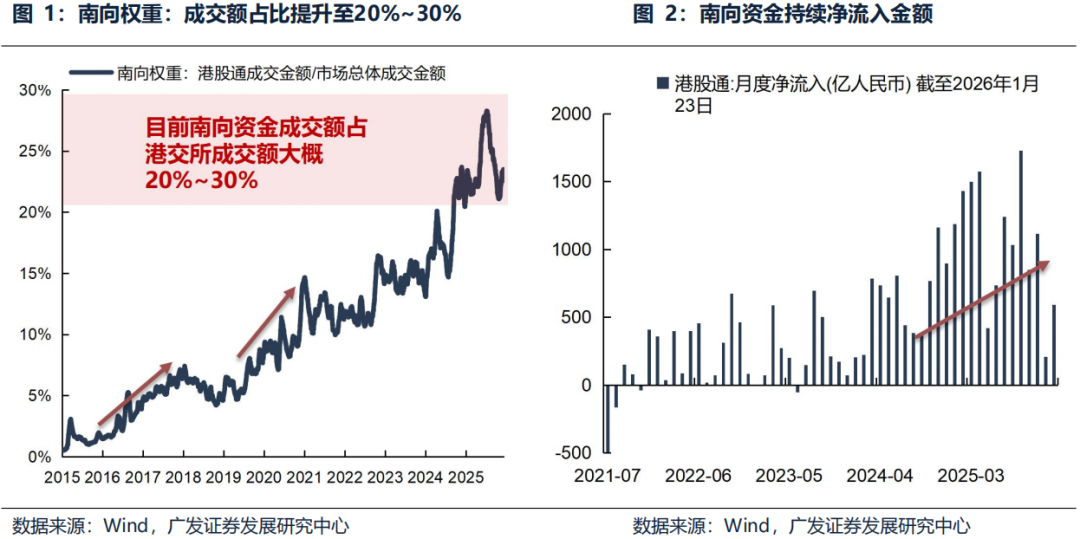
Group 1 - Since September 2024, the proportion of southbound capital transactions has rapidly increased to 20%-30%, nearly doubling compared to before 2024 [2][5] - In 2025, both active and passive foreign capital have become synchronous indicators of the Hong Kong stock market, showing no leading characteristics [2][5] - During sharp declines or corrections in the Hong Kong stock market, southbound capital tends to buy against the trend [2][5] Group 2 - Each round of pricing power competition typically begins with the optimization of the Stock Connect policy or the influx of incremental capital, which usually flows into dividend and scarce assets [5] - Net outflows of southbound capital often occur in response to adverse industry policies or external macroeconomic environments, particularly in sectors where foreign capital pricing power is increasing, such as software services, hardware equipment, consumer services, and discretionary retail [5][12] - Industries less likely to experience significant net outflows include those favored by long-term capital, such as banking, telecommunications, and public utilities, unless there are clear adverse policies affecting the sector [5][12] Group 3 - The proportion of medium to long-term capital in the current round of southbound capital inflow into Hong Kong stocks has increased, with insurance capital making 41 stakes, 35 of which are in H-shares, marking the highest record in the past decade [8] - Key industries for increased holdings include discretionary retail, finance (banking, insurance), innovative pharmaceuticals, software services, and hardware equipment [8] Group 4 - Current industries with pricing power for southbound capital and Chinese capital include semiconductors and dividend stocks, while industries lacking pricing power include internet, hardware equipment, software services, home appliances, and media [11][12] - Active management public funds have low pricing power in the Hong Kong stock market, focusing heavily on AI-related CSP giants, electronics, and innovative pharmaceuticals [16]
量化基本面系列之三:业绩预告与行业表现呈现分化
GF SECURITIES· 2026-01-23 15:38
- The overall disclosure rate of 2025 annual performance forecasts is approximately 13.1%, with a cumulative positive performance rate of about 40.3%[4][20] - Among the disclosed performance forecasts, 180 companies have forecasted performance growth, accounting for 25.1%[4][20] - The advanced manufacturing sector shows a high growth trend, with the machinery and equipment industry having a net profit growth rate of 890.3%[4][39] - The pharmaceutical and medical sector's performance matches the market performance moderately, with the pharmaceutical and biological industry having a net profit growth rate of 10.35%[4][40] - The cyclical sector shows significant internal performance differentiation, with the basic chemical and non-ferrous metal industries having strong performance, with profit growth rates of 135.5% and 57.02%, respectively[4][40] - The consumer sector shows large performance elasticity, with the social services and automotive industries having net profit growth rates of 1900.3% and 587.7%, respectively[4][42] - The technology (TMT) sector shows a divergence, with the media industry having a net profit decline of 65.62%, but the index has increased by 17.69% since the beginning of the year[4][42] - The financial and real estate sectors show mixed performance, with the real estate industry having a net profit decline of 100.5%, but the index has increased by 6.66%[4][42]
2025年12月社零数据跟踪报告12月社零总额同比+0.9%,已连续7个月增速环比下降
Wanlian Securities· 2026-01-23 12:35
Investment Rating - The industry is rated as outperforming the market, with an expected increase of over 10% relative to the market index in the next six months [49]. Core Insights - In December 2025, China's total retail sales of consumer goods reached 451.36 billion yuan, showing a year-on-year growth of 0.9%, but the growth rate has declined by 2.8 percentage points compared to the same period last year and decreased by 0.4 percentage points month-on-month [11][12]. - The Consumer Price Index (CPI) in December increased by 0.8% year-on-year, up from 0.7% in November [11]. - Retail sales of goods and dining both saw a month-on-month decline, with goods retail growing by 0.7% year-on-year and dining income increasing by 2.2% year-on-year [12][13]. Summary by Sections Overall Performance - December 2025 retail sales showed a year-on-year increase of 0.9%, but both year-on-year and month-on-month growth rates have been declining [11][12]. - The total retail sales figure for December was 451.36 billion yuan, with a CPI increase of 0.8% [11][12]. Breakdown by Categories - In December, among 16 categories of goods, 6 categories experienced negative growth, including household appliances and audio-visual equipment, which saw a decline of 18.7% year-on-year [18]. - Conversely, 10 categories showed positive growth, with communication equipment experiencing a remarkable increase of over 20% [18]. - The retail sales growth rate for 7 categories, including grain and oil, pharmaceuticals, and beverages, declined, while 9 categories, including daily necessities and cosmetics, saw an increase in growth rates [18]. Online Retail Performance - In 2025, the total online retail sales reached 1,597.22 billion yuan, with a year-on-year growth of 8.6%, accounting for 31.87% of total retail sales [36]. - The online retail sales of physical goods amounted to 1,309.23 billion yuan, with a growth of 5.2% year-on-year [36]. Investment Recommendations - The report suggests focusing on several sectors: 1. **Food and Beverage**: The white liquor industry is seen as bottoming out, with low valuations and high dividends providing support [42][43]. 2. **Social Services**: Sectors like tourism, duty-free, and education are expected to benefit from policy support [46]. 3. **Retail**: Gold and jewelry are highlighted as attractive due to their status as safe-haven assets, while domestic cosmetics brands are gaining market share [46][47]. 4. **Light Industry Manufacturing**: The demand for home appliances and furniture is expected to rise due to policies aimed at stabilizing the real estate market [47].
万联晨会-20260123
Wanlian Securities· 2026-01-23 10:36
周四 A 股三大指数集体收涨,截止收盘,沪指收涨 0.14%,深成指收 涨 0.5%,创业板指收涨 1.01%。沪深两市成交额 26914.89 亿元。申 万行业方面,建筑材料、国防军工、石油石化领涨,美容护理、银行、 医药生物领跌;概念板块方面,国产航母、可燃冰、成飞概念涨幅居 前,科创次新股、光刻胶、国家大基金持股跌幅居前。港股方面,恒 生指数收涨 0.17%,恒生科技指数收涨 0.28%;海外方面,美国三大 指数集体收涨,道指收涨 0.63%,标普 500 收涨 0.55%,纳指收涨 0.91%。 【重要新闻】 【央行行长潘功胜表示,2026 年将继续实施好适度宽松的货币政策, 灵活高效运用降准降息等多种货币政策工具,保持流动性充裕,今年 降准降息还有一定的空间】要继续维护好金融市场的平稳运行。做好 预期管理,保持人民币汇率在合理均衡水平上的基本稳定。加强债券 市场、外汇市场、货币市场、票据市场、黄金市场监督管理。建立在 特定情景下向非银机构提供流动性的机制性安排。继续用好支持资本 市场的两项货币政策工具,支持资本市场稳定发展。 市 场 研 究 [Table_Title] 万联晨会 [Table_Mee ...