
化工行业

Search documents
泰禾股份: 控股子公司管理制度(2025年8月)
Zheng Quan Zhi Xing· 2025-08-12 04:09
南通泰禾化工股份有限公司 控股子公司管理制度 第一章 总则 第一条 为加强南通泰禾化工股份有限公司(以下简称"公司")对控股子公 司的管理,完善法人治理结构,确保控股子公司规范、有序、健康发展,根据《中 华人民共和国公司法》、 《中华人民共和国证券法》、 《深圳证券交易所创业板股票 上市规则》、《深圳证券交易所上市公司自律监管指引第 2 号——创业板上市公 司规范运作》等相关法律、法规、规范性文件及《南通泰禾化工股份有限公司章 程》 (以下简称"《公司章程》")的有关规定,结合公司实际情况,制订本制度。 (六)法律、法规或控股子公司章程规定的其他权利。 第二章 组织机构及人事管理 第二条 本制度所称控股子公司是指公司持有其 50%以上股份的,或者能 够决定其董事会半数以上成员组成,或者通过协议或者其他安排能够实际控制的 具有独立法人资格的公司。 控股子公司需遵守证券监管部门对上市公司的各项管理规定,遵守公司关 于公司治理、关联交易、信息披露、财务管理、募集资金、对外担保等方面的各 项管理制度,做到诚信、公开、透明。 第三条 加强对控股子公司的管理,旨在建立有效的控制机制,对公司的组 织、资源、资产、投资等和公 ...
泰禾股份: 董事会秘书工作细则(2025年8月)
Zheng Quan Zhi Xing· 2025-08-12 04:09
南通泰禾化工股份有限公司 董事会秘书工作细则 第一章 总则 《中华人民 共和国证券法》、 《深圳证券交易所创业板股票上市规则》 (以下简称"《上 《深圳证券交易所上市公司自律监管指引第 2 号——创业板 市规则》")、 上市公司规范运作》的规定,制定本工作细则。 拟聘任董事会秘书因涉嫌犯罪被司法机关立案侦查或者涉嫌违法违规被 中国证监会立案调查,尚未有明确结论意见的,公司应当及时披露拟聘 任该人士的原因以及是否存在影响公司规范运作的情形,并提示相关风 险。 第三章 董事会秘书的职责 时向深圳证券交易所报告并公告; 《上市规则》及深圳证 券交易所其他相关规定的培训,协助前述人员了解各自在信息披露 中的权利和义务; 《中华人民共和国证券法》、中国证监会 和深圳证券交易所要求履行的其他职责。 第四章 董事会秘书的任免及工作细则 第十条 董事会秘书由董事长提名,经董事会聘任或解聘。 公司董事会聘任董事会秘书后,及时公告并向深圳证券交易所提交 相关资料。 公司在聘任董事会秘书的同时,应当另外聘任证券事务代表,协助董 事会秘书履行职责。在董事会秘书不能履行职责时,由证券事务代表 行使其权利并履行其职责,在此期间,并不当然 ...
泰禾股份: 内幕信息知情人登记管理制度(2025年8月)
Zheng Quan Zhi Xing· 2025-08-12 04:09
南通泰禾化工股份有限公司 内幕信息知情人员登记管理制度 第一章 总则 第一条 为规范南通泰禾化工股份有限公司(以下简称"公司")的内幕信息 管理,加强内幕信息保密工作,提高公司股东、董事、高级管理人员及其他内 幕信息知情人的法制、自律意识,杜绝内幕交易、股价操纵等违法行为,维护 证券市场"公开、公平、公证"原则,根据《中华人民共和国公司法》、《中华 人民共和国证券法》、《上市公司信息披露管理办法》、《深圳证券交易所创 业板股票上市规则》等有关法律、法规和《南通泰禾化工股份有限公司章程》 (以下简称"《公司章程》")的有关规定,制定本制度。 第二条 本制度规定了公司内幕信息知情人登记管理及相关事项。本制度适 用于公司内幕信息知情人的登记管理工作。 第三条 本制度的适用范围为:公司、子公司(包括公司直接或间接控股50% 以上的子公司和其他纳入公司合并会计报表的子公司、以及公司能够对其实施 重大影响的参股公司)、分公司。 第四条 公司董事会应当按照深圳证券交易所(以下简称"深交所")相关规 则要求及时登记和报送内幕信息知情人档案,并保证内幕信息知情人档案真 实、准确和完整,董事长为主要责任人。董事会秘书负责办理公司 ...
泰禾股份: 外汇衍生品业务管理办法(2025年8月)
Zheng Quan Zhi Xing· 2025-08-12 04:09
Core Viewpoint - The document outlines the management measures for foreign exchange derivative trading at Nantong Taihe Chemical Co., Ltd, aiming to standardize operations, enhance risk management, and ensure asset safety [1][2]. Group 1: General Principles - The foreign exchange derivative trading is defined as trading activities involving swap contracts, forward contracts, and non-standard options, among others [1]. - The company and its subsidiaries must adhere to the principles of legality, prudence, safety, and effectiveness in conducting foreign exchange derivative trading [2]. Group 2: Business Operations - Foreign exchange derivative trading must be based on the company's foreign currency receivables and payables forecasts, ensuring that the contract amounts do not exceed these forecasts [2][3]. - The company is required to establish trading accounts in its own name and cannot use third-party accounts for trading [3]. Group 3: Responsibilities and Approval Authority - The document specifies the responsibilities for planning, funding, operations, and daily management of foreign exchange derivative trading [4]. - The board of directors is responsible for approving significant trading activities, especially those involving substantial financial commitments [4]. Group 4: Internal Management and Procedures - The internal operating procedures for foreign exchange derivative trading include analysis of future foreign exchange trends and obtaining necessary approvals before implementation [5][6]. - All personnel involved in trading must comply with confidentiality protocols to protect sensitive information related to trading activities [5]. Group 5: Risk Reporting and Management - The finance center must analyze and report any significant fluctuations in exchange or interest rates to the management for timely decision-making [6]. - In case of major anomalies in trading activities, the finance center is responsible for submitting analysis reports and proposed solutions to mitigate risks [6]. Group 6: Information Disclosure and Record Keeping - All foreign exchange derivative trading activities must be disclosed in accordance with legal and regulatory requirements, detailing the purpose, instruments, and expected financial implications [7][8]. - The finance center is tasked with maintaining all relevant documentation related to foreign exchange derivative trading, ensuring proper record-keeping [8].
助剂龙头跨界算力,日科化学:对专注主业说不!
市值风云· 2025-08-11 10:08
Core Viewpoint - The article discusses the performance and strategic decisions of Nikkoh Chemical, highlighting its leading position in the plastic and rubber additives industry, while also addressing the challenges and implications of its recent investments and stock incentive plans [4][26]. Financial Performance - In 2024, the company's total revenue reached approximately 3.52 billion, a year-on-year increase of 38.64% compared to 2.54 billion in 2023 [5]. - The chemical industry contributed 95.36% of the total revenue, with ACR series products accounting for 49.17% and ACM series products for 34.87% of the revenue [5]. - The company experienced a significant increase in revenue in Q1 2025, with a 54% rise to 900 million [6]. Profitability Challenges - Despite revenue growth, the company's profit margins declined, with ACM series products' gross margin dropping by 8.7 percentage points into negative territory, and ACR series products' gross margin decreasing by 3.6 percentage points [8]. - The decline in margins is attributed to intense competition in the ACM product line and the ramp-up of new production capacities, which led to increased costs and lower utilization rates [10][12]. Production and Capacity Expansion - The company reported a 20%+ increase in both sales and production volumes for its main products, aligning with revenue growth [15]. - Fixed asset depreciation rose significantly from 3.43 million in 2023 to 20.75 million in 2024, indicating increased capital expenditures for capacity expansion [16]. - The company’s fixed assets increased dramatically, with a total of 26.5 billion by the end of 2024, marking a substantial investment in new production capabilities [19]. Stock Incentive Plan - The company announced a stock incentive plan involving 4.15% of its shares to incentivize key personnel in its newly acquired computing power leasing business, which has raised concerns about the appropriateness of such incentives given the company's current financial performance [26][30]. - The performance targets set for the stock incentives are perceived as lenient, focusing solely on revenue growth without considering profitability [29][32]. Strategic Concerns - The acquisition of a controlling stake in Carbon Technology for 110 million is viewed as a superficial move to appease investors, with the stock incentive plan further complicating the company's strategic direction [31]. - There are internal dissenting opinions regarding the company's foray into the computing power sector, with concerns about the lack of experience and the potential risks associated with this new business line [33].



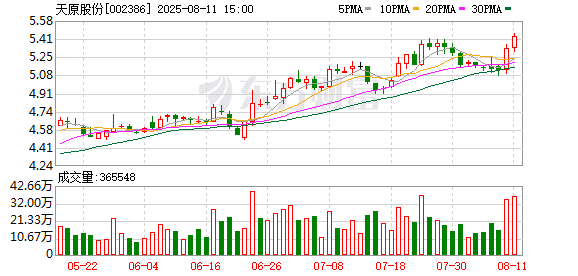
天原股份:股东增持公司股份计划完成,累计增持约3267万股
Mei Ri Jing Ji Xin Wen· 2025-08-11 08:50
Group 1 - The revenue composition of Tianyuan Co., Ltd. for the year 2024 is as follows: Chemical industry accounts for 69.12%, Supply chain services account for 23.0%, New energy battery and materials account for 4.06%, Building materials account for 3.13%, and Power industry accounts for 0.68% [1] Group 2 - Tianyuan Co., Ltd. announced on August 11 that its controlling shareholder, Yifazhan, completed a stock buyback plan, acquiring approximately 32.67 million shares, which represents 2.51% of the total share capital, with a total transaction amount of about 154 million yuan [3]

国际油价、钛白粉价格下跌,制冷剂价格上涨 | 投研报告
Zhong Guo Neng Yuan Wang· 2025-08-11 06:28
Core Viewpoint - The chemical industry is experiencing mixed price movements, with 18 products increasing in price, 39 decreasing, and 43 remaining stable during the week of August 4-10. The international oil prices have also declined, with WTI and Brent crude oil prices dropping by 5.12% and 4.42% respectively, amid concerns over US-India trade relations [1][4]. Industry Dynamics - During the week of August 4-10, 100 tracked chemical products showed that 38% had month-on-month price increases, while 56% experienced declines, and 7% remained unchanged. The top gainers included aniline, pure MDI, and urea, while the largest declines were seen in liquid ammonia and WTI crude oil [3]. - International oil prices fell, with WTI closing at $63.88 per barrel and Brent at $66.59 per barrel. The US oil production averaged 13.284 million barrels per day, down 30,000 barrels from the previous week, and total US oil demand was 20.122 million barrels per day, a decrease of 126,500 barrels [4]. - The titanium dioxide market saw a price drop, with an average price of 13,302 yuan per ton, down 1.10% from the previous week. The supply side remains tight, with operating rates around 66.71% for sulfate titanium dioxide [6]. - Refrigerant prices increased, with R32 averaging 56,500 yuan per ton, up 2.73% week-on-week. The demand for R134a remains stable, while R125 prices are expected to stabilize due to consistent single-component demand [7]. Investment Recommendations - As of August 10, the SW basic chemical sector's P/E ratio is 24.68, and the oil and petrochemical sector's P/E ratio is 11.19. The report suggests focusing on mid-year earnings, the impact of "anti-involution" on supply, and companies in electronic materials and energy sectors with stable dividend policies [8][9]. - The report highlights potential investment opportunities in oil and gas exploration, electronic materials, and new energy materials, emphasizing the importance of domestic control in semiconductor materials and the growth of the new energy materials market [9]. - Recommended stocks include China Petroleum, CNOOC, Sinopec, and various technology and chemical companies, indicating a positive outlook for sectors with strong demand recovery and high valuation potential [9].
银禧科技:上半年归母净利润同比增长82.39%
Xin Lang Cai Jing· 2025-08-08 11:12
银禧科技8月8日披露半年报,公司上半年实现营业收入10.85亿元,同比增长23.99%;归属于上市公司 股东的净利润4777.54万元,上年同期2619.34万元,同比增长82.39%;基本每股收益0.1046元。 ...

银禧科技:2025年上半年净利润4777.54万元,同比增长82.39%
Xin Lang Cai Jing· 2025-08-08 11:04
Group 1 - The company reported a revenue of 1.085 billion yuan for the first half of 2025, representing a year-on-year growth of 23.99% [1] - The net profit for the same period was 47.7754 million yuan, showing a significant year-on-year increase of 82.39% [1] - The company announced that it will not distribute cash dividends, issue bonus shares, or increase share capital from reserves [1]
广东转型金融进阶:破局、探索与前行
2 1 Shi Ji Jing Ji Bao Dao· 2025-08-08 06:57
Core Viewpoint - Guangdong's financial sector is innovating to support green transformation in traditional industries through tailored financial products linked to environmental performance metrics [1][3][9]. Group 1: Financial Innovations - Dongguan Agricultural Commercial Bank has launched a "scattered industrial wastewater index-linked loan" that ties financing costs and credit limits to the company's wastewater treatment performance [1]. - As of now, Guangdong financial institutions have issued 39 loans meeting transformation finance standards, totaling 3.36 billion yuan [2]. - The shift in banking perspective has moved from "whether to do" to "how to do" regarding transformation finance, indicating a growing acceptance of financing high-carbon industries [3][9]. Group 2: Industry Standards and Implementation - The establishment of transformation finance standards is crucial for supporting projects in high-carbon industries like steel and cement, which have traditionally struggled to secure financing [3][4]. - Local transformation finance standards can take months to over a year to develop and implement, as seen with the ceramic industry standard initiated in August 2023 [4]. - The People's Bank of China is leading the development of transformation finance standards for several industries, while local governments are encouraged to create their own standards based on regional characteristics [3][7]. Group 3: Challenges and Solutions - The complexity of implementing transformation finance projects remains a challenge compared to traditional green projects, requiring detailed documentation and assessments [5][6]. - Financial institutions are exploring ways to streamline the process for small and medium-sized enterprises by adjusting information disclosure requirements [8]. - The Guangdong government has introduced loan interest subsidies for manufacturing and high-tech enterprises, which could enhance the attractiveness of transformation finance [9][10]. Group 4: Future Directions - Financial institutions are focusing on identifying viable transformation projects and enhancing collaboration with government departments to create project databases [9]. - There is a call for clearer regulatory guidance to help banks navigate financing for high-carbon industries while managing risks [10]. - The ongoing development of transformation finance is seen as a critical step in supporting Guangdong's transition to a greener economy [1][8].