核能

Search documents
欧尔班与特朗普举行会谈 讨论解除制裁和核能合作
Yang Shi Xin Wen· 2025-11-07 22:32
Core Points - Hungary's Prime Minister Orban visited Washington and met with President Trump, who confirmed that the U.S. will not impose sanctions on Hungary for purchasing energy from Russia [1] - Orban stated that this exemption from sanctions has no time limit [1] - Hungary signed a nuclear cooperation agreement with the U.S., allowing Hungary to purchase nuclear fuel from Westinghouse Electric Company and establish small modular nuclear power plants [1] - The agreement includes technology transfer to ensure Hungary can safely store nuclear waste [1]
上证早知道|国务院批复:原则同意;规范金融账号经营行为 抖音出手;2只新股 今日可申购
Shang Hai Zheng Quan Bao· 2025-11-06 23:15
Group 1 - The State Council has approved the "Chengdu-Chongqing Economic Circle Land Space Planning (2021-2035)", emphasizing the preservation of agricultural land and ecological protection in the region, with a target of maintaining at least 74.18 million acres of arable land by 2035 [2][4] - The National Medical Insurance Administration has initiated a pilot program for intelligent review of medical insurance processes, integrating AI technology to standardize review standards and processes across regions [2] - Douyin has announced stricter regulations for financial account operations on its platform, aiming to enhance compliance and create a more reliable industry environment for merchants [2][3] Group 2 - Coherent, a leading US optical module company, reported Q1 revenue of $1.58 billion, exceeding expectations, driven by strong demand in AIDC and communications sectors, with continued growth anticipated throughout the fiscal year [4] - The global Ethernet optical module market is projected to grow at a rate of approximately 50% by 2025, with a stable annual growth rate of 15% to 18% expected in the following five years [4] - The evolution of AI data center architecture is expected to drive demand for high-end optical modules, providing long-term growth momentum for the industry [4] Group 3 - AMD's Instinct MI 308 AI chip has received export approval to China, positioning it as a strong competitor to Nvidia's H20 chip, while the approval status of the Blackwell AI chip remains uncertain [7] - AMD's Instinct MI350 series accelerators have shown impressive performance in key workloads, with rapid adoption and significant interest from new customers [7] - The semiconductor equipment sector is expected to benefit from the rapid development of AI chips [7] Group 4 - The Fourth China Nuclear Energy High-Quality Development Conference will be held in Shenzhen, focusing on the global influence of the nuclear energy industry [8] - The report indicates that Asia has been the primary driver of global nuclear power generation growth over the past decade, with a significant number of new reactors being built in the region [8] - Nuclear power is expected to play a larger role in various applications beyond electricity generation, including desalination and hydrogen production [8] Group 5 - Su Dawei Ge plans to acquire a 51% stake in Changzhou Weipu Semiconductor Equipment Co., Ltd. for 510 million yuan, focusing on semiconductor photomask defect detection equipment [10] - Zhongjian Technology has signed a procurement contract worth approximately 563 million yuan, representing 69.34% of its recent audited revenue [10] - Tianqi Materials has secured contracts for the supply of 87,000 tons of electrolyte products with Guoxuan High-Tech for the years 2026-2028 [10]

2025中国核能产业大会召开在即,我国核电建设按下“快进键”
Xuan Gu Bao· 2025-11-06 14:57
Industry Insights - The 2025 Fourth China Nuclear Energy High-Quality Development Conference and Shenzhen International Nuclear Industry Innovation Expo will be held from November 12 to 14 in Shenzhen, focusing on creating a globally influential nuclear energy industry exchange event [1] - Over the past decade, global nuclear power generation growth has primarily relied on Asia, with 56 out of 68 new operational units located in Asia [1] - Nuclear power plants maintain an annual utilization hour rate of over 7000 hours, the highest among all energy sources, and do not emit sulfur dioxide, nitrogen oxides, smoke, or carbon dioxide during production [1] - The future role of nuclear energy is expected to expand beyond power generation to include seawater desalination, hydrogen production, and medical protection [1] Company Developments - Shangda Co., Ltd. has successfully developed and delivered high-end products such as ultra-pure stainless steel TP316H and TP316L forged bars for nuclear engineering, applied in domestic third and fourth-generation nuclear projects [2] - Guoguang Electric has completed the development and mass production of several valve models, including DN40, which are supplied to multiple units in the nuclear industry, featuring strong radiation resistance, high gas tightness, and low overall and internal leakage rates [2]

晚报 | 11月7日主题前瞻
Xuan Gu Bao· 2025-11-06 14:30
Group 1: Optical Modules - Coherent, a leading company in the optical module sector, reported Q1 revenue of $1.58 billion, exceeding expectations of $1.54 billion, with adjusted EPS of $1.16 against an estimate of $1.05, driven by strong demand in AIDC and communications [1] - The growth in demand and continuous capacity expansion are expected to sustain strong growth throughout the fiscal year, leading to a significant pre-market stock price increase [1] - The evolution of AI data center architecture is expected to drive high-end optical module demand, with a projected global Ethernet optical module market growth rate of around 50% by 2025, stabilizing at a CAGR of 15% to 18% over the following five years [1] Group 2: Semiconductors - AMD's CEO revealed that the Instinct MI308 AI chip has received export approval to China, positioning it as a strong competitor to Nvidia's H20 chip, although future revenue from China is not yet included in Q4 forecasts [2] - AMD's advancements in AI, particularly with the MI350 series accelerators, show industry-leading memory bandwidth and capacity, achieving competitive performance in key workloads while reducing costs and complexity [2] - The rapid development of AI chips is creating new opportunities in semiconductor equipment and related sectors [2] Group 3: Nuclear Energy - The 2025 Fourth China Nuclear Energy High-Quality Development Conference will be held from November 12-14, focusing on global nuclear energy industry collaboration [3] - Asia has been the primary driver of global nuclear power generation growth over the past decade, with 56 out of 68 new operational units located in Asia [3] - Nuclear power plants maintain high annual utilization hours, exceeding 7000 hours, and are expected to play a larger role in seawater desalination, hydrogen production, and medical protection in the future [3] Group 4: 5G - The International Electrotechnical Commission (IEC) has released the first global industrial 5G international standard, addressing the integration of 5G technology in industrial applications [4] - This standard is a significant milestone for China's contributions to the "5G + Industry" integration, with projections indicating a global industrial 5G market size of approximately 345.75 billion yuan by 2025, expanding at a CAGR of 41.32% from 2025 to 2032 [4] Group 5: Commercial Aerospace - The 27th China International High-Tech Achievements Fair will take place from November 14-16, featuring the global launch of China's space tourism project [5] - The fair will cover various sectors, including satellite communication and space tourism, with predictions that the global space economy could exceed $1 trillion by 2030 [5] Group 6: OLED - Three high-end equipment for the mass production line of 8.6-generation large-size OLED screens were officially launched in Chengdu, marking a breakthrough in display equipment [6] - OLED technology is expanding from mobile devices to larger applications, including computers and automotive displays [6]

Centrus Energy (LEU) - 2025 Q3 - Earnings Call Transcript
2025-11-06 14:30
Financial Data and Key Metrics Changes - In Q3 2025, the company achieved revenue of $74.9 million, a 30% increase from the same quarter last year, which was $57.7 million [13] - The company reported a gross loss of $4.3 million compared to a gross profit of $8.9 million in Q3 2024 [14] - Net income for Q3 2025 was $3.9 million, a significant improvement from a net loss of $5 million in the same period last year [15] - Year-to-date net income for 2025 reached $60 million, compared to $19.5 million during the same period last year [15] - The total company backlog stood at $3.9 billion as of September 30, 2025, extending to 2040 [16] Business Line Data and Key Metrics Changes - The LEU segment generated $44.8 million in Q3 2025, an increase of 29% or $10 million compared to Q3 2024, driven by increased uranium sales volume [13] - The technical solutions segment delivered revenue of $30.1 million in Q3 2025, a 31% increase over Q3 2024, attributed to LEU sales to the DOE [13] Market Data and Key Metrics Changes - The published spot price for LEU SWU soared to $220, near historic levels, indicating strong demand for U.S.-owned enrichment capacity [19] - The Nuclear Energy Institute identified over 8 gigawatts of expected additional generation from the existing fleet, indicating a growing market for nuclear power [18] Company Strategy and Development Direction - The company is focused on strengthening its operational preparations and capitalizing on growth opportunities, including a $1 billion at-the-market program to raise funds ahead of planned expansion [10][11] - The company aims to secure funding through public-private partnerships, leveraging potential task order awards under its LEU enrichment contract [6][8] - The company is actively pursuing readiness initiatives to prepare for large-scale deployment of its technology [8] Management's Comments on Operating Environment and Future Outlook - Management expressed confidence in the growing demand for nuclear power, driven by investments from technology giants and government initiatives [18] - The company anticipates a tight market for enrichment in the late 2020s and early 2030s, reinforcing its business model [36] - Management highlighted the importance of securing commitments from customers to support future expansion plans [65] Other Important Information - The company closed an oversubscribed convertible senior note transaction, increasing its unrestricted cash balance to over $1.6 billion [8] - The company has signed agreements with KHNP and POSCO International for potential investment in its enrichment capacity [9] Q&A Session Summary Question: National security opportunity and NNSA's Notice of Intent - Management acknowledged the NNSA's intent to sole source award and expressed readiness to support national security missions [23][24] Question: Readiness efforts at Piketon - Management confirmed that readiness efforts for planned build-out are progressing rapidly, including hiring and operational studies [28][29] Question: Impact of waivers for 2026 and 2027 on political commentary - Management indicated no official updates on the January 1, 2028 deadline for Russian imports but emphasized the growing demand for enrichment [34][36] Question: Dynamics of SWU prices - Management noted that SWU prices are expected to rise due to increasing demand and limited new capacity [46][47] Question: Korean investment and third-party capital - Management confirmed ongoing discussions with private sector investors and emphasized the importance of maximizing public-private partnerships [58][59] Question: Expansion signals and SWU pricing - Management stated that further expansion will depend on market commitments and highlighted the current favorable SWU pricing environment [62][65]

“中国制造”亮相世界核能工业博览会
Xin Hua She· 2025-11-06 14:22
Core Insights - The sixth World Nuclear Industry Exhibition was held from November 4 to 6 in Paris, attracting over 1,000 exhibitors from more than 80 countries, including China, France, the USA, Japan, and South Korea [1][2] - The exhibition showcased the critical role of nuclear technology across various sectors such as electricity, healthcare, agriculture, aerospace, hydrogen energy, and heating [1] - The Chinese delegation, led by the China Nuclear Energy Association, was one of the largest international groups at the event, featuring 12 participating units [1] Company Highlights - China National Nuclear Corporation (CNNC) highlighted its capabilities in nuclear power with models like Hualong One, Linglong One, and high-temperature gas-cooled reactors, along with comprehensive clean energy solutions [1] - China General Nuclear Power Group (CGN) showcased its "Harmony System," the first domestically developed nuclear-grade digital control system platform, which has passed independent engineering reviews by the International Atomic Energy Agency [1] - Huaneng Group presented its high-temperature gas-cooled reactor demonstration project, set to commence commercial operation in December 2023, marking the world's first operational fourth-generation nuclear power unit [1] Industry Collaboration - The China Nuclear Energy Association organized participation from major nuclear equipment manufacturers like Dongfang Electric Group and Shanghai Electric Group to demonstrate the strength and potential of China's nuclear manufacturing capabilities [2] - The Chinese delegation aimed to deepen systematic cooperation with key international organizations, participating in seminars with the International Atomic Energy Agency and the French Nuclear Industry Association to promote Chinese nuclear enterprises in the global market [2] - The Director General of the International Atomic Energy Agency noted China's rapid growth in new nuclear power capacity and its diverse reactor technologies, emphasizing nuclear energy as a key option for addressing climate change [2]
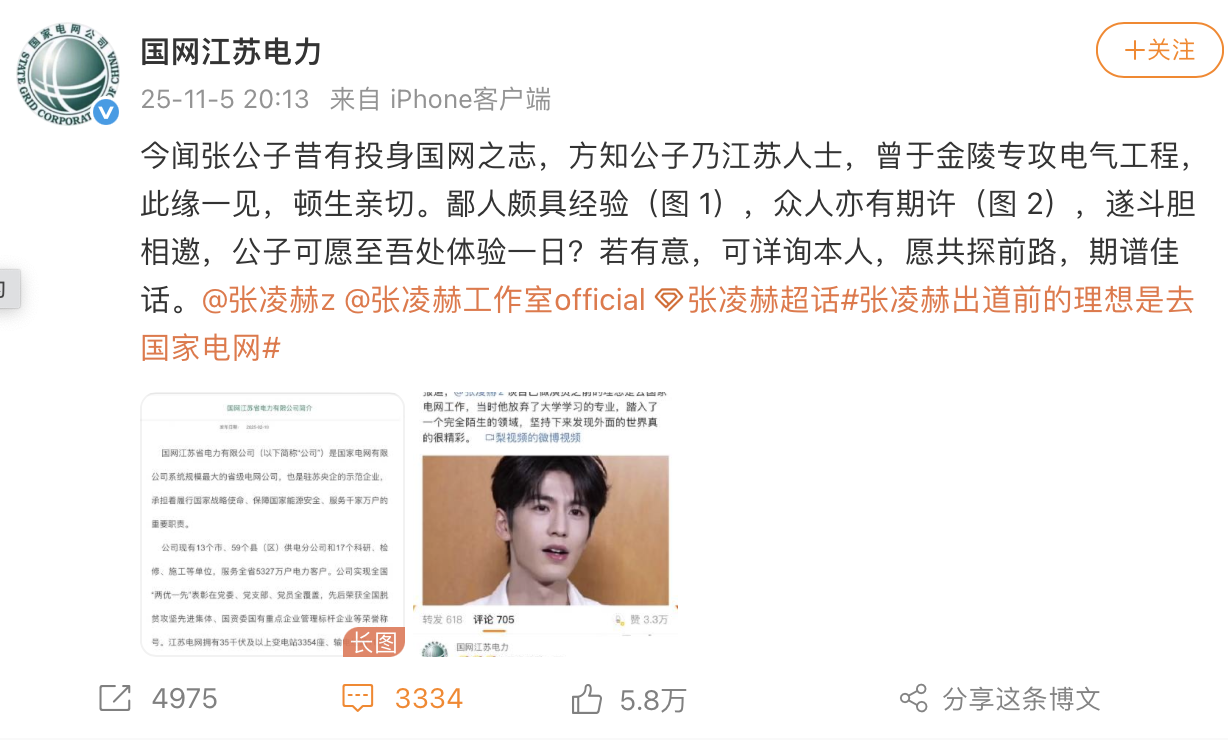
演员张凌赫曾想去国家电网工作,江苏电力、中国石化、中国华能集体回应
Xin Lang Cai Jing· 2025-11-06 12:28
Group 1 - The interaction between state-owned enterprises such as State Grid Jiangsu Electric Power, Sinopec, and China Huaneng with actor Zhang Linghe has garnered significant attention [1][4][6] - Zhang Linghe expressed that his initial dream was to work for State Grid before becoming an actor, highlighting the appeal of the energy sector [1] - Following Zhang's comments, various state-owned enterprises invited him to visit their facilities, emphasizing their interest in engaging with the public [4][6][7] Group 2 - State-owned enterprises like State Grid and Sinopec are crucial to national energy security, managing important strategic resources such as electricity, oil, and nuclear energy [8] - In the 2025 Fortune China 500 rankings, State Grid leads with a revenue of $548.41 billion (approximately 3.9 trillion RMB), while Sinopec ranks third with $407.49 billion (approximately 2.9 trillion RMB) [8] - China Huaneng ranks 68th with a revenue of $55.76 billion (approximately 397.1 billion RMB), showcasing the financial scale of these enterprises [8]

中国核建(601611.SH):核聚变相关项目由公司控投股东中核集团主导开展
Ge Long Hui· 2025-11-06 08:32
Core Viewpoint - China Nuclear Engineering (601611.SH) is actively involved in nuclear fusion projects led by its controlling shareholder, China National Nuclear Corporation (CNNC) [1] Group 1 - The company is following a three-step strategy for nuclear energy development: Pressurized Water Reactor (PWR) - Fast Reactor - Fusion Reactor [1] - The company will collaborate with its controlling shareholder to implement this strategic plan [1]

浙富控股:控股子公司曾为钍基熔盐实验堆供货
Zheng Quan Shi Bao Wang· 2025-11-06 07:56
Core Viewpoint - Zhejiang Fu Holdings (002266) has successfully completed key equipment procurement contracts related to thorium-based molten salt reactor projects with the Shanghai Institute of Applied Physics, Chinese Academy of Sciences, indicating strong operational capabilities in the nuclear equipment manufacturing sector [1] Group 1: Company Developments - The company's subsidiary, Sichuan Huadu Nuclear Equipment Manufacturing Co., Ltd. (referred to as "Huadu Company"), signed a procurement contract for the key equipment of the "Thorium-based Molten Salt Reactor Comprehensive Simulation Experimental Platform Project" in December 2015 [1] - The equipment was accepted and delivered in June 2017, showcasing the company's commitment to advancing nuclear technology [1] - In August 2018, Huadu Company entered into a procurement contract for the control rod system of the "2MWt Liquid Fuel Thorium-based Molten Salt Experimental Reactor (TMSR-LF1)," with all engineering supplies now fully completed [1] Group 2: Operational Performance - The control rod system for the TMSR-LF1 reactor is reported to be operating normally and stably, reflecting the reliability of the equipment provided by the company [1]

抢占能源“新质赛道”,山东能源科技创新取得多点突破
Feng Huang Wang Cai Jing· 2025-11-06 07:34
Core Insights - Shandong Province has made significant advancements in energy technology innovation and equipment development since the start of the 14th Five-Year Plan, focusing on major technological breakthroughs and the promotion of advanced equipment [1][2][3] Group 1: Innovation Platform Development - Shandong has established a tiered innovation platform system, including the establishment of the Nuclear Science and Energy Power Institute at Shandong University to accelerate research in nuclear energy [1] - The American Nuclear Electric Institute's Yeqizhen Academy has achieved breakthroughs in key technologies such as nuclear-grade flow meters, enabling domestic substitution [1] - Weichai Group has set up the only National Fuel Cell Technology Innovation Center in the hydrogen energy sector [1] Group 2: Major Technological Demonstration Projects - The "Hydrogen into Thousands of Homes" project has successfully promoted over 2,000 hydrogen fuel cell vehicles, ranking fourth nationally, and established 38 hydrogen refueling stations, ranking second in the country [2] - The "Nuclear Power Future" project has made significant progress in optimizing parameters for the "Guohe No. 1" reactor and developing components for high-temperature gas-cooled reactors [2] - The perovskite solar cell project has advanced from laboratory scale to an integrated technology production line, positioning itself among the top tier in the country [2] Group 3: Innovative Achievements Filling Industry Gaps - Yantai Penglai has produced the world's longest 150-meter offshore wind turbine blades, used in the largest 26 MW offshore wind turbine, capable of supplying electricity for 55,000 households annually [3] - Weichai Power has developed the world's first high-power commercial solid oxide fuel cell with an efficiency of 92.55%, setting a global record [3] - Shandong Aiyu has created the highest efficiency photovoltaic ABC components in mass production globally [3] Group 4: Industry Development and Collaboration - Shandong has established three major offshore wind power equipment manufacturing bases and developed a complete lithium battery industry chain, with simultaneous advancements in solid-state, sodium, and flow batteries [4] - The province has formed nuclear energy equipment industrial clusters in Yantai and Weihai, collaborating with cities like Jinan and Zibo for heavy and specialized equipment [4] - The "Lu Hydrogen Economic Belt" is fostering leading enterprises in hydrogen energy across various stages of production, storage, transportation, and utilization, making Shandong one of the most complete hydrogen energy provinces in the country [4]