餐饮服务

Search documents
促消费济南开启新年“第一补”
Qi Lu Wan Bao· 2026-01-07 05:19
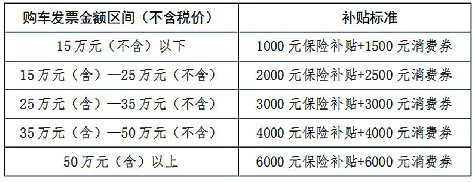
Group 1 - The core point of the news is the launch of a 50 million yuan subsidy program in Jinan for car purchases, aimed at stimulating consumer spending and economic growth [1][2][4] - The subsidy program is open to both individuals and enterprises, with no restrictions on residency or vehicle registration location, allowing out-of-town consumers to benefit [1][2] - The subsidy is structured in five tiers based on the pre-tax price of the vehicle, offering a maximum of 12,000 yuan in combined insurance subsidies and consumption vouchers [1][2] Group 2 - The car purchase subsidy application period is from January 1 to March 31, 2026, with three rounds of application windows [2] - The electronic consumption vouchers issued as part of the subsidy are valid for 90 days and can be used at various local merchants, with a maximum usage limit of 3,000 yuan per merchant [2] - The program aims to link automotive sales with broader consumer spending in retail and dining sectors, enhancing overall economic activity [2] Group 3 - A separate subsidy program for replacing old home appliances and purchasing new digital and smart products was also launched, covering ten categories of products [3] - The subsidy for home appliances is capped at 1,500 yuan per item, while digital products have a limit of 500 yuan per item, calculated as 15% of the final sales price after discounts [3] - The initiative is part of Jinan's broader strategy to enhance domestic demand and support high-quality economic development [4]


90%菜品不同、瞄准“漂亮饭” 麻六记再推新品牌寻增长新局
Bei Jing Shang Bao· 2026-01-07 00:22
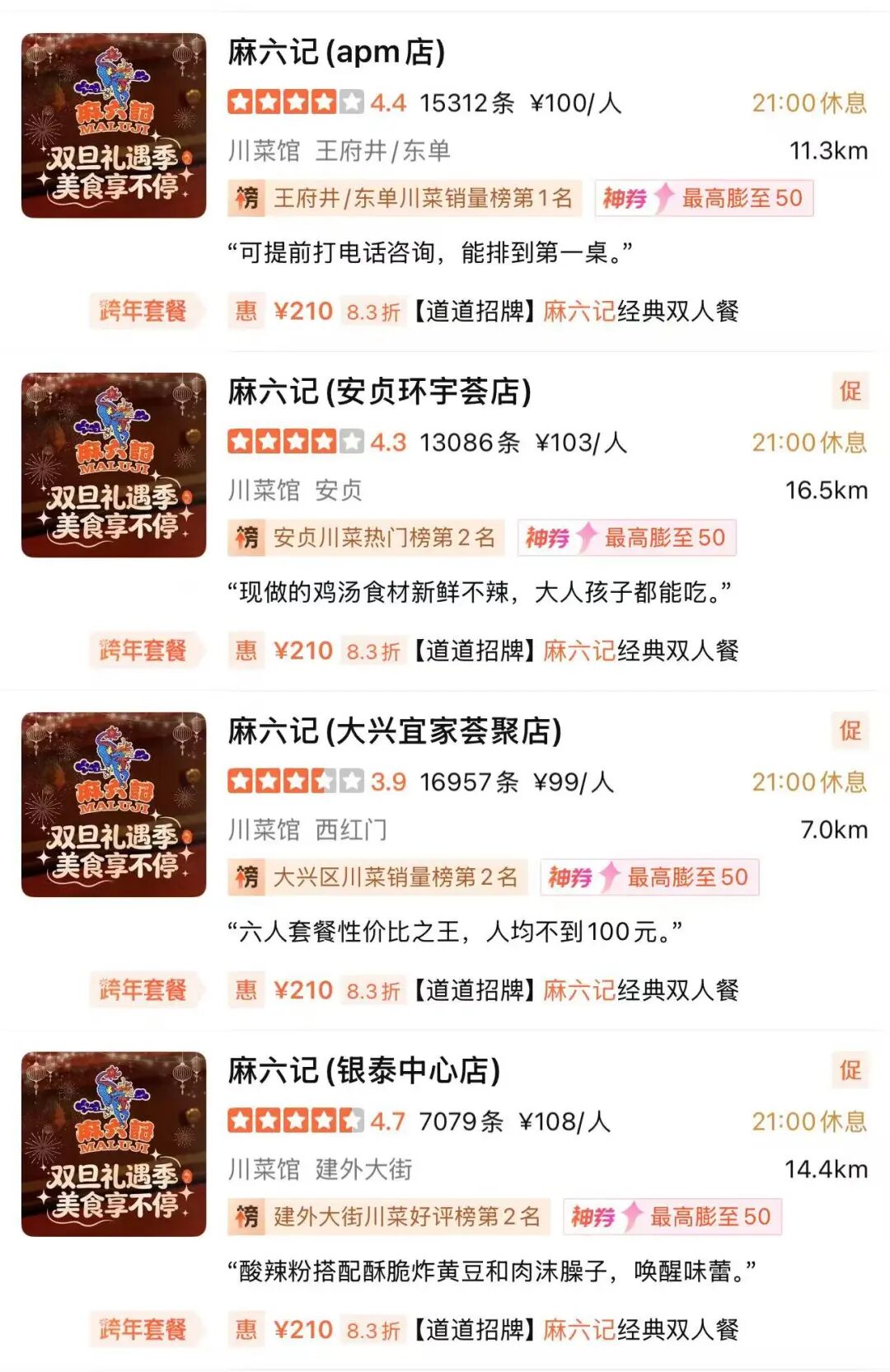
Core Viewpoint - The launch of the new brand "Xiao Ma Liu" by Ma Liu Ji aims to capture the non-first-tier market by offering a competitive advantage through 90% innovative dishes and a more affordable price point, complementing the main brand's offerings [1][4]. Group 1: Brand Positioning and Strategy - Xiao Ma Liu's first store opened in Shijiazhuang, targeting young consumers with a focus on trendy dining experiences and a lower average spending of 60-70 yuan per person [2][3]. - The brand's strategy includes a significant departure from the main brand's offerings, with 90% of the dishes being different, aiming to attract a diverse customer base [2][4]. - The introduction of Xiao Ma Liu is seen as a strategic move to expand into lower-tier markets and enhance the overall market presence of Ma Liu Ji [3][4]. Group 2: Market Trends and Consumer Behavior - The current dining market is experiencing a trend of consumption stratification and down-market expansion, with younger consumers increasingly valuing cost-effectiveness and convenience [4][6]. - Xiao Ma Liu's smaller store format and lower price point align with the market demand for lightweight and flexible dining models [4][5]. Group 3: Operational Challenges and Recommendations - Despite the brand's initial popularity and recognition, Xiao Ma Liu will face challenges in the competitive landscape of non-first-tier cities, requiring a localized management approach and optimized supply chain [6][7]. - Recommendations for Xiao Ma Liu include enhancing dish innovation to avoid homogenization, focusing on unique products to create memorable experiences, and balancing cost with customer experience to ensure sustainable profitability [6][7].
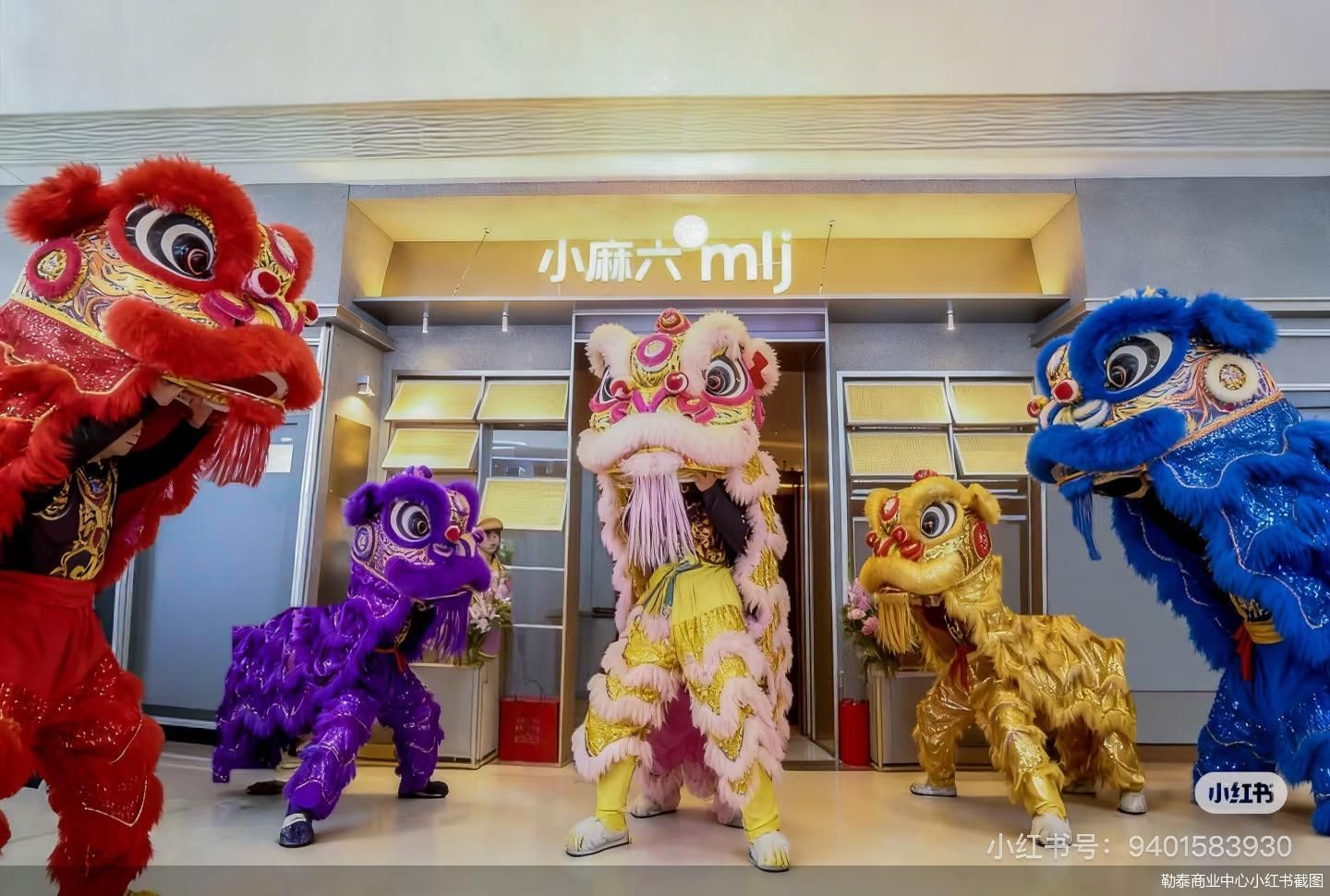
汪小菲露面!新品牌“小麻六”开业,便宜40%,瞄准年轻人
Bei Jing Shang Bao· 2026-01-07 00:17
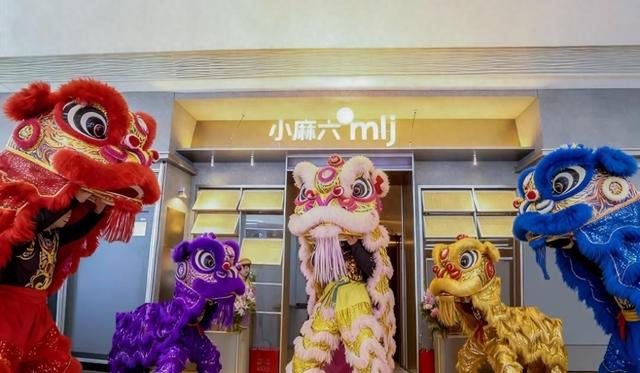
Core Insights - The new brand "Xiao Ma Liu" launched by Ma Liu Ji aims to capture the non-first-tier market with a focus on affordable Sichuan cuisine and a vibrant atmosphere [1][6][8] - Xiao Ma Liu differentiates itself from the main brand by offering 90% innovative dishes and a lower average spending of 60-70 yuan per person, compared to 100 yuan for Ma Liu Ji [2][6] - The brand's strategy targets young consumers and aims to fill market gaps by providing high cost-performance options, which is essential for scaling [7][8] Brand Positioning - Xiao Ma Liu is designed to appeal to younger demographics with a trendy environment and lively music, while maintaining the essence of Sichuan cuisine [1][6] - The restaurant features a smaller footprint and a distinct aesthetic compared to Ma Liu Ji, emphasizing a more youthful and accessible brand image [2][6] Market Strategy - The launch of Xiao Ma Liu is part of Ma Liu Ji's broader strategy to explore various market segments and expand its consumer base, particularly in lower-tier cities [7][8] - The brand's approach includes leveraging social media for pre-launch marketing and engaging with consumers through innovative product offerings [6][9] Competitive Landscape - The restaurant industry is experiencing a trend of consumer segmentation and down-market expansion, with Xiao Ma Liu positioned to meet the rising demand for affordable and convenient dining options [8][9] - Despite the advantages of brand recognition and supply chain support, Xiao Ma Liu will face challenges from local competitors and the need for effective cost management [9][10] Operational Recommendations - To ensure sustainable profitability, Xiao Ma Liu should focus on menu innovation, local market adaptation, and maintaining quality control [10] - The brand is encouraged to enhance its supply chain transparency and establish a rapid response mechanism to uphold its reputation amidst food safety concerns [10]
麻六记再推新品牌寻增长线
Xin Lang Cai Jing· 2026-01-06 17:29
Core Insights - The launch of the new brand "Xiao Ma Liu" by the Ma Liu Ji restaurant group aims to capture the non-first-tier city market with a focus on affordability and innovation in menu offerings [1][4] - The brand positions itself to attract younger consumers with a lower average spending of 60-70 yuan per person, compared to its main brand [3][5] - The introduction of Xiao Ma Liu is part of a broader strategy to expand the group's market presence and adapt to changing consumer preferences for cost-effective dining options [6][7] Group 1: Brand Strategy and Market Positioning - Xiao Ma Liu's menu features 90% new dishes distinct from the main brand, aiming to create a complementary price matrix [1][3] - The brand's design and atmosphere are tailored to appeal to younger demographics, with a smaller store footprint and a lively environment [3][5] - The strategic focus on high cost-performance aims to cover a diverse customer base and facilitate scalable expansion [4][6] Group 2: Market Trends and Consumer Behavior - The restaurant industry is experiencing a trend of consumption stratification and down-market expansion, with younger consumers increasingly valuing affordability and convenience [5][6] - Xiao Ma Liu's lower price point and smaller store size align with the current market demand for lightweight and flexible dining models [6][7] - The brand's entry into non-first-tier cities is seen as a response to the competitive landscape, where it must navigate local brand competition and fast-food chains [6][7] Group 3: Operational Challenges and Recommendations - Despite the brand's initial popularity, Xiao Ma Liu faces challenges in maintaining quality control and balancing costs as it expands into new markets [6][7] - Recommendations for the brand include enhancing menu innovation to avoid homogenization, optimizing store models, and focusing on local market characteristics [7] - The parent company, Ma Liu Ji, is advised to strengthen supply chain oversight and ensure food safety to maintain brand reputation amid past concerns [6][7]
90%菜品不同、瞄准“漂亮饭” 麻六记再推新品牌寻增长线
Bei Jing Shang Bao· 2026-01-06 13:31
Core Viewpoint - The launch of the new brand "Xiao Ma Liu" by Ma Liu Ji aims to capture the non-first-tier market by offering a competitive advantage through 90% innovative dishes and a more affordable price point, complementing the main brand's pricing matrix [1][4][5]. Group 1: Brand Positioning and Strategy - Xiao Ma Liu's first store opened in Shijiazhuang, targeting young consumers with a focus on trendy dining experiences and a lower average spending of 60-70 yuan per person [3][4]. - The brand emphasizes a distinct identity from Ma Liu Ji, featuring a smaller store size and a more youthful ambiance, while maintaining a core offering of Sichuan cuisine [3][5]. - The introduction of Xiao Ma Liu is seen as a strategic move to expand into lower-tier markets and diversify consumer engagement, aligning with the rising demand for cost-effective dining options among younger demographics [5][6]. Group 2: Market Expansion and Competition - Ma Liu Ji has been actively exploring new market opportunities, including the successful launch of its "Ma Liu Ji Spicy Noodle" stores, which cater to a different consumer segment with lower pricing [4][6]. - The brand's expansion strategy includes leveraging its existing supply chain and brand recognition to penetrate smaller cities, where operational costs are lower, thus facilitating rapid replication of its business model [6][7]. - Despite the potential for growth, Xiao Ma Liu faces challenges in a competitive landscape, particularly in non-first-tier cities, where it must navigate local brand competition and maintain quality control to avoid price wars [6][7]. Group 3: Operational Considerations - The company is advised to focus on product innovation and local market adaptation to avoid homogenization and create unique selling points [7]. - Ensuring food safety and transparency in the supply chain is critical for maintaining brand reputation, especially in light of past incidents that raised consumer concerns [6][7]. - Future strategies may include enhancing digital operations, expanding multi-channel integration, and fostering emotional connections with consumers through storytelling and user experience [7].
遇见小面:授权董事会购回公司H股
Zhi Tong Cai Jing· 2026-01-06 13:01
Core Viewpoint - The company has resolved to seek shareholder authorization for a buyback of its H-shares, aiming to demonstrate confidence in its long-term business prospects, enhance company value, and protect shareholder interests [1] Summary by Relevant Sections - **Buyback Authorization** The company will repurchase H-shares using its own funds, with the total number of shares not exceeding 10% of the total H-shares issued as of the date of the shareholder meeting approving the buyback resolution [1] - **Market Conditions and Capital Management** The company may cancel any repurchased H-shares or hold them as treasury shares based on market conditions and its capital management needs [1] - **Duration of Buyback Authorization** The "relevant period" for the buyback authorization is defined as the time from the approval of the resolution at the shareholder meeting until the earliest of the following dates: (i) the conclusion of the company's annual general meeting in 2026; or (ii) the date the buyback authorization is revoked or amended by a special resolution at any shareholder meeting [1]
阿五黄河鲤鱼:以豫文化提质扩容促消费
Sou Hu Cai Jing· 2026-01-06 08:18
Core Viewpoint - The opening of the new Awu Yellow River Carp restaurant at Zhengzhou East Station represents a significant effort to boost consumption in Henan Province, aligning with government initiatives to enhance the dining and cultural tourism sectors [1][3][10]. Group 1: Company Overview - Awu Yellow River Carp has launched its fifth-generation restaurant, emphasizing Henan culture and aiming to attract both local and international visitors with its slogan "Represent Henan, Host the World" [3][7]. - The restaurant features a design that integrates elements of Henan's cultural heritage, including traditional crafts and artistic representations, creating an immersive cultural experience for diners [5][10]. Group 2: Market Positioning - The new restaurant is strategically located near major brands and enterprises, positioning itself as a key player in the "Henan brand consumption scene" and enhancing the overall appeal of the area to tourists [7][14]. - Awu's menu follows a "Four Changes" principle, focusing on portion design, fresh flavors, artistic presentation, and a blend of traditional and contemporary culinary practices, catering to the evolving preferences of younger consumers [7][8]. Group 3: Industry Impact - The opening of the new Awu restaurant is seen as a timely boost for the Henan cuisine industry, reflecting a broader trend of upgrading local dining experiences and enhancing brand recognition [10][12]. - Industry leaders view Awu as a benchmark for local dining upgrades, capturing the new consumer trends of integrating high-speed rail, cultural tourism, and gastronomy [12][14].

一席家宴,如何品鉴高原烟火与文化?
Xin Lang Cai Jing· 2026-01-05 18:44
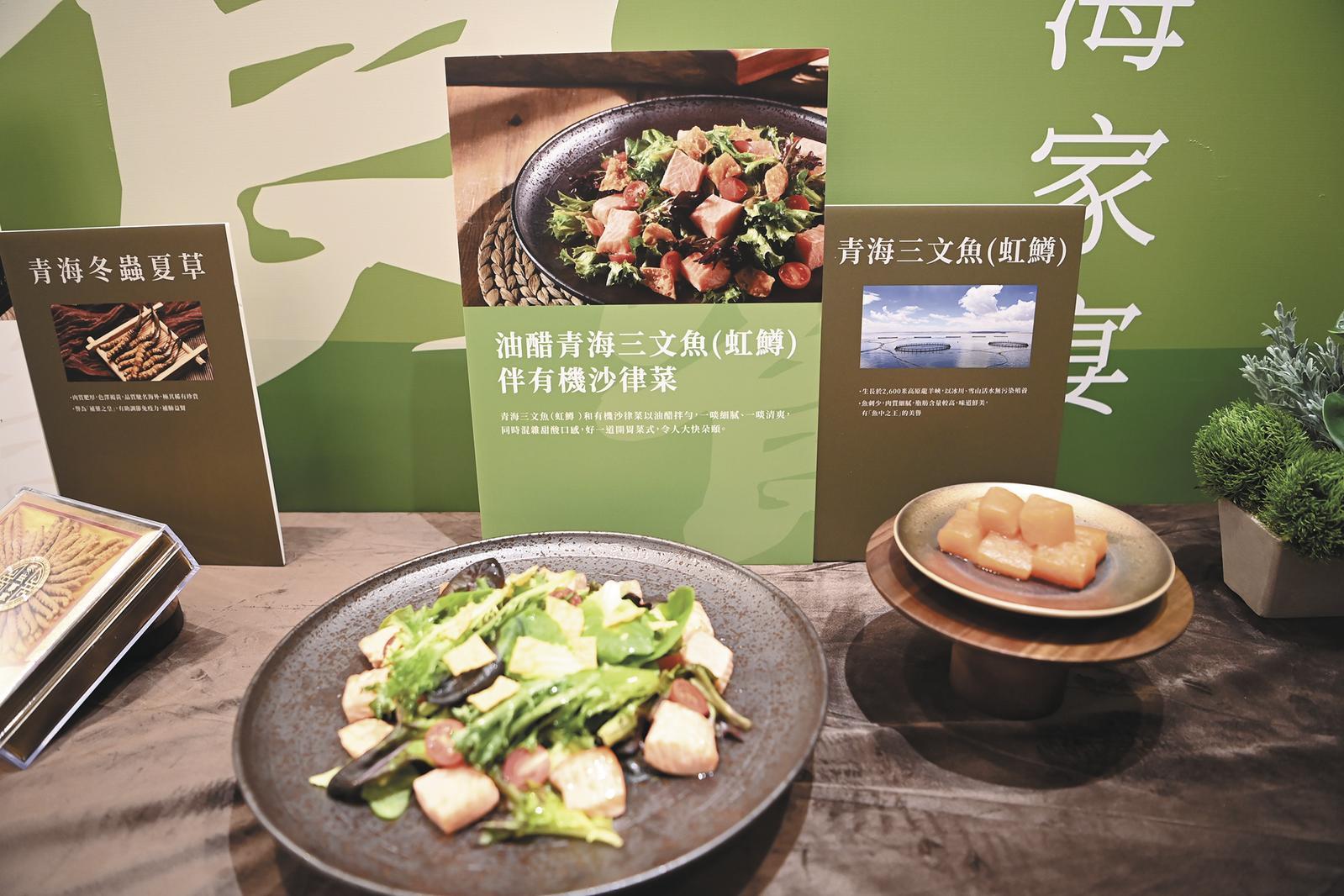
Core Insights - The "Qinghai Family Feast" brand is evolving into a significant cultural and economic initiative, integrating local cuisine with tourism and cultural heritage, marking a shift towards a more diversified and regional development strategy [7][17] - The initiative aims to transform Qinghai's unique organic ingredients into a high-end culinary experience, leveraging partnerships with established culinary entities like Hong Kong's Maxim's Group to enhance market penetration [8][10] - The project emphasizes the importance of ecological sustainability and cultural heritage, aiming to create a closed-loop industry model that connects ecological value, cultural transmission, and economic development [12][16] Industry Development - The "Qinghai Family Feast" brand is positioned as a key player in promoting Qinghai's organic agricultural products, with a focus on high-quality, locally sourced ingredients [12][19] - The initiative has led to the establishment of a standardized supply chain system, ensuring quality control and traceability of ingredients, which is crucial for building consumer trust and enhancing market competitiveness [12][18] - The brand's growth is supported by a series of promotional events and culinary showcases, which have successfully attracted attention from various regions, including Hong Kong, Beijing, and Shanghai, thereby expanding its market reach [11][17] Cultural Integration - The "Qinghai Family Feast" reflects the rich culinary heritage of Qinghai, incorporating diverse ethnic influences and traditional cooking techniques, which enhances its cultural appeal [13][14] - The initiative aims to modernize traditional dishes while preserving their cultural significance, making them more accessible and appealing to contemporary consumers [14][15] - The project promotes a narrative of cultural exchange and culinary innovation, positioning Qinghai as a bridge between local traditions and global culinary trends [8][19] Economic Impact - The initiative has demonstrated significant economic potential, with reported sales exceeding 200,000 yuan in a single day during promotional events, indicating strong market demand for Qinghai's culinary offerings [17] - The establishment of standards and certifications for Qinghai's agricultural products has led to increased export values, particularly in organic products, contributing to the region's economic growth [18][19] - The "Qinghai Family Feast" is seen as a catalyst for rural revitalization, linking culinary tourism with local economic development and enhancing the livelihoods of local farmers and producers [16][19]
绿茶集团1月5日斥资182.59万港元回购27.52万股
Zhi Tong Cai Jing· 2026-01-05 11:55
Core Viewpoint - Green Tea Group (06831) announced a share buyback plan, indicating confidence in its stock value and future prospects [1] Group 1: Share Buyback Details - The company will repurchase 275,200 shares at a total cost of HKD 1.8259 million [1] - The buyback price per share ranges from HKD 6.51 to HKD 6.80 [1]
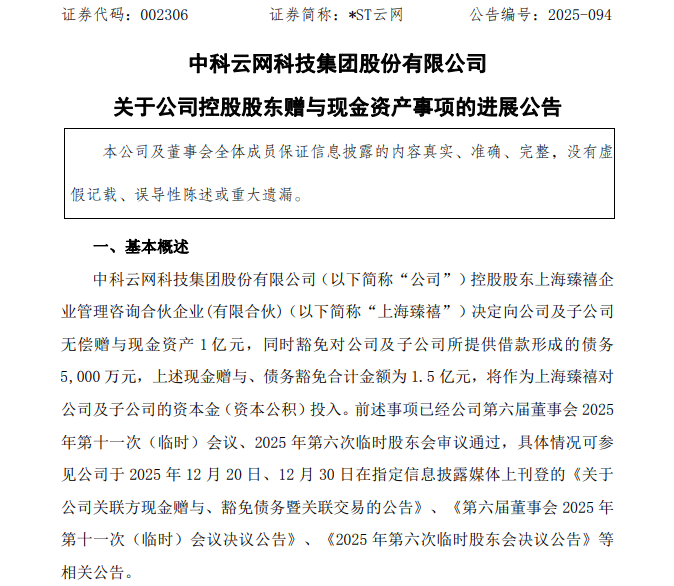
股东砸1.5 亿\"救场\",这家光伏企业又活了?
Xin Lang Cai Jing· 2026-01-05 11:46
Group 1 - The core point of the news is that *ST Yunwang (002306) announced significant developments on December 31, including a cash asset donation from its controlling shareholder and the freezing of bank accounts [1][6]. Group 2 - The controlling shareholder, Shanghai Zhenxi, decided to donate cash assets of 100 million yuan to the company and its subsidiaries, while also waiving debts amounting to 50 million yuan that were formed from loans provided to the company and its subsidiaries [1][6]. Group 3 - The company and its subsidiaries have had several bank accounts frozen, with a total amount of 59.8153 million yuan being affected [3][8]. Group 4 - The details of the frozen accounts include: - Zhongke Yunwang: 47.53 million yuan in a basic account at ICBC and 12.2853 million yuan in a general account at Shanxi Bank - Zhongke Gaolang: 47.53 million yuan in a basic account at Bank of China [4][9].