化妆品

Search documents
2025年中国化妆品市场交易额突破1.1万亿元
Zhong Guo Jing Ying Bao· 2026-01-25 07:00
Core Insights - The Chinese cosmetics market is projected to exceed 1.1 trillion yuan (approximately 1104.245 billion yuan) by 2025, with a year-on-year growth of 2.83% [1] - Domestic brands have seen their market share grow for five consecutive years, surpassing 50% in 2022 and expected to reach 57.37% by 2025 [1] - In terms of brand competition, Chinese brands are expected to generate a total transaction amount of 268.863 billion yuan by 2025, significantly outpacing brands from other countries [1] Market Dynamics - The top 1000 brands in online transactions show that French brands rank second with a transaction amount of 75.541 billion yuan, holding a market share of 16.12% [1] - American, Japanese, and South Korean brands rank third to fifth with transaction amounts of 55.033 billion yuan, 29.931 billion yuan, and 18.724 billion yuan, respectively, with market shares of 11.74%, 6.39%, and 4.00% [1] - Other countries' brands collectively account for 4.38% of the market [1] Channel Performance - Online channel transactions are expected to reach 721.773 billion yuan by 2025, reflecting a year-on-year growth of 4.45% and a market share of 65.36% [1] - Offline channel transactions are projected at 382.472 billion yuan, showing a slight decline of 0.08% and a market share of 34.64% [1] Industry Trends - The "Matthew Effect" is intensifying, with over 60% of the top 500 brands experiencing positive growth, while only about 26% of brands ranked below 500 show growth [2] - The number of brands expected to be eliminated in 2025 is 26,941, representing 41.08% of the total active brands, while 17,076 new brands are anticipated to enter the market [2] - The industry is at a critical transformation point, shifting from "total expansion" to "structural optimization," indicating a move towards deeper competition and higher quality development [2]
以“北方美谷”为引擎,推动山东化妆品产业高质量发展
Qi Lu Wan Bao· 2026-01-25 06:28
Core Insights - The article discusses the development of the cosmetics industry in Shandong, highlighting its strong industrial foundation and consumer potential, with "Northern Beauty Valley" as a key platform for growth [1][2]. Group 1: Industry Overview - Shandong is recognized as a major cosmetics province with a solid industrial base and significant consumer potential [1]. - "Northern Beauty Valley" is being developed as a multi-point support and all-region collaborative development platform, focusing on cities like Jinan, Heze, Linyi, and Qingdao [1]. Group 2: Challenges and Recommendations - The Shandong cosmetics industry faces challenges such as a reliance on OEM production, insufficient brand influence, and a lack of integration between R&D and industry [1]. - Recommendations include implementing a "Qilu Beauty" brand enhancement project to establish a provincial public brand and create a comprehensive evaluation standard [2]. Group 3: Innovation and Talent Development - The establishment of a "Northern Beauty Valley" industry-academia-research collaborative innovation center is proposed to accelerate technological advancements using local resources [2]. - Suggestions to optimize the industry ecosystem include creating a digital public service platform and enhancing educational programs to attract high-end talent [2]. Group 4: Community Engagement - The Shandong provincial government is initiating a public consultation to gather opinions on economic and social development for the 14th Five-Year Plan and the 2026 government work [3].
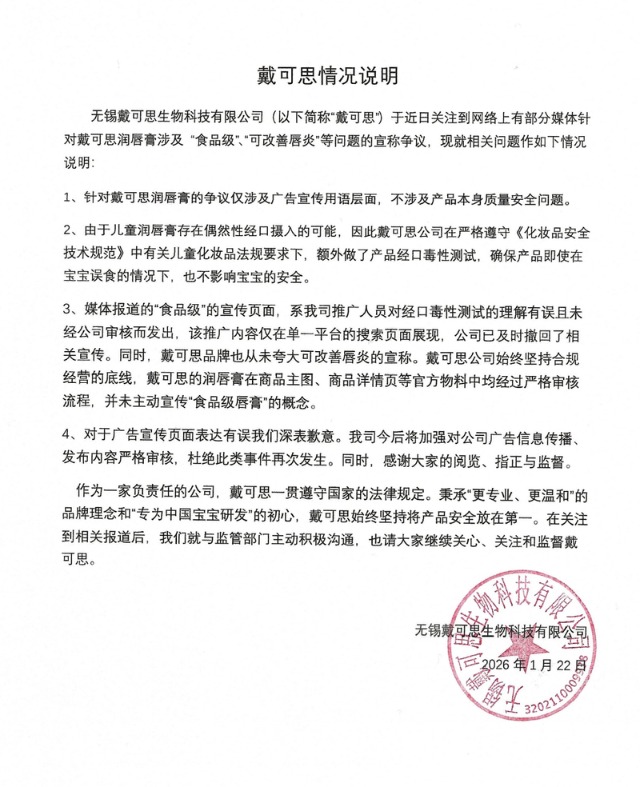
被立案调查后,戴可思致歉
Xin Lang Cai Jing· 2026-01-24 12:26
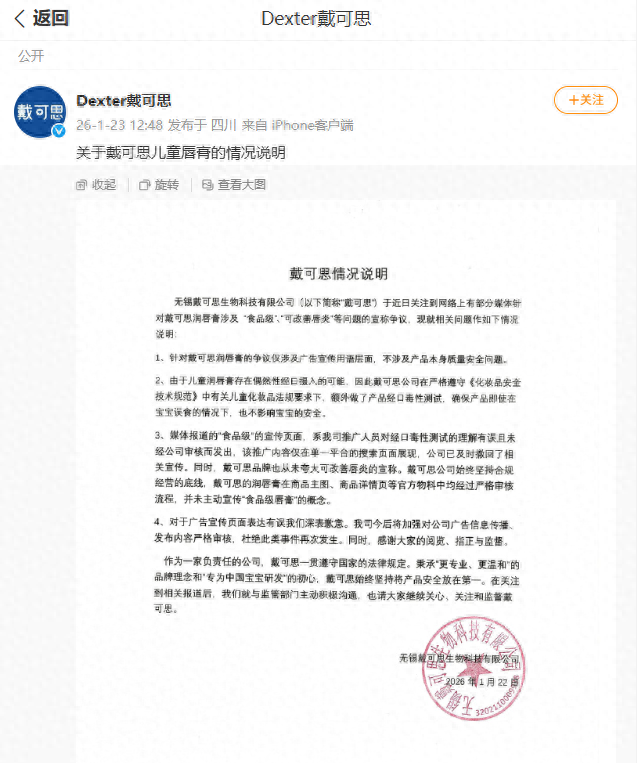
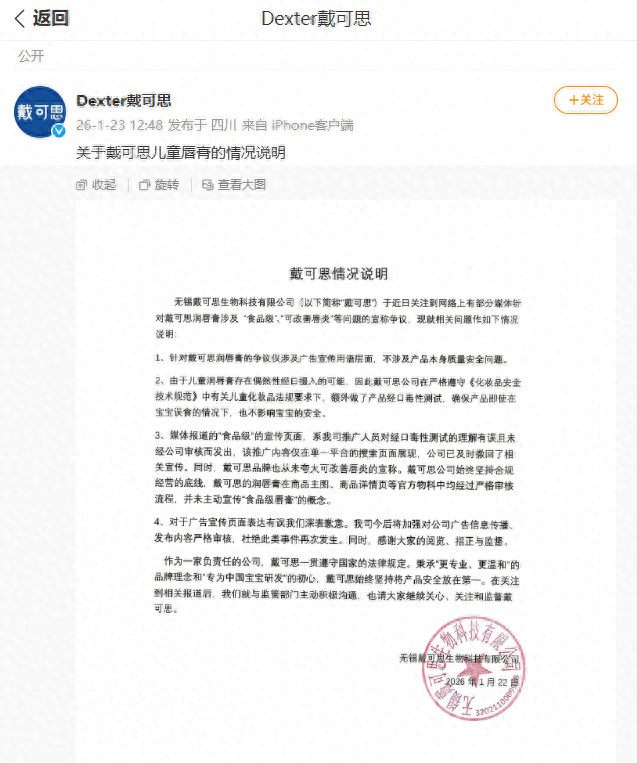
Core Viewpoint - The company Daikosi has faced controversy regarding its lip balm's promotional claims of being "food-grade" and "capable of improving lip inflammation," which it attributes to a misunderstanding by promotional personnel and has since retracted the misleading advertisements [1][2]. Group 1: Company Response - Daikosi issued a statement acknowledging the controversy surrounding its lip balm's advertising claims, clarifying that the issue pertains only to advertising language and does not affect the product's quality or safety [1][2]. - The company emphasized that it adheres to the "Cosmetic Safety Technical Specifications" for children's cosmetics and conducted oral toxicity tests to ensure safety in case of accidental ingestion by children [1][2]. - Daikosi expressed regret over the misleading advertisement and committed to strengthening the review process for advertising content to prevent similar incidents in the future [2]. Group 2: Media Reports and Regulatory Actions - Media reports indicated that Daikosi's flagship store on a shopping platform advertised the "Daikosi Baby Lip Balm" as "food-grade lip balm" and highlighted that it is safe for babies to lick [2]. - The product was promoted with claims of passing safety tests from authoritative institutions, stating that it is "non-toxic" when ingested [2]. - On January 19, 2026, the Wuxi New District Market Supervision Administration decided to file a case against Daikosi after reviewing the situation, indicating potential regulatory scrutiny [2].

美妆品牌抢滩药店新渠道
Jing Ji Guan Cha Wang· 2026-01-24 08:48
Core Insights - The article discusses the growing trend of domestic beauty brands entering the OTC (over-the-counter) channel in China, with 2025 being marked as a pivotal year for this transition [2][3] - Major players like Proya and other beauty companies are preparing to launch products in the OTC space, which is seen as a way to leverage the professional credibility of pharmacies and meet specific skincare needs [4][5] Group 1: Market Entry and Growth - By 2025, over six domestic cosmetic companies are expected to enter the OTC channel, expanding the current limited presence of leading brands [2] - Proya announced its entry into the OTC channel in January 2026, joining other brands that have already established a presence [2][4] - The OTC channel has seen significant sales, with brands like Winona achieving nearly 1 billion yuan in sales from this channel in 2023 [3] Group 2: Strategic Partnerships and Product Development - Companies are focusing on strategic partnerships and product development tailored for the OTC market, with Proya preparing multiple products aimed at post-operative recovery and daily skincare [4] - Winona and other brands are actively seeking to enhance their product offerings and market reach through collaborations with pharmacies [3][4] Group 3: Market Potential and Challenges - The OTC channel is projected to have about double the growth potential, with Winona aiming to cover 250,000 pharmacies [5] - The regulatory environment is becoming more favorable for pharmacies to sell cosmetic products, which aligns with the increasing demand for beauty products in these settings [6] - Despite the opportunities, there is a significant talent shortage in the OTC channel, as brands require personnel who are knowledgeable in both pharmaceuticals and cosmetics [7] Group 4: Financial Metrics and Profitability - The average gross margin for medical beauty products in the OTC channel is significantly higher than that of regular cosmetic products, with margins for medical dressings ranging from 77% to 83% [6] - Specific companies report high gross margins, such as 84.22% for Chuerjia's medical device products and 82% for Jinjian Biological's collagen products [6]

戴可思被曝唇膏宣称“食品级”,回应:推广人员未经审核发出
Xin Lang Cai Jing· 2026-01-24 08:15
Core Viewpoint - The company, Daikosi, has faced controversy regarding its lip balm's promotional claims of being "food-grade" and capable of "improving lip inflammation," which it attributes to a misunderstanding by promotional staff and has since retracted the claims [1][2]. Group 1: Company Response - Daikosi issued a statement acknowledging the controversy surrounding its lip balm's advertising, clarifying that the issue pertains only to promotional language and not to the product's quality or safety [1]. - The company emphasized that it adheres to the "Cosmetic Safety Technical Specifications" for children's cosmetics and conducted oral toxicity tests to ensure safety in case of accidental ingestion by children [1][2]. - Daikosi expressed regret over the misleading advertising and committed to strengthening the review process for advertising content to prevent similar incidents in the future [2]. Group 2: Media and Regulatory Actions - Reports indicated that Daikosi's lip balm was marketed on a shopping platform as "food-grade lip balm" with claims that it is safe for babies to lick, which raised concerns [2]. - The New Wu District Market Supervision Administration in Wuxi announced on January 19, 2026, that it would initiate a case against Daikosi after reviewing the promotional claims [2].
儿童唇膏宣称“食品级”被立案 戴可思致歉:已撤回相关宣传
Xin Jing Bao· 2026-01-24 02:07
Core Viewpoint - The children's care brand "Dai Kesi" is under investigation for allegedly misleading advertising regarding a children's lip balm claimed to be "food-grade," violating regulations on children's cosmetics [1][6]. Group 1: Company Response - On January 22, Dai Kesi issued a statement clarifying that the "food-grade" claim was a misunderstanding by promotional staff and was not approved by the company, and the content was only displayed on a single platform [1][6]. - The company emphasized that the controversy pertains only to advertising language and does not involve the safety or quality of the product itself [6][7]. - Dai Kesi has committed to improving the review process for advertising content to prevent similar incidents in the future [6][7]. Group 2: Regulatory Actions - On January 19, the Wuxi Market Supervision Administration decided to investigate Dai Kesi after confirming that the case met the criteria for filing [6]. - The company had previously faced regulatory penalties in December 2025 for false advertising related to other products, including claims about suitability for pregnant women and unsupported benefits [7]. - Dai Kesi was fined 5,000 yuan for these violations and was ordered to correct its advertising practices [7].
卖了几十年的高保湿,为什么它一直是秋冬基础面霜?
Xin Lang Cai Jing· 2026-01-24 00:01
Core Insights - The article emphasizes the importance of maintaining hydration and stability in skincare during seasonal changes, as many individuals experience dryness and sensitivity [4][21]. Product Overview - Kiehl's Ultra Facial Cream is highlighted as a well-known product that effectively addresses seasonal skin issues, priced at 218 yuan for a 125ml large capacity [5][6]. - The product is currently offered at a discounted price due to a reduction in the supplier's price, with a special offer of 399 yuan for two bottles [7][24]. Key Ingredients - The cream contains two main active ingredients: Squalane derived from olives and Glacier Proteins, which provide deep hydration and strengthen the skin barrier [14][16]. - Squalane is noted for its excellent skin compatibility, quickly penetrating the skin and forming a natural moisture barrier, making it suitable for all skin types, including sensitive skin [19]. - Glacier Proteins are highlighted for their ability to protect the skin from extreme weather conditions and enhance the skin's resilience during seasonal transitions [21][23]. Brand Background - Kiehl's, established in 1851 in New York, has a long-standing reputation for combining natural ingredients with scientific research, making it a trusted choice for consumers, including many Hollywood celebrities [10][12].
关于美妆医美公司的最近观点如何
2026-01-23 15:35
Summary of Key Points from the Conference Call Industry Overview - The conference call discusses the beauty and medical aesthetics industry, focusing on two companies: 毛戈平 (Mao Ge Ping) and 美丽田园 (Meili Tianyuan) [1][2][3]. Mao Ge Ping (毛戈平) Customer Engagement and Sales Strategy - Mao Ge Ping enhances customer loyalty through counter experiences and makeup services, with online channels attracting new customers and driving them to offline stores, achieving brand rejuvenation. Online new customer consumption accounts for over 75%, with 25%-30% converting to offline repeat purchases [1][2]. - The membership system is differentiated, with online members enjoying points and discounts, while offline members receive personalized beauty services, effectively guiding high-spending customers to offline stores and increasing overall sales. Same-store growth rate reached 18% in the first half of 2025, with a repurchase rate of 30% [1][2][6]. Product Line Expansion - Mao Ge Ping has expanded its product line to include skincare products (caviar masks, black cream) and perfumes, targeting younger consumers. The skincare category is developing steadily, with the caviar series performing exceptionally well [1][4][9]. Online and Offline Development - As of the first half of 2025, online channels surpassed offline for the first time, accounting for 25% of sales. The company aims to use online channels to attract younger customers, with the 25-30 age group increasing from 12% to 19% [5][6]. Meili Tianyuan (美丽田园) Growth Strategy - Meili Tianyuan is expanding through both organic growth and acquisitions, acquiring leading brands in the industry and adopting a "dual beauty and health" model to drive customers from lifestyle beauty to medical aesthetics, increasing average transaction value and customer lifecycle [1][3][16]. - The company has a remarkably low customer acquisition cost of about 1%, significantly lower than the industry average of 30-40%, attributed to membership asset acquisitions and cross-selling strategies [1][16][17]. Membership and Customer Retention - The company enhances membership assets through acquisitions of related businesses (e.g., yoga studios, gyms) and refined operations to improve member engagement. They have implemented over 200 standard operating procedures (SOPs) to enhance service quality and customer satisfaction [3][18]. Market Position and Future Goals - Meili Tianyuan aims to double profits in the next three years and revenues in five years, relying on both internal growth and external acquisitions to achieve these targets [20][21]. - The current landscape of the lifestyle beauty industry shows low chain penetration, with 90% of companies operating only one store, which presents opportunities for Meili Tianyuan to consolidate its market position through acquisitions [22]. Challenges and Market Dynamics - The collagen market faces challenges such as increased competition and market saturation, with many brands entering the space and consumer sensitivity to product differentiation decreasing [14]. - The profit distribution between upstream medical material suppliers and downstream medical institutions is changing, with suppliers relying more on institutions for sales, leading to a decrease in their control over pricing [15]. Conclusion - Both Mao Ge Ping and Meili Tianyuan are leveraging unique strategies to enhance customer engagement, expand product lines, and optimize membership operations, positioning themselves for growth in the competitive beauty and medical aesthetics market.

华仁药业:公司积极布局饮料、化妆品、健康饮品等大健康产品线
Zheng Quan Ri Bao Zhi Sheng· 2026-01-23 11:40
Core Viewpoint - The company is actively expanding its product lines in the health sector, including beverages, cosmetics, and health drinks, with a focus on brand and channel development for future growth [1] Group 1: Beverage Business - The beverage segment includes products such as electrolyte supplements, purified water, large bottled water, glucose rehydration solutions, and solid beverages [1] Group 2: Cosmetics Business - The cosmetics division features products developed through a collaboration between the subsidiary Hubei Huaren Tongji and Tongji Hospital, focusing on medical science skincare [1] - Key products include collagen sleep masks, small molecule collagen water, vitamin E moisturizing cream, aurora night essence, vitamin E lotion, and sunscreen [1] Group 3: Health Drinks - The health drink line includes the "Huaren Tongji Bird's Nest Collagen Tripeptide Drink," which has been launched and is supported by the "Huaren Tongji Joint Laboratory" [1] - Currently, the sales revenue from this product line is relatively small, but the company plans to enhance brand and channel development for both online and offline sales [1]

月烧1亿营销,平均售价21.5元的半亩花田要上市
Guo Ji Jin Rong Bao· 2026-01-23 10:53
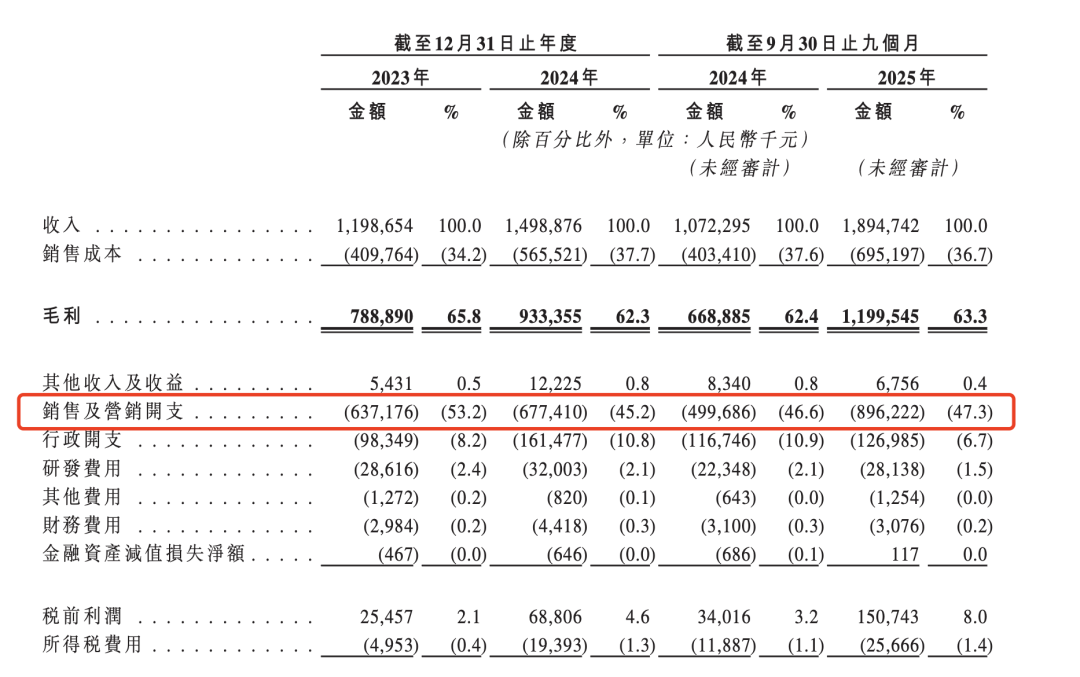
Core Viewpoint - The company "Shandong Huawutang Cosmetics Co., Ltd." is preparing for an IPO on the Hong Kong Stock Exchange, aiming to become the first domestic personal care brand listed in Hong Kong. The brand "Banmu Huatian" has seen significant growth in revenue and profit, largely driven by aggressive marketing strategies and celebrity endorsements [2][4][6]. Group 1: Company Overview - Banmu Huatian was established in 2010 in Jinan, Shandong, initially focusing on body care products, and has since expanded its product line to include body, hair, and facial care, with a total of 509 main SKUs expected by September 30, 2025 [2]. - According to Frost & Sullivan, Banmu Huatian is the leading domestic brand in body lotion, body scrub, and facial cleansing mousse by retail sales in 2024 [3]. Group 2: Financial Performance - In 2024, the company achieved a revenue of 1.499 billion RMB, a 25% increase from 1.199 billion RMB in the previous year, with a corresponding net profit of 49 million RMB, marking a 140.99% year-on-year growth [4]. - For the first nine months of 2025, revenue surged to 1.895 billion RMB, a 76.7% increase compared to the same period in 2024, with a net profit of 125 million RMB, reflecting a staggering 465.22% year-on-year growth [5]. Group 3: Marketing Strategy - The company's marketing expenses have been substantial, with monthly marketing costs nearing 10 million RMB, and total marketing expenditures for 2023 and 2024 amounting to 6.37 billion RMB and 6.77 billion RMB, respectively, representing 53.2% and 45.2% of total revenue [6][7]. - Banmu Huatian's marketing strategy heavily relies on celebrity endorsements, with various stars like Guan Xiaotong and Yang Yang promoting its products, which has significantly boosted sales [3][4]. Group 4: Sales Channels and Pricing - Online sales have been the primary revenue source, contributing 10.27 billion RMB, 11.37 billion RMB, and 14.45 billion RMB in 2023, 2024, and the first nine months of 2025, respectively, with online sales accounting for 85.7%, 75.9%, and 76.3% of total revenue [9]. - The average selling price of products has seen a decline, from 21.9 RMB in 2023 to 19.3 RMB in 2024, before slightly recovering to 21.5 RMB in the first nine months of 2025 [12]. Group 5: Product Performance - The facial care segment, which was the leading revenue contributor in 2023, saw its average selling price drop from 20.7 RMB to 17.9 RMB in 2024, while its revenue contribution decreased from 50.1% to 40.6% [14]. - Conversely, body care products became the main revenue driver in 2024, with a revenue share of 46.8%, although their average selling price also fell by 7.2% to 21.9 RMB [15]. Group 6: Research and Development - The company's R&D expenses have decreased over the years, with costs of 28.6 million RMB, 32 million RMB, and 28.1 million RMB for 2023, 2024, and the first nine months of 2025, respectively, representing only 2.4%, 2.1%, and 1.5% of total revenue [16]. - Banmu Huatian holds 21 important patents, including 8 invention patents, indicating a relatively low level of intellectual property protection compared to competitors [17].