Semiconductor

Search documents
恒玄科技:2025年营收35.25亿元,净利润同比增27.75%
Xin Lang Cai Jing· 2026-02-25 09:30
Core Viewpoint - Hengxuan Technology announced an expected revenue of 3.525 billion yuan in 2025, representing a year-on-year growth of 8.02% and a net profit attributable to the parent company of 588 million yuan, reflecting a year-on-year increase of 27.75% [1] Financial Performance - The company anticipates a comprehensive gross margin of approximately 38.70% for 2025, which is an increase of 4 percentage points year-on-year [1] - The total R&D expenses for the year are projected to be around 691 million yuan, marking a year-on-year increase of approximately 12% [1] Product Development - Hengxuan Technology continues to invest in R&D in the low-power wireless computing SoC chip sector, with the flagship wearable chip series BES2800 being widely adopted [1] - Multiple wearable chips have successfully completed tape-out and have been mass-produced and launched, solidifying the company's market leadership position [1]

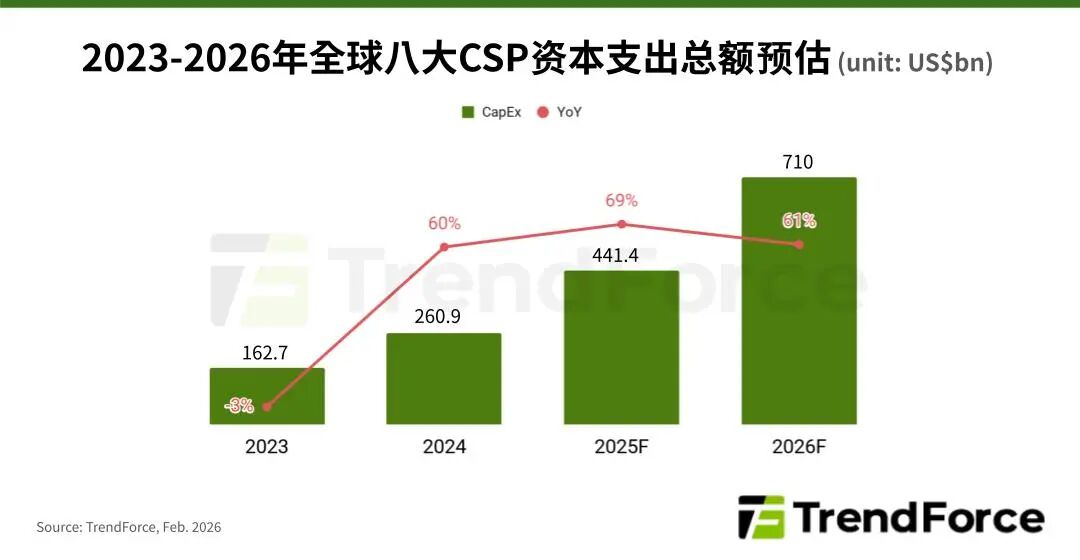
TrendForce:预计2026年八大主要CSP的合计资本支出将超7100亿美元 年增率约61%
智通财经网· 2026-02-25 09:14
Group 1: Industry Overview - Global cloud service providers (CSPs) are significantly increasing investments in AI servers and related infrastructure, with total capital expenditure expected to exceed $710 billion by 2026, reflecting a year-on-year growth rate of approximately 61% [1] - The eight major CSPs include Google, AWS, Meta, Microsoft, Oracle, Tencent, Alibaba, and Baidu [4] Group 2: Company-Specific Insights - Alphabet (Google) is projected to have capital expenditures surpassing $178.3 billion by 2026, with a year-on-year increase of 95%. Google has a significant advantage in self-developed ASICs, with expectations that TPU shipments will account for nearly 78% of its AI server output by 2026 [4] - Amazon is increasing its procurement of NVIDIA GPU systems, with expectations that GPU models will comprise nearly 60% of its AI servers by 2026. The new generation of Trainium ASIC is expected to be launched in the second quarter of 2026 [5] - Meta's capital expenditure is expected to exceed $124.5 billion by 2026, with GPU models expected to account for over 80% of its AI servers. Meta is also working on self-developed ASICs to reduce costs and dependency on single suppliers [5] - Microsoft is focusing on long-term demand for large model training and inference, primarily purchasing NVIDIA solutions for its AI servers. The company has released its self-developed chip, Maia 200, targeting efficient AI inference applications [6] - ByteDance is expected to allocate over half of its capital expenditure towards AI chip procurement, with NVIDIA's H200 being a key solution, contingent on regulatory reviews [6] - Tencent is acquiring NVIDIA GPU solutions to support cloud and generative AI demands while also collaborating with local firms to develop its own ASIC solutions [6] - Alibaba and Baidu are both actively developing their own ASIC AI chips, with Alibaba providing AI application infrastructure and Baidu planning to introduce its Kunlun solutions for large-scale AI training and inference applications [7]




研报 | 预估2026年全球八大CSP合计资本支出将破7,100亿美元,谷歌TPU引领ASIC布局
TrendForce集邦· 2026-02-25 09:01
Core Insights - The global cloud service providers (CSPs) are significantly increasing their capital expenditures on AI servers and related infrastructure, with a projected total exceeding $71 billion in 2026, reflecting a year-on-year growth rate of approximately 61% [2][5][6]. Group 1: Major CSPs and Their Investments - The eight major CSPs include Google, AWS, Meta, Microsoft, Oracle, Tencent, Alibaba, and Baidu [6]. - Google is expected to have a capital expenditure exceeding $1.783 billion in 2026, with a year-on-year increase of 95%. Google has a significant lead in ASIC development, with its TPU shipments projected to account for nearly 78% of its AI server output [6][7]. - Amazon is increasing its procurement of NVIDIA GPU systems, with its GPU models expected to represent nearly 60% of its AI server offerings in 2026. The new generation of its self-developed ASIC, Trainium 3, is anticipated to launch in the second quarter of 2026 [7]. - Meta's capital expenditure is projected to exceed $1.245 billion in 2026, with a year-on-year growth of 77%. Its AI servers will primarily utilize NVIDIA and AMD solutions, with GPU models expected to account for over 80% [8]. Group 2: ASIC Development and Market Dynamics - Microsoft is focusing on long-term demand for large model training and inference, primarily acquiring NVIDIA solutions for its AI servers. The company has released its self-developed chip, Maia 200, aimed at high-efficiency AI inference applications [8]. - Oracle is expanding its GPU solutions in response to AI data center projects, while ByteDance is expected to allocate over half of its capital expenditure to AI chip procurement, with NVIDIA's H200 being a key solution [9]. - Tencent is sourcing NVIDIA GPUs to support cloud and generative AI demands while collaborating with local firms to develop its own ASIC solutions [9]. - Both Alibaba and Baidu are actively developing their own ASIC AI chips, with Alibaba providing AI infrastructure through its subsidiaries and Baidu planning to introduce its Kunlun solutions for large-scale AI training and inference applications [9].


星宸科技:暂不涉及AI手机及AI PC领域
Ge Long Hui· 2026-02-25 07:54
格隆汇2月25日丨星宸科技(301536.SZ)在投资者互动平台表示,公司专注于端边侧 AI SoC 产品布局, 暂不涉及AI手机及AI PC领域,与其在产品定位、目标市场上均为差异化赛道,双方独立经营、独立决 策、独立核算,不存在对公司业务经营产生重大不利影响的同业竞争情形。 ...
星宸科技(301536.SZ):暂不涉及AI手机及AI PC领域
Ge Long Hui· 2026-02-25 07:54
Group 1 - The company focuses on edge AI SoC product layout and does not involve AI smartphones or AI PCs, indicating a differentiated market strategy [1] - The company operates independently in terms of product positioning, target market, decision-making, and accounting, ensuring no significant adverse impact from industry competition [1]
康希通信:目前未涉足光模块领域的研究
Ge Long Hui· 2026-02-25 07:41
Core Viewpoint - Kangxi Communication (688653.SH) has clarified its current focus on RF front-end chip design and has not yet ventured into the optical module sector, which is critical for fiber optic communication [1] Group 1: Company Overview - The company specializes in the design of RF front-end chips, which are essential for the analog end of communication systems [1] - Kangxi Communication has not engaged in research related to optical modules, which are composed of optoelectronic devices, functional circuits, and optical interfaces [1] Group 2: Industry Insights - Optical modules are identified as core components in fiber optic communication, responsible for the conversion between optical and electrical signals [1] - The proper functioning of data centers heavily relies on these optical modules, highlighting their importance in the industry [1]
Amazon Just Delivered Great News for This Top AI Stock
The Motley Fool· 2026-02-25 07:30
Core Insights - Amazon's custom chips, Graviton and Trainium, are experiencing rapid growth, achieving a run rate of over $10 billion in annual revenue, doubling year-over-year, and potentially worth $100 billion as a standalone business [2] - The success of Graviton is beneficial not only for Amazon but also for Arm Holdings, which designs the CPUs used in Graviton, generating over $1 billion in revenue per quarter [3][6] - Graviton offers over 40% better price performance per instance compared to x86 processors, which may lead to increased spending on Arm CPUs for cloud services [5][7] Amazon's Growth and Strategy - Amazon is significantly increasing its EC2 core computing capacity daily, with a majority utilizing Graviton chips [5] - The company's plans to invest $200 billion in capital expenditures have raised concerns among investors, impacting stock performance [1] Arm Holdings' Position - Arm's data center royalty revenue has doubled in the most recent quarter, with expectations that it could surpass smartphone revenue in the next three years [7] - The growth of AI agents is expected to drive demand for more CPUs, benefiting Arm's royalty collections [9] - New versions of Graviton, such as Graviton 5, are utilizing advanced Arm designs, which command higher royalty rates [9] Market Implications - As demand for Graviton and related cloud AI chips increases, Arm is positioned to be a significant beneficiary in the ongoing AI boom [10]

科创半导体设备ETF鹏华(589020)涨超5.7%,半导体产业链强势拉升
Xin Lang Cai Jing· 2026-02-25 06:05
Group 1 - The core point of the article highlights the successful IPO approval of Shenghe Jingwei, which, if successful, will become the first A-share listed company focused on wafer-level advanced packaging [1] - During the Spring Festival, multiple cloud service providers are actively advancing data center construction, indicating a sustained high demand in the computing hardware supply chain [1] - According to招商证券, the storage sector is expected to experience a significant performance release this year due to the resonance of price and demand, with a focus on the market price trends and the sustainability of performance growth across various segments [1] Group 2 - As of January 30, 2026, the top ten weighted stocks in the Shanghai Stock Exchange Sci-Tech Innovation Board Semiconductor Materials and Equipment Index (950125) account for 73.89% of the index, indicating a concentrated investment in key players [2]
铠侠控股:电话会议纪要- 价格上行趋势将延续,但对估值倍数维持中性看法
2026-02-25 04:07
Kioxia Holdings Conference Call Summary Company Overview - **Company**: Kioxia Holdings (285A.T) - **Industry**: Semiconductor, specifically NAND flash memory Key Points from the Conference Call 3Q Results - **Volume and Pricing**: 3Q results were roughly in line with guidance; however, average selling prices (ASP) exceeded expectations, rising by a low-teens percentage quarter-over-quarter (qoq) [2] - **Sales Mix**: Approximately 60% of SSD and storage sales were for data center/enterprise applications, with just under 20% sold as NAND chips and over 40% as SSDs. The sales mix remained largely unchanged from 2Q, although the ratio of SSDs has increased slightly [2] 4Q Guidance - **Shipment Volume**: For 4Q (Jan-Mar), Kioxia expects bit shipment volume to decrease by about 10% qoq, consistent with the trend observed in FY3/25. Shipments for data center/enterprise applications are expected to increase qoq, while smart devices are anticipated to decline by more than 10% due to inventory levels and seasonality [3] - **Price Trends**: The price uptrend is expected to continue across all applications, with guidance reflecting mainly like-for-like price increases. Prices have been agreed for less than half of the planned shipments for 4Q [3] Outlook for FY3/27 Earnings - **Growth Expectations**: Kioxia anticipates CY26 bit shipment growth to be at least in line with market growth, projected at high-teens percentage year-over-year (yoy). The company expects quarter-over-quarter increases in every quarter following 4Q3/26 through the end of CY26 [4] - **Cost Reductions**: The effect of per-bit cost reductions is expected to become more pronounced as the transition from BiCS 5 to 8 is completed by the end of FY3/26 [4] Component Procurement and Capital Expenditure - **DRAM Prices**: Prices for DRAM used in enterprise SSDs are expected to rise, but Kioxia has already procured the necessary volume for FY3/27 eSSD production. The company aims to mitigate the impact of rising prices by expanding sales of high-capacity products and passing on costs [7] - **Capex Plans**: Kioxia plans to focus on equipment investment for FY3/27 capex, estimating it to be around ¥400 billion. No additional investment in buildings and cleanrooms is anticipated until around FY3/30 [7] Valuation and Risks - **Price Target**: The 12-month target price is set at ¥24,000, implying a P/E of 6.0X for FY3/27E [8] - **Key Risks**: Risks include NAND industry cyclicality, high dependence on specific customers, capacity utilization trends, and the rise of NAND players in China [8] Financial Metrics - **Market Capitalization**: ¥12.1 trillion / $78.5 billion - **Revenue Projections**: Expected revenues for FY3/26E and FY3/27E are ¥2,236.2 billion and ¥4,887.1 billion, respectively [9] - **Operating Profit**: Projected operating profit for FY3/27E is ¥3,136.5 billion [9] - **EPS**: Expected EPS for FY3/27E is ¥3,995.8 [9] Additional Insights - **Investment Rating**: The company maintains a Neutral rating due to the historical P/E multiple trends in the NAND industry cycle, which typically remain in the mid-to-high single digits [1] - **Market Dynamics**: The company is navigating a complex market environment with fluctuating demand across different segments, particularly between enterprise and consumer applications [3][4] This summary encapsulates the essential insights from Kioxia Holdings' conference call, highlighting the company's performance, future guidance, and market positioning within the semiconductor industry.
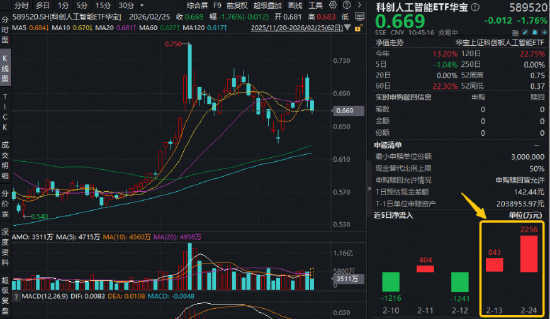
低吸时刻?科创人工智能ETF回踩10日均线,吸金超3000万元!机构:AI春节档爆发,国产大模型超预期!
Xin Lang Cai Jing· 2026-02-25 03:01
Group 1 - The core viewpoint is that the domestic AI industry is experiencing significant investment interest, as evidenced by the recent performance of the Science and Technology Innovation Artificial Intelligence ETF (589520), which has seen a decline of 1.76% over two days while attracting 30.99 million yuan in inflows, indicating confidence in the future of domestic AI [1][8] - The ETF's composition includes leading domestic companies in the AI sector, such as Cambricon Technologies and Chipone Technology, with a strong focus on semiconductor and software industries, which are expected to benefit from the AI application surge [4][11] - Recent reports highlight a surge in demand for domestic AI models, with predictions of explosive growth in token usage by 2026, reflecting an exponential increase in AI inference demand and the potential for domestic computing power to dominate the infrastructure layer [10][11] Group 2 - The ETF is designed as an efficient tool for investors to gain exposure to the domestic computing power sector, with a significant portion of its holdings in semiconductor stocks, which account for nearly half of the ETF's weight [4][11] - The report from Huaxi Securities indicates that the current phase of AI development is critical, with advancements in industrial-grade video generation and programming tools, suggesting a shift from general chat tools to specialized productivity applications [10] - The fee structure for the ETF and its linked funds is outlined, with no sales service fees and specific commission rates for subscription and redemption, making it accessible for investors [6][13]