
医药

Search documents
165家公司获机构调研(附名单)
Zheng Quan Shi Bao Wang· 2026-01-16 01:30
Group 1 - In the past five trading days, a total of 165 companies were investigated by institutions, with significant interest in Xiangyu Medical, Haitan Ruisheng, and Aipeng Medical [1][2] - Among the companies investigated, 35 received attention from more than 20 institutions, with Xiangyu Medical being the most popular, attracting 208 institutions [1][2] - The types of institutions involved in the investigations included 143 from securities companies, 123 from fund companies, and 59 from private equity firms [1] Group 2 - In terms of investigation frequency, two companies, Binglun Environment and Taihe New Materials, were investigated four times, indicating high interest [2] - Out of the stocks investigated by more than 20 institutions, 11 saw net capital inflows, with Liou Co. receiving the highest net inflow of 1.176 billion yuan [2] - Among the stocks investigated, 28 experienced price increases, with Liou Co., Aipeng Medical, and Hehe Information showing significant gains of 53.39%, 33.24%, and 32.40% respectively [2] Group 3 - Three companies among those investigated released performance forecasts, with two expecting profit increases; Changlan Technology projected a net profit of 145 million yuan, representing a year-on-year increase of 94.16% [2]
A股盘前播报 | 台积电财报点燃AI行情!美芯片股齐走强 费城半导体指数刷新高
智通财经网· 2026-01-16 00:55
盘前要闻 1、事关定向降息、楼市去库存!央行推货币政策"组合拳",专家解读 类型:宏观 情绪影响:正面 类型:行业 1月15日,央行在国新办召开发布会,其中提出,下调各类结构性货币政策工具利率0.25个百分点、扩 大多个结构性货币政策工具范围和规模等。专家指出,此次央行进一步在规模以及在适用范围上扩容, 明确了国家对特定产业的金融支持决心。降低商业用房首付比例等则有利于房地产市场进一步去库存。 2、台积电财报点燃AI行情!美芯片股齐走强,费城半导体指数刷新历史高位 类型:市场 情绪影响:正面 美股三大指数集体收涨,芯片股在台积电亮眼财报推动下上涨,费城半导体指数上涨1.8%,刷新历史 高位。得益于高端芯片的强劲需求,台积电第四季度利润同比增长35%,超出预期并创下新高。机构认 为,台积电的业绩证实行业需求的真实性,下游客户具备极强的支付能力,供需紧张态势将延续至2028 至2029年。 3、增长40%!国网拟投资4万亿元建设新型电力系统 情绪影响:正面 1月15日,国家电网对外披露,"十五五"期间,其固定资产投资预计达到4万亿元,较"十四五"投资增长 40%,以扩大有效投资带动新型电力系统产业链供应链高质量发 ...

股市必读:*ST长药(300391)1月15日收盘跌12.82%,今年累计跌幅已超20%
Sou Hu Cai Jing· 2026-01-15 18:36
Trading Information Summary - The stock of *ST Changyao (300391) closed at 0.68 yuan on January 15, 2026, down 12.82%, with a trading volume of 638,794 shares and a transaction amount of 63.8794 million yuan [1][4] - The stock has experienced a continuous decline for three days, with two days in the last five trading days showing a drop of over 5%, resulting in a cumulative decline of 20.72% for the year [1][4] - In the first ten trading days, the net outflow of main funds reached 34.3049 million yuan, with a cumulative stock price drop of 26.76% during this period [1] Fund Flow Analysis - On January 15, the net outflow of main funds was 10.8822 million yuan, while retail funds saw a net inflow of 4.2771 million yuan [2][4] Company Announcement Summary - Changjiang Pharmaceutical Holdings Co., Ltd. may face delisting due to trading, financial issues, and significant legal violations, as the stock price has been below 1 yuan for ten consecutive trading days and the market capitalization has been below 300 million yuan for four days [3][4] - The company is expected to have a negative net asset by the end of 2025, and its financial report may receive a non-standard opinion, indicating potential financial delisting risks [3][4] - The company has received a preliminary notice of administrative punishment from the China Securities Regulatory Commission due to false records in annual reports from 2021 to 2023, which may trigger mandatory delisting for significant violations [3][4] - The company and its subsidiaries are facing numerous lawsuits, overdue debts, and frozen bank accounts [3]

进博会|帝人集团展台技术演讲会专题Vol.3
DT新材料· 2026-01-15 16:05
Core Viewpoint - Teijin aims to become a global leader in sustainable carbon fiber solutions, focusing on innovative materials and recycling technologies to meet the demands of various industries, including automotive and aerospace [2][4]. Group 1: Product Offerings - Teijin's carbon fiber division offers a range of products, including the Tenax™ series of high-performance carbon fibers, thermoplastic prepregs, and thermosetting prepregs, which are widely used in aerospace, automotive, sports, leisure, electronics, and industrial sectors [2]. - The core product line includes ISCC PLUS certified sustainable products made from bio-circular AN and recycled AN materials, achieving a carbon footprint reduction of 10%-20% [2]. - High-performance thermoplastic prepregs are designed with resins such as PC, PA, and PES, providing advantages like flame resistance, moisture resistance, and high rigidity [2]. Group 2: Sustainability Initiatives - Teijin is committed to advancing carbon fiber recycling technology, promoting a circular economy through the regeneration of short fibers [2]. - The company has received the EcoVadis silver award for its sustainable practices, emphasizing its dedication to green innovation across multiple fields [2]. Group 3: Company Background - Teijin was established in 1918 and is headquartered in Tokyo and Osaka, Japan, with a focus on composite materials, aramid fibers, carbon fibers, resins, and medical businesses [9]. - The company operates 150 subsidiaries globally and employs approximately 20,000 people, with a mission to pioneer solutions for a healthy planet [9]. - Teijin's operations in China began in the 1970s, with significant investments and a diversified business presence across the country, employing around 2,000 people [11].

六连板人工智能概念牛股异动核查完毕 明起复牌|盘后公告集锦
Sou Hu Cai Jing· 2026-01-15 13:26
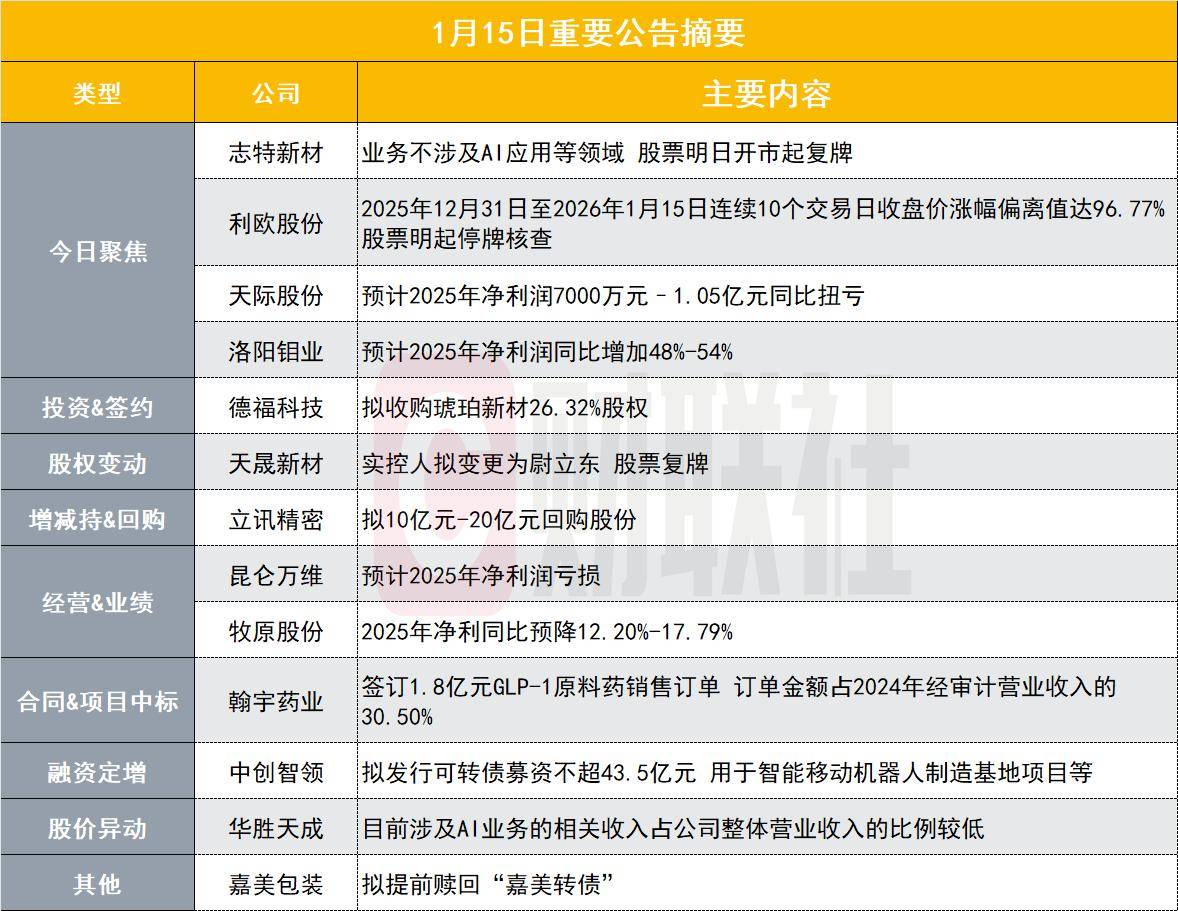
| | | 1月15日重要公告摘要 | | --- | --- | --- | | 类型 | 公司 | 主要内容 | | 今日聚焦 | 志特新材 | 业务不涉及AI应用等领域 股票明日开市起复牌 | | | 利欧股份 | 2025年12月31日至2026年1月15日连续10个交易日收盘价涨幅偏离值达 股票明起停牌核查 | | | 天际股份 | 预计2025年净利润7000万元 - 1. 05亿元同比扭亏 | | | 洛阳辑业 | 预计2025年净利润同比增加48%-54% | | 投资&签约 | 德福科技 | 拟收购琥珀新材26. 32%股权 | | 股权变动 | 天泉新材 | 实控人拟变更为尉立东 股票复牌 | | 增减持&回购 | 立讯精密 | 拟10亿元-20亿元回购股份 | | 经营&业绩 | 昆仑万维 | 预计2025年净利润亏损 | | | 牧原股份 | 2025年净利同比预降12. 20%-17. 79% | | 合同&项目中标 | 翰宇药业 | 签订1.8亿元GLP-1原料药销售订单 订单金额占2024年经审计营业收入 30. 50% | | 融资定增 | 中创智领 | 拟发行可转债募资不超4 ...
北大教授李玲重磅发声:中国下一个增长极已现,规模或远超房地产!
新浪财经· 2026-01-15 09:32
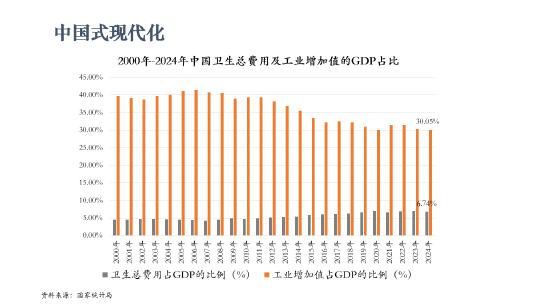
Core Viewpoint - The article emphasizes the importance of transitioning China's healthcare system from a disease-centric model to a health-centric model, highlighting the need for preventive care and a focus on overall well-being as part of the "Healthy China" national strategy [6][10]. Group 1: Healthcare System and Spending - China is recognized as the world's strongest industrialized nation, with significant progress in healthcare reform. In 2024, the total health expenditure in China was approximately 90,895.5 billion yuan, with government spending at 24.9%, social spending at 47.6%, and personal spending at 27.5%. The per capita health expenditure was 6,454.4 yuan, and the total health expenditure as a percentage of GDP fell below 7% for the first time, standing at 6.7% [4]. - The government is shifting the healthcare model to a system where hospitals and healthcare providers are incentivized to keep people healthy rather than treating them after they become ill. This involves creating a "health community" where resources are pooled to promote health and prevent disease [7]. Group 2: Challenges and Opportunities - The aging population presents significant challenges but also opportunities for a new development paradigm termed "Health+" that integrates healthcare, pharmaceuticals, green food, wellness, and elderly care into a new health industry. This industry is expected to be a lifelong necessity for individuals and could surpass the real estate sector in scale [8]. - The integration of artificial intelligence and new productive forces is seen as a competitive advantage for the nation, enabling a comprehensive health management system that spans an individual's entire life cycle [10]. Group 3: Global Contribution and Future Vision - The "Healthy China" initiative is positioned not only as a new development model for China but also as a potential original contribution to global health, leveraging China's rich agricultural civilization and wisdom in health [10]. - The article contrasts China's approach to health with that of the United States, suggesting that the challenges faced by the U.S. healthcare system present an opportunity for China to lead in global health solutions [10].

30 年蝶变,健康消费升级背后的产业自信与全球突围
Sou Hu Cai Jing· 2026-01-15 08:10
Core Insights - The Chinese health consumption market is projected to exceed 8 trillion yuan in 2024, with a compound annual growth rate of 15.3%, reflecting a shift from passive medical responses to proactive health management [3][6] - The emergence of new brands like "Guàn Ài" signifies a transition from reliance on imported products to domestic leadership in the health sector, showcasing the quality upgrade of Chinese pharmaceutical products [3][6] Industry Evolution - The pharmaceutical market in China has evolved from a state of "import dependency" and "supply shortages" 30 years ago to a focus on "quality pursuit," with significant improvements in domestic production capabilities [4][6] - In the erectile dysfunction (ED) treatment sector, domestic brands have increased their market share from less than 30% in 2000 to 65% in 2024, with domestic ED medications capturing 58% of the market, a 42 percentage point increase since 2010 [6][8] Technological Advancements - "Guàn Ài" has established a comprehensive quality control system that meets international standards, utilizing high-quality raw materials to ensure drug purity and stability, addressing past issues of inferior domestic products [7][8] - The brand's dissolution rate is 97%, significantly higher than the industry average of 85%, and its impurity levels are below the Chinese Pharmacopoeia's limit, enhancing the safety and efficacy of long-term treatments [7][8] Market Validation - "Guàn Ài" has achieved over 100 million units sold for two consecutive years, with a customer satisfaction rate of 99.9% on major e-commerce platforms, indicating strong market acceptance [9][11] - The brand was recognized as the top recommended domestic brand in the "2024 China ED Drug Industry White Paper," reflecting its technological strength and market reputation [9][11] Globalization Strategy - Following its domestic success, "Guàn Ài" is expanding globally by participating in international pharmaceutical exhibitions and winning prestigious design awards, enhancing its brand recognition [12][15] - The shift in Chinese pharmaceutical exports from low-cost competition to high-quality differentiation is exemplified by "Guàn Ài's" establishment of a manufacturing facility in the U.S., which aims to increase its market penetration in Western markets [15][16] Conclusion - The transformation of the Chinese health consumption market over the past 30 years illustrates a significant shift towards quality and consumer empowerment, with domestic brands like "Guàn Ài" leading the way in both local and international markets [16][18] - The ongoing growth of the health consumption market, projected to maintain a compound annual growth rate of over 15%, indicates a competitive landscape that prioritizes value over price, positioning the Chinese pharmaceutical industry for future global leadership [18]

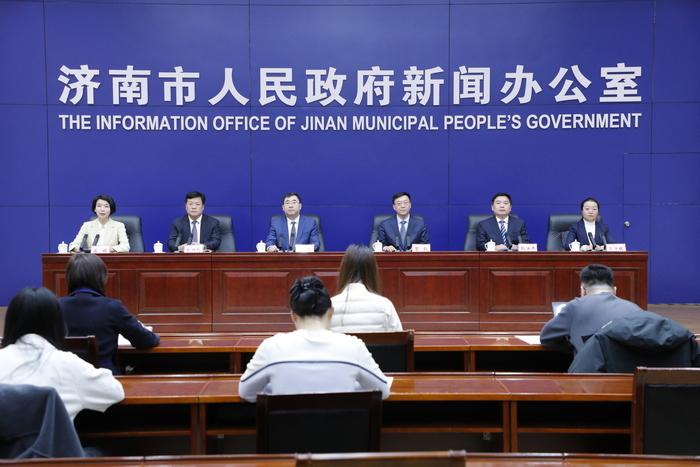
2025年前11个月,济南规上工业企业营收9962.5亿元
Feng Huang Wang Cai Jing· 2026-01-15 07:18
Group 1 - The core viewpoint of the article highlights the significant progress made by Jinan in achieving high-quality economic development through the implementation of the "14th Five-Year Plan," with a focus on industrial growth and innovation [1][3]. - Jinan's industrial revenue for the period from January to November 2025 reached 996.25 billion yuan, reflecting a year-on-year growth of 9.2% [3]. - The total industrial output value in Jinan is projected to exceed 1 trillion yuan for the first time in 2024, reaching 1,018.9 billion yuan, marking a historic milestone for the city's industrial economy [3]. Group 2 - Jinan has seen a significant increase in market vitality, with 15 enterprises achieving over 10 billion yuan in revenue and 807 enterprises surpassing 100 million yuan by the end of 2024, representing a net increase of 5 and 159 respectively compared to the end of the "13th Five-Year Plan" [3]. - The number of large-scale industrial enterprises in Jinan has reached 2,854, an increase of 942 from the end of the "13th Five-Year Plan," with a robust ecosystem of both large and small enterprises [3][4]. - The city has implemented over 1,000 technical transformation projects annually during the "14th Five-Year Plan," contributing to the development of key projects such as BYD's core components for electric vehicles and digital factories [4].
北京大学国发院李玲:“健康中国”或将为人类健康做出中国式原创贡献
Xin Lang Cai Jing· 2026-01-15 04:29
Core Insights - The "Sina Finance 2025 Conference and the 18th Golden Unicorn Forum" will be held on January 15, 2026, in Beijing, focusing on the theme of "Starting the 14th Five-Year Plan, New Economic Voyage - Reshaping Growth Paradigms, Creating Future Prosperity" [1][9] - Li Ling, a prominent figure in China's economic and health sectors, highlighted the achievements and challenges of China's healthcare system, emphasizing the need for a shift from a disease-centered approach to a health-centered paradigm [4][12] Healthcare Spending - In 2024, China's total health expenditure is estimated at 90,895.5 billion yuan, with government spending accounting for 24.9%, social spending for 47.6%, and personal spending for 27.5% [1][9] - The per capita health expenditure is 6,454.4 yuan, and the total health expenditure as a percentage of GDP is 6.7%, marking a significant decline below 7% for the first time [1][9] Challenges and Opportunities - The aging population presents significant challenges, necessitating a focus on disease prevention rather than treating aging as a disease [4][12] - The "Healthy China" national strategy prioritizes health as a key indicator of socialist modernization, advocating for a preventive approach to health [4][12] Systemic Changes in Healthcare - The government is promoting a systemic approach to healthcare, integrating county, township, and village services into a cohesive "health community" model, moving away from hospitals competing for patient revenue [5][13] - The "Sanming Model" aims to incentivize hospitals and doctors to manage patients' health proactively, with a nationwide rollout planned within four years [5][13] Emerging Health Industry - The integration of healthcare, pharmaceuticals, green food, wellness, and elderly care is expected to create a new "big health" industry, which could surpass the real estate sector in scale [5][13] - This industry is seen as a lifelong necessity for individuals, with potential benefits extending beyond China to serve global health needs [5][13] Future Health Management - The envisioned future health model includes a personal health code system, supported by AI for continuous health management throughout an individual's life [6][14] - The "Healthy China" and "Smart Health" initiatives are positioned as new development models that will contribute significantly to global health, leveraging China's historical wisdom and modern technological advancements [6][14]
北京大学国发院教授李玲:新型大健康产业规模不可限量,“可以远远超过房地产”
Xin Lang Cai Jing· 2026-01-15 04:23
Core Viewpoint - The "Sina Finance 2025 Conference and the 18th Golden Unicorn Forum" emphasizes the theme of reshaping growth paradigms and creating future prosperity, highlighting the importance of health in China's modernization strategy [1][9]. Group 1: Healthcare Spending and Trends - In 2024, China's total health expenditure is estimated at 90,895.5 billion yuan, with government spending at 24.9%, social spending at 47.6%, and personal spending at 27.5% [1][9]. - The per capita health expenditure is 6,454.4 yuan, and the health expenditure as a percentage of GDP has dropped to 6.7%, marking a significant decline below 7% for the first time [1][9]. Group 2: Challenges and Strategic Shifts - The primary challenge facing China is population aging, necessitating a shift from a disease treatment focus to a health-centered approach, promoting disease prevention [4][12]. - The "Healthy China" national strategy prioritizes health as a key indicator of socialist modernization, requiring collaboration among government, society, and individuals to implement a preventive health model [4][12]. Group 3: Systemic Changes in Healthcare - The government is promoting a systemic approach to healthcare, integrating county, township, and village services into a cohesive "health community," moving away from a profit-driven model based on patient volume [5][13]. - The "Sanming Model" aims to incentivize hospitals and doctors to manage patients' health effectively, with a goal of nationwide implementation within four years [5][13]. Group 4: Opportunities in the Health Industry - The aging population presents opportunities for a new "health+" development paradigm, integrating healthcare, pharmaceuticals, green food, wellness, and elderly care into a large health industry [5][13]. - This emerging health industry is expected to be a lifelong necessity for individuals, with potential market size surpassing that of real estate, serving both Chinese citizens and the global population [5][13]. Group 5: Future Health Management - The envisioned future health model includes a personal health code system, utilizing AI for continuous health management throughout an individual's life, aiming to reduce disease incidence and promote longevity [6][14]. - The integration of traditional wisdom with modern technology is seen as a unique contribution from China to global health, especially in light of challenges faced by developed nations like the U.S. [6][14].