
数字货币

Search documents
稳定币系列报告之二:宏观视角下稳定币的四种内涵
Huachuang Securities· 2025-07-20 10:03
Investment Rating - The report maintains a recommendation for investment in the stablecoin sector, emphasizing its potential to revolutionize global payment efficiency and its implications for the financial system [2][10]. Core Insights - Stablecoins represent a technological innovation that enhances global payment efficiency while also reflecting the digital extension of dollar hegemony and the ongoing competition within sovereign financial systems [2][10]. - The future development of stablecoins will depend on the maturation of regulatory frameworks and the evolution of a multipolar stablecoin ecosystem, which could determine their role as a core component of inclusive global financial infrastructure [2][10]. Summary by Sections Stablecoin 1.0: Efficiency Revolution in Traditional Payment Models - Stablecoins leverage smart contracts for automated payments, reducing credit risk and enhancing efficiency [11][12]. - They significantly lower cross-border payment costs, with fees dropping to as low as $0.00025 per transaction compared to traditional systems [19][20]. - In high-inflation economies, stablecoins serve as a hedge against inflation and facilitate cross-border settlements [27][28]. Stablecoin 2.0: Digital Extension of the Dollar - As of July 4, 2025, the global stablecoin market is valued at $241.634 billion, predominantly backed by the US dollar [30][32]. - The issuance of stablecoins is expected to increase demand for US Treasury securities, reinforcing the dollar's dominance [33][36]. Stablecoin 3.0: New Variables for Global Financial Stability - The stability of stablecoins relies on trust mechanisms, with potential systemic risks emerging from liquidity and credit risks [37][42]. - The rise of stablecoins may challenge sovereign monetary policies and reduce the effectiveness of macroeconomic controls [38][42]. Stablecoin 4.0: Future Compliance and Ecosystem Integration - The report anticipates four concurrent trends in stablecoin development: regulatory frameworks enhancing compliance, deeper integration with traditional finance, the creation of stablecoin application ecosystems, and the emergence of a multipolar stablecoin system [45][52]. - Regulatory developments in regions like the EU, the US, and Hong Kong are expected to shape the future landscape of stablecoins [46][48].
全球流动性的“去中介化”生产——稳定币重构基础货币理论
Sou Hu Cai Jing· 2025-07-19 14:35
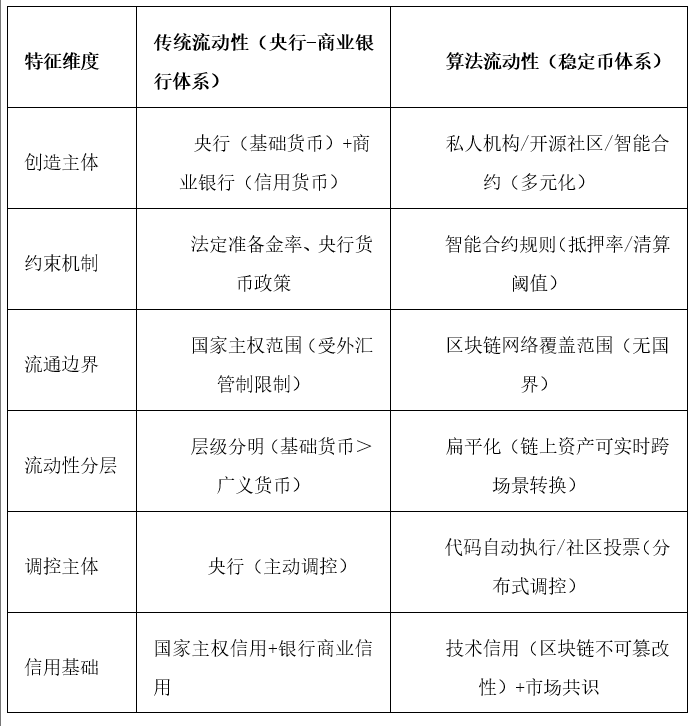
Group 1 - The article focuses on the disruptive impact of stablecoins on traditional monetary theory, proposing the "algorithmic liquidity" theory to explain the shift from a "central bank-commercial bank" intermediary model to a "code-network" disintermediation model [1][2] - The rise of stablecoins, particularly since the introduction of USDT in 2014, has led to a significant increase in their market value, projected to exceed $250 billion by 2025, with a trading volume surpassing $25 trillion annually [1][2] - The study highlights the limitations of traditional monetary theory in the digital age, emphasizing the need for a new framework to understand the supply of money and its implications for global financial regulation [1][2] Group 2 - Traditional monetary theory is based on a binary structure involving central banks and commercial banks, which has been effective in explaining monetary supply in the industrial era but is increasingly challenged by the emergence of stablecoins [2][4] - The article identifies three main dilemmas faced by traditional monetary theory in the context of stablecoins: the failure of liquidity stratification, the breakdown of the money multiplier, and the ungoverned distribution of cross-border liquidity [2][7][12] - The emergence of stablecoins has led to a "flattening" of liquidity, allowing for instant conversions across different asset classes, which undermines the traditional hierarchical liquidity structure [8][9] Group 3 - The article introduces the concept of "algorithmic liquidity," which describes the decentralized production of liquidity through blockchain technology and smart contracts, contrasting it with traditional liquidity production mechanisms [13][14] - Algorithmic liquidity is characterized by three types: fiat-collateralized, crypto-collateralized, and algorithmic stablecoins, each with distinct production logic and mechanisms [18][19] - The study constructs a mathematical model for algorithmic liquidity production, revealing its unique expansion mechanisms driven by network effects and scenario penetration [24][27] Group 4 - Case studies of USDT and DAI illustrate the practical applications of algorithmic liquidity, with USDT serving as a fiat-collateralized stablecoin that enhances dollar liquidity in emerging markets, while DAI exemplifies a crypto-collateralized model that operates independently of traditional monetary systems [29][30][31] - The comparison between USDT and DAI highlights the spectrum of algorithmic liquidity, showing how different types of stablecoins interact with traditional monetary systems, from digital extensions of fiat to independent liquidity sources [33]

天融信20250718
2025-07-19 14:02
Summary of Conference Call on Stablecoins and Cybersecurity Industry Overview - The discussion revolves around the **stablecoin** industry, which is emerging as a significant tool for **cross-border payments** due to its advantages of convenience, low cost, and real-time transactions [2][3][8]. Key Points and Arguments - **Technological Risks**: Stablecoins face substantial cybersecurity risks, including system vulnerabilities and DDoS attacks, as evidenced by incidents like the theft of 400,000 Ether worth $1.5 billion [5][9]. - **Regulatory Developments**: Various regions are actively developing stablecoin regulations. For instance, Hong Kong is set to implement a stablecoin licensing system, while the U.S. Senate has passed the "Genius Act" to establish a regulatory framework [2][6]. - **Market Opportunities**: The rise of stablecoins is expected to create new opportunities in the cybersecurity market, particularly in infrastructure development and security assurance, as businesses increasingly rely on secure information systems for cross-border transactions [2][8][12]. - **Technological Components**: The technology behind stablecoins includes blockchain, smart contracts, encryption, and user identity verification, all of which are critical for ensuring security [7][12]. Important but Overlooked Content - **Current Stage of Development**: The stablecoin sector is at different stages globally, with the U.S. and Europe having more established infrastructure compared to Hong Kong, which is preparing for pilot projects, and mainland China, which is still in the research phase [11][14]. - **Cybersecurity Solutions**: The need for comprehensive cybersecurity solutions is emphasized, including risk assessments for cross-border data and compliance with data security laws [9][14]. - **Commercial Models**: The commercial model for stablecoin security solutions is still in exploration, focusing on providing integrated security solutions rather than standalone products [15]. - **Market Expansion**: The potential for cybersecurity firms to expand into international markets through stablecoin applications in Hong Kong is highlighted, as it simplifies cross-border transactions [19][21]. Future Outlook - The stablecoin market has significant growth potential, but its expansion is contingent on regulatory clarity. Once policies are established, the growth rate of stablecoins could surpass that of other technologies like quantum-resistant cryptography [22]. - The cybersecurity industry is expected to remain relevant as digitalization continues, with a call for increased attention from capital markets towards cybersecurity firms [23].

稳定币及RWA观点分享
2025-07-19 14:02
Summary of Key Points from the Conference Call on Stablecoins and RWA Industry Overview - The discussion revolves around the **stablecoin** industry, highlighting its applications in **cross-border trade** and **smart payment solutions** such as invoice tokenization and Project DSFT, which have received fintech innovation awards and funding, showcasing commercial potential [1][2] - The global trend towards stablecoin policy is one of increasing attention and support, with central banks and regulatory bodies accelerating the formulation of relevant policies to ensure safe and compliant development, although regulatory intensity varies across countries [1][3] Core Insights and Arguments - Future trends for stablecoins include expansion in cross-border trade and smart payment sectors, growth in commercial applications, and increased attention and investment from traditional financial institutions, indicating a positive outlook [1][5] - The digital asset market has recently shown strong performance, with Bitcoin and Ethereum prices surging, suggesting that major economies are entering the stablecoin economic competition, driven by expectations of relaxed monetary policy from the Federal Reserve [1][10] - The market faces challenges from geopolitical tensions, policy changes, monetary policy uncertainties, internal market risks, and potential bubble cycles, necessitating vigilance against various risks [1][12] Regulatory Landscape - Key regulations impacting the digital asset space include the **Stablecoin Act**, **Clarity Act**, **Anti-CBDC Act**, and **Fit 21 Act**, which could significantly influence the global digital asset landscape and economy [1][6] - Different countries exhibit varying regulatory attitudes, with Hong Kong actively following U.S. legislation, while Singapore is tightening regulations, leading to operational challenges for stablecoin payment companies [1][7] Misconceptions and Risks - There are misconceptions within the Chinese community regarding the potential and risks of stablecoin economic models, which could lead to new risks if not addressed [1][4] - The digital asset market is expected to experience a new bull market, with stablecoins playing a central role, but significant risks and misunderstandings could lead to a potential crash [1][11] Market Dynamics - The primary battleground for stablecoins is in the offshore dollar stablecoin system, with major users of USDT and USDC located outside the U.S., particularly in regions like Africa, Asia, and Latin America [1][17] - The issuance of stablecoins is seen as straightforward, but operational security and management are complex due to the prevalence of malicious actors in the blockchain ecosystem [1][18] Future Opportunities and Challenges - The stablecoin market is expected to see hundreds or even thousands of different types of stablecoins, with major companies and celebrities likely to issue their own for brand promotion and low-cost financing [1][26] - Hong Kong is positioned as a significant player in the global stablecoin market, with initiatives to support Chinese entrepreneurs in the stablecoin economy [1][28] Conclusion - The future scale of the stablecoin market is closely tied to China's stablecoin strategy, with significant challenges in competing against the dominance of the U.S. dollar, which currently holds 97% to 99% of the market share [1][30] - Users in global payment systems tend to prefer dollar stablecoins, indicating a need for strategies to encourage the use of Hong Kong or Renminbi offshore stablecoins [1][31][32]
氪星晚报|英国石油出售美国陆上风电业务;比亚迪在济南成立销售服务新公司;香港航空推出免费机场接送服务
3 6 Ke· 2025-07-18 12:03
Group 1: Company Developments - Hong Kong Airlines has launched a free airport transfer service in collaboration with 永东直通巴士有限公司 and 日本阿拉丁集团, available until December 31, 2025, for passengers with valid boarding passes [1] - 京东币链科技 has reported that a fake digital currency named JD-HKD has been circulating on major trading platforms, clarifying that no such stablecoin has been issued and urging users to avoid scams [1] - 一亩田集团 has established an international business operation center in Hong Kong, marking the beginning of its global expansion, with active buyers from over 50 countries [2] - 宇树科技 has initiated its listing guidance with 中信证券 as the advisory firm, with its controlling shareholder holding 34.763% of the company [3] - 必和必拓 has announced that its Canadian potash project may exceed budget by $1.7 billion, with the first phase 68% complete and initial production now expected in mid-2027 [4] - 英国石油 has agreed to sell its onshore wind energy business in the U.S. to LS Power [4] - 比亚迪 has established a new sales service company in Jinan, fully owned by its subsidiary [4] - 小米 has officially opened its Shenzhen headquarters, marking its fourth regional headquarters in China [6] - 赛诺菲 has completed the acquisition of Blueprint Medicines for over $9 billion, including a rare disease drug that has been approved in the U.S. and EU [6] - 保泰人寿 has secured $70 million in Series C funding, led by 永明金融有限公司 [6] - 长石资本 has raised 728 million yuan for its hard technology fund, achieving over 50% IPO success rate across its investments [6] Group 2: Product and Partnership Announcements - 腾讯元宝 has integrated with QQ Music, allowing users to play music directly within the app [7] - Airwallex has formed a multi-year global partnership with Arsenal Football Club, becoming the official financial software partner [8] Group 3: Market Insights - The global cryptocurrency market has surpassed $4 trillion for the first time, with Bitcoin accounting for 59.91% of the total market cap at approximately $2.39 trillion [12]

稳定币应用场景及行业研究
China Post Securities· 2025-07-18 06:43
- The report focuses on the application scenarios of stablecoins, including DeFi, local payments, cross-border settlements, and Real World Assets (RWA), analyzing their full circulation processes and loss-profit dynamics[3][4][25] - Stablecoins are categorized into three types: fiat-backed stablecoins (e.g., USDT, USDC), crypto-collateralized stablecoins (e.g., DAI), and algorithmic stablecoins, each with distinct mechanisms for maintaining value stability[11][12] - USDC's core business model is built on compliance and transparency, supported by reserves in cash and short-term U.S. Treasury bills, and strategic partnerships with regulated crypto exchanges like Coinbase[15][16][17] - USDC demonstrates efficiency improvements across four key scenarios: DeFi transactions, local and cross-border payments, and RWA investments, significantly reducing costs and transaction times compared to traditional systems[18][19][25][45] - DeFi applications of stablecoins include borrowing/lending protocols, liquidity pools in decentralized exchanges (DEXs), derivatives markets, and serving as a safe haven during market volatility[25][33][34] - Local payment systems integrate stablecoins into existing networks like Visa, enabling T+0 settlements and reducing merchant fees to 0.3%-0.7%, compared to traditional rates of 2%-3%[35][38][41] - Cross-border settlements using stablecoins bypass SWIFT systems, achieving near-instant transactions with fees below 1%, compared to traditional costs of 3%-6%[42][45][48] - RWA tokenization leverages stablecoins for efficient fund subscription, automated yield distribution, and 24/7 liquidity, reducing transaction costs and enhancing accessibility[49][55][58] - The stablecoin market is dominated by USD-backed assets, with USDT leading at $1606 billion and USDC rapidly growing to $620 billion, driven by compliance and transparency[66][68][73] - USDC is positioned as the "compliance-first" choice across multiple scenarios, while USDT dominates offshore and less-regulated markets, facing challenges in transparency and auditability[75][76] - Bank-issued stablecoins target B2B wholesale clearing, while tech giants like PayPal leverage native user bases for retail payments, constrained by regulatory limits[77][78] - CBDCs are designed as government-operated RTGS systems, focusing on cross-border applications through projects like m-Bridge[79][80] - The stablecoin ecosystem is reshaping traditional financial intermediaries, benefiting end-users and digital infrastructure providers while challenging legacy systems like SWIFT and correspondent banks[63][72][73]
大成研究 | 王杰等:人民币稳定币的发行路径、可行性及与RWA的协同发展研究
Sou Hu Cai Jing· 2025-07-18 03:45
Group 1 - The article discusses the significance of issuing a Renminbi stablecoin in the context of global financial changes and the challenges posed by the dominance of the US dollar in the international monetary system [5][11]. - The issuance of a Renminbi stablecoin is seen as a way to enhance the internationalization of the Renminbi, improve cross-border trade efficiency, and address the limitations of the digital Renminbi [11][14]. - The global stablecoin market has grown rapidly, with a market size exceeding $240 billion, and 98% of these stablecoins pegged to the US dollar, highlighting the need for alternatives like the Renminbi stablecoin [10]. Group 2 - The article outlines various types of stablecoins, including fiat-collateralized, crypto-collateralized, and algorithmic stablecoins, emphasizing the regulatory focus on fiat-collateralized stablecoins due to their stability and ease of understanding [6][7][9]. - The potential paths for issuing a Renminbi stablecoin include both domestic and offshore models, with suggestions for collaboration between financial institutions and regulatory bodies to ensure compliance and operational stability [18][20]. - Legal challenges such as currency sovereignty, regulatory clarity, and anti-money laundering compliance are identified as significant obstacles to the issuance of a Renminbi stablecoin, necessitating coordinated regulatory efforts [21][22][23]. Group 3 - The relationship between Renminbi stablecoins and Real-World Assets (RWA) is explored, indicating that stablecoins can support RWA transactions by providing price stability, liquidity, and cross-border payment capabilities [26][27]. - The feasibility of issuing a Renminbi stablecoin is supported by favorable policy environments, technological advancements, market demand, and the willingness of financial institutions to participate [30][31][32][33]. - The article concludes that the exploration of a Renminbi stablecoin could serve as a strategic tool to counter the digital dominance of the US dollar and facilitate China's integration into the global economy [42].

稳定币与跨境电商创新发展,稳定币含量最高的金融科技ETF华夏(516100)近5日吸金3.2亿
Mei Ri Jing Ji Xin Wen· 2025-07-18 02:46
Group 1 - The three major indices continued to show strength, with the fintech ETF Huaxia (516100) experiencing a slight decline after a brief high opening, reflecting a mixed performance in the market [1] - The fintech ETF Huaxia (516100) has seen a net subscription of 320 million in the past five days, indicating strong investor interest despite the current dip [1] - The China Service Trade Association plans to launch a high-level training course on "Stablecoins and Innovative Development in Cross-Border E-Commerce" in August, focusing on the core concepts, underlying logic, and regulatory framework of stablecoins [1] Group 2 - The fintech ETF Huaxia (516100) closely tracks the CSI Financial Technology Theme Index, which includes major players in software development, internet finance, and the digital currency industry, with a stablecoin content of 23.43%, the highest in the market [2] - The index's top holdings include industry leaders such as Tonghuashun, Dongfang Caifu, and Runhe Software, as well as popular stablecoin stocks like Dongxin Pinghe and Yingshisheng, providing investors with a convenient way to invest in stablecoins and digital currencies [2] - According to Everbright Securities, the use of stablecoin-related technologies and platforms can facilitate cross-border transactions and reduce transaction costs for buyers and sellers [1]
帮主郑重:美股新高背后的暗战!中长线投资者该如何破局?
Sou Hu Cai Jing· 2025-07-18 01:24
咱来聊聊美股为啥能创新高。首先得夸夸英伟达,这家公司最近简直是"AI芯片界的霸主",黄仁勋前脚刚宣布恢复对华H20芯片的销售,后脚股价就蹭蹭 往上涨,市值直接冲破4.2万亿美元。不过有个细节得注意,黄仁勋最近在减持,虽然是按照预设计划进行,但这么大的动作还是得留个心眼。 各位朋友,咱们又见面了。最近美股市场可是相当热闹,纳指和标普500齐刷刷创下历史新高,连英伟达的市值都突破了4.2万亿美元,相当于A股整个半 导体板块的总市值。这场景,就像一场高手过招的棋局,表面上风平浪静,实则暗流涌动。 先给大家盘盘昨夜的关键事儿。美国众议院通过了加密货币法案,这可是给数字货币市场打了一剂强心针。不过另一边,穆迪敲响了警钟,说关税风险 可能让更多公司逼近违约。再看Netflix,第二季度营收110.79亿美元,虽说超了预期,但股价盘后还是跌了,看来市场对它的未来增长有点疑虑。 国际油价最近因地缘风险和供应趋紧涨了不少,但金价却跌了,黄金现货下跌0.23%。这说明市场的避险情绪在降温,但同时也反映出大家对经济复苏的 预期在增强。 作为中长线投资者,咱们得把眼光放长远。首先,要关注企业的财报质量,尤其是那些在关税压力下还能保持 ...

加密数字货币立法草案在美国众议院通过一个程序性障碍。此前,众议院的程序性表决失败。
news flash· 2025-07-16 17:27
Core Points - A legislative proposal regarding cryptocurrency has passed a procedural hurdle in the U.S. House of Representatives [1] - Prior to this, the House faced a failure in a procedural vote [1]