
教育

Search documents
克州:产业兴州 富民稳边
Xin Lang Cai Jing· 2025-12-23 19:08
Core Viewpoint - The news highlights the significant achievements of the Kizilsu Kirghiz Autonomous Prefecture in social stability, economic development, ethnic unity, cultural prosperity, and openness in recent years, under the theme "Industrial Prosperity and Stable Borders" [1][2] Group 1: Social Stability and Ethnic Unity - Kizilsu has focused on social stability and long-term peace, enhancing the sense of security among various ethnic groups through legal construction and conflict resolution initiatives [1] - The region has created 1,516 ethnic unity demonstration zones at the county level and above, promoting the awareness of a shared Chinese national identity [1] - Cultural initiatives, such as the "Manas" International Cultural Tourism Festival, have fostered cultural integration and development [1] Group 2: Economic Development - The region's GDP has increased from 6.277 billion yuan in 2012 to 25.666 billion yuan in 2024, reflecting a strong economic growth trajectory [2] - The total installed capacity of green electricity has grown 13.8 times since 2012, and the tourism economy continues to thrive [2] - Foreign trade has seen a 5.6 times increase from 2012 to 2024, with this year's import and export value reaching 170 billion yuan [2] Group 3: Improvement in Living Standards - The per capita disposable income of rural residents has increased 2.8 times since 2012, with over 50% of village collective economic incomes exceeding 1 million yuan [2] - Public services in education and healthcare have expanded, including the establishment of a vocational university and a comprehensive medical community [2] - The construction of earthquake-resistant housing and the improvement of services for the elderly and children have enhanced the overall sense of well-being among the population [2]
活力暖冬展风采 健康同行伴成长 ——未央区西航三校教育集团大课间展示评比活动圆满落幕
Xin Lang Cai Jing· 2025-12-23 14:59
冬日暖阳照校园,活力运动绽芳华。为贯彻落实上级部门关于加强学校体育艺术教育的相关要求,切实提升学生体质健康水平,近日,西安市未央区西航 三校教育集团以"我与健康同行 阳光伴我成长"为主题,在集团各校区依次开展2025年冬季锻炼大课间展示评比活动。集团领导、各校区执行校长、管理 团队及体育团队全程观摩,共同见证师生们的运动风采。 401 LOTT CH LOTT T का 11 4 m 4 410 Tre al t ................. A : 1 . E 201 F PERE S S FEE 日時 N D BE 1 00 00 0 the F 電車 x Fir n n 日本日 n 00 ii. ii 11:00 | ata a H 取"可 FK. L 0 0 NITZ T re from the e, a Car in 日 H 电量电商品 t 上目标题 E H AH FART HE FOR FOR FILE E "LI tentate 间"门 " on the host of 间""网 er == and K i (LS) 官方版社 图片 ® A B and and and and seats ...


创新建设管理模式,茂名信宜县城人口三年增4.6万
Nan Fang Du Shi Bao· 2025-12-23 14:08
同时,龚庆介绍,信宜在提升县城基础设施和宜居程度方面,通过合理用活资金,将排涝、污水等项目 与市民空间、路网等建设整合在一起,让5个堰塞塘和4条黑臭涌转变为海绵城市蓝绿廊道,达到"一分 钱花出两分钱"的效果。 除了基础设施建设外,信宜在县城公共服务品质提升上也取得诸多成效。龚庆说,今年来信宜通过推动 校地深度合作、引入高水平医院、设立科研平台等举措,使当地人居品质得以明显提升。"建成华师砺 儒高中、华师附属学校、广外附属学校,新增优质学位11400个;共建中大六院粤西医院,一年半晋升 三甲医院,四级手术量增长185.2%,9个月建成肿瘤中心;建立中山大学、生态部华南所信宜水环境治 理中心,三年来城市污水收集率从28.9%提升到55.2%……"龚庆介绍。 在"百千万工程"的带动下,信宜市如何实现"五年显著变化"?龚庆表示,当地未来将探索以信宜50万在 外产业工人作为招商切入口,构建制造业人力资源优势,再用两年时间初步构建起信宜现代工业框架; 与此同时,探索更广泛的群众参与机制,推动裸房改造从"政府出资"转为"群众出资",未来两年再改造 4万栋。 南都讯 记者朱唯信 12月23日下午,2025年全省推进"百县千镇 ...
“十四五”时期山东完成2.17万项审计
Qi Lu Wan Bao· 2025-12-23 10:46
Core Viewpoint - The Shandong Provincial Government is focusing on enhancing the quality of auditing during the 14th Five-Year Plan period to support the construction of a strong province, with significant achievements in various sectors through comprehensive auditing efforts [1][2][3][4][6]. Group 1: Audit Projects and Economic Impact - A total of 21,320 audit projects have been conducted, significantly contributing to the smooth implementation of government policies, deepening reforms, maintaining economic security, and promoting integrity [1]. - The auditing efforts have facilitated the revitalization of 2.132 billion yuan in existing funds through systematic audits in key areas along the Yellow River [1]. - Audits related to economic stability and development policies have been implemented, including 56.02 billion yuan in subsidies to enterprises [2]. Group 2: Environmental and Resource Audits - Systematic audits focusing on natural resource development and ecological governance have been conducted, including the establishment of a natural resource asset audit evaluation system [1]. - The auditing of green and low-carbon development policies has been initiated to support the transition towards a more sustainable economy [1]. Group 3: Financial Audits and Risk Management - The Shandong Provincial Audit Office has implemented 17 key financial audit projects, identifying and reporting 101 major violations involving 122 individuals [6]. - A three-year action plan for financial audits aims to achieve comprehensive coverage of provincial financial supervision, focusing on risk prevention and regulatory strengthening [6]. Group 4: Social Welfare and Community Audits - Audits in agriculture and rural development have included 682 projects aimed at promoting rural revitalization and addressing community issues, with 907 problem leads transferred to disciplinary inspection agencies [4]. - Education and health audits have been conducted to ensure compliance with policies and improve service quality, including special investigations into food safety in schools [4].
天立国际控股(01773)12月23日耗资约23.38万港元回购10万股
智通财经网· 2025-12-23 10:45
智通财经APP讯,天立国际控股(01773)公布,2025年12月23日耗资约23.38万港元回购10万股股份。 ...
中国高科12月23日现1笔大宗交易 总成交金额257.8万元 溢价率为0.00%
Xin Lang Cai Jing· 2025-12-23 10:29
炒股就看金麒麟分析师研报,权威,专业,及时,全面,助您挖掘潜力主题机会! 12月23日,中国高科收跌9.99%,收盘价为12.89元,发生1笔大宗交易,合计成交量20万股,成交金额 257.8万元。 责任编辑:小浪快报 第1笔成交价格为12.89元,成交20.00万股,成交金额257.80万元,溢价率为0.00%,买方营业部为国泰 海通证券股份有限公司深圳福华三路证券营业部,卖方营业部为中国国际金融股份有限公司北京建国门 外大街证券营业部。 ...

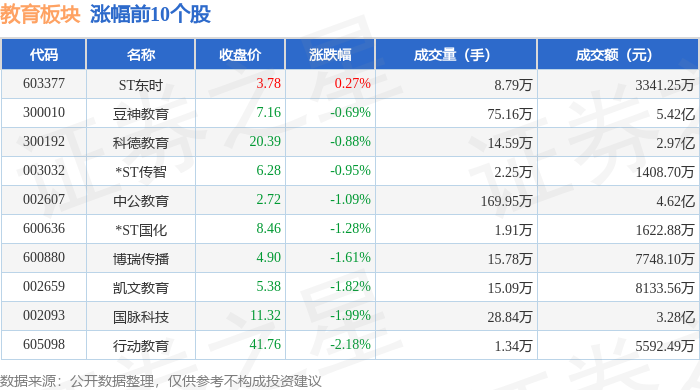
教育板块12月23日跌2.28%,中国高科领跌,主力资金净流出1.33亿元
Zheng Xing Xing Ye Ri Bao· 2025-12-23 09:08
证券之星消息,12月23日教育板块较上一交易日下跌2.28%,中国高科领跌。当日上证指数报收于 3919.98,上涨0.07%。深证成指报收于13368.99,上涨0.27%。教育板块个股涨跌见下表: | 代码 | 名称 | 收盘价 | 涨跌幅 | 成交量(手) | 成交额(元) | | | --- | --- | --- | --- | --- | --- | --- | | 603377 | ST东时 | 3.78 | 0.27% | 8.79万 | | 3341.25万 | | 300010 | 豆神教育 | 7.16 | -0.69% | 75.16万 | | 5.42亿 | | 300192 | 科德教育 | 20.39 | -0.88% | 14.59万 | | 2.97亿 | | 003032 | *ST传智 | 6.28 | -0.95% | 2.25万 | | 1408.70万 | | 002607 | 中公教育 | 2.72 | -1.09% | 169.95万 | | 4.62亿 | | 600636 | *ST国化 | 8.46 | -1.28% | 1.91万 | | 1622.88 ...
A股三大指数尾盘回落,卫星互联网下挫,华体科技等多股跌停,港股多只科网股跳水
2 1 Shi Ji Jing Ji Bao Dao· 2025-12-23 07:48
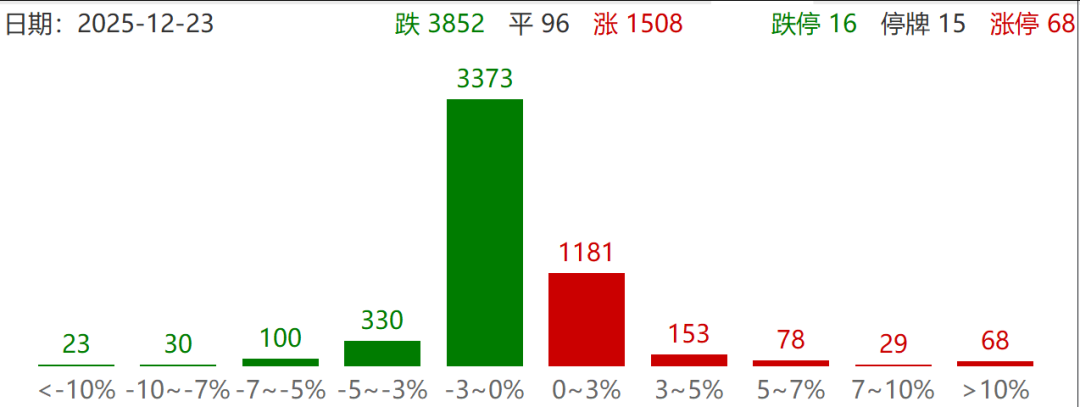
Market Overview - On December 23, A-shares experienced a slight increase with the Shanghai Composite Index rising by 0.07%, the Shenzhen Component Index by 0.27%, and the ChiNext Index by 0.41% [1] - The total trading volume in the Shanghai and Shenzhen markets approached 1.92 trillion, showing a slight increase compared to the previous day [1] - Over 1,500 stocks rose, with nearly 70 stocks hitting the daily limit, while around 3,900 stocks declined [1] Sector Performance - The Hainan Free Trade Zone concept stocks showed strong performance, with Hainan Haiyao (000566), Hainan Ruize (002596), and Hainan Development (002163) hitting the daily limit [3] - The lithium battery sector also performed well, with Tianji Co. (002759) reaching the daily limit [3] - Liquid cooling service providers saw gains in the afternoon, with Yingweike (002837) and Jitai Co. (002909) hitting the daily limit [3] - Semiconductor equipment concepts were active, with Shenghui Integration (603163) and Yaxiang Integration (603929) achieving consecutive limit-ups [3] - The non-ferrous tungsten sector was active, with Xianglu Tungsten (002842) and Zhangyuan Tungsten (002378) both hitting the daily limit [3] - The electric grid equipment sector saw a late surge, with Baobian Electric (600550) hitting the daily limit, followed by other stocks like Shun Sodium (000533) and Zhongneng Electric (300062) rising [3] New Listings - Three newly listed stocks all experienced significant gains, with N Tian Su (N天溯) and N Xi Hua (N锡华) triggering a second trading halt due to rapid price increases [3] Declining Sectors - The satellite internet sector faced declines, with stocks like Huati Technology (603679) hitting the daily limit down, and China Satellite Communications (601698) nearing the limit down [4] - The commercial aerospace sector also struggled, with Shunhao Co. (002565) and others hitting the daily limit down [4] - The tourism and hotel sector declined, with Qujiang Cultural Tourism (600706) hitting the daily limit down [4] - The education sector continued to decline, with China High-Tech (600730) hitting the daily limit down [4] - The Beidou navigation sector weakened, with Jiuzhiyang (300516) dropping over 12% [4] - Other sectors such as 3D glass, 6G concepts, and digital currency saw significant declines [4] Hong Kong Market - In the Hong Kong market, major indices turned negative, with the Hang Seng Technology Index falling by 0.8% [5] - Several tech stocks experienced sharp declines, including Horizon Robotics down nearly 5% and Kuaishou down 4% [5]

收评:沪指涨0.07% 电池板块全天领涨
Zhong Guo Jing Ji Wang· 2025-12-23 07:33
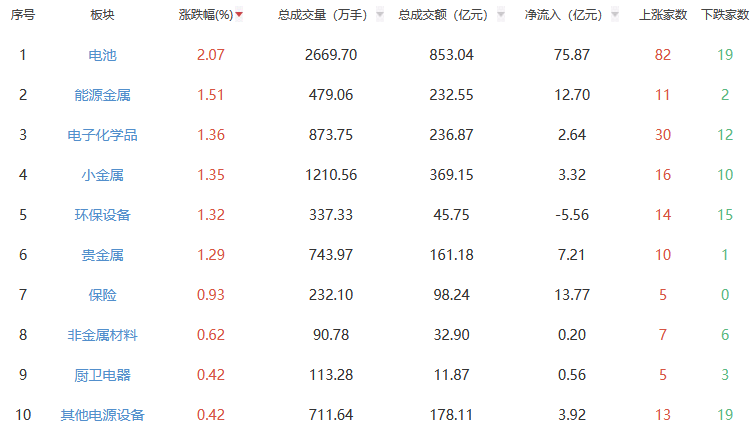
Market Overview - The A-share market saw all three major indices rise, with the Shanghai Composite Index closing at 3919.98 points, up 0.07%, and a total trading volume of 806.85 billion yuan [1] - The Shenzhen Component Index closed at 13368.99 points, up 0.27%, with a trading volume of 1092.99 billion yuan [1] - The ChiNext Index closed at 3205.01 points, up 0.41%, with a trading volume of 493.68 billion yuan [1] Sector Performance - The battery sector led the gains with an increase of 2.07%, totaling a trading volume of 266.97 million hands and a transaction value of 85.30 billion yuan [2] - The electronic chemicals sector rose by 1.36%, with a trading volume of 87.38 million hands and a transaction value of 23.69 billion yuan [2] - The tourism and hotel sector experienced the largest decline, falling by 2.73%, with a trading volume of 114.34 million hands and a transaction value of 10.39 billion yuan [2] - The education sector decreased by 1.86%, with a trading volume of 34.34 million hands and a transaction value of 2.21 billion yuan [2]
十年携手,中伊战略伙伴关系再续新篇
Xin Hua She· 2025-12-23 07:29
Core Viewpoint - The strategic partnership between China and Iraq, established in December 2015, has significantly strengthened over the past decade, focusing on mutual respect, political trust, and practical cooperation, serving as a model for cooperation among developing countries in a changing world [2][3]. Political Trust - Political trust has been the solid foundation for the steady development of bilateral relations, with China supporting Iraq's economic development, improving livelihoods, and combating terrorism, while opposing external interference in Iraq's internal affairs [2]. - Both countries respect each other's sovereignty and territorial integrity, accommodating core interests and major concerns, which has expanded consensus and provided crucial support for the growth of the strategic partnership [2]. Mutual Benefit and Cooperation - China has been the earliest and longest participant in Iraq's economic reconstruction, engaging in various infrastructure projects across multiple sectors, including energy, electricity, and transportation [3]. - The bilateral trade volume is expected to exceed $54 billion in 2024, covering sectors such as energy, automotive, and electronics, with Chinese electric vehicle brands gaining popularity in Iraq [3]. - Chinese-made electronic devices and smart home products have improved the convenience of daily life for Iraqi citizens, while the application of Chinese standards in electrical equipment and construction materials has enhanced public service levels [3]. Cultural Exchange - Cultural exchanges have deepened the relationship, with initiatives such as the establishment of a global civilization initiative research center in Iraq and an increase in Iraqi students studying in China [4]. - These exchanges have expanded into education, culture, academia, and youth interactions, fostering a social foundation for the strategic partnership [4]. Future Outlook - Both countries aim to continue their traditional friendship, deepen mutual trust, and elevate the strategic partnership to higher levels, broader fields, and deeper dimensions, embarking on a new chapter of high-quality cooperation under the Belt and Road Initiative for the next decade [4].