绿电

Search documents
国证国际-港股晨报-20260331
国投证券(香港)· 2026-03-31 05:13
Group 1: Market Overview - The Hong Kong stock market experienced a collective decline, with the Hang Seng Index falling by 0.81%, the Hang Seng China Enterprises Index down by 0.65%, and the Hang Seng Tech Index decreasing by 1.84% [2] - Southbound capital saw a net outflow of 2.467 billion HKD, with Tencent Holdings and Xun Ce being the most actively bought stocks, while the most sold were the Tracker Fund of Hong Kong and Southern Hang Seng Tech [2] Group 2: Sector Performance - In the consumer sector, the pork concept led the decline, with stocks like Muyuan Foods down by 6.04% and Hisense Home Appliances down by 6.43%. The industry faces significant short-term downward pressure due to rising feed costs and ongoing losses [3] - The renewable energy sector, including solar and wind power stocks, also performed poorly, with New Special Energy down by 5.22% and Datang New Energy down by 11.29%. The cancellation of the 9% VAT export rebate for solar products starting April 1 is expected to negatively impact financial results for the second quarter [3] Group 3: Gold and Metals Performance - Gold and non-ferrous metal stocks showed strong performance, with companies like Chifeng Jilong Gold up by 10.3% and China Aluminum up by 7.31%. The geopolitical tensions in the Middle East have heightened inflation risks, impacting global energy supply chains [4] - The recent rise in gold prices, alongside oil prices, indicates a shift in market perception towards gold as a hedge against macroeconomic risks, with gold becoming a rare asset that can counter both inflation and recession [5] Group 4: Company Analysis - Alibaba - Alibaba's revenue for the December quarter was 284.8 billion CNY, a year-on-year increase of 1.7%, slightly below market expectations. Excluding certain retail segments, revenue growth was 9%, with notable increases in cloud intelligence [7] - The company is optimistic about its full-stack AI capabilities under the Agentic paradigm, with external revenue from Alibaba Cloud growing by 35% year-on-year. The company aims for AI and cloud revenue to exceed 100 billion USD in the next five years [8] - Financial forecasts for Alibaba have been adjusted, with expected revenue growth of 9.7% for FY2026 and 6.3% for FY2027 in the Chinese e-commerce segment, while cloud intelligence revenue is projected to grow by 35% and 43% respectively [10]

全市场超4300股上涨
财联社· 2026-03-27 07:18
Market Overview - The A-share market opened lower but closed higher, with the Shenzhen Component Index rising over 1% [1] - The total trading volume in the Shanghai and Shenzhen markets was 1.85 trillion, a decrease of 903 billion compared to the previous trading day [1][5] - More than 4,300 stocks in the market experienced gains, indicating a broad-based rally [1] Sector Performance - The lithium battery industry chain saw significant gains, with multiple stocks hitting the daily limit, including Rongjie Co., Ltd. with four consecutive limit-ups and Shida Shenghua with two consecutive limit-ups [1] - The pharmaceutical sector also performed well, with Keta Bio hitting the daily limit and several other stocks showing strong upward momentum [1] - The chemical sector was active, with stocks like Suli Co., Ltd. and Luban Chemical hitting the daily limit [1] Declines - In contrast, several stocks in the green energy sector experienced declines, with Liaoning Energy hitting the limit down and other companies like Jieneng Wind Power and Hunan Development also facing significant drops [2] Closing Statistics - At the close, the Shanghai Composite Index rose by 0.63%, the Shenzhen Component Index increased by 1.13%, and the ChiNext Index gained 0.71% [3][4]



A股超级大反攻!原因找到了!
天天基金网· 2026-03-24 08:42
Market Performance - On March 24, the A-share market experienced a significant rebound, with the Shanghai Composite Index rising by 1.78%, the Shenzhen Component Index increasing by 1.43%, and the ChiNext Index up by 0.5%. The STAR Market Index surged by 3% [2] - The total number of stocks that rose reached 5,136, with 100 stocks hitting the daily limit up, while 329 stocks declined [3] Stock Indexes and Trading Volume - The Shanghai Composite Index closed at 3,881.28, up by 68.00 points, while the Shenzhen Component Index closed at 13,536.56, up by 191.04 points. The ChiNext Index ended at 1,639.06, up by 51.38 points [3] - The total trading volume for the day was approximately 2,096.07 billion, with a total transaction volume of 141,836.17 [4] Sector Performance - Green energy stocks were notably active, with Huadian Liaoning Energy achieving a seven-day limit up, and several other stocks like Huayin Power also hitting the limit up [5] - The military industry sector saw collective strength, with stocks like Changcheng Military Industry and Construction Industry reaching their daily limit up [6] - The lithium battery sector also experienced a surge, with stocks such as Rongjie Co. and Tibet City Investment hitting the limit up [8] Declining Stocks - Oil and gas stocks showed weaker performance, with notable declines in companies like Tongyuan Petroleum, which fell by 5.87%, and China Petroleum, which decreased by 2.84% [10] External Market Influence - The rebound in the A-share market appears to be correlated with overseas market performance, as the oil market saw an increase, although it slightly retreated in the afternoon. Additionally, U.S. stock futures were significantly up [9]

绿电、军工板块集体走强
财联社· 2026-03-24 03:40
Market Overview - A-shares market showed a rebound in early trading, with the Shanghai Composite Index rising over 1% at one point, while the ChiNext Index's decline narrowed. The market saw a clear differentiation between large and small-cap stocks, with mid-cap stocks performing strongly, and the micro-cap index increasing by over 2%. The total trading volume in the Shanghai and Shenzhen markets reached 1.32 trillion yuan, a decrease of 143.2 billion yuan compared to the previous trading day, with over 4,500 stocks rising across the market [1]. Sector Performance - The green energy sector continued to strengthen, with Huadian Liaoning Energy achieving a seven-day consecutive rise, Shaoneng Co. gaining four out of five days, and Liaoning Energy recording two consecutive increases. Disen Co. hit the daily limit with a 20% increase. The military industry sector also performed well, with Changcheng Military Industry, Hunan Tianyan, and Construction Industry all hitting the daily limit. The shipping sector saw fluctuations but ultimately rose, with China Merchants Energy hitting the daily limit. The computing power chip concept rebounded, with Muxi Co. increasing by over 15% and Moer Thread rising by over 9% [3]. Declines - In contrast, the storage chip sector experienced a downturn, with Purang Co. dropping by over 9%. By the end of the trading session, the Shanghai Composite Index rose by 0.95%, the Shenzhen Component Index increased by 0.26%, while the ChiNext Index fell by 0.79% [4].

机制电价重塑核电
2026-03-24 01:27
Summary of Key Points from Conference Call Records Industry Overview - The conference call discusses the nuclear power industry in China, focusing on the recent changes in pricing mechanisms and their implications for companies like China General Nuclear Power Group (CGN) and the overall nuclear power sector. Core Insights and Arguments 1. **Pricing Mechanism Shift**: The nuclear power pricing mechanism is transitioning from a "fixed price similar to hydropower" to a "market entry + off-market compensation" model, with pilot programs in Liaoning and Guangxi expected to expand nationwide by 2026 [1][2][3]. 2. **Profit Impact**: The policy adjustment is projected to increase CGN's profits by approximately 1 billion yuan in 2026, revising the profit expectation from 9.5 billion yuan (down 5% year-on-year) to 10.5-10.6 billion yuan (up 5%-6% year-on-year) [1][8]. 3. **Long-term Growth**: With the doubling of installed capacity and the implementation of price guarantees, CGN's performance targets are expected to reach 13-14 billion yuan and 18 billion yuan by 2031 for the nuclear power sector [1][8]. 4. **Valuation Logic**: The price-to-book (PB) ratio for nuclear assets is anticipated to recover from current levels to previous highs of 2.4-2.5 times, driven by a clear profit floor established by policy [1][10]. 5. **Comparative Analysis**: The fundamentals of nuclear power are seen as more favorable than hydropower, with thermal power benefiting from capacity price increases and spot pricing authority, likely exceeding expectations in 2026 [1][11]. Additional Important Content 1. **Market Misconceptions**: In 2024, market perceptions of nuclear power as a stable, high-priced asset led to inflated valuations, ignoring the market-driven nature of nuclear pricing [2]. 2. **Compensation Mechanism**: A proposed compensation mechanism aims to ensure reasonable returns for nuclear power in market transactions, following a model similar to the "Document 136" for renewable energy [3]. 3. **Liaoning and Guangxi Policies**: The specific policies in Liaoning and Guangxi include time-segmented compensation for 80% of electricity, with the average settlement price around 0.3798 yuan/kWh, indicating a favorable pricing environment [4][5][6]. 4. **Future National Policy Trends**: The pilot policies in Liaoning and Guangxi are expected to serve as a blueprint for national nuclear pricing policies, providing a clear profit floor and stabilizing asset returns [7][10]. 5. **Performance Projections**: The new pricing mechanisms in Liaoning and Guangxi are expected to significantly enhance CGN's profits, with estimates indicating a total profit increase of around 1 billion yuan for 2026 [8][9]. Conclusion The nuclear power sector in China is undergoing significant changes in pricing mechanisms, which are expected to enhance profitability and stabilize valuations for companies like CGN. The transition to a market-driven pricing model, coupled with compensation mechanisms, aims to address the challenges posed by the increasing participation of renewable energy sources in the market.


【公募基金】震荡盘整,防御优先——公募基金指数跟踪周报(2026.03.16-2026.03.20)
华宝财富魔方· 2026-03-23 09:20
Equity Market Review and Outlook - The core variable affecting the market remains the Middle East, with both short-term trading logic and long-term "stagflation risk" expectations dependent on whether the geopolitical conflict can be resolved quickly [1][5] - Until uncertainties in the geopolitical situation decrease or commodity price volatility declines, the market will continue to be impacted by event narratives and liquidity shocks, leading to a focus on long-term expectations [5][6] - A-shares are expected to maintain a volatile trend, with structural opportunities being more prominent than overall opportunities; recommended sectors include energy-related stocks (oil, green energy, coal, coal chemical), low valuation and low volatility stocks (state-owned banks, utilities), and sectors that can maintain high prosperity independent of geopolitical and oil price influences (energy storage, domestic AIDC) [1][5][6] Fixed Income Market Review and Outlook - The bond market showed significant differentiation between short and long ends, with the 1-year government bond yield decreasing by 2.00 basis points to 1.26%, while the 10-year and 30-year yields increased by 1.56 basis points to 1.83% and 2.16 basis points to 2.39%, respectively [2][7] - The current bond market is in a volatile state, with extreme risk aversion driving down short-end yields, while long-end yields are rising due to escalating geopolitical conflicts and heightened inflation expectations [7][8] - The market sentiment is cautious, with a focus on short-end credit products showing strong allocation value; however, long-end yields have limited downward momentum, and liquidity may face certain shocks as the quarter-end approaches [2][7] Market Performance - The A-share market experienced a volatile decline, with average daily trading volume at 22,091 billion, a decrease from the previous week; the ongoing disruption in the Strait of Hormuz has led to a significant drop in global risk assets [4][5] - Funds are shifting from macro-sensitive cyclical sectors to technology manufacturing sectors with independent growth logic, driven by multiple industry benefits such as the overseas GTC conference and price increases in cloud computing and storage products [4][5] - Resource cyclical sectors like non-ferrous metals and chemicals are under pressure, primarily due to external macroeconomic impacts, including rising oil prices and concerns over the Federal Reserve's hawkish stance [4][5]

A股三大指数跌超2%,寒武纪股价跌破1000元,比亚迪市值重回万亿元
2 1 Shi Ji Jing Ji Bao Dao· 2026-03-23 04:01
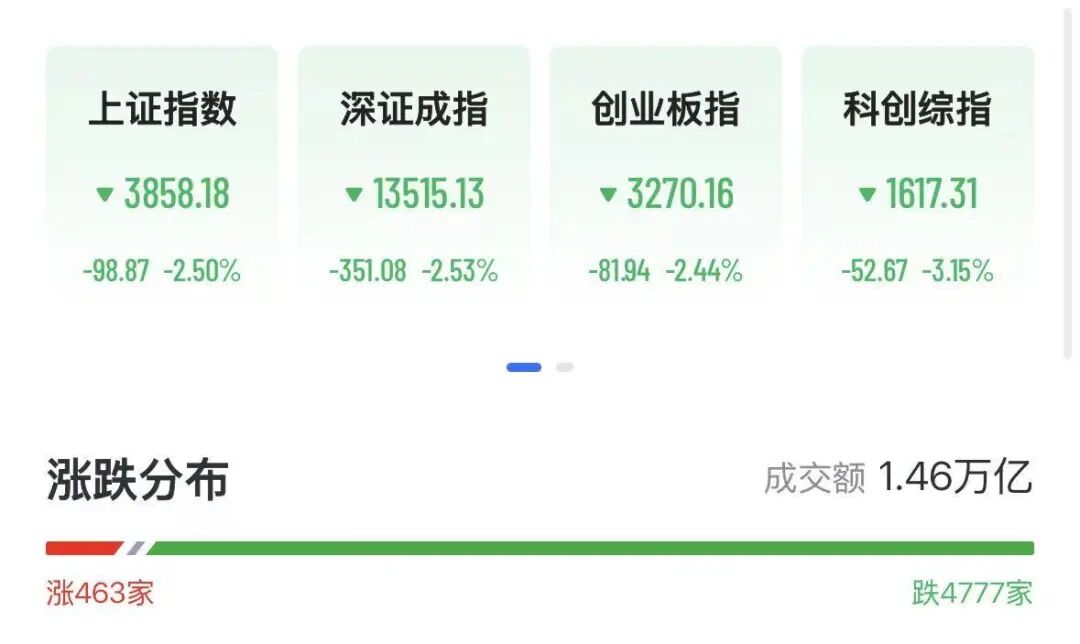
Market Overview - The A-share market opened lower on March 23, with all three major indices dropping over 2%, and the Shanghai Composite Index falling below the 3900-point mark [1] - By midday, the Shanghai Composite Index was down 2.5%, the Shenzhen Component Index down 2.53%, and the ChiNext Index down 2.44%, while the Sci-Tech Innovation Index fell over 3% [1][2] - The total trading volume in the Shanghai and Shenzhen markets reached 1.46 trillion yuan, an increase of 15.5 billion yuan compared to the previous trading day [1] Sector Performance - The green electricity concept showed resilience, with Huadian Liao Energy (600396) achieving six consecutive trading limits, and Dongfang New Energy (002310) hitting four trading limits in six days [5] - The robotics sector also performed well, with multiple stocks including Zhongdali De (002896) and Jinfatech (600143) reaching trading limits [5] - The coal sector saw significant gains, with Liaoning Energy (600758) hitting a trading limit and a buy order exceeding 1.24 million hands [5] Declining Sectors - Precious metals and pork sectors faced significant declines, with stocks like Muyuan Foods (002714) and Jinxinnong (002548) experiencing substantial drops [6] Individual Stock Movements - Domestic AI chip leader Cambricon Technologies saw its stock price drop over 3%, falling below the 1000 yuan mark, amid intensifying competition in the domestic AI chip market [7] - Chifeng Gold (600988) faced a trading halt, with its stock price hitting the limit down due to ongoing pressure in the international gold market, which saw prices drop below 4400 USD per ounce [7] - BYD (002594) experienced a counter-trend increase, with its stock price rising 5.69% to 108.89 yuan, bringing its market capitalization back to 1 trillion yuan [8] Industry Insights - The geopolitical situation in the Middle East is driving up refined oil prices, with predictions of a price increase in the domestic market [9] - The Chinese new energy vehicle market has surpassed a 50% penetration rate, shifting competition from price wars to core technology and supply chain resilience [9]



油价高波动下的周期策略
2026-03-20 02:27
Summary of Key Points from Conference Call Records Industry Overview - **Oil and Gas Industry**: High volatility in oil prices is suppressing downstream procurement, suggesting a wait-and-see approach until volatility decreases. Short-term focus on sectors with rigid demand such as chemical fibers (polyester filament, spandex) and refrigerants is recommended [1][2]. - **Chemical Industry**: The recent decline in the chemical sector is attributed to high oil price volatility rather than high prices themselves. This volatility has led to significant market uncertainty and reduced purchasing willingness in the downstream market [2]. - **New Energy Sector**: The strategic value of new energy is highlighted, with storage and lithium batteries expected to see the highest certainty in growth over the next three years. Companies like CATL are projected to increase their storage business share to 50% [1][4]. - **Real Estate Sector**: 2026 is anticipated to be a year of value reassessment for commercial real estate, driven by REITs policy and the need for asset management cycles [1][7]. - **Coal and Power Sectors**: The coal sector is expected to benefit from rising oil prices, while the power sector will gain from energy transition trends, with a focus on green electricity, nuclear power, and hydropower [1][9]. Core Insights and Arguments - **Chemical Sector Dynamics**: The high volatility in oil prices has led to a significant impact on market expectations and the real economy, causing a distortion in production and sales rates. The recommendation is to wait for stabilization in oil prices before making investment decisions [2][3]. - **Long-term Opportunities in Chemical Industry**: If geopolitical tensions ease, a strong replenishment demand is expected post-de-stocking, with a potential increase in China's market share in the global chemical supply chain as older facilities in other regions exit the market [3]. - **Investment Strategy in New Energy**: The focus should be on storage and lithium battery sectors, with companies like CATL and system integrators like Sungrow Power being highlighted for their competitive edge [4]. - **Valuation in Aluminum Sector**: The aluminum sector, particularly electrolytic aluminum, is viewed as undervalued with a current valuation of 7-8 times earnings, despite stable fundamentals and potential profit increases [5]. - **Copper and Precious Metals**: Despite recent adjustments in prices, the fundamental logic for copper and precious metals remains intact, with ongoing demand from new growth areas like AR technology [6]. Additional Important Insights - **Real Estate Market Outlook**: The real estate sector is under pressure from rising oil prices, which may lead to inflation concerns and cautious monetary policy. However, potential policy changes in mid-2026 could create opportunities [7]. - **Coal Sector Rotation**: The coal sector is expected to follow a rotation pattern, with coal chemical companies benefiting first, followed by leading thermal coal producers and then coking coal [11]. - **Power Sector Investment Opportunities**: The power sector is expected to benefit from the energy transition, with specific attention to companies in green electricity, nuclear, and hydropower [12]. This summary encapsulates the key points from the conference call records, providing a comprehensive overview of the current state and future outlook of various industries.
光大期货金融期货日报-20260317
Guang Da Qi Huo· 2026-03-17 06:18
1. Report Industry Investment Rating - No relevant content provided 2. Core Views of the Report - For stocks, in the short - term, if the current conflict ends quickly, its impact on the A - share market is limited; if it turns into a long - term war, it may shock global stock markets. In the medium - term, the A - share market is likely to fluctuate with increased volatility. Since December last year, A - share technology themes have outperformed US - listed Chinese concept stocks and the Hang Seng Technology Index, and the RMB has been appreciating rapidly, which may support the A - share market in the first half of 2026. However, the article "The 2028 Global Intelligence Crisis" may continue to ferment and increase market volatility [1]. - For bonds, the bond market is supported by reasonable and abundant liquidity and the weak economic recovery. But due to improved inflation data and cautious interest - rate cuts, it lacks upward momentum. It maintains a low - interest - rate environment and fluctuates within a certain range [2]. 3. Summary by Directory 3.1 Research Views - **Stock Index Futures**: The market recovered after hitting bottom, with the three major indexes showing mixed performance. Over 2,800 stocks in the Shanghai, Shenzhen, and Beijing stock markets rose, and the trading volume was 2.34 trillion yuan. The Shanghai Composite Index fell 0.26%, the Shenzhen Component Index rose 0.19%, and the ChiNext Index rose 1.41%. The short - and medium - term trends of the A - share market are as mentioned above [1]. - **Treasury Bond Futures**: The 30 - year, 10 - year, 5 - year, and 2 - year treasury bond futures contracts fell by 0.43%, 0.11%, 0.08%, and 0.04% respectively. The central bank carried out 137.3 billion yuan of 7 - day reverse repurchase on March 16 with a winning bid rate of 1.4%, and announced 50 billion yuan of outright reverse repurchase. After offsetting the maturing reverse repurchases, there was a net withdrawal of 1.12 billion yuan. DR001 rose 0.1BP to 1.32%, and DR007 fell to 1.45% [1][2]. 3.2 Price Changes in the Second Quarter - **Stock Index Futures**: IH decreased by 0.17% from 2,957.0 on March 13 to 2,952.0 on March 16; IF increased by 0.10% from 4,658.0 to 4,662.8; IC decreased by 0.43% from 8,213.8 to 8,178.4; IM remained unchanged at 8,187.0 [3]. - **Stock Indexes**: The Shanghai 50 Index decreased by 0.09% from 2,956.8 to 2,954.1; the CSI 300 Index increased by 0.05% from 4,669.1 to 4,671.6; the CSI 500 Index decreased by 0.66% from 8,239.8 to 8,185.2; the CSI 1000 Index decreased by 0.04% from 8,214.3 to 8,211.4 [3]. - **Treasury Bond Futures**: TS decreased by 0.03% from 102.47 to 102.43; TF decreased by 0.08% from 105.97 to 105.89; T decreased by 0.09% from 108.22 to 108.12; TL decreased by 0.39% from 111.06 to 110.63 [3]. 3.3 Market News - **Overall Market**: The market recovered after hitting bottom, with the three major indexes showing mixed performance. Over 2,800 stocks rose, and the trading volume was 2.34 trillion yuan. The Shanghai Composite Index fell 0.26%, the Shenzhen Component Index rose 0.19%, and the ChiNext Index rose 1.41% [5]. - **Industry Sectors**: Storage chips, PCB, agriculture, and liquor sectors led the gains, while precious metals, non - ferrous metals, rare earths, and power grid equipment sectors led the losses [5]. - **Hot Concepts**: The storage chip sector soared, with many stocks such as Langke Technology, Zhaoyi Innovation, and Taiji Industry hitting the daily limit. The shipping sector strengthened, with stocks like China Merchants Nanyou and HNA Technology hitting the daily limit. PCB concept stocks rose, with Chaoying Electronics and Jing An Guo Ji hitting the daily limit. The marine economy concept was active, with stocks like Dongfang Ocean and Youfu Co., Ltd. hitting the daily limit. On the downside, green power concept stocks adjusted, with PowerChina hitting the daily limit down; the precious metals sector declined, with Shanjin International falling more than 6% [5]. 3.4 Chart Analysis - **Stock Index Futures**: The report provides charts of the trends of IH, IF, IM, and IC main contracts, as well as the basis trends of these contracts [7][8][9][10][11]. - **Treasury Bond Futures**: The report includes charts of the trends of treasury bond futures main contracts, treasury bond spot yields, basis, inter - period spreads, cross - variety spreads, and capital interest rates [13][14][15][16][19]. - **Exchange Rates**: The report presents charts of the central parity rates of the US dollar, euro against the RMB, forward exchange rates, the US dollar index, and exchange rates between different currencies [21][22][23][25][26].
刚刚,直线猛拉!伊朗传来大消息!
天天基金网· 2026-03-16 08:21
Group 1 - The storage chip concept stocks in A-shares experienced a collective surge, with Baiwei Storage rising over 13% and reaching a historical high, while companies like Zhaoyi Innovation and Jintaiyang hit the daily limit [2] - The semiconductor industry chain remained active in the afternoon, with Huahong Company increasing by over 12% [2] - The PCB concept also showed strong performance, with stocks like Jin'an Guoji and Chaoying Electronics hitting the daily limit [2] Group 2 - The shipping sector saw a significant rise in the afternoon, with stocks such as China Merchants Energy and HNA Technology reaching the daily limit [2][6] - China Merchants Energy opened with a sharp increase, closing at 4.81 yuan per share, with a total market value of 22.512 billion yuan [2] Group 3 - The energy shipping industry is facing anxiety over supply chain disruptions due to overseas conflicts, which, combined with concentrated replenishment demand, is expected to drive freight rates upward [11][12] - The average number of ships passing through the Strait of Hormuz dropped to zero on the 14th, marking a significant disruption since military actions began, with a pre-conflict average of 77 ships daily [10] Group 4 - The Hang Seng Technology Index showed strong performance, rising nearly 3% during the day [14] - Multiple factors contributed to the rise of the Hang Seng Technology Index, including perceived undervaluation by notable investors and significant valuation advantages compared to other indices [15] - The Hong Kong stock market is seen as a key player in the AI ecosystem, encompassing major technology companies and benefiting from the current liquidity environment [15]