
中药

Search documents
云南白药数智平台交易额破20亿元,63岁董事长张文学曾获评劳动模范
Sou Hu Cai Jing· 2026-01-12 10:43
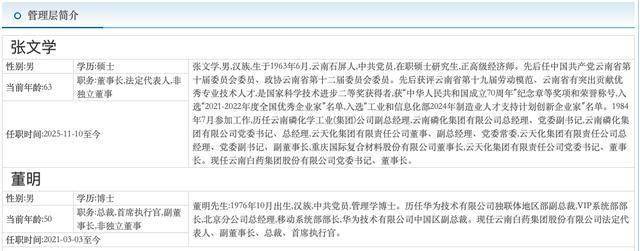
Core Insights - Yunnan Baiyao's "Digital Cloud Medicine" platform is projected to achieve a cumulative transaction volume exceeding 2 billion yuan by December 2025, indicating significant progress in the digital transformation of the traditional Chinese medicine industry [1] - Chairman Zhang Wenhua emphasized the platform's role in leading the construction of GAP bases across a wider range of varieties in Yunnan province, promoting standardized planting and sustainable development in the Chinese medicinal materials industry [1] Management Overview - Zhang Wenhua, born in June 1963, is the current Chairman of Yunnan Baiyao Group, with a background in various leadership roles within the chemical and pharmaceutical industries [2] - Dong Ming, born in October 1976, serves as the CEO and Vice Chairman of Yunnan Baiyao Group, previously holding significant positions at Huawei Technologies [2][3] Board Elections - On November 10, Yunnan Baiyao announced the election of Zhang Wenhua as Chairman and Dong Ming as Vice Chairman of the 11th Board of Directors, with a term of three years [3] - Prior to Zhang's official appointment, Dong Ming acted as the Chairman of the Board [3]


(2026.1.5—2026.1.9):长寿医学行业把握:老龄化进程与健康跨度需求共振,主动健康理念驱动医疗模式重构与产业加速演进
Huafu Securities· 2026-01-12 10:31
Core Insights - The report emphasizes the importance of longevity medicine, which focuses on proactive health and disease prevention, as a critical response to the aging population and the challenges of "pathological longevity" [2][9][14] - The aging population in China is rapidly increasing, with the number of individuals aged 65 and above reaching 203 million in 2023, accounting for 25% of the global elderly population [10] - The demand for longevity medicine is accelerating, driven by the need for aging management, early prevention, and comprehensive health optimization, transitioning the healthcare model from disease treatment to continuous management [2][11][14] Industry Overview - The longevity medicine industry in China is still in its early stages, characterized by a dual-track development model where public institutions focus on research foundations while private entities explore service and business models [11] - The industry is facing structural pressures due to the increasing burden of chronic diseases and the inefficiencies of the traditional disease-centered healthcare system [2][10] - The report highlights that the core competitive advantage in the industry will shift towards long-term health management capabilities, data integration, and value proposition [11] Market Performance - The pharmaceutical sector showed positive performance in the week of January 5-9, 2026, with all six sub-sectors recording gains, particularly in medical services (+12.34%) and medical devices (+9.42%) [15] - The report notes that the valuation levels for biopharmaceuticals and chemical pharmaceuticals are among the highest, at 89.93 times and 84.19 times respectively [15] Innovations and Developments - A significant breakthrough in cancer vaccine research was reported by a team from Peking University, utilizing protein-targeted degradation technology to enhance immune response against cancer cells [22][25] - The new basic medical insurance drug list was implemented on January 1, 2026, with over half of the newly added 114 drugs already available in medical institutions [26] - The National Medical Products Administration is enhancing support for innovative drugs, aiming for a significant increase in the approval of new drugs and medical devices in 2025 [27][30][31]
中药板块1月12日涨0.11%,万邦德领涨,主力资金净流出5.5亿元
Zheng Xing Xing Ye Ri Bao· 2026-01-12 09:04
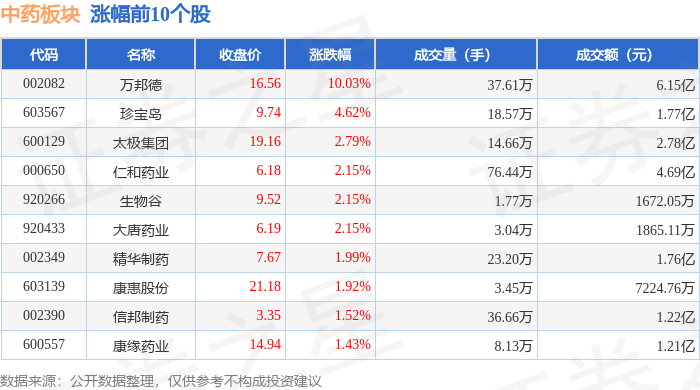
Market Overview - The Chinese traditional medicine sector saw a slight increase of 0.11% on January 12, with Wanbangde leading the gains [1] - The Shanghai Composite Index closed at 4165.29, up by 1.09%, while the Shenzhen Component Index closed at 14366.91, up by 1.75% [1] Stock Performance - Wanbangde (002082) closed at 16.56, with a significant increase of 10.03% and a trading volume of 376,100 shares, amounting to 615 million yuan [1] - Zhenbaodao (603567) rose by 4.62% to close at 9.74, with a trading volume of 185,700 shares [1] - Taiji Group (600129) increased by 2.79% to 19.16, despite a decrease in trading volume of 146,600 shares [1] - Renhe Pharmaceutical (000650) and other companies also showed positive growth, with Renhe closing at 6.18, up by 2.15% [1] Capital Flow - The traditional medicine sector experienced a net outflow of 550 million yuan from institutional investors, while retail investors contributed a net inflow of 460 million yuan [2] - The overall capital flow indicates a mixed sentiment, with institutional investors withdrawing funds while retail investors increased their positions [2] Individual Stock Capital Flow - Wanbangde saw a net inflow of 95.22 million yuan from institutional investors, but a net outflow from retail investors of 67.16 million yuan [3] - Other companies like Jianxin Pharmaceutical (002412) and Jilin Aodong (000623) also experienced varying degrees of net inflows and outflows from different investor categories [3]


收评:三大指数均涨超1% 两市成交额创新高
Zhong Guo Jing Ji Wang· 2026-01-12 07:28
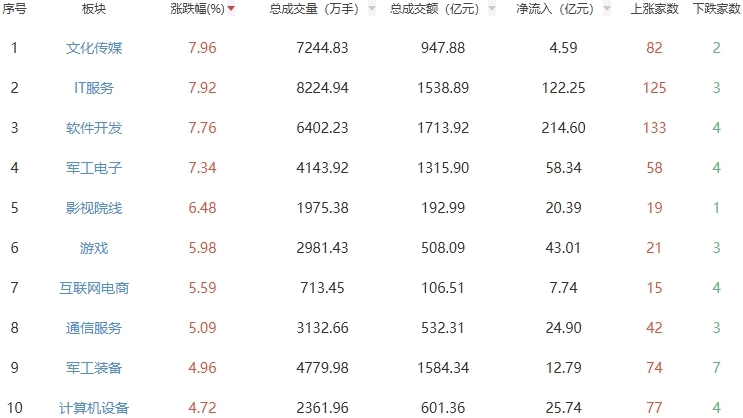
Market Overview - The A-share market indices collectively rose today, with total trading volume exceeding 3.6 trillion yuan, marking the second consecutive trading day above 3 trillion yuan, an increase of 478.7 billion yuan compared to the previous trading day, setting a new historical record for trading volume in 2024 [1] Index Performance - The Shanghai Composite Index closed at 4165.29 points, up 1.09%, with a trading volume of 1.446 trillion yuan - The Shenzhen Component Index closed at 14366.91 points, up 1.75%, with a trading volume of 2.155 trillion yuan - The ChiNext Index closed at 3388.34 points, up 1.82%, with a trading volume of 1.086 trillion yuan [1] Sector Performance - The leading sectors in terms of growth included: - Cultural Media: up 7.96%, with a trading volume of 724.48 billion yuan and a net inflow of 94.79 billion yuan - IT Services: up 7.92%, with a trading volume of 822.49 billion yuan and a net inflow of 122.25 billion yuan - Software Development: up 7.76%, with a trading volume of 640.22 billion yuan and a net inflow of 214.60 billion yuan [2] Declining Sectors - The sectors with the largest declines included: - Insurance: down 0.81%, with a trading volume of 18.93 billion yuan and a net outflow of 10.62 billion yuan - Oil and Gas Extraction and Services: down 0.34%, with a trading volume of 164.48 billion yuan and a net outflow of 8.16 billion yuan - Agricultural Chemicals: down 0.22%, with a trading volume of 182.31 billion yuan and a net outflow of 22.81 billion yuan [2]
中药饮片有了新“医保身份证”
Ren Min Ri Bao· 2026-01-12 02:12
Core Viewpoint - The National Healthcare Security Administration has revised the coding rules for traditional Chinese medicine (TCM) decoction pieces to adapt to new requirements in the healthcare sector, enhancing the quality development of the TCM industry [1] Group 1: Impact on TCM Industry - The new coding system provides each TCM decoction piece with a "medical insurance ID," which plays a crucial role in billing, reimbursement, and fund supervision [1] - The updated database now includes over ten thousand TCM decoction piece codes, covering more than 3,000 types of medicinal materials and 22 categories of different effects, achieving a "national unified code" [1] - This initiative improves the efficiency of medical insurance services and lays a solid data foundation for the standardization and normalization of TCM development [1] Group 2: Key Features of the Revision - The revision retains four key elements: identification code, standard classification code, efficacy classification code, and name code, while adding two new critical codes: the "authentic medicinal material identification code" and the "decoction piece enterprise code" [1] - The new authentic medicinal material identification code provides geographical certification labels for decoction pieces, making it easier to identify local varieties such as Yunnan Sanqi and Sichuan Chuanbei [1] - The enterprise code allows for precise accountability of production responsibilities, ensuring clear traceability of manufacturer information, which compels companies to take responsibility and strengthens the foundation for centralized procurement of TCM decoction pieces [1]
全国卫生健康工作会议定调,中医药服务渗透率有望持续提升
Xiangcai Securities· 2026-01-11 12:17
Investment Rating - The industry investment rating is maintained at "Overweight" [2] Core Views - The market performance of the traditional Chinese medicine (TCM) sector has shown a modest increase of 2.89%, which is the smallest among the pharmaceutical sub-sectors due to a lack of short-term catalysts and market style shifts [4][5] - The TCM sector's price-to-earnings (PE) ratio (ttm) is 27.39X, reflecting a 0.76X increase from the previous week, while the price-to-book (PB) ratio (lf) stands at 2.3X, up 0.06X [6] - The national health conference held in January 2026 indicates a positive outlook for the penetration rate of TCM services, suggesting a comprehensive development approach for TCM in various healthcare aspects [8] Summary by Sections Market Performance - The TCM sector's performance is lagging behind other pharmaceutical sub-sectors, with a 12-month relative return of -24% compared to the CSI 300 index [4] - The TCM sector's index closed at 6414.65 points, with a weekly increase of 2.89% [21] Valuation - The TCM sector's PE ratio (ttm) is at 27.39X, with a maximum of 30.26X and a minimum of 24.72X over the past year [6] - The PB ratio (lf) is 2.3X, with a maximum of 2.52X and a minimum of 2.17X in the same period [6] Industry Trends - The TCM material market has seen a slight decline in price index due to reduced market traffic, with a total index of 227.06 points, down 0.6% week-on-week [7] - The national health conference emphasizes the ongoing development of TCM services, which is expected to enhance its integration into the healthcare system [8] Investment Recommendations - The report suggests focusing on three main investment themes: price governance, consumption recovery, and state-owned enterprise reform [9] - Specific investment targets include companies with strong R&D capabilities and unique products, as well as those less affected by centralized procurement [11]


中药饮片实现追溯“一码通”
Xin Lang Cai Jing· 2026-01-10 21:36
Core Viewpoint - The National Healthcare Security Administration has revised the coding rules for traditional Chinese medicine (TCM) decoction pieces, introducing new identifiers to enhance traceability and transparency in the industry [1]. Group 1: Coding Revisions - The revision does not significantly alter the existing coding structure but adds two key segments: the "Authentic Medicinal Material Identifier" and the "Decoction Piece Enterprise Code" [1]. - The "Authentic Medicinal Material Identifier" serves as a geographical certification label for decoction pieces, making information about authentic varieties like Yunnan Sanqi and Sichuan Chuanbei clear [1]. - The "Decoction Piece Enterprise Code" accurately links to the producing enterprises, ensuring traceability and accountability [1]. Group 2: Industry Impact - The new coding segments fill a long-standing information gap regarding the authenticity and production of decoction pieces, thereby enhancing product transparency [1]. - The coding provides each decoction piece with a unique healthcare "identity," applicable in billing, reimbursement audits, and fund supervision, which helps enforce corporate responsibility [1]. - The current database includes over ten thousand decoction piece codes, covering more than 3,000 types of medicinal materials and 22 categories of efficacy, achieving a "national unified code" [1].
中国中药(00570.HK):国药集团入主加强产业和科技赋能 积极布局中药产业链
Ge Long Hui· 2026-01-10 12:52
Investment Highlights - The company, China Traditional Chinese Medicine (00570), is given a neutral rating with a target price of HKD 2.40, corresponding to P/E ratios of 34.5 and 16.3 for 2026 and 2027 respectively [1] - There is increasing policy support for the development of the traditional Chinese medicine industry, with the State Council issuing measures to accelerate its growth, which is expected to enhance the traditional Chinese medicine service system [1] - The company has a solid layout in the traditional Chinese medicine industry chain, currently undergoing a restructuring phase, focusing on core products like traditional Chinese medicine formula granules and expanding into various segments [1] Business Strategy - The company is actively engaged in marketing reforms and business restructuring to adapt to policy impacts such as centralized procurement, aiming for collaborative development across different segments [1][2] - The company is enhancing its technological innovation system to address industry challenges, focusing on the development of innovative traditional Chinese medicines and secondary development of existing products [1] Market Outlook - The market is concerned about potential profit declines due to centralized procurement; however, the company is optimistic about controlling expense ratios through marketing reforms and evidence-based medical research [2] - The company forecasts EPS of -0.11, 0.06, and 0.13 for 2025 to 2027, with current stock price corresponding to P/E ratios of 31.0 and 14.7 for 2026 and 2027, indicating an 11.1% upside potential [2]
华创医药投资观点&研究专题周周谈 · 第158期:海外脑机接口代表企业布局情况-20260110
Huachuang Securities· 2026-01-10 11:12
Investment Rating - The report maintains a "Recommended" rating for the medical device sector, particularly highlighting opportunities in innovative drugs and medical devices [49]. Core Insights - The report emphasizes a transition in the innovative drug sector from quantity to quality, suggesting a focus on differentiated products and internationalization by 2025 [11]. - In the medical device sector, there is a notable recovery in bidding volumes for imaging equipment, with a focus on companies like Mindray and United Imaging [11]. - The report identifies a significant growth potential in the orthopedic market due to aging demographics and increasing surgical penetration rates in China [43]. - The life sciences service sector is experiencing a demand recovery, driven by both domestic and international market needs, with a focus on the importance of mergers and acquisitions for growth [50]. Summary by Sections Market Review - The medical index rose by 7.70%, outperforming the CSI 300 index by 4.91 percentage points, ranking 5th among 30 sectors [7]. - The top-performing stocks included Baitai, Innovation Medical, and Sanbo Neuroscience, while the worst performers were Baihua Pharmaceutical and Jinhao Medical [7]. Overall Views and Investment Themes - Innovative drugs are expected to see a shift towards quality, with a focus on companies like BeiGene and Innovent [11]. - Medical devices are benefiting from a recovery in bidding for imaging equipment and a push for domestic substitutes in the market [11]. - The innovative chain (CXO + life sciences services) is anticipated to see a rebound in investment, with a focus on high-growth potential companies [11]. - The report highlights the potential for growth in the blood products sector, with an emphasis on companies like TianTan Biological and Boya Biological [11]. Specific Company Insights - Neuralink is positioned as a leader in the invasive brain-computer interface sector, with significant advancements in its technology and clinical trials [21]. - Synchron is noted for its endovascular brain-computer interface, which offers a safer solution for severely paralyzed patients [25]. - Paradromics focuses on high-bandwidth brain-computer interfaces, aiming to decode complex human intentions [32]. - CorTec is pioneering closed-loop brain-computer interfaces, providing real-time interaction between the brain and external devices [36]. - Precision Neuroscience is innovating minimally invasive implantation techniques for brain-computer interfaces [39]. - Blackrock Neurotech is recognized for its comprehensive solutions in the brain-computer interface field, aiding patients with sensory restoration and control [42].
中药饮片医保编码身份升级,道地药材、生产厂家一码掌握
Xin Jing Bao· 2026-01-10 04:35
Core Viewpoint - The National Healthcare Security Administration has revised the coding rules for traditional Chinese medicine (TCM) decoction pieces to enhance the quality development of the TCM industry and adapt to new healthcare business requirements [1][2] Group 1: New Coding System - A new "medical insurance ID" has been assigned to each TCM decoction piece, which serves as a universal key in various aspects such as billing, reimbursement, and fund supervision [1] - The updated coding system includes over 10,000 entries covering more than 3,000 types of TCM materials and 22 categories of different effects, achieving a "national unified code" [1] Group 2: Key Features of the Revision - The revision retains four core elements: identification code, standard classification code, efficacy classification code, and name code, while adding two new key segments: the "authentic medicinal material identification code" and the "decoction piece enterprise code" [1] - The authentic medicinal material identification code acts like a geographical certification label, allowing easy identification of local varieties such as Yunnan Sanqi and Sichuan Chuanbei [1] - The enterprise code ensures precise accountability for production, making manufacturer information clear and traceable, which encourages companies to take responsibility and supports the implementation of centralized procurement for decoction pieces [1] Group 3: Future Developments - The National Healthcare Security Administration plans to continuously improve the TCM decoction piece information database and organize relevant enterprises to update and maintain coding information [2] - A coding scheme for the traceability code of decoction pieces is under broad consultation, aiming to promote more standardized and refined management of decoction pieces in the future [2]