智能穿戴设备

Search documents
儿童手表“已读乱回”、诱导孩子付费怎么办?新国标拟出台
Nan Fang Du Shi Bao· 2025-05-15 14:59
Core Viewpoint - The Ministry of Industry and Information Technology of China has released a draft for a mandatory national standard titled "Safety Technical Requirements for Children's Watches," which is open for public consultation until June 12, 2025 [1][3]. Group 1: Safety and Security Requirements - The new standard aims to address content safety issues in children's smartwatches, prohibiting the pre-installation of generative voice Q&A applications and requiring that any voice Q&A information comes from a fixed knowledge base [3][7]. - Specific requirements include that the operating system of children's smartwatches must support security upgrades during maintenance periods, and that any permissions for microphone, camera, and location must be explicitly granted by guardians [6][10]. - The standard also mandates that children's smartwatches must have features to prevent the installation of malicious programs and must include password protection for startup and lock screen [6] Group 2: Content and Usage Restrictions - The standard restricts the types of applications that can be pre-installed on children's smartwatches, disallowing those that promote gaming or entertainment, and requires controls on usage time and payment functionalities [10]. - It emphasizes the need for a dedicated content pool for children, ensuring that all information provided is safe and appropriate, with daily safety checks and records maintained [9][10]. - Advertising content on the watches is also regulated, prohibiting splash screen ads and requiring clear options to close any in-app advertisements [10]. Group 3: Market Context - As of now, approximately 170 million children aged 5 to 12 in China own smartwatches, with a penetration rate exceeding 50% in urban areas [8][9]. - The increasing functionality of children's smartwatches, resembling mini smartphones, has raised concerns about safety and content accuracy, particularly following controversies involving major brands [9].


2024年消费级AR眼镜市场动态与行业趋势洞察
艾瑞咨询· 2025-05-14 12:41
Core Insights - The report highlights the rapid evolution of consumer-grade AR glasses, driven by advancements in optical display and AI integration, leading to a competitive landscape among various manufacturers [1][2][4]. Industry Status - Continuous R&D investment in the AR sector by domestic and international companies is fostering technological innovation and product development. Major players include internet giants, smartphone manufacturers, and AR startups, with a significant shift towards AI integration in AR glasses [2][19]. - The domestic AR glasses market is characterized by a strong presence of local brands such as Starry Sky Meizu, Thunderbird Innovation, XREAL, Rokid, and INMO, collectively referred to as the "Five Little Dragons" of AR glasses, which are rapidly gaining market share against foreign competitors [2][19][21]. Market Overview - In 2024, AR glasses sales reached 286,000 units, with Q4 witnessing record-high sales due to new product launches. Leading brands dominate the market, each carving out niches based on specific advantages [2][23][26]. - The market is expected to maintain momentum into 2025, with ongoing product innovations enhancing portability, functionality, and technology [23][29]. Company Analysis - The report provides an in-depth analysis of leading brands such as Starry Sky Meizu, Thunderbird Innovation, and XREAL, focusing on their product launches, technological advancements, and ecosystem collaborations [3][34][46]. - Starry Sky Meizu is noted for its significant investment in optical waveguide technology and AI integration, positioning itself as a leader in the AR glasses market [42][44]. Technological Trends - Optical waveguide technology is identified as a key driver for the future of consumer-grade AR glasses, offering advantages in lightweight design, high transparency, and display quality [8][50]. - The integration of AI into AR glasses is enhancing user experience and expanding application scenarios, making these devices more appealing to consumers [51][52]. Competitive Landscape - The competitive dynamics of the AR glasses market are influenced by short-term hardware specifications and popular products, while long-term success will depend on cross-device collaboration, developer ecosystems, and data asset depth [55].

2025 年全球 AR 眼镜市场情况分析 2030 年预计达到 800 万台
Sou Hu Cai Jing· 2025-05-12 13:14
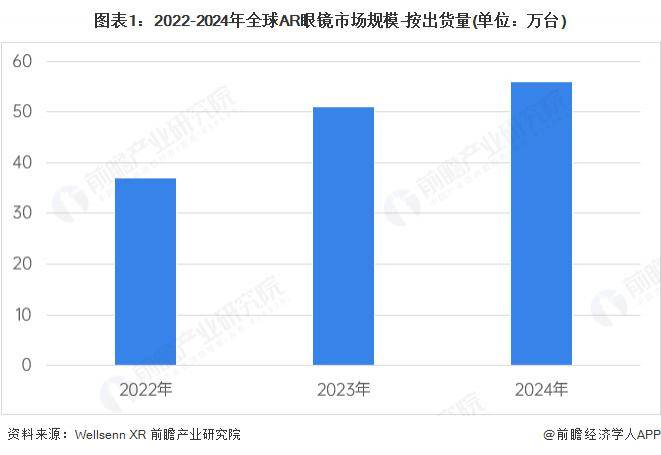
Core Insights - The global augmented reality (AR) glasses market is expected to grow significantly by 2025, driven by the entry of various tech giants and startups [1] - In 2023, global AR shipments reached approximately 510,000 units, marking a year-on-year increase of 35.1% [1] - The market is experiencing a shift with the rise of non-display AI smart glasses in 2024, leading to a decline in traditional B-end AR glasses demand [1] Global Market Size - The global AR glasses market is projected to see a shipment of over 560,000 units in 2024, despite a relatively subdued demand [1] - The market is characterized by a significant contribution from the B-end market, which has maintained steady growth [1] Regional Market Share - In 2023, Asia and North America led the global AR glasses market, with Asia's share increasing due to explosive growth in consumer AR products in China [2] - China alone accounted for 240,000 units shipped in 2023, reflecting a year-on-year growth of 133.9% [2] Brand Market Share - The AR market is dominated by three main groups: international tech giants (e.g., Microsoft, Meta, Apple), domestic smartphone manufacturers (e.g., Huawei, OPPO, Xiaomi), and emerging AR companies (e.g., Xreal, Rokid) [6] - In 2023, Xreal held a 45% market share in global AR glasses, followed by Rokid at 14% and 雷鸟创新 at 13% [6] Pricing Trends - From 2021 to 2024, AR glasses transitioned from "technology novelty" to "mass consumer products," with consumer acceptance highest for products priced between $300 and $500 [9] - The average price of consumer-grade AR glasses is expected to drop from $2,000 in 2021 to around $400 by 2025 [9] Market Forecast - The penetration rate of waveguide technology is projected to reach 95% by 2024, with costs decreasing by 70% since 2021, facilitating the development of lightweight consumer products [10] - Despite short-term market slowdowns, long-term technological advancements and price reductions are anticipated to drive the AR glasses market into a growth phase, with shipments expected to reach 1.8 million units by 2027, reflecting a compound annual growth rate (CAGR) of 37.7% [11]



AI眼镜专家:产业链一线动态更新及趋势展望
2025-05-06 02:28
Summary of Key Points from the Conference Call Industry Overview - The conference call focuses on the AR and AI glasses industry, highlighting key players such as Meta, Ray-Ban, Xiaomi, and RocketDNA, along with their product developments and market performance [1][3][7]. Core Insights and Arguments - **Meta's Performance**: Meta's AR glasses sales surged, with Q1 2025 sales tripling year-over-year to 600,000 units. The company anticipates total sales for the year to reach between 4.5 million and 5 million units, despite skepticism about achieving a target of 10 million units [1][3][4]. - **Product Launches**: Meta plans to release three new products by the end of 2025, including the third-generation Ray-Ban AI glasses and a sports version in collaboration with Oakley, which has an annual shipment volume of approximately 10 to 12 million units [1][6]. - **Xiaomi's Entry**: Xiaomi is set to launch AI glasses without display functionality, weighing around 40-50 grams, priced between 1,799 and 1,899 yuan [1][9]. - **RocketDNA's Growth**: RocketDNA's smart glasses, featuring dual green waveguide displays, are expected to launch before the 618 shopping festival, with pre-orders exceeding 200,000 units. The company’s valuation is nearing 10 billion yuan [2][11][12]. - **Market Dynamics**: The domestic AR and AI glasses market is projected to sell around 1 million units in 2025, with Xiaomi expected to sell 300,000 to 500,000 units, and Rokid around 120,000 units [2][15]. Additional Important Insights - **Technological Innovations**: The focus on waveguide technology is significant, with diffraction waveguides seen as the future direction despite current low optical efficiency. The combination of diffraction waveguides and Micro LED technology is anticipated to dominate the market in the coming years [34][36]. - **User Experience Enhancements**: Improvements in AI applications for message display and voice recognition are critical for enhancing the practicality of waveguide glasses. Companies like Tencent are researching better voice understanding to improve user interaction [19][20]. - **Impact of Government Promotion**: The endorsement of AR technology by high-profile figures, such as Premier Li Qiang, has significantly raised public awareness and interest in the sector, positively affecting market performance and expectations for companies like RocketDNA [10][12]. - **Competitive Landscape**: Domestic brands are actively competing with international leaders, leveraging technological innovations and market strategies to enhance their competitiveness. The market is expected to see more domestic brands emerging in the coming years [7][11]. Conclusion The AR and AI glasses industry is experiencing rapid growth, driven by significant advancements in technology and strategic product launches from key players. The market dynamics are shifting, with both international and domestic brands vying for a share, influenced by government endorsements and evolving consumer preferences.

【大涨解读】智能眼镜/MR头显:Meta、小米、谷歌都有新动作,AI眼镜行业即将迎来密集催化,垂直场景或率先落地
Xuan Gu Bao· 2025-04-30 06:17
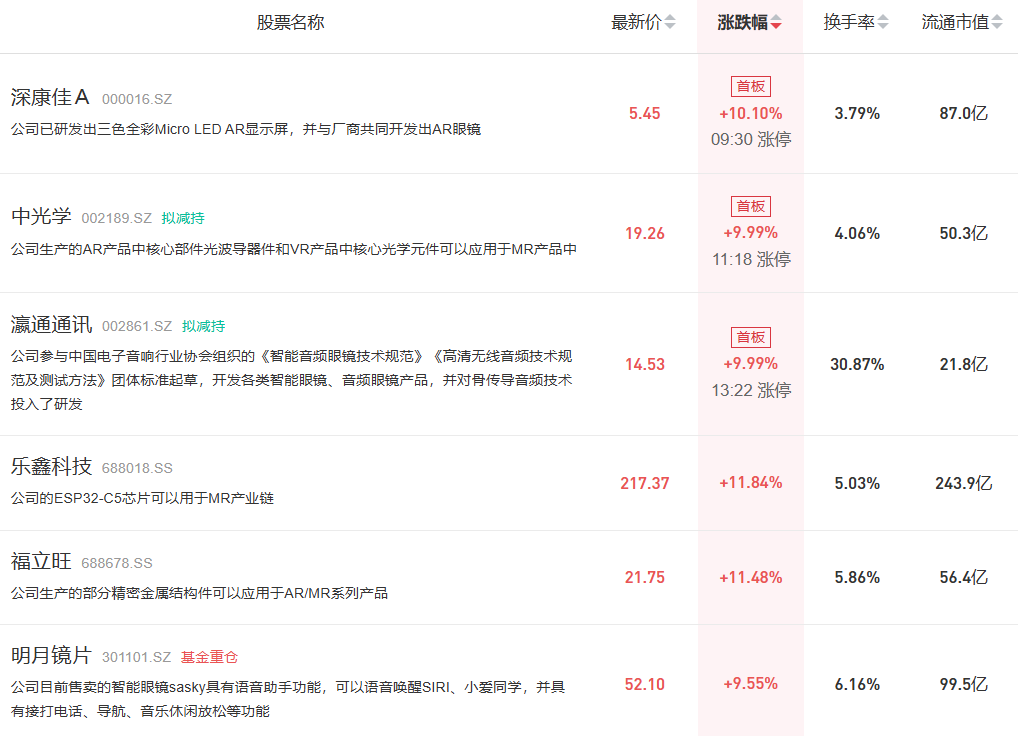
一、行情 4月30日,AI眼镜板块大幅走强。深康佳A、中光学、瀛通通讯等涨停,博士眼镜、明月镜片一度涨逾10%。 | 股票名称 | 最新价 = | 涨跌幅 ◆ | 换手率 = | 流通市值令 | | --- | --- | --- | --- | --- | | 深康佳A 000016.SZ | 5.45 | 首板 +10.10% | 3.79% | 87.0亿 | | 公司已研发出三色全彩Micro LED AR显示屏,并与厂商共同开发出AR眼镜 | | 09:30 涨停 | | | | 中光学 002189.SZ 拟减持 | | 首板 | | | | | 19.26 | +9.99% | 4.06% | 50.3亿 | | 公司生产的AR产品中核心部件光波导器件和VR产品中核心光学元件可以应用于MR产品中 | | 11:18 涨停 | | | | 瀛通通讯, 002861.SZ 拟减持 | | 首板 | | | | 公司参与中国电子音响行业协会组织的《智能音频眼镜技术规范》《高清无线音频技术规 | 14.53 | +9.99% | 30.87% | 21.8亿 | | 范及测试方法》团体标准起草,开发各类 ...





智能眼镜或将重塑人机交互方式
Ke Ji Ri Bao· 2025-04-29 23:55
Core Viewpoint - Smart glasses are evolving from futuristic concepts to real products, driven by advancements in AI, display technology, and miniaturization, potentially revolutionizing human-computer interaction and personal computing [1][2]. Group 1: Technological Advancements - Major breakthroughs in augmented reality (AR) display technology have significantly enhanced the clarity, color accuracy, and field of view, creating an unprecedented immersive experience [2]. - The introduction of AI has transformed smart glasses from mere tech gadgets into intelligent assistants that improve daily life quality through features like instant translation and object recognition [2]. - Improvements in battery life and interaction methods, such as gesture control and voice commands, are essential for the development of smart glasses [2]. Group 2: Applications in Various Fields - In the medical field, smart glasses can provide real-time access to patient data, enhancing surgical precision and efficiency [3]. - In education, they create immersive learning environments that make abstract concepts more tangible [3]. - In navigation and tourism, smart glasses offer real-time route guidance and information about attractions, enriching the travel experience [3]. - In daily life and entertainment, they seamlessly integrate social information and digital content into the user's view, redefining human-computer interaction [3]. Group 3: Industry Players and Market Dynamics - Meta leads the consumer smart glasses market, having sold over 1 million Ray-Ban Meta smart glasses by 2024, and has introduced real-time translation features [4]. - Google has entered the smart glasses space with its Android XR smart glasses, which include voice interaction, real-time translation, and environmental awareness capabilities [4]. - Other companies like Seiko Epson, Snap, Amazon, Huawei, and Lenovo are also actively developing smart glasses, while Apple is laying the groundwork for future entry with its AR Kit and XR technology [5]. Group 4: Standardization and Future Outlook - As smart glasses gain popularity, data security and privacy concerns are prompting regulatory bodies to establish guidelines to balance functionality and privacy [6]. - Industry organizations are collaborating to create unified production standards focusing on interoperability, data security, and comfort, which are crucial for a sustainable smart glasses ecosystem [7]. - The future of smart glasses may extend beyond being mere electronic devices, potentially evolving into the next generation of personal computing platforms that integrate digital information into the physical world [7].
星纪魅族发布智能眼镜线下支付功能
news flash· 2025-04-29 01:10
Core Insights - Starry Meizu launched the world's first smart glasses with offline payment functionality on April 29 in Hong Kong [1] - This feature is a result of deep collaboration with Ant International's Alipay+ cross-border payment technology team [1] - The payment function will be first available on the StarV Air2 product and is expected to be rolled out across new products in Q3 of this year [1] - The payment can be completed through voice recognition without the need for a mobile phone, filling a gap in the smart glasses industry regarding payment capabilities [1]
领益智造连续5个季度双位数增长,AI眼镜业务“百镜大战镜镜有我”
Xin Lang Cai Jing· 2025-04-28 12:21
Core Insights - The company reported a revenue of 11.494 billion yuan for Q1 2025, marking a year-on-year growth of 17.11% [1] - Net profit attributable to shareholders reached 565 million yuan, up 23.52% year-on-year, while the net profit excluding stock incentive expenses was 641 million yuan, reflecting a 37.59% increase [1] - The company has achieved over 100 billion yuan in quarterly revenue for three consecutive quarters and has maintained double-digit year-on-year growth for five consecutive quarters [1] Group 1: Company Performance - The company has made significant progress in various innovative fields, including robotics, AI glasses, foldable screens, and servers, contributing to its revenue and profit growth [1] - The AI glasses market is expected to experience explosive growth in 2025, with the company positioned to leverage its manufacturing capabilities and strategic foresight [1] Group 2: Industry Trends - In 2024, the company generated 4.041 billion yuan in revenue from AI glasses and XR wearable devices, focusing on core components and technology development for AR, VR, MR, and AI glasses [2] - The company is a long-term strategic partner of XREAL, contributing to the production of AR glasses and providing essential components and assembly services [2] - Global AI glasses shipments are projected to reach 6.86 million units in 2025, a 265% increase from 2024, indicating a rapidly growing market [3] - The AI glasses industry is expected to evolve into the next major computing platform, with significant sales growth anticipated through 2035 [3][4]

46页详解AR眼镜技术方向:碳化硅SiC+SRG光波导+刻蚀工艺+大尺寸衬底
材料汇· 2025-04-26 15:17
点击 最 下方 "在看"和" "并分享,"关注"材料汇 添加 小编微信 ,遇见 志同道合 的你 投资建议 7 东吴证券 2 公众号·材料汇 ● AR服镜是AI应用的完美载体,可以结合虚拟和现实。AR眼镜(增强现实限镜)是一种将虚拟信息叠加到现实 世界中的智能穿戴设备,核心在于虚拟信息与现实世界的完美融合。2024年全球AR眼镜出货量达到55.3万副, 同比+7.8%,其中中国2024年出货28.6万副。光学显示系统为AR眼镜的核心。光学显示系统由尤学组合器和微 显示屏组成。光学显示系统是整个AR眼镜的核心部件,也是价值量最大的部件,约占整个AR眼镜成本的40%t。 ● 表面浮雕光栅波导方案是AR眼镜光学显示系统的未来主流趋势。表面浮雕光栅波导相对制造成本可控、工艺 成熟,光学性能优秀。尽管存在色散和彩虹纹问题,但可以将衬底更换为SiC采解决。结合技术水平和量产难 度,表面浮雕光栅波导是最现实也最有前景的量产方案。目前即将推出的主流AR眼镜均采用该方案。 ● 碳化硅材料具备高折射率、高热导性,成为AR眼镜镜片的理想来底材料。米底材料的折射率越高,AR镜片的 FOV就更大,单层SiC镜片即可实现80度以上FOV, ...


小米AI眼镜突传消息!多股涨停
21世纪经济报道· 2025-03-24 04:51
3月2 4日早上,据小米智能生态微博, MI J IA智能音频眼镜2发布,其配备" 5mm纤细镜腿"、拥有约1 2小时续航。新 品将于3月2 6日1 0 : 0 0开启众筹,建议零售价11 9 9元、众筹价9 9 9元。 值得注意的是,此前多次有爆料称小米将打造AI眼镜,预计在3月至4月发布。 3月2 4日,AI眼镜板块领涨,多股涨停!2 0 2 5年被业内视为AI眼镜爆发"元年",许多企业接连发布各自的AI眼镜新 品,"百镜大战"打响。 小米A I眼镜上线?求证:" 系音频眼镜二代 " 实际上,早在去年11月,已有小米进军AI眼镜行业、入局"百镜大战"的市场传闻。 3月2 3日, 小米智能生态官方微博发布消息称:米家上新,焕然一新,"镜"请期待。并配有一款眼镜的图片,被不少 人认为是小米即将上线AI眼镜。 据 财 联 社,记 者 就 小 米 是 否 将 上 线 A I 眼 镜 向 小 米 求 证, 内 部 人 士 否 认 称:系 音 频 眼 镜 二 代 。 截 至 目 前,该 产 品 在 小 米 商 城 以 及 米 家 均 尚 未 上 线 。 据南财快讯此前2月份报道,小米集团公关部总经理王化曾在微博发文表 ...