高端装备制造

Search documents
全球硕博天团对决创新创业大赛,89个项目签订意向落地协议
Nan Fang Du Shi Bao· 2025-12-03 15:42
Group 1 - The Shenzhen Innovation and Entrepreneurship Competition concluded its ninth international finals, showcasing 21 top innovative projects from seven major industries, with "Sifai Photon: Silicon Photonics Innovation for Artificial Intelligence" winning the championship due to its disruptive technology and mature business model [2] - The competition aimed to align with Shenzhen's "20+8" industrial cluster layout, focusing on new-generation electronic information, digital and fashion, high-end equipment manufacturing, green and low-carbon, new materials, biomedicine and health, and marine economy [2][6] - A total of 89 projects have signed intention agreements with various districts in Shenzhen, indicating early success in connecting innovative projects with local industrial needs [2][7] Group 2 - The competition is organized by the Shenzhen Municipal Government and aims to attract global innovative talents, with a significant presence of international participants, including over 60% foreign competitors [6] - The event featured a high-caliber judging panel, including experts from top universities and investment institutions, ensuring the authority and fairness of the evaluation process [4][5] - The competition attracted nearly 3,000 projects and over 3,000 overseas talents, with 49% holding doctoral degrees, showcasing the high quality of participants [6] Group 3 - The final competition adopted an "8+7" format, allowing 8 minutes for project presentations followed by 7 minutes of Q&A, rigorously assessing technical innovation, business models, and team capabilities [5] - An "interactive invitation segment" was introduced to facilitate direct connections between investors and promising projects, enhancing the efficiency of industry coupling [5] - The competition has a prize pool exceeding 8 million yuan, attracting over 50 well-known venture capital institutions to support participating projects [6] Group 4 - The competition serves as a platform for projects to connect with the Chinese market, with several projects already establishing partnerships in Shenzhen, such as the "KenBridge AI" project and the "New Generation Smart Electric Surfboard" project [8] - Since its inception in 2016, the competition has attracted 23,000 global innovators, becoming a significant brand for gathering international innovation resources and serving Shenzhen's development [9] - Many projects from the competition have evolved into "National High-tech Enterprises" and "Specialized and New Enterprises," illustrating the deep integration of innovation and global wisdom in Shenzhen [9]


大型高端装备专用部件制造商 锡华科技(603248.SH)拟公开发行1亿股
智通财经网· 2025-12-03 12:46
Group 1 - The company, Xihua Technology (603248.SH), plans to publicly issue 100 million shares, accounting for 21.74% of the total share capital after the issuance [1] - Senior management and core employees will participate in a strategic placement, with a maximum of 10% of the public offering shares, equating to 10 million shares, and a subscription amount not exceeding 97.8 million yuan [1] - The company specializes in the R&D, manufacturing, and sales of high-end equipment components, primarily focusing on wind power gearbox components and injection molding machine components [1] Group 2 - The company's annual operating revenue has remained stable at over 900 million yuan from 2022 to 2024, with a slight fluctuation in 2023, but an overall upward trend expected in 2024 [2] - The net profit has experienced some fluctuations, but the overall profitability remains at a high level [2] - For the first half of 2025, the company's operating revenue and net profit are expected to show significant year-on-year growth [2] Group 3 - The funds raised from the public offering will primarily be invested in the industrialization project of core wind power equipment (Phase I) and the construction of a research and development center, with an intended investment of approximately 1.498 billion yuan [2]
大型高端装备专用部件制造商 锡华科技拟公开发行1亿股
Zhi Tong Cai Jing· 2025-12-03 12:45
公司本次公开发行所募集的资金主要投资于:风电核心装备产业化项目(一期)、研发中心建设项目,拟 投入募集资金约14.98亿元。 2022年至2024年,公司整体年营业收入均稳定在9亿元以上,在经历了2023年的小幅波动后,2024年整 体稳中有升;公司净利润有所波动,但盈利能力整体保持在较高水平。2025年1-6月,公司的营业收入和 净利润同比均实现较大幅度增长。 锡华科技(603248.SH)披露招股意向书,公司拟公开发行股份数量为1亿股,占本次发行后公司总股本的 比例为21.74%。公司高级管理人员与核心员工参与本次战略配售设立专项资产管理计划国泰海通君享 锡华科技1号战略配售集合资产管理计划,参与战略配售数量不超过本次公开发行股份数量的10%,即 1000万股,同时参与认购金额不超过9780万元。本次发行初步询价日期为2025年12月9日,申购日期为 2025年12月12日,发行结束后,将尽快申请在上交所主板上市。 公司主要从事大型高端装备专用部件的研发、制造与销售,产品结构以风电齿轮箱专用部件为主、注塑 机厚大专用部件为辅,是全球行业领先、质量可靠、技术卓越的大型高端装备专用部件制造商。公司产 品主要应 ...
润邦股份:公司将积极争取包括西芒杜铁矿项目在内的相关项目和市场的订单
Zheng Quan Ri Bao Wang· 2025-12-03 09:41
Core Viewpoint - Runbang Co., Ltd. is committed to actively expanding its global market for high-end equipment business and aims to secure orders for relevant projects, including the Ximangdu Iron Mine project [1] Group 1 - The company is focused on developing its high-end equipment business [1] - The company is actively seeking orders for various projects and markets [1] - The Ximangdu Iron Mine project is highlighted as a key target for securing orders [1]

中国深圳创新创业大赛第九届国际赛总决赛收官 89个项目与深圳签订意向落地协议
Zheng Quan Shi Bao Wang· 2025-12-03 03:55
Core Insights - The ninth International Innovation and Entrepreneurship Competition in Shenzhen concluded on December 2, focusing on the city's "20+8" industrial cluster layout [1] Group 1: Competition Overview - The competition featured seven industry tracks: new generation electronic information, digital and fashion, high-end equipment manufacturing, green and low-carbon, new materials, biomedicine and health, and marine economy [1] - The event aimed to align with the industrial development needs of Shenzhen, injecting "global momentum" into the city's high-quality development [1] Group 2: Project Outcomes - A total of 89 projects have signed intention agreements for landing in various districts of Shenzhen, indicating initial success of the competition [1]
蜀道装备设立气体产业基金
Zhong Guo Hua Gong Bao· 2025-12-03 03:26
Core Viewpoint - Shudao Equipment plans to establish a gas industry equity investment fund with a total scale of 2 billion yuan, focusing on hydrogen energy, liquefied natural gas (LNG), and industrial gases, aiming for deep synergy between industry and capital [1] Group 1 - The fund will target high-growth sectors such as hydrogen energy, LNG, and industrial gases, benefiting from the transformation of the energy structure and the demand for high-end manufacturing upgrades [1] - The establishment of the fund aligns with national strategies for energy structure transformation and the optimization of state-owned capital [1] - The fund aims to help Shudao Equipment accelerate the construction of a comprehensive platform for industrial gases, clean energy, and hydrogen energy, expanding its business boundaries and investment landscape [1] Group 2 - The investment is expected to cultivate new profit growth points and enhance the company's core competitiveness [1] - As the fund gradually invests and projects are implemented, Shudao Equipment is likely to strengthen its competitive advantage in high-end equipment manufacturing and clean energy [1] - The company aims to create an industrial ecosystem of "high-end manufacturing + energy operation + capital empowerment," forming a new development pattern characterized by technological leadership, capital support, and industrial synergy [1]

深市指数焕新 筑牢价值投资“压舱石”
Jin Rong Shi Bao· 2025-12-03 02:24
相较之下,创业板指作为新质生产力的强引擎,聚焦于研发驱动的高成长性新兴产业,创新发展势 头更为强劲。三季报数据显示,新一期样本公司2025年前三季度营业收入、净利润同比分别增长16%、 24%,其中,高端装备制造、新能源产业净利润同比分别增长60%、54%。 据悉,本次调整将于12月15日正式实施,深证成指将更换17只样本股,调入主板公司7家、创业板 公司10家;创业板指将更换8只样本股;深证100将更换7只样本股,调入主板公司4家、创业板公司3 家;创业板50将更换5只样本股。 "强引擎"推动新质生产力发展 目前,深市上市公司已整体呈现出业绩稳中向好、战略性新兴产业增长强劲、科技创新驱动特征显 著的态势,是新质生产力发展的重要策源地。据统计,调整后的创业板指战略性新兴产业权重占比将达 93%。根据今年三季报数据,新一期样本公司前三季度研发费用同比增速为13%,研发费用占营业收入 比重为5%,其中30家公司研发强度超10%。 与此同时,本次调整后,深证100新质蓝筹属性将更为突出,战略性新兴产业权重提升至81%,先 进制造、数字经济、绿色低碳等重点领域权重提升至79%;创业板50战略性新兴产业权重则达到98% ...
应流股份20251202
2025-12-03 02:12
Summary of Yingliu Co., Ltd. Conference Call Industry and Company Overview - **Company**: Yingliu Co., Ltd. (应流股份) - **Industry**: High-temperature alloys, precision casting, gas turbines, nuclear energy materials, and low-altitude economy Key Points and Arguments Business Segmentation and Strategy - Yingliu has restructured its revenue reporting into three main segments: high-temperature alloys and precision cast steel products, new materials and equipment, and nuclear power and other large castings, enhancing clarity on its core competencies and future direction [2][5][6] - The company has extended its value chain from casting to encompass upstream and downstream processes, focusing on high-value, high-difficulty areas, thereby increasing its technical barriers and profitability [2][7] Growth Drivers - The two-machine business (aviation engines and gas turbines) is a significant growth driver, projected to account for 37.8% of revenue in 2024 with a gross margin exceeding 40%, outperforming other segments [2][8] - The surge in electricity consumption by data centers is expected to boost gas turbine demand, with North America's installed capacity forecasted to grow from nearly zero in 2024 to 10.6 GW by 2028, presenting growth potential for Yingliu [2][9][10] Market Dynamics - The global gas turbine market is dominated by Siemens, GE, and Mitsubishi, which together hold over 80% market share. Yingliu has established partnerships with Siemens and Baker Hughes, indicating significant potential for expansion in overseas markets [2][11] - The pandemic has negatively impacted aviation engine demand, leading to a tight supply of high-temperature alloy castings and capacity constraints in the two-machine industry due to labor market and supply chain challenges [2][14] Low-altitude Economy - Yingliu is developing a full industry chain in the low-altitude economy, including turboshaft engines and helicopter technology, although this segment is currently operating at a loss. Revenue is expected to gradually increase over the next few years [3][18][19] Nuclear Power Business - The nuclear power equipment business has stabilized since the resumption of project approvals in 2019, with a stable order outlook for the next two to three years. The company is involved in various nuclear materials, which are widely used in advanced nuclear energy applications [2][16][22] Future Outlook - Yingliu aims to achieve a revenue target of 10 billion RMB within five years, with specific contributions from traditional business, nuclear power, and the two-machine business. The company anticipates a net profit margin increase to 18%, corresponding to a profit target of 1.8 billion RMB [2][23][24] Additional Important Insights - The company has a strong cost advantage in core components, with a self-manufacturing rate of 40% to 70% for its turboshaft engines, enhancing its competitive position in the low-altitude economy [18][19] - The domestic heavy gas turbine manufacturing sector is in a breakthrough phase, with significant potential benefits for local component manufacturers if breakthroughs are achieved [12][13] - The two-machine business is expected to see substantial growth driven by military and civil aviation opportunities, with a projected revenue of 5 billion RMB by 2030 [20][21]

杰瑞股份挺进北美高端市场签7亿合同 年投5亿研发有效授权专利2022项
Chang Jiang Shang Bao· 2025-12-02 23:30
Core Viewpoint - The signing of a contract worth over $100 million for generator sales to North American data centers marks a significant strategic upgrade for the company and a key step in its integrated capabilities in the data center sector [1][4][5] Financial Performance - In the first three quarters of 2025, the company achieved revenue exceeding 10 billion yuan, a year-on-year increase of nearly 30%, with a net profit of over 1.8 billion yuan, up over 10% [1][7] - Cumulatively, since its listing in 2010, the company has earned a total profit of 18.254 billion yuan, averaging over 1.1 billion yuan annually [2][7] - The company reported a revenue of 13.355 billion yuan for 2024, indicating that the recent $100 million order, equivalent to over 700 million yuan, is relatively minor compared to its annual revenue [3] Research and Development - The company has consistently invested in R&D, with annual expenditures exceeding 500 million yuan in both 2023 and 2024, and a total of 209 patent applications filed by mid-2025 [2][6] - As of June 2025, the company has received a total of 2,022 effective authorized patents, showcasing its commitment to innovation [2][6] Market Position and Strategy - The recent contract signifies a breakthrough in the company's market strategy, transitioning from leasing gas turbines to direct sales, and expanding its role from OEM to comprehensive solution provider for data centers [5][8] - The company has established a solid foundation for deepening its global digital infrastructure layout, with ongoing business development in various sectors including small modular reactors and gas turbine rapid power supply [4][5] Order and Revenue Growth - The company secured new orders worth 9.881 billion yuan in the first half of 2025, a year-on-year increase of 37.65%, with a backlog of orders totaling 12.386 billion yuan, up 34.76% [8] - The company has maintained a leading position in the oil and gas sector, achieving significant market share and expanding its overseas strategic market presence [8]

不止山东、河南 这个北方省份也想争“经济大省”
Mei Ri Jing Ji Xin Wen· 2025-12-02 14:31
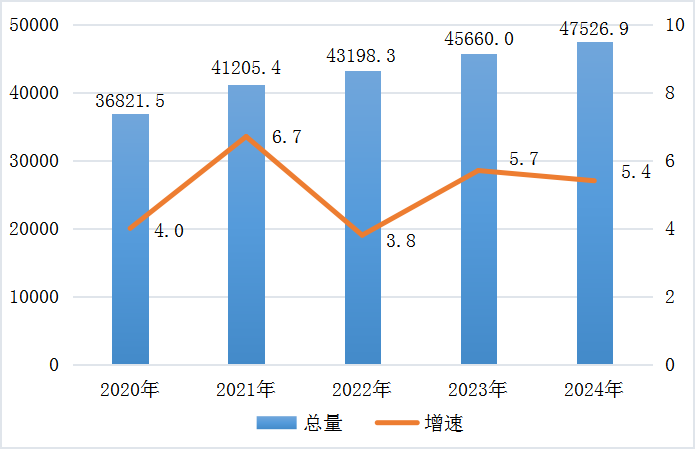
Core Viewpoint - Hebei province is aiming to become an "economic powerhouse" by surpassing a GDP of 5 trillion yuan, as outlined in the recently released "15th Five-Year Plan" [1][2][3] Economic Growth and Goals - Hebei's GDP is projected to reach 4.75 trillion yuan in 2024, ranking 13th nationally, down from a peak of 6th place due to reliance on heavy industries like steel and coal [2][4] - The province aims for average annual economic growth rates to exceed the national average during the "15th Five-Year" period, with a significant increase in economic strength by 2035 [1][8] Historical Context - Hebei was once a leading economic province, ranking 6th in GDP until 2012, but has since fallen behind due to structural transformation challenges and the "siphoning effect" from Beijing and Tianjin [4][5] Industrial Structure and Challenges - The province's economy has been heavily reliant on high-energy, high-pollution industries, which constituted 50% of its industrial value added [5][18] - Recent environmental policies have forced a reduction in steel production capacity, leading to slower economic growth as new industries have not filled the gap [5][19] Urban Development and Center Cities - The development of urban clusters and metropolitan areas is crucial for Hebei's economic rise, with a focus on enhancing the capabilities of its capital city, Shijiazhuang, and other regional centers like Tangshan [10][12][16] - Shijiazhuang has been designated as a national-level urban cluster, expected to play a significant role in driving economic growth in the central and southern regions of Hebei [16] Industrial Upgrading and Innovation - Hebei is focusing on upgrading its steel industry from raw material production to material-level competitiveness, with significant growth in industrial value added [18][19] - The province is also encouraged to leverage technological innovation to drive industrial transformation and maintain its traditional industries as a foundation for future growth [19] Collaboration with Beijing and Tianjin - Hebei plans to enhance its integration with Beijing and Tianjin, aiming to attract more enterprises and facilitate the transfer of non-capital functions from the capital [19] - The province is set to strengthen collaborative innovation and industrial cooperation, particularly in emerging sectors like new energy and artificial intelligence [19]