
工业

Search documents
前三季度兵团经济运行稳中向好
Sou Hu Cai Jing· 2025-10-31 00:28
Economic Performance - The production value of the region reached 251.71 billion yuan in the first three quarters, with a year-on-year growth of 6.2%, indicating a stable and improving economic performance [1] - The agricultural, forestry, animal husbandry, and fishery sectors saw a total output value increase of 5.5%, with record yields in winter wheat across various scales [1] - Industrial added value for enterprises above designated size grew by 7.4%, while the construction industry increased by 10.3%, contributing 21.7% to overall economic growth [1] Investment and Consumption - Fixed asset investment grew by 10% year-on-year, reflecting robust investment activity [1] - The total retail sales of consumer goods reached 67.908 billion yuan, with a year-on-year increase of 7.6%, highlighting the strengthening role of consumption in the economy [1] Employment and Social Welfare - The region achieved a total of 76,700 new urban jobs, completing 91.3% of the annual target, demonstrating a stable employment situation [2] - Significant support was provided to 32,100 unemployed individuals for re-employment, along with 7,800 individuals facing employment difficulties, showcasing effective measures in job stabilization [2]
中国海防:10月30日召开董事会会议
Mei Ri Jing Ji Xin Wen· 2025-10-30 18:08
Group 1 - The company, China Haifang, announced that its 39th meeting of the 9th board of directors was held on October 30, 2025, via communication methods [1] - The meeting reviewed the proposal regarding the appointment of the auditing institution for the company's 2025 financial statements and internal control [1] - For the year 2024, the company's revenue composition is 98.29% from industrial operations and 1.71% from other businesses [1]

中国动力:10月30日召开董事会会议
Mei Ri Jing Ji Xin Wen· 2025-10-30 13:13
Group 1 - The core viewpoint of the article highlights that China Power (SH 600482) held its 18th meeting of the 8th Board of Directors on October 30, 2025, to review the proposal regarding the company's Q3 2025 report [1] - For the year 2024, the revenue composition of China Power is reported to be 99.15% from industrial operations and 0.85% from other businesses [1] - As of the report date, China Power's market capitalization stands at 49.4 billion yuan [1] Group 2 - The article mentions the occurrence of "negative electricity prices" in multiple regions, raising questions about why power plants are reluctant to shut down despite not making profits from electricity sales [1]

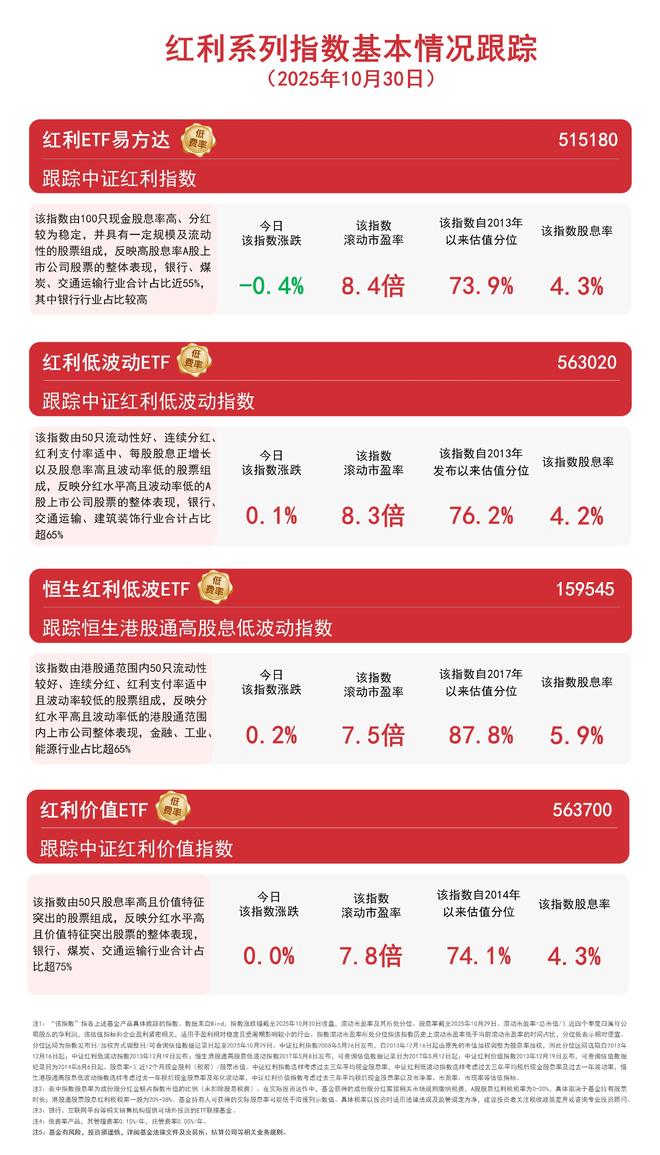
港股红利板块震荡上行,恒生红利低波ETF(159545)全天获近8000万份净申购
Mei Ri Jing Ji Xin Wen· 2025-10-30 12:23
Core Viewpoint - The performance of various dividend-focused indices and ETFs in the Chinese and Hong Kong markets shows a mixed trend, with some indices experiencing slight increases while others have declined, indicating varying investor sentiment and market conditions. Group 1: Index Performance - The Hang Seng High Dividend Low Volatility Index increased by 0.2% [1] - The CSI Dividend Low Volatility Index rose by 0.1% [1] - The CSI Dividend Value Index saw a slight increase of 0.04% [1] - The CSI Dividend Index decreased by 0.4% [1] Group 2: ETF Subscription Activity - The Hang Seng Dividend Low Volatility ETF (159545) recorded a net subscription of nearly 80 million units throughout the day [1] Group 3: Index Composition and Characteristics - The CSI Dividend Index consists of 100 stocks with high cash dividend yields and stable dividends, with significant representation from the banking, coal, and transportation sectors, accounting for nearly 55% [3] - The CSI Dividend Low Volatility Index is composed of 50 stocks with good liquidity and continuous dividends, with over 65% representation from the banking, transportation, and construction sectors [3] - The Hang Seng Dividend Low Volatility ETF tracks an index made up of 50 stocks within the Hong Kong Stock Connect that have high dividend levels and low volatility, with over 65% representation from the financial, industrial, and energy sectors [3] - The CSI Dividend Value Index includes 50 stocks with high dividend yields and value characteristics, with over 75% representation from the banking, coal, and transportation sectors [3]

2024年中国创新指数测算结果显示: 增长5.3%!我国科技创新能力持续提升
Ke Ji Ri Bao· 2025-10-30 01:58
Core Insights - The 2024 China Innovation Index is reported at 174.2, reflecting a 5.3% increase from the previous year, indicating a continuous enhancement in the country's technological innovation capabilities [1] Group 1: Innovation Environment - The innovation environment index, part of the overall innovation index, stands at 186.0, with a growth of 4.9% year-on-year [1] - In 2024, 137,000 industrial enterprises benefited from the R&D expense deduction policy, marking an 11.1% increase from the previous year [2] - The number of graduates in science, engineering, agriculture, and medicine reached 3.145 million, an increase of 172,000 from the previous year, representing 50.7% of the eligible population [2] Group 2: Innovation Input - Basic research funding reached 250.09 billion yuan, a 10.7% increase, accounting for 6.88% of total R&D expenditure, the highest in history [2] - Enterprises contributed 77.1% to the growth of national R&D expenditure, solidifying their role as the main force in driving R&D growth [2] - R&D expenditure for large-scale industrial enterprises was 2,254.77 billion yuan, reflecting a 7.5% increase [2] Group 3: Innovation Output - The number of invention patents granted in 2024 was 1.045 million, a 13.5% increase from the previous year [3] - By the end of 2024, the number of high-value invention patents reached 1.978 million, accounting for 42.2% of valid domestic invention patents [3] - The technology market saw 994,000 contracts with a total transaction value of 6.8 trillion yuan, representing growth of 5.1% and 11.2% respectively [3] Group 4: Innovation Effectiveness - The overall labor productivity in 2024 was 173,898 yuan per person, an increase of 4.9% year-on-year [4] - The value added by the "three new" economy reached 24.3 trillion yuan, growing by 6.7% and accounting for 18.01% of GDP [4] - Sales revenue from new products in large-scale industrial enterprises was 35.5 trillion yuan, reflecting a 3.9% increase from the previous year [4]
顺钠股份:10月28日召开董事会会议
Mei Ri Jing Ji Xin Wen· 2025-10-29 16:33
Group 1 - The company, ShunNa Co., Ltd. (SZ 000533), announced the convening of its 11th Board of Directors' temporary meeting on October 28, 2025, to review the Q3 2025 report and other documents [1] - For the first half of 2025, the company's revenue composition was 99.79% from industrial operations and 0.21% from commercial and other activities [1]

*ST海源:10月29日召开董事会会议
Mei Ri Jing Ji Xin Wen· 2025-10-29 16:33
Group 1 - The company *ST Haiyuan (SZ 002529) announced on October 30 that its seventh second board meeting was held on October 29, 2025, combining in-person and communication methods [1] - The meeting reviewed the proposal for the re-election of a non-independent director among other documents [1] - For the first half of 2025, the company's revenue composition was 100% from industrial activities [1]

中铁工业:1—9月新签合同额同比降14.44%
Zheng Quan Shi Bao Wang· 2025-10-29 07:47
人民财讯10月29日电,中铁工业(600528)10月29日公告,1—9月新签合同额为319.38亿元,同比下降 14.44%。 ...

财政部:2025年1-9月国有企业营业总收入613290.5亿元
Xin Hua Wang· 2025-10-29 06:22
Core Insights - In the first nine months, the total operating revenue of state-owned enterprises (SOEs) increased by 0.9% year-on-year, while total profits decreased by 1.6% [1] Revenue Summary - The total operating revenue of SOEs reached 613,290.5 billion yuan, reflecting a year-on-year growth of 0.9% [1] Profit Summary - The total profit of SOEs amounted to 31,670.3 billion yuan, showing a year-on-year decline of 1.6% [1] Tax and Fees Summary - The taxes and fees payable by SOEs were 44,145.4 billion yuan, which represents a year-on-year increase of 0.5% [1] Debt Summary - As of the end of September, the asset-liability ratio of SOEs was 65.2%, an increase of 0.2 percentage points year-on-year [1]
9月普惠金融-景气指数整体向好
Zhong Guo Jing Ji Wang· 2025-10-29 06:07
Core Insights - The Inclusive Finance Prosperity Index for September reached 49.50 points, an increase of 0.32 points from August, indicating improvements in both operational and financing dimensions [1] - The financing prosperity index stood at 54.93 points, up 0.71 points from August, reflecting effective release of corporate financing demand and a stable decline in financing costs [1] - The total social financing stock at the end of September was 437.08 trillion yuan, a year-on-year increase of 8.7%, with RMB loans to the real economy at 267.03 trillion yuan, up 6.4% year-on-year [1] Financing Dimension - The average interest rate for newly issued corporate loans in September was approximately 3.1%, down about 40 basis points from the same period last year, indicating a continued low-cost financing environment [1] - The growth rates for inclusive small and micro loans and medium to long-term loans in the manufacturing sector were 12.2% and 8.2% respectively, both exceeding the growth rate of other loans [1] Operational Dimension - The operational prosperity index for September was 48.44 points, an increase of 0.24 points from August, driven by a sustained recovery in consumer demand and improved performance of small and micro enterprises [2] - The operational vitality index rose by 0.29 points in September, becoming a key driver for the increase in the operational prosperity index, as companies accelerated production and optimized service processes [2] Industry Trends - Among nine major industries, six showed an increase in operational prosperity, particularly in wholesale and retail, accommodation and catering, and transportation services, while the real estate and construction industries experienced declines [2] - The industrial economy demonstrated steady growth, with advancements in artificial intelligence and modern service industries contributing to the overall economic development [2] Regional Insights - The operational prosperity index across seven major regions showed five increases and two decreases, with notable improvements in East China, South China, Central China, Northwest, and Southwest regions [2] - The Northeast and North China regions experienced declines in their operational prosperity indices [2]