奢侈品行业

Search documents
开云集团第二季度营收37亿欧元 低于预期
Ge Long Hui A P P· 2025-07-29 15:55
Group 1 - The core viewpoint of the article indicates that Kering Group's second-quarter revenue was €3.7 billion, which fell short of market expectations of €3.77 billion, representing a 15% decline compared to the previous year, while the market had predicted a 14.7% decrease [1] - For the first half of the year, Kering Group's revenue also decreased by 15%, with market expectations forecasting a decline of 14.4% [1]
LVMH如何在“奢侈寒冬”续写口红经济?
Sou Hu Cai Jing· 2025-07-29 04:52
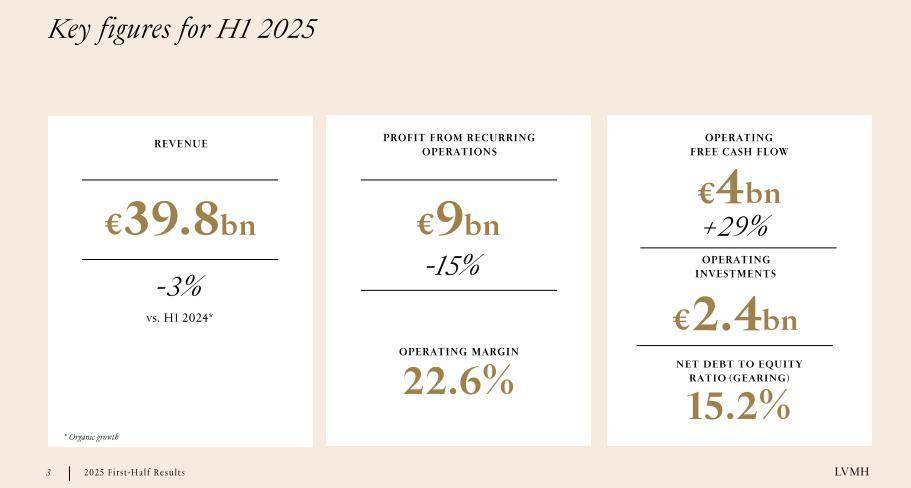
Core Insights - LVMH reported a total revenue of €39.81 billion (approximately ¥335.12 billion) for the first half of 2025, a decline of 4% year-on-year, with operating profit down 15% to €9.01 billion (approximately ¥75.84 billion) [1][5][10] - The luxury goods sector is facing significant challenges, with the "Veblen Effect" losing its influence as younger consumers reassess the value of luxury items [3][4] - The high-end beauty segment has emerged as a key area of focus for LVMH, showing resilience with stable revenue of €4.08 billion (approximately ¥34.34 billion) in the first half of 2025 [12][13] Financial Performance - LVMH's total revenue for the first half of 2025 was €39.81 billion, down 4% from the previous year, while operating profit decreased by 15% to €9.01 billion [1][5][10] - The operating margin fell to 22.6%, a decrease of 2.5 percentage points year-on-year [5] - The Asian market (excluding Japan) saw its share decline to 28%, down 2 percentage points [1][10] Market Trends - The luxury goods market is experiencing a shift, with younger consumers increasingly questioning the traditional pricing logic of luxury items [4][5] - The beauty segment, particularly high-end cosmetics, is viewed as a potential growth driver amidst overall market contraction [12][19] - LVMH's beauty brands, including Christian Dior and Fenty Beauty, are adapting to changing consumer preferences, with Fenty Beauty showing significant growth in China [15][19] Strategic Initiatives - LVMH is focusing on brand revitalization and innovation in the beauty sector, with new product launches and a commitment to quality and desirability [17][18] - The company is restructuring its operations, including closing underperforming DFS stores and laying off staff in its wine and spirits division to reallocate resources towards beauty [21][23] - Sephora is being positioned as a key player in the Chinese market, with new brand introductions and a direct reporting structure to the global CEO [21][23]

约42万名奢侈品买家的信息“被泄露”!香港隐私公署亮剑LV:正在调查,若泄露且不纠正错误或面临刑事诉讼
Mei Ri Jing Ji Xin Wen· 2025-07-22 08:38
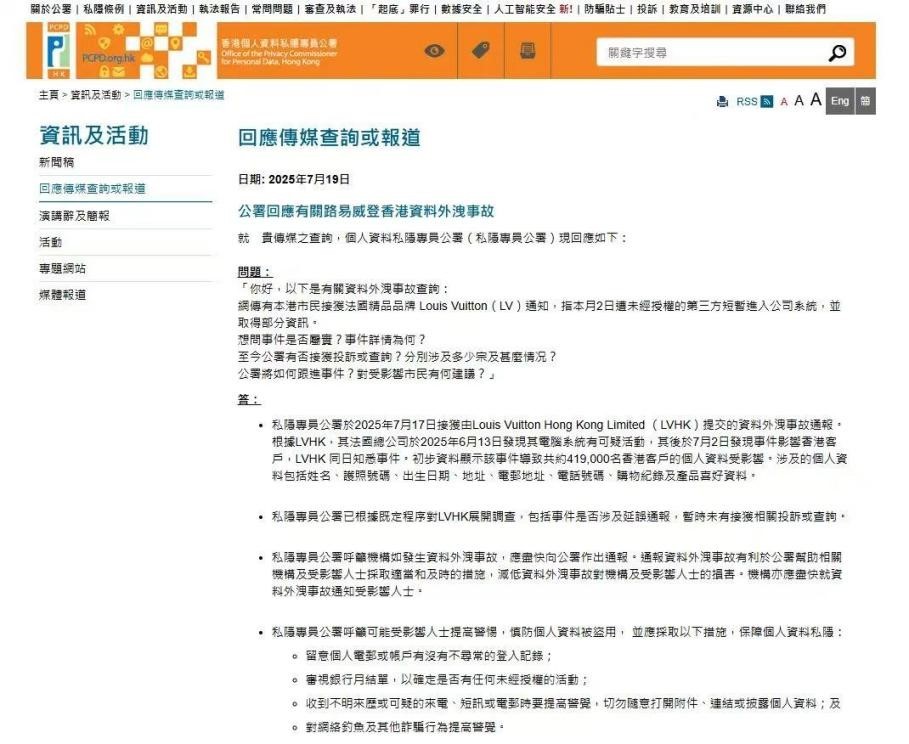
Core Points - Louis Vuitton (LV) has experienced a significant data breach affecting approximately 419,000 customers in Hong Kong, with personal information such as names, phone numbers, and shopping records compromised [1][3][10] - The Hong Kong Personal Data Privacy Commissioner (PCPD) is investigating LV for potential delays in reporting the breach, which could lead to criminal prosecution if found negligent [1][5] - The incident is part of a broader trend in the luxury goods sector, with multiple brands under LVMH, including Dior and Cartier, also facing similar data security issues [2][12] Group 1: Incident Details - LVHK reported the data breach to the PCPD on July 17, after discovering suspicious activity in their system on June 13 and confirming the breach's impact on Hong Kong customers by July 2 [3][5] - The breach has raised concerns about LV's data management practices, as similar incidents have occurred in Singapore and South Korea, indicating a systemic issue within the brand [6][11] Group 2: Industry Implications - The luxury goods sector is facing increasing scrutiny over data security, with experts suggesting that the lack of investment in data protection measures has made these brands vulnerable to attacks [10][12] - The recent data breaches could negatively impact LV's brand image, particularly among high-end consumers, as the luxury market increasingly values data privacy [2][10] - There is a call for stronger data protection regulations and industry standards to prevent future breaches, highlighting the need for luxury brands to enhance their data security protocols [11][12]
奢侈品牌又现信息泄露!LV近42万香港客户资料外泄
21世纪经济报道· 2025-07-21 12:49
Core Viewpoint - The article highlights a series of data leakage incidents involving luxury brands, particularly focusing on Louis Vuitton's recent breach affecting approximately 420,000 customers in Hong Kong, raising concerns about customer data privacy and security in the luxury goods sector [1][2]. Group 1: Data Breach Incidents - Louis Vuitton reported a data breach affecting nearly 420,000 customers in Hong Kong, with leaked information including names, passport numbers, and shopping records, but no payment information was compromised [1][2]. - The Hong Kong Privacy Commissioner has initiated an investigation into Louis Vuitton's data breach, assessing whether there was a delay in reporting the incident [2]. - Other luxury brands, such as Cartier and Dior, have also experienced data breaches recently, with similar types of customer information being leaked, although financial data was not included [5][6]. Group 2: Impact of AI on Luxury Brands - The rapid development of AI is seen as a double-edged sword for luxury brands, providing new ways to engage with customers while also raising concerns about data privacy [8]. - Brands like Hermès and Louis Vuitton are leveraging AI for customer data integration and marketing strategies, but this has led to consumer anxiety regarding the potential misuse of non-sensitive data [9]. - High-net-worth individuals, who are the primary customers of luxury brands, have a lower tolerance for data breaches, indicating that brands must establish robust data protection standards to maintain trust [9].
珠宝需求保持强劲,历峰集团Q1销售额攀升 | 财报见闻
Hua Er Jie Jian Wen· 2025-07-16 08:58
Core Insights - Richemont Group reported strong Q1 results for FY2026, driven primarily by robust demand in the jewelry segment, despite a downturn in the luxury goods industry [1][2] Financial Performance - Q1 sales reached €5.41 billion, a 6% increase at constant exchange rates, exceeding expectations by 5.34%, and a 3% increase at actual exchange rates [2] - Jewelry sales grew by 11% to €3.91 billion, significantly surpassing the expected 8.55%, marking the third consecutive quarter of double-digit growth [6] - Net cash stood at €7.4 billion, reflecting a €100 million increase year-on-year [2] Business Segment Analysis - Jewelry segment accounted for 72% of total sales, with brands like Cartier and Van Cleef & Arpels contributing to the growth [6] - Specialist watchmakers saw a decline of 7% to €824 million, while other business areas experienced a slight decrease of 1% [2][4] Regional Performance - Strong growth was observed in the Americas (+17%) and Europe (+11%), driven by local demand and increased tourism spending [3][7] - Asia Pacific remained stable, with Japan experiencing a significant decline of 15% due to high base effects and currency fluctuations [3][7] Distribution Channel Insights - Retail sales reached €3.73 billion, a 6% increase, accounting for 69% of total sales, with growth across all regions except Japan [2][4] - Online retail sales also grew by 6% to €323 million, while wholesale and royalty income increased by 6% to €1.36 billion [2][4]
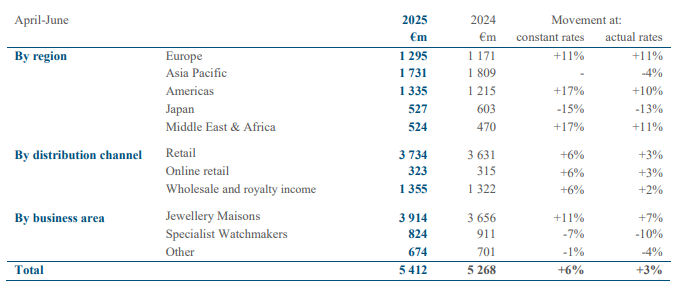
历峰集团第一季度销售额为54.1亿欧元,在固定汇率下增长6%。(分析师预计为54.7亿欧元)
news flash· 2025-07-16 05:34
Group 1 - The core sales figure for Richemont in the first quarter is €5.41 billion, reflecting a 6% growth at constant exchange rates [1] - Analysts had projected sales to be €5.47 billion, indicating a slight miss in expectations [1]
Hermès International: Situation of the liquidity contract as of June 30, 2025
Globenewswire· 2025-07-09 16:00
Core Insights - The liquidity contract between Hermès International and BNP Paribas shows significant trading activity in the first half of 2025, with total buy trades amounting to €216,547,071 and sell trades totaling €210,013,542 [1][2]. Group 1: Liquidity Contract Overview - As of June 30, 2025, outstanding means included 3,416 shares of Hermès International and €17,719,592 [1]. - In the first half of 2025, there were 87,824 shares bought across 3,264 transactions and 85,073 shares sold across 3,835 transactions [1]. - The previous half-year situation (December 31, 2024) reported outstanding means of 665 shares and €24,002,097 [1]. Group 2: Historical Comparison - In the second half of 2024, total trades included 74,349 shares bought for €154,427,181 and 76,039 shares sold for €158,887,483 [1]. - The first application of the AMF 2021-01 decision on July 1, 2021, showed outstanding means of 496 shares and €18,278,671 [1]. - As of December 31, 2018, the outstanding means were 9,166 shares and €10,762,173 [2].

山姆和LV,突击同一个战场
创业邦· 2025-07-06 03:08
Core Viewpoint - The rise of self-produced podcasts by brands is a significant trend, driven by the need for deeper engagement and connection with consumers, moving away from traditional advertising methods [7][18][22]. Group 1: Growth of Podcasts - The number of Chinese podcasts surged from 11,000 in June 2020 to 42,000 by June 2024, indicating a robust growth in the medium [6]. - Over 30 brands have ventured into self-produced podcasts in the past five years, including luxury brands like GIADA and LV, as well as tech companies like Feishu and Zhihu [11]. Group 2: Types of Brand Podcasts - Two main categories of self-produced podcasts have emerged: those focusing on practical value (e.g., career and finance) and those exploring the "spiritual world" of contemporary individuals [15][16]. - Popular examples include Feishu's "Organizational Evolution" and GIADA's "Rock in the Flower," which cater to different audience needs [15][16]. Group 3: Reasons for Brands to Produce Podcasts - Self-produced content allows brands to create a more authentic connection with consumers, moving away from overt sales tactics [18][19]. - Brands are increasingly choosing podcasts as they offer a platform for deeper storytelling and engagement, particularly appealing to younger, educated audiences [22][23]. Group 4: Audience Characteristics - Podcast listeners are predominantly young, with 70% being post-90s and post-00s, and they tend to be well-educated and have higher income levels [28]. - The audience is concentrated in first-tier and new first-tier cities, with a significant portion holding bachelor's degrees or higher [25]. Group 5: Production Process and Challenges - The production process for brand podcasts is described as flexible and lightweight, allowing for high-value content creation with relatively low effort [29][30]. - Despite the potential for engaging content, brands face challenges in reaching wider audiences, as emotional connections are often more effective than functional value in attracting listeners [41][42].
不做广告,只做文化:LVMH如何用“隐形赞助”赢下戛纳全场大奖?
Jing Ji Guan Cha Bao· 2025-06-27 08:11
Core Viewpoint - LVMH's strategy of "silent sponsorship" at the 2024 Paris Olympics has redefined luxury branding, focusing on cultural participation rather than overt advertising [1][9]. Group 1: No Logo Olympic Partnership - LVMH's involvement in the 2024 Olympics is not about advertising but a deep expression of "French culture and identity" [2]. - The company chose to operate behind the scenes, becoming a "cultural co-creator" without visible branding or self-promotion [2]. Group 2: Paradigm Shift in Luxury Branding - LVMH challenges traditional sponsorship logic by emphasizing that high-end brands do not need to be "seen" but rather "perceived" [3]. - The company recognized an opportunity to engage emotionally with users through cultural means, rather than through visible branding [3]. Group 3: Cultural Creation Instead of Advertising - LVMH's Olympic marketing strategy lacks traditional promotional materials, yet it generated global attention [5]. - The brand's contributions included Chaumet's Olympic medals, Louis Vuitton's ceremonial boxes, Berluti's custom outfits for torchbearers, and Dior's artistic performances [5][6]. Group 4: Non-Marketing Approach - The Cannes jury praised LVMH's approach as "not an advertisement, but a cultural heritage" [8]. - This strategy reflects a new logic in the luxury sector, where high-end consumers value cultural depth and authenticity over aggressive exposure [8]. Group 5: Redefining Luxury Brand Presence - LVMH's success at the Cannes International Creativity Festival signifies a new definition of luxury branding in a competitive global market [9]. - The company demonstrates that in an era of information overload, "silence" can be the most sophisticated form of expression [10]. Group 6: Measurable Impact - LVMH achieved over €350 million in earned media exposure, a 36% increase in global brand favorability, and a 12-fold increase in brand consideration among consumers [11]. - The strategy shifted focus from selling products to building meaning, from shaping trends to conveying values, and from capturing attention to creating resonant experiences [12].
我的白富美闺蜜们,出境游不买包了
Hu Xiu· 2025-06-22 01:45
Core Insights - The article discusses a shift in consumer behavior among high-net-worth individuals, particularly women, who have historically been significant consumers of luxury goods. This change reflects a broader trend in the luxury market as these consumers become more discerning and value experiences over material possessions [10][54]. Group 1: Consumer Behavior Changes - High-net-worth individuals, previously characterized by impulsive luxury purchases, are now more cautious and deliberate in their spending, reflecting a shift from "buying" to "measuring" [15][30]. - The luxury consumption patterns of individuals like Sissi and Ivy illustrate a transition from frequent purchases of luxury items to prioritizing experiences, such as high-end hotel stays and immersive travel [44][51]. - The luxury market is experiencing a slowdown, with LVMH reporting an 11% decline in sales in the Asia-Pacific region (excluding Japan) and a 20% drop in the Chinese luxury market last year [36][37]. Group 2: Economic Context - The economic environment has influenced consumer sentiment, with factors such as currency fluctuations and tightening profit margins prompting a reevaluation of spending habits [24][35]. - Sissi's family business, which focuses on cross-border trade, has faced challenges, leading to a more cautious approach to luxury spending [21][23]. - Ivy's family, involved in the pharmaceutical industry, has also adjusted their spending habits in response to changing market conditions and policy shifts [26][28]. Group 3: Luxury Market Implications - The luxury industry is recognizing the need to adapt to changing consumer behaviors, as evidenced by comments from LVMH executives regarding reduced spending by Chinese tourists [35]. - The decline in luxury goods consumption, particularly in high-value categories like watches and jewelry, indicates a significant shift in market dynamics [37][38]. - The evolving preferences of affluent consumers suggest a potential redefinition of luxury, focusing more on personal fulfillment and experiences rather than mere ownership of luxury items [54][56].