石油和化工

Search documents
石油和化工行业“质量月”活动见质见效
Zhong Guo Hua Gong Bao· 2025-09-24 02:25
Group 1: Quality Management Initiatives - The "Quality Month" event emphasizes the theme of "Strengthening Comprehensive Quality Management to Promote Quality Power Construction," leading to a surge in quality improvement across the petroleum and chemical industries [1] - Companies are integrating digital intelligence into production processes, enhancing efficiency and quality management through various technological innovations [1] - China National Offshore Oil Corporation (CNOOC) has developed adaptive software for high-precision prediction of logging curves, improving exploration accuracy [1] Group 2: Safety and Standardization - China Chemical Engineering's construction site utilizes high-definition cameras for real-time monitoring, enhancing safety management by automatically identifying risks and notifying management [2] - The company aims for "star-rated construction site" status, focusing on standardization and intelligent management to improve project quality and safety [2] - Quality inspections and the implementation of a "first piece sample" system are being enforced to ensure compliance with quality standards [2] Group 3: Quality Control Measures - Dalian Petrochemical Company is focusing on strict quality control of aviation fuel, enhancing operational oversight and compliance throughout the production process [3] - The company is conducting quality training and management initiatives to ensure a 100% compliance rate for water vapor quality [3] - Henan Oilfield is improving its quality management system by shifting from mere compliance to effective enhancement through various quality-focused activities [3] Group 4: Continuous Improvement and Risk Management - Sinopec Guangdong Petroleum is advancing its quality management and standardization efforts, achieving a "three-zero target" for five consecutive years, indicating no substantial complaints or quality accidents [4] - Tianeng Chemical is leveraging AI and big data for precise detection of safety hazards and quality issues, fostering a culture of quality improvement among employees [4] - The company is actively engaging employees in quality enhancement initiatives, contributing to cost reduction and efficiency improvements [4]
2024年石化行业责任关怀报告发布:石油和化工行业持续深化责任关怀实践
Zhong Guo Hua Gong Bao· 2025-09-19 02:27
Core Viewpoint - The report highlights the continuous advancement of responsibility care practices in the oil and chemical industry, emphasizing a commitment to green, safe, and low-carbon development, with significant achievements in self-discipline and social responsibility fulfillment [1] Group 1: Responsibility Care Implementation - In 2024, the oil and chemical industry added 98 new responsibility care commitment units, bringing the total to 1,082, including 96 chemical parks and 986 enterprises, achieving the "100 parks and 1,000 enterprises" goal during the 14th Five-Year Plan [2] - Collaborative efforts among government, associations, and enterprises have been established, with various initiatives such as environmental innovation events and safety culture manuals enhancing HSE performance [2] - Companies are actively engaging in innovative practices, such as AI video monitoring systems and new sludge drying technologies, significantly reducing hazardous waste emissions [2] Group 2: Green Transformation - The industry is responding to national "dual carbon" goals by promoting green production methods, with 40 national standard plans proposed and several key standards completed, including carbon footprint and emission accounting [3] - Innovations in environmental governance are being addressed, such as the low-temperature catalytic decomposition technology for nitrous oxide, which can reduce emissions by 46,200 tons annually, equivalent to 13.76 million tons of CO2 [3] - The coverage of energy and water efficiency leaders is expanding, with significant reductions in energy consumption and CO2 emissions across key products [3] Group 3: Industry Benchmarking - The report identifies 20 "Responsibility Care Stars" that exemplify best practices in safety, environmental protection, and social responsibility, serving as role models for the industry [4] - Key performance indicators show a steady improvement in HSE performance, with the process safety incident rate dropping to 0.195 in 2024, and reductions in energy and water consumption as well as CO2 emissions over the past four years [4] - The industry is also actively engaging in social responsibility initiatives, supporting underprivileged students and contributing to ecological protection [4] Group 4: Future Challenges and Directions - The industry faces new challenges in responsibility care amidst profound changes in the development environment, with plans to deepen the responsibility care system, enhance evaluation mechanisms, and expand international cooperation [5]
中央企业开放134个中试验证平台
Zhong Guo Hua Gong Bao· 2025-09-19 01:37
Core Points - The State-owned Assets Supervision and Administration Commission (SASAC) officially released the "Central Enterprises Pilot Verification Platform Open Service Manual (2025 Edition)" on September 17, promoting the sharing of pilot verification services among central enterprises [1] - The manual includes 134 pilot verification platforms and 291 service items, covering various industrial technology fields such as resource development, energy utilization, manufacturing engineering, information networks, advanced materials, life health, green environmental protection, and public safety [1] Group 1: Platforms in Oil and Chemical Sector - Platforms related to the oil and chemical sector include various pilot verification platforms such as those for energy-saving and environmental protection technologies, hydrogen liquefaction equipment, drilling engineering technologies, and enhanced oil recovery [2] - Specific platforms include the oil and gas pipeline pilot verification platform, catalytic cracking catalyst and preparation process platform, and carbon capture technology platforms [2] Group 2: Additional Pilot Verification Platforms - Additional platforms include those for CO₂ hydrogenation to methanol, CO₂ electrolysis for syngas production, and clean and efficient low-carbon conversion technologies [3] - The platforms aim to enhance the connection between central enterprises and the upstream and downstream of the industrial chain, facilitating the demand for pilot testing from large, medium, and small enterprises [3]
60余家石化企业上榜中企500强
Zhong Guo Hua Gong Bao· 2025-09-17 02:29
Group 1 - The 2025 China Enterprise 500 list was released, highlighting over 60 oil and chemical companies, with the total revenue of the top 500 enterprises reaching 110.15 trillion yuan and total assets at 460.85 trillion yuan, marking a 7.46% increase from the previous year [1] - Oil and chemical companies accounted for 12% of the total list, underscoring their role as a pillar of the national economy and a stabilizing force for industrial economic growth [1] - China National Petroleum Corporation and China Petroleum & Chemical Corporation ranked second and third, with revenues of 29,690 billion yuan and 29,320 billion yuan respectively [1] Group 2 - Innovation is crucial for enterprise development, with several petrochemical companies, including Sinopec and PetroChina, listed among the 2025 China Top 100 Innovators [2] - Chinese petrochemical companies are advancing international operations, with overseas assets for China National Petroleum Corporation reaching 1 trillion yuan, leading the 2025 China Top 100 Multinational Companies [2] - The threshold for entering the China Enterprise 500 has increased by over 8.7 billion yuan, with total revenue and assets growing by over 22% and 34% respectively, indicating a significant rise in the scale of enterprises [2]



三板斧”推进节能减碳 | 大家谈 如何当好“碳路先锋
Zhong Guo Hua Gong Bao· 2025-09-12 03:41
Core Viewpoint - Energy conservation and carbon reduction are crucial for achieving carbon peak and carbon neutrality, with the oil and chemical industry playing a significant role in this transition through three main strategies. Group 1: Capacity Transformation - The first strategy involves accelerating capacity transformation by promoting carbon capture, utilization, and storage (CCUS) projects, which will lead to industrialization across various petrochemical facilities [1] - Emphasis on developing the hydrogen industry, increasing investment in projects such as wind and solar hydrogen production, seawater hydrogen production, and pressure swing adsorption (PSA) technology for blue hydrogen production [1] - Implementation of deep utilization projects for waste heat and pressure in petrochemical facilities to minimize energy waste [1] Group 2: Process Reengineering - The second strategy focuses on process reengineering, breaking down traditional production silos through raw material substitution, process innovation, energy restructuring, by-product recycling, and digital empowerment [2] - Importance of low-carbon raw material substitution and adaptation in the production process, along with the replacement of traditional processes with efficient, low-consumption methods [2] - Adoption of advanced equipment to replace outdated machinery, particularly in steam production facilities, and the use of "green gas" alternatives to traditional coal/gas boilers [2] - Accelerating the construction of CCUS projects and resource recycling initiatives for waste catalysts and waste liquids at the end of the production process [2] Group 3: Carbon Emission Management - The third strategy is to enhance the carbon emission management system by implementing a lifecycle carbon accounting and trading management system for petrochemical production [2] - Establishing a complete system that includes quantifying carbon emissions, managing them, and incentivizing reductions through market mechanisms [2] - Clear identification of carbon accounting objects throughout the entire process, from crude oil extraction and transportation to refining, chemical synthesis, product transportation, usage, and end-of-life treatment [2]
业界:将《关于深入实施“人工智能+”行动的意见》转化为提质增效实际动能
Zhong Guo Hua Gong Bao· 2025-08-29 02:08
Core Viewpoint - The recent issuance of the "Opinions on Deepening the Implementation of 'Artificial Intelligence+' Action" by the State Council marks a transition of "Artificial Intelligence+" from concept to large-scale application, providing strategic guidance for the oil and chemical industry to embrace the intelligent era [1] Group 1: Industry Application of AI - The application of AI in the chemical industry has progressed from initial exploration to large-scale implementation, significantly shortening the R&D cycle for new materials through molecular simulation and high-throughput computing [1] - Intelligent optimization control systems and digital twin technology are becoming widespread in production processes, effectively enhancing production efficiency and energy utilization [1] - AI-driven intelligent monitoring and risk warning systems have become standard in safety and environmental protection, greatly reducing accident rates [1] Group 2: Challenges in AI Adoption - The chemical industry faces challenges such as data silos, insufficient computing power, and a shortage of interdisciplinary talent, necessitating breakthroughs through policy guidance and technological collaboration [1] - The slow advancement of "Artificial Intelligence+" in the chemical sector is attributed to the industry's unique requirements for stability and safety, which traditional AI models struggle to meet [2] - Data heterogeneity and the prevalence of data silos among different systems like DCS and MES hinder effective AI integration [2] Group 3: Recommendations for AI Integration - Experts suggest accelerating the construction of a diverse adaptive technology system, integrating mechanism-driven and data-driven approaches, and establishing a safe and trustworthy AI framework [3] - A "three-step" strategy is recommended, focusing on demonstration and phased implementation, system integration, and ecosystem building to achieve a leap from automation to intelligence [3] - The chemical industry should concentrate on five key application scenarios: "AI+ R&D," "AI+ Production," "AI+ Safety and Environmental Protection," "AI+ Supply Chain," and "AI+ Services," while establishing a four-dimensional support system [3] Group 4: Company Initiatives - The Henan Xinlianxin Group aims to accelerate its intelligent transformation by integrating "Artificial Intelligence+ Manufacturing" into its industrial production processes [4] - The company plans to utilize new-generation AI technologies, such as big data intelligence and digital twin factories, to enhance safety production and transition from passive responses to proactive warnings [4]
2025中国民企500强公布!这些化工企业上榜→
Zhong Guo Hua Gong Bao· 2025-08-28 10:40
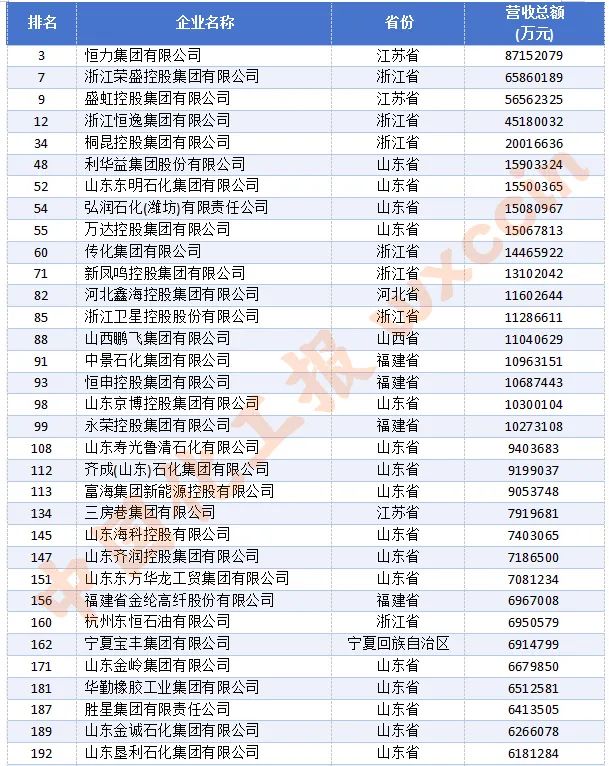
8月28日,全国工商联在辽宁沈阳发布"2025中国民营企业500强"。结果显示,京东集团、阿里巴巴(中 国)有限公司、恒力集团有限公司、华为投资控股有限公司、比亚迪(002594)股份有限公司位居前 五,营业收入均超过7700亿元。 2025中国民营企业500强中,石油和化工企业数量占据榜单份额超过10%,有70余家企业上榜,18家化 企进入前100强。其中,2024年营业收入超过1000亿元的化企有18家,比上年度增加了6家;500亿 ~1000亿元的化企有21家。 民营化工企业前10强依次是:恒力集团有限公司(第3名,以下数字表示位次)、浙江荣盛控股集团有限 公司(7)、盛虹控股集团有限公司(9)、浙江恒逸集团有限公司(12)、桐昆控股集团有限公司 (34)、利华益集团股份有限公司(48)、山东东明石化集团有限公司(52)、弘润石化(潍坊)有限责 任公司(54)、万达控股集团有限公司(55)、传化集团有限公司(60)。 按省份分,山东有26家化工企业上榜,以绝对的数量优势领跑全国;民营经济是浙江的"金名片",民营 化企实力不俗,上榜数量为15家,其中6家企业进入百强。此外,民营经济大省江苏和福建分别有10 ...




多维度探索节能降碳路径 | 大家谈 如何当好“碳路先锋”
Zhong Guo Hua Gong Bao· 2025-08-25 02:02
Core Viewpoint - The petrochemical industry, as a crucial pillar of the national economy, is facing significant challenges and opportunities in energy conservation and carbon reduction under the "dual carbon" strategy. Jinzhou Petrochemical is actively exploring energy-saving paths through innovative practices [1][2]. Group 1: Energy Conservation Initiatives - Jinzhou Petrochemical recognizes that understanding its energy usage is the primary task for energy conservation. In 2024, the company will conduct comprehensive energy audits in collaboration with professional firms and Dalian University of Technology [1]. - By early 2025, operational departments will develop rectification plans and energy-saving initiatives based on the audit findings. A notable example includes optimizing the isopropanol unit's startup process, reducing propylene concentration time from 30 days to 20 days, resulting in a profit of 1.05 million yuan [1]. Group 2: Long-term Management System - In early 2025, Jinzhou Petrochemical will revise its management methods and assessment criteria, enhancing core modules such as plan management and quota assessment, while introducing reward and punishment measures to support energy-saving efforts [2]. - The company has launched a personal action plan for all employees to promote energy and water conservation, optimizing low-temperature heat operations across the plant. This includes reducing the hourly steam consumption in the heavy oil tank area by 7.31 tons, potentially generating an annual profit of 7.8 million yuan [2]. Group 3: Innovation-Driven Energy Efficiency - Jinzhou Petrochemical has adopted the PDCA dynamic cycle management model, integrating planning, execution, inspection, and adjustment into the energy efficiency enhancement process [2]. - The company has implemented several technical innovations, such as optimizing the high-temperature condensate water process in the propane depropanizer, saving 4 tons of steam per hour. Additionally, the intelligent spray system in the delayed coking unit has achieved over 50% steam savings during the gas extraction phase, significantly improving energy utilization efficiency [2].
上半年石化行业经济运行基本平稳
Zhong Guo Chan Ye Jing Ji Xin Xi Wang· 2025-08-21 00:23
Core Insights - The petrochemical industry in China experienced a stable economic performance in the first half of the year, with a total revenue of 7.77 trillion yuan, a year-on-year decrease of 2.6% [1] Group 1: Economic Performance - Crude oil production, import, processing, and consumption all saw year-on-year growth, marking a turnaround from last year's declines [1] - Major chemical products' production and consumption both achieved "double growth," indicating stable market demand for petrochemical products and chemical materials [1] - The chemical sector outperformed the oil and gas extraction and refining sectors, with revenue and import-export values increasing, while profits decreased [1] Group 2: Trade Dynamics - The import and export dynamics showed a "volume increase, price decrease" trend, with total import-export value, import value, and trade deficit all declining year-on-year, while export value slightly increased by 0.4% [1] Group 3: Product Trends - Both production and consumption of refined oil experienced a "double decline," attributed to the impact of new energy vehicles on gasoline markets and liquefied natural gas heavy trucks on diesel consumption [2] - The production rate of refined oil dropped to 55.3%, down from 59.7% in the previous year, reflecting the industry's structural adjustments and transition towards "reducing oil and increasing chemicals" [2] Group 4: Price Trends - Prices for crude oil and major petrochemical products continued to decline, influenced by ongoing geopolitical conflicts and economic uncertainties [2] Group 5: Future Outlook - The industry aims to prioritize quality improvement and efficiency enhancement, focusing on cost reduction, potential exploration, and optimization [2] - There is a push for accelerating the high-end and green transformation of the petrochemical industry, alongside efforts to manage "involutionary" competition and ensure the orderly exit of outdated capacities [2]
2025全国石油和化工行业经济形势分析会召开——上半年石化行业经济运行基本平稳
Zhong Guo Hua Gong Bao· 2025-08-18 02:41
Core Viewpoint - The petrochemical industry in China experienced a stable economic performance in the first half of the year, with a slight decline in overall revenue but growth in key production and consumption metrics [1][3]. Group 1: Economic Performance - The petrochemical industry achieved a total revenue of 7.77 trillion yuan, representing a year-on-year decrease of 2.6% [1]. - Crude oil production, import, processing, and consumption all saw year-on-year growth, marking a recovery from the previous year's declines [3]. - Major chemical products experienced "double growth" in both production and consumption, indicating stable market demand for petrochemical products [3]. Group 2: Sector Differentiation - There is an increasing divergence within the industry, with the chemical sector performing better than oil and gas extraction and refining sectors, which saw declines in revenue, profit, and import/export figures [3]. - The oil and gas extraction and refining sectors experienced a "triple decline" in revenue, profit, and import/export figures [3]. Group 3: Trade Dynamics - The import and export activities continued to show a "volume increase, price decrease" trend, with total import and export values, import amounts, and trade deficits all declining year-on-year, while exports saw a slight increase of 0.4% [3]. - The persistent low prices of petrochemical products in the global market contributed to this trend [3]. Group 4: Product Trends - There was a "double decline" in both production and consumption of refined oil products, with total production and consumption of gasoline, diesel, and kerosene all declining for the first time [3]. - The decrease in refined oil production was noted despite a 1.6% year-on-year increase in crude oil processing, with a production rate of 55.3%, down from 59.7% in the previous year [3]. Group 5: Price Trends - Prices for crude oil and major petrochemical products continued to decline, influenced by ongoing geopolitical conflicts and economic uncertainties [4]. Group 6: Future Outlook - The industry aims to prioritize quality improvement and efficiency enhancement in the second half of the year, focusing on cost reduction, potential growth, and optimization [4]. - There is a push for the petrochemical industry to transition towards high-end and green development, while addressing "involutionary" competition and ensuring the orderly exit of outdated capacities [4].