
有色金属矿采选业

Search documents
12月通胀数据解读:2025年通胀回眸
Huachuang Securities· 2026-01-10 07:51
1. Report Industry Investment Rating No information about the industry investment rating is provided in the report. 2. Core Viewpoints of the Report - In 2025, CPI increased by 0.8% year - on - year, with core consumer goods, services, and fresh produce prices improving. PPI's year - on - year decline narrowed to - 1.9%, and prices gradually recovered from upstream to mid - downstream after the "anti - involution" policy [2][3]. - In December 2025, due to the decline in vegetable price growth and the seasonal recovery of consumer goods, CPI's year - on - year increase rebounded to 0.8% under the low - base effect. PPI's month - on - month increase rebounded to 0.2% due to the heating season and the impact of imported non - ferrous metals [29][45]. 3. Summary According to the Directory 2025 Inflation Review CPI - In 2025, CPI increased by 0.8% year - on - year. The factors contributing to the CPI increase from high to low were core consumer goods (0.63 pct), fresh produce (0.4 pct), services (0.25 pct), while livestock and meat (- 0.19 pct) and energy (- 0.3 pct) dragged it down [2][9]. - Core consumer goods: Gold prices contributed half of the increase, and prices of household appliances and daily necessities improved under consumption - promoting policies. Services: Service consumption scenarios mainly related to travel still supported prices, with significant price fluctuations between peak and off - peak seasons. Livestock and meat: Pig production capacity reduction was slow under "large - scale" farming, and terminal demand was weak, leading to a slow decline in prices. Fresh produce: Extreme weather affected production and transportation, tightening supply and driving up prices. Energy: Trade frictions led to weak demand and a downward price trend [2][14][15]. PPI - In 2025, the year - on - year decline of PPI narrowed to - 1.9%. After the "anti - involution" policy in July, mid - stream production materials industries showed positive signals, but the durable consumer goods manufacturing industry related to long - term income expectations and closer to terminal demand was still weak [24]. - Industries with continuous price increases included the imported non - ferrous metal industry chain, which had six consecutive months of price increases. Domestically, industries generally saw price recovery from upstream to mid - downstream, such as coal and black mining in the upstream, the paper - making industry, and then lithium - ion battery manufacturing and non - metallic mineral products industries [27]. December CPI Food Items - CPI food prices increased by 0.3% month - on - month, slightly weaker than the seasonal average, driving CPI up by about 0.05 percentage points. Pork prices decreased slightly due to oversupply, and fresh produce prices were weaker than the seasonal level, with fresh fruit prices rising seasonally and fresh vegetable prices rising less than expected [31]. Non - food Items - The non - food item of CPI increased by 0.1% month - on - month, stronger than the seasonal average, driving CPI up by about 0.12 percentage points. Energy prices decreased slightly, core consumer goods drove CPI up by about 0.16 percentage points (21% contributed by gold price increases), and service prices had limited impact on CPI during the off - travel season [32][37][38]. December PPI Overall - In December, PPI's month - on - month increase rebounded to 0.2% after 19 months, with price increases spreading from the mining industry to raw material and processing industries. Production material prices increased by 0.2%, while downstream living material prices remained flat [45]. By Industry - The number of industries with rising prices among industrial producers remained at 9. Supportive factors included the seasonal increase in demand and prices of coal, gas, and the non - ferrous metal industry chain, as well as the continuous price recovery of the paper - making industry. The drag factor was the imported crude oil industry chain [47][51][59].
优化供需结构,持续提振投资与消费预期
2 1 Shi Ji Jing Ji Bao Dao· 2026-01-10 03:15
Group 1 - The latest data from the National Bureau of Statistics indicates that the domestic CPI rose by 0.8% year-on-year in December 2025, surpassing the previous value of 0.7%, with a month-on-month increase of 0.2%, marking a near three-year high [1] - The month-on-month increase in CPI is primarily driven by rising prices of industrial consumer goods excluding energy, which increased by 0.6%, contributing approximately 0.16 percentage points to the CPI increase [1] - The core CPI, excluding food and energy, rose by 1.2% year-on-year, maintaining a growth rate above 1% for four consecutive months, indicating a positive trend [1] Group 2 - The main factors affecting CPI include energy and automobile prices, with energy prices decreasing by 0.5% month-on-month and gasoline prices down by 1.2% [2] - PPI showed an expanding month-on-month increase and a narrowing year-on-year decline, with positive factors stemming from industry capacity governance and market competition order improvements [2] - International commodity prices, particularly for non-ferrous metals, have positively impacted domestic PPI levels, while the decline in international oil prices has negatively affected domestic oil extraction and refining prices [3] Group 3 - The current price recovery is a direct result of the demand-side expansion and supply-side governance policies in 2025, characterized by structural features and policy-driven characteristics [3] - The transition from short-term policy-driven effects to sustainable market-driven growth is a key task for 2026, with strong price expectations playing a crucial role in boosting investment and consumption [3] - Continued efforts to expand domestic demand and improve supply-demand relationships are essential for stabilizing the real estate market and stimulating stock market vitality, promoting a virtuous cycle in the Chinese economy [4]
21社论丨优化供需结构,持续提振投资与消费预期
21世纪经济报道· 2026-01-10 02:11
Group 1 - The core viewpoint of the articles indicates a positive trend in price recovery for 2025, with CPI and PPI showing simultaneous growth, suggesting a foundation for price warming in 2026 [1][2][3] - CPI increased by 0.8% year-on-year, surpassing the previous value of 0.7%, and the month-on-month CPI rose by 0.2%, marking a three-year high [1] - The rise in CPI is primarily driven by the increase in industrial consumer goods prices, excluding energy, which rose by 0.6%, contributing approximately 0.16 percentage points to the CPI increase [1] Group 2 - PPI showed a month-on-month increase of 0.2%, marking three consecutive months of growth, with the growth rate expanding by 0.1 percentage points compared to the previous month [1][2] - The improvement in PPI is attributed to industry capacity governance and market competition order, which have positively influenced supply-demand structures, leading to price increases in certain sectors [2][3] - International commodity prices, particularly in non-ferrous metals, have positively impacted domestic PPI levels, while the decline in international oil prices has negatively affected domestic oil extraction and refining prices [3] Group 3 - The current price recovery is a direct result of coordinated demand-side expansion and supply-side governance policies, with structural characteristics and policy-driven features [3] - The sustainability of this price recovery and its transmission to broader investment and consumption expectations will determine whether the economy can enter a virtuous cycle in 2026 [3] - Continued efforts to expand domestic demand and improve supply-demand relationships are essential for stabilizing the real estate market and stimulating the stock market, which will facilitate smoother transmission from PPI to CPI [4]


国家统计局:2025年12月CPI同比上涨0.8% PPI同比下降1.9%
Guo Jia Tong Ji Ju· 2026-01-10 01:11
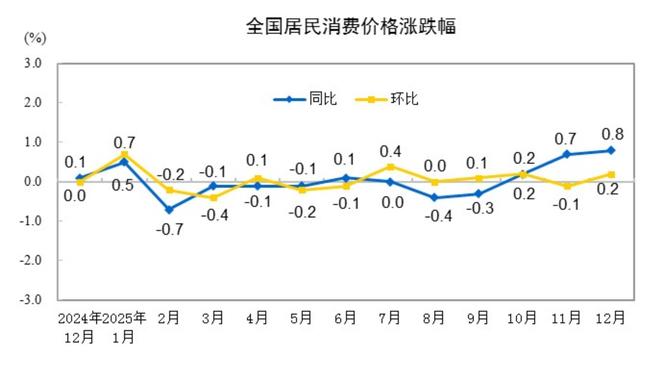
Core Insights - In December 2025, the Consumer Price Index (CPI) increased by 0.8% year-on-year, marking the highest growth since March 2023, primarily driven by rising food prices [3][6] - The Producer Price Index (PPI) saw a month-on-month increase of 0.2% and a year-on-year decrease of 1.9%, with the decline in PPI narrowing compared to the previous month [4][15] CPI Analysis - The CPI rose by 0.2% month-on-month, reversing a previous decline of 0.1%, influenced by increased demand for consumer goods as the New Year approached [2] - Core CPI, excluding food and energy, increased by 1.2% year-on-year, maintaining a growth rate above 1% for four consecutive months [3] - Food prices rose by 1.1% year-on-year, with significant increases in fresh vegetables (18.2%) and fresh fruits (4.4%), contributing to the overall CPI increase [3][9] PPI Analysis - The PPI's month-on-month increase of 0.2% marks the third consecutive month of growth, with improvements in supply-demand dynamics leading to price increases in certain sectors [4][5] - Year-on-year, the PPI decline of 1.9% reflects a narrowing of the decrease, with specific industries like coal mining and lithium-ion battery manufacturing showing price increases [5][15] - Input prices for industrial producers decreased by 2.1% year-on-year, with notable declines in various raw materials, while prices for non-ferrous metals increased significantly [19][20] Price Changes by Category - In December, food and beverage prices rose by 0.8% year-on-year, contributing approximately 0.24 percentage points to the CPI [9] - Among various categories, prices for other goods and services saw significant increases, with household services rising by 1.2% and other consumer goods increasing by 17.4% [9][11] - Conversely, transportation and housing prices experienced declines, with transportation costs decreasing by 2.6% year-on-year [9][14]
2025年物价低位温和回升
Xin Lang Cai Jing· 2026-01-09 22:52
Group 1: CPI Analysis - In December 2025, the Consumer Price Index (CPI) increased by 0.2% month-on-month and 0.8% year-on-year, with the core CPI (excluding food and energy) rising by 1.2% year-on-year, marking a stable recovery in demand [1][2] - The year 2025 saw the CPI remain flat compared to the previous year, while the PPI decreased by 2.6% year-on-year, indicating a low and moderate recovery in price levels [1][4] - The increase in CPI was primarily driven by rising prices of industrial consumer goods, with a notable increase in prices for communication tools, baby products, and entertainment durable goods, which rose between 1.4% and 3.0% [1][2] Group 2: PPI Analysis - The Producer Price Index (PPI) rose by 0.2% month-on-month in December 2025, marking three consecutive months of increase, influenced by improved supply-demand dynamics and ongoing capacity governance in key industries [2][3] - Year-on-year, the PPI decreased by 1.9%, but the decline was less severe than in previous months, reflecting positive changes in certain industries due to macroeconomic policies [3][5] - The PPI's year-on-year decline was initially exacerbated by insufficient external demand and structural adjustments, but improved market competition and policy effects led to a narrowing of the decline in the latter half of the year [5] Group 3: Economic Outlook - The changes in CPI and PPI in December 2025 indicate a stable and improving economic environment, with demand gradually recovering and supply-side structural optimization continuing [3][5] - The implementation of consumption-boosting policies and the deepening of the unified national market are expected to support a moderate and stable price environment moving forward [3][5] - Looking ahead to 2026, a more proactive macroeconomic policy is anticipated to foster economic growth and reasonable price recovery, with the potential for PPI to enter a recovery phase, although it may take time to turn positive [5]
提振消费政策显效、企业竞争秩序优化、新动能快速成长——2025年物价低位温和回升
Jing Ji Ri Bao· 2026-01-09 22:02
Group 1: CPI Analysis - In December 2025, the Consumer Price Index (CPI) increased by 0.2% month-on-month and 0.8% year-on-year, with the core CPI (excluding food and energy) rising by 1.2% year-on-year [1][2] - The year 2025 saw the CPI remain flat compared to the previous year, while the PPI decreased by 2.6% year-on-year, indicating a generally low and mild recovery in price levels [1][4] - The increase in CPI is attributed to rising prices of industrial consumer goods, with a notable increase in prices for communication tools, baby products, and entertainment durable goods, which rose between 1.4% and 3.0% [1][2] Group 2: PPI Analysis - The Producer Price Index (PPI) rose by 0.2% month-on-month in December 2025, marking three consecutive months of increase, despite a year-on-year decline of 1.9% [2][3] - The PPI's year-on-year decline narrowed by 0.3 percentage points compared to the previous month, reflecting improvements in supply-demand structures and effective policies in key industries [3][5] - Prices in the coal mining and processing sectors, as well as lithium-ion battery manufacturing and cement production, have shown consistent increases, indicating a positive trend in certain industries [2][3] Group 3: Economic Outlook - Analysts suggest that the changes in CPI and PPI reflect a stable and improving economic environment in China, with demand gradually recovering and supply-side structural optimization continuing [3][5] - The implementation of consumption-boosting policies and the deepening of the national unified market construction are expected to support a stable and mild recovery in prices moving forward [3][5] - Looking ahead to 2026, a more proactive macroeconomic policy environment is anticipated to foster economic growth and reasonable price recovery, with CPI expected to rise steadily [5]
扩内需促消费政策显效2025年物价呈温和回升态势
Shang Hai Zheng Quan Bao· 2026-01-09 18:38
Core Viewpoint - The expansion of domestic demand and consumption policies is showing effectiveness, leading to a moderate recovery in prices and improved supply-demand relationships in key industries [2][6][7]. Group 1: CPI and PPI Trends - In December 2025, the Consumer Price Index (CPI) increased by 0.8% year-on-year, marking the highest level since March 2023, with food prices significantly contributing to this rise [2][3]. - The Producer Price Index (PPI) decreased by 1.9% year-on-year in December, but the decline was narrower than in November, indicating positive changes in certain industries due to improved market competition [4][6]. - The core CPI, excluding food and energy, rose by 1.2% year-on-year, maintaining a growth rate above 1% for four consecutive months, reflecting stable demand recovery [3][6]. Group 2: Industry-Specific Insights - Prices in the coal mining, lithium-ion battery manufacturing, and photovoltaic equipment sectors showed reduced declines, indicating a positive trend in market competition and production capacity management [4][5]. - The price of lithium-ion batteries and cement manufacturing increased by 1.0% and 0.5% month-on-month, respectively, demonstrating a recovery in these key industries [4][5]. - The prices of external storage devices and bio-liquid fuels rose by 15.3% and 9.0% year-on-year, respectively, driven by the growth of new productive forces [5]. Group 3: Future Outlook - Experts predict that with continued policy support for domestic demand and consumption, the CPI is expected to show a steady upward trend in 2026, with food prices returning to a reasonable fluctuation range [6][7]. - The overall economic operation is expected to improve, with demand gradually recovering and supply-side structural optimization continuing [7].
CPI同比涨幅继续扩大 PPI同比降幅收窄
Xin Lang Cai Jing· 2026-01-09 17:39
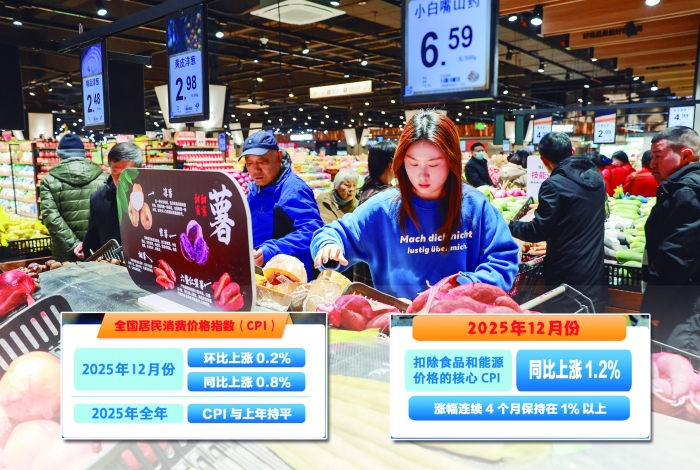
Group 1 - In December 2025, the Consumer Price Index (CPI) increased by 0.2% month-on-month and 0.8% year-on-year, while the Producer Price Index (PPI) rose by 0.2% month-on-month but decreased by 1.9% year-on-year [1][2] - The CPI's year-on-year growth rate expanded by 0.1 percentage points compared to the previous month, reaching the highest level since March 2023, primarily driven by an increase in food prices, which rose by 1.1% [1][3] - Key food items such as fresh vegetables and fruits saw price increases of 18.2% and 4.4%, respectively, contributing approximately 0.16 percentage points to the CPI's year-on-year increase [1][2] Group 2 - The month-on-month CPI increase was influenced by rising prices of industrial consumer goods, excluding energy, which rose by 0.6%, contributing about 0.16 percentage points to the CPI [2] - The PPI's year-on-year decline of 1.9% showed a narrowing of the decline by 0.3 percentage points from the previous month, with significant price reductions in coal mining and lithium-ion battery manufacturing [3] - Prices in sectors such as external storage devices and biomass liquid fuels increased by 15.3% and 9.0%, respectively, indicating a growth in new productive forces [3]
盛龙股份IPO获证监会批复
Zheng Quan Ri Bao Wang· 2026-01-09 14:46
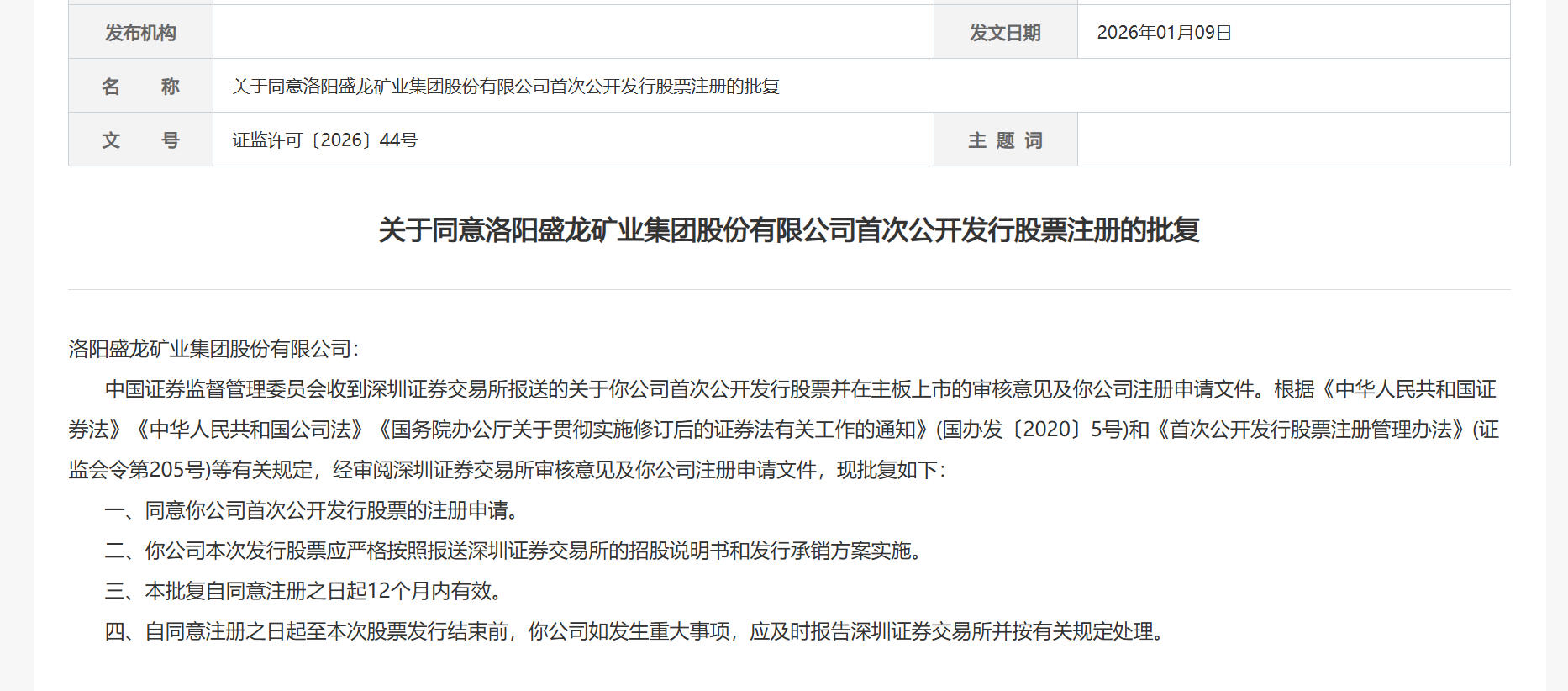
Group 1 - The China Securities Regulatory Commission (CSRC) has approved the registration application for Luoyang Shenglong Mining Group Co., Ltd. to conduct its initial public offering (IPO) [1][2] - The approval is valid for 12 months from the date of registration [1] - Shenglong Mining plans to list on the Shenzhen Stock Exchange and aims to raise 1.53 billion yuan for various projects, including a molybdenum multi-metal mining project and a mining technology research center [4] Group 2 - Shenglong Mining is recognized as a leading large-scale molybdenum company in China, focusing on the comprehensive development and utilization of non-ferrous metal mineral resources [4] - The company’s main business involves the production, processing, and sales of molybdenum-related products, with capabilities in molybdenum mining and selection [4] - The funds raised will enhance the company's competitive strength, expand its scale, and improve its sustainable development and risk resistance capabilities [4] Group 3 - Shenglong Mining is committed to implementing a development strategy focused on "resource priority, innovation-driven, and cost leadership" [4] - The company aims to align with the new development philosophy of "innovation, coordination, green, openness, and sharing" [4] - The strategic positioning as a "first-class mining enterprise" will guide the company’s focus on mineral resources and new materials to promote high-quality development [4]
2025年12月通胀数据点评:PPI超预期回升
CMS· 2026-01-09 14:01
CPI Analysis - December CPI increased by 0.8% year-on-year, the highest growth since March 2023[2] - Food prices contributed significantly to CPI, with fresh vegetables and fruits rising by 18.2% and 4.4% respectively[2] - Core CPI, excluding food and energy, remained stable at 1.2% year-on-year[2] PPI Analysis - December PPI decreased by 1.9% year-on-year, but the decline narrowed by 0.3 percentage points from the previous month[2] - PPI recorded a month-on-month increase of 0.2%, marking three consecutive months of growth[2] - Key industries such as coal mining and cement manufacturing saw price increases of 1.3%, 0.8%, and 0.5% respectively[2] Market Outlook - January CPI is expected to drop to around 0.4% year-on-year due to a high base effect from the previous year[2] - January PPI is projected to rise to approximately 0.3% month-on-month, with a year-on-year estimate of -1.2%[2] - The impact of low oil prices continues to weigh on PPI improvements, while rising prices in non-ferrous metals support certain sectors[2] Risks - Domestic policy effectiveness may fall short of expectations, posing risks to economic recovery[2]