
石油加工

Search documents
沥青早报-20250919
Yong An Qi Huo· 2025-09-19 00:23
1. Report Industry Investment Rating - No information provided in the content. 2. Core Viewpoints - No clear core viewpoints are presented in the given content. It mainly provides a series of data on asphalt, including futures prices, trading volumes, positions, spot prices, basis, spreads, and profit margins. 3. Summary by Relevant Catalogs Futures Prices - On September 18, the BU main contract price was 3427, a daily decrease of 18 and a weekly decrease of 23 [4]. - BU06 was 3358, down 12 daily and 12 weekly [4]. - BU09 was 3349, down 13 daily and 71 weekly [4]. - BU12 was 3388, down 16 daily and 11 weekly [4]. - BU03 was 3377, down 1 daily and unchanged weekly [4]. Trading Volume and Position - The trading volume on September 18 was 210,608, an increase of 1,178 daily and a decrease of 12,209 weekly [4]. - The position was 408,756, an increase of 1,203 daily and a decrease of 27,301 weekly [4]. Spot Prices - The Shandong market price was 3,520, unchanged daily and down 20 weekly [4]. - The East China market price was 3,590, down 50 daily and 50 weekly [4]. - The South China market price was 3,490, unchanged daily and down 30 weekly [4]. - The North China market price was 3,660, unchanged daily and up 10 weekly [4]. - The Northeast market price was 3,850, unchanged daily and down 20 weekly [4]. Basis and Monthly Spreads - The Shandong basis was 93, an increase of 18 daily and 3 weekly [4]. - The East China basis was 163, down 32 daily and 27 weekly [4]. - The South China basis was 63, an increase of 18 daily and a decrease of 7 weekly [4]. - The 03 - 06 spread was 19, an increase of 11 daily and 12 weekly [4]. - The 06 - 09 spread was 9 [4]. - The 09 - 12 spread was -39, an increase of 3 daily and a decrease of 60 weekly [4]. - The 12 - 03 spread was 11, down 12 daily and 11 weekly [4]. Spreads and Profits - The asphalt Brent spread was -4, an increase of 27 daily and a decrease of 93 weekly [4]. - The asphalt Ma Rui profit was -71, an increase of 24 daily and a decrease of 84 weekly [4]. - The general refinery comprehensive profit was 384, an increase of 14 daily and a decrease of 76 weekly [4]. - The Ma Rui - type refinery comprehensive profit was 715, an increase of 18 daily and a decrease of 79 weekly [4]. - The import profit (South Korea - East China) was -137, down 44 daily and 36 weekly [4]. - The import profit (Singapore - South China) was -939, unchanged daily and down 16 weekly [4]. Related Prices - The Brent crude oil price was 68.0, down 0.5 daily and up 1.6 weekly [4]. - The Shandong gasoline market price was 7,511, down 9 daily and 36 weekly [4]. - The Shandong diesel market price was 6,468, down 17 daily and 1 weekly [4]. - The Shandong residual oil market price was 3,700, unchanged daily and up 125 weekly [4].
3899.96→3801 沪指近百点巨震!发生了什么?谁在“压盘”?
Mei Ri Jing Ji Xin Wen· 2025-09-18 07:57
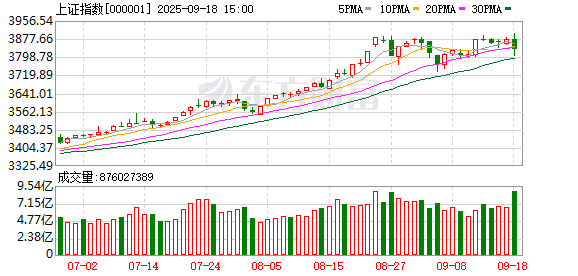
Market Overview - The three major indices experienced a rapid rise followed by a decline, with the Shanghai Composite Index dropping by 1.15%, the Shenzhen Component Index by 1.06%, and the ChiNext Index by 1.64% at the close [2] - Over 4,600 stocks in the market declined, with a total trading volume of 3.135 trillion yuan, an increase of 758.4 billion yuan compared to the previous trading day, marking the third highest volume of the year [2] Index Performance - The Shanghai Composite Index reached a peak of 3,899.96 points in the morning, nearing the 3,900-point mark, but fell to a low of 3,801 points in the afternoon, nearly erasing the gains from the previous Thursday [3] - The rise was primarily driven by technology stocks in the Shanghai market, while traditionally supportive sectors like banking and dividends lagged behind [4] Sector Analysis - The afternoon saw a significant decline in the financial sector, which dampened the bullish sentiment in technology stocks, leading to a drop in all three major indices [5] - There were indications of large sell orders from leading brokerages, suggesting that funds might be using the financial sector to control the market and suppress index gains [6] Investment Sentiment - The proximity of the Shanghai Composite Index to the 3,900-point threshold raises questions about market timing rather than capability, suggesting that the market may not be ready for a breakout yet [7] - The current market is characterized by a strong trend in stocks with consecutive gains, despite the overall index fluctuations [10] Stock Highlights - Certain stocks have shown remarkable performance, such as *ST Weir with a 5.02% increase over 18 days and Tian Guan shares with a 10% increase over 12 consecutive days [11] - The technology sector's leading stocks have shown signs of consolidation, transitioning from a strong upward trend to a more volatile phase [12] Future Outlook - Analysts suggest that the market's upward potential is currently limited, with a need for a transition from a liquidity-driven bull market to a fundamental-driven one [14] - Recent reports indicate that the Federal Reserve's potential interest rate cuts could support a slow bull market in A-shares, driven by improved domestic economic policies and market sentiment [14][15]

恒力石化:2025年半年度权益分派实施公告
Zheng Quan Ri Bao· 2025-09-17 14:09
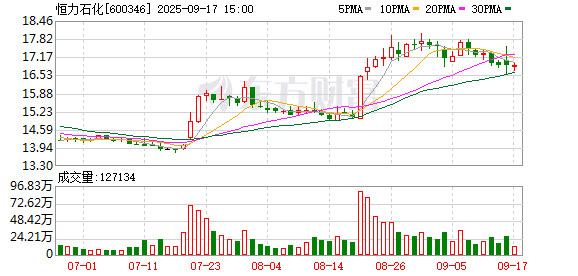
Core Viewpoint - Hengli Petrochemical announced a cash dividend of 0.08 yuan per share (tax included) for the first half of 2025, with the record date set for September 23, 2025, and the ex-dividend date and payment date on September 24, 2025 [2] Summary by Category - **Dividend Announcement** - The company will distribute a cash dividend of 0.08 yuan per share for A-shares [2] - The dividend is inclusive of tax [2] - **Key Dates** - The record date for the dividend is September 23, 2025 [2] - The ex-dividend date and the date of cash dividend payment is September 24, 2025 [2]

原油月报:OPEC+8月已按计划上限实施增产-20250917
Xinda Securities· 2025-09-17 09:18
Investment Rating - The report maintains a "Positive" investment rating for the oil processing industry [1] Core Insights - The report highlights that OPEC+ has implemented production increases as planned in August 2025, indicating a recovery in oil supply [1] - Predictions for global oil supply and demand are optimistic, with significant increases expected in 2025 and 2026 [2][32] - The report emphasizes the importance of geopolitical factors and OPEC+ production policies in influencing oil prices and market stability [4] Supply and Demand Overview - IEA, EIA, and OPEC predict global oil supply for 2025 to be 10582.51, 10552.82, and 10460.46 million barrels per day respectively, showing increases from 2024 [2][32] - For 2026, the predicted supply is 10787.62, 10664.34, and 10618.42 million barrels per day, indicating continued growth [2][32] - Global oil demand predictions for 2025 are 10387.45, 10380.99, and 10513.52 million barrels per day, with increases from 2024 [2][32] Price Trends - As of September 16, 2025, Brent crude oil is priced at $68.47, WTI at $64.52, and Russian ESPO at $63.69, with recent price changes showing slight increases [9][10] - Year-to-date price changes show Brent down by 9.82%, WTI down by 11.77%, and Russian ESPO down by 11.48% [9][10] Inventory Insights - Global oil inventory changes are predicted to be +195.06, +171.83, and -53.06 thousand barrels per day for 2025, with an average increase of +104.61 thousand barrels per day [27] - For 2026, the average inventory change is expected to be +150.95 thousand barrels per day [27] Related Companies - Key companies in the industry include China National Offshore Oil Corporation (CNOOC), China Petroleum & Chemical Corporation (Sinopec), and China National Petroleum Corporation (PetroChina) [4]
2025年8月份河南规模以上工业能源生产情况
Sou Hu Cai Jing· 2025-09-17 04:25
Group 1: Coal and Oil Production - In August, the industrial raw coal production in Henan Province reached 8.8748 million tons, showing a year-on-year increase of 0.6%, but the growth rate decreased by 3.8 percentage points compared to July [2] - From January to August, the total industrial raw coal production was 71.0986 million tons, with a year-on-year growth of 2.7% [2] - The industrial crude oil processing in August was 0.9641 million tons, marking a year-on-year increase of 20.7%, with the growth rate improving by 6.1 percentage points from July [2] Group 2: Electricity Production - In August, the industrial electricity generation was 37.935 billion kWh, reflecting a year-on-year increase of 7.7%, but the growth rate fell by 19.6 percentage points compared to July [3] - From January to August, the total industrial electricity generation was 241.395 billion kWh, with a year-on-year growth of 4.0% [4] - Breakdown of electricity generation in August: thermal power increased by 7.6% (down 25.1 percentage points from July), hydropower turned from a decline of 27.1% in July to a growth of 6.4%, wind power grew by 9.9% (up 6.5 percentage points), and solar power increased by 7.0% (down 29.8 percentage points) [4]
中国石化在新疆年原油加工能力达500万吨
Xin Hua Cai Jing· 2025-09-16 14:26
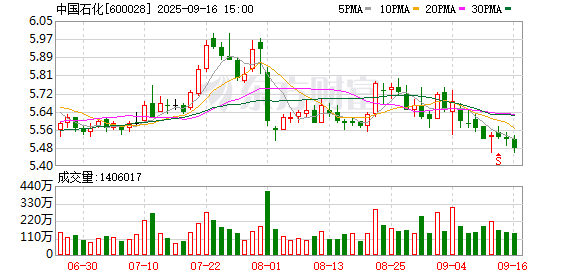
Core Insights - China Petroleum & Chemical Corporation (Sinopec) has a crude oil processing capacity of 5 million tons per year in Xinjiang as of the report date [2] - Since the reform and opening up, Sinopec has discovered and developed oil and gas fields, with proven oil geological reserves of 2.167 billion tons and natural gas geological reserves of 338.703 billion cubic meters [2] - Sinopec has invested 890 million yuan in ecological restoration projects in Xinjiang, demonstrating a commitment to environmental sustainability [2] Group 1: Oil and Gas Operations - Sinopec has cumulatively produced 177 million tons of crude oil and 41.8 billion cubic meters of natural gas in Xinjiang [2] - The company has processed a total of 76.4706 million tons of raw oil and produced 72.01 million tons of refined oil [2] Group 2: Ecological and Social Responsibility - Sinopec has implemented ecological restoration projects, including the removal of 105 oil wells in the Tarim Populus euphratica National Nature Reserve and greening 2.563 million square meters in the Taklamakan Desert [2] - The company has established 113 charging stations and 36 distributed photovoltaic power stations in Xinjiang, and launched a 10,000-ton-level photovoltaic green hydrogen demonstration project in Kuqa in 2023 [2] - The "Sunshine Bazaar" brand has sold over 120 million yuan worth of Xinjiang specialty agricultural products through 28,000 convenience stores [3] - Sinopec's targeted assistance in Yuepuhu County has helped 78 villages transition from poverty alleviation to revitalization [3] - The "China Petroleum Light of Hope" health express has provided services to nearly 7,000 cataract patients in Xinjiang [3] - The company has built 183 "National Unity and Love Stations" and 72 "Driver's Homes" to support truck drivers and sanitation workers [3] - Sinopec has actively promoted ethnic unity through various community engagement activities, helping 532 villagers achieve stable employment over the past seven years [3]

港股16日跌0.03% 收报26438.51点
Xin Hua Wang· 2025-09-16 09:16
Market Overview - The Hang Seng Index fell by 8.05 points, a decrease of 0.03%, closing at 26,438.51 points [1] - The total turnover for the day on the main board was 294.069 billion HKD [1] - The Hang Seng China Enterprises Index increased by 1.63 points, up 0.02%, closing at 9,386.39 points [1] - The Hang Seng Tech Index rose by 34.05 points, an increase of 0.56%, closing at 6,077.66 points [1] Blue-Chip Stocks - Tencent Holdings rose by 0.23%, closing at 645 HKD [1] - Hong Kong Exchanges and Clearing increased by 0.53%, closing at 451.8 HKD [1] - China Mobile decreased by 0.63%, closing at 87.1 HKD [1] - HSBC Holdings rose by 0.66%, closing at 107.2 HKD [1] Local Hong Kong Stocks - Cheung Kong Holdings fell by 0.42%, closing at 37.76 HKD [1] - Sun Hung Kai Properties decreased by 1.34%, closing at 95.55 HKD [1] - Henderson Land Development rose by 0.5%, closing at 28.18 HKD [1] Chinese Financial Stocks - Bank of China increased by 0.23%, closing at 4.43 HKD [1] - China Construction Bank rose by 0.26%, closing at 7.77 HKD [1] - Industrial and Commercial Bank of China fell by 0.34%, closing at 5.95 HKD [1] - Ping An Insurance decreased by 2.22%, closing at 55.05 HKD [1] - China Life Insurance fell by 2.44%, closing at 22.36 HKD [1] Oil and Petrochemical Stocks - China Petroleum & Chemical Corporation remained unchanged, closing at 4.22 HKD [1] - China National Petroleum Corporation fell by 0.81%, closing at 7.35 HKD [1] - CNOOC Limited decreased by 0.87%, closing at 19.31 HKD [1]
大越期货沥青期货早报-20250916
Da Yue Qi Huo· 2025-09-16 05:11
1. Report Industry Investment Rating No relevant content provided. 2. Core Viewpoints of the Report - The supply pressure of asphalt is expected to decrease in the short - term as refineries have recently reduced production. However, the overall demand recovery is less than expected and remains sluggish. The cost is supported by the strengthening of crude oil in the short - term. It is expected that the asphalt futures market will fluctuate narrowly in the short - term, with the asphalt 2511 contract fluctuating in the range of 3371 - 3415 [7][9]. - The bullish factors include relatively high crude oil costs providing some support; the bearish factors are the insufficient demand for high - priced goods and the overall downward demand with an increasing expectation of an economic recession in Europe and the United States [11][12]. - The main logic is that the supply pressure remains high, and the demand recovery is weak [13]. 3. Summary According to the Directory 3.1 Daily Views - **Supply**: In August 2025, the total planned asphalt production in China was 2.413 million tons, a month - on - month decrease of 5.1% and a year - on - year increase of 17.1%. This week, the sample capacity utilization rate of domestic petroleum asphalt was 30.501%, a month - on - month decrease of 0.90 percentage points. The refineries reduced production this week, and it is expected to reduce supply pressure next week [7]. - **Demand**: The current demand for various types of asphalt is lower than the historical average. The heavy - traffic asphalt开工率 was 28.1%, a month - on - month decrease of 0.04 percentage points; the construction asphalt开工率 was 18.2%, unchanged from the previous month; the modified asphalt开工率 was 15.8893%, a month - on - month decrease of 1.25 percentage points; the road - modified asphalt开工率 was 27.5%, a month - on - month decrease of 0.83 percentage points; the waterproofing membrane开工率 was 33.93%, a month - on - month increase of 0.07 percentage points [7]. - **Cost**: The daily asphalt processing profit was - 513.38 yuan/ton, a month - on - month decrease of 3.00%. The weekly delayed coking profit of Shandong local refineries was 792.0771 yuan/ton, a month - on - month increase of 6.94%. The asphalt processing loss decreased, and the profit difference between asphalt and delayed coking increased. The strengthening of crude oil is expected to support the market in the short - term [8]. - **Basis**: On September 15, the spot price in Shandong was 3,520 yuan/ton, and the basis of the 11 - contract was 127 yuan/ton, with the spot price higher than the futures price [9]. - **Inventory**: The social inventory was 1.225 million tons, a month - on - month decrease of 3.54%; the in - factory inventory was 0.642 million tons, a month - on - month decrease of 4.74%; the port diluted asphalt inventory was 0.32 million tons, a month - on - month increase of 68.42%. Social and in - factory inventories are continuously decreasing, while port inventories are continuously increasing [9]. - **Market**: The MA20 is downward, and the price of the 11 - contract closed below the MA20 [9]. - **Main Position**: The main position is net short, and the short position is increasing [9]. 3.2 Asphalt Market Overview - **Futures Closing Price**: The prices of different contracts showed various changes. For example, the 11 - contract futures price increased by 0.74% compared with the previous value [16]. - **Downstream Demand and Other Data**: The downstream demand开工率, asphalt coking profit, weekly shipment volume, weekly production, and inventory data all had different degrees of change. For example, the weekly shipment volume of the whole country was 263,500 tons, a month - on - month decrease of 0.11%; the sample enterprise production was 509,000 tons, a month - on - month decrease of 2.86% [16]. 3.3 Asphalt Futures Market - Spread Analysis - **Basis and Spread Trends**: The report provides the historical trends of the basis in Shandong and East China, as well as the spread trends of main contracts such as 1 - 6 and 6 - 12, the price trends of asphalt and crude oil, the crude oil cracking spread, and the price - ratio trends of asphalt, crude oil, and fuel oil [18][21][24]. 3.4 Asphalt Fundamental Analysis - **Profit Analysis**: It includes the profit trend of asphalt and the profit spread trend between coking and asphalt [36][39]. - **Supply - Side Analysis**: It covers aspects such as shipment volume, diluted asphalt port inventory, production volume, Ma Rui crude oil price and Venezuelan crude oil monthly production, local refinery asphalt production,开工率, and maintenance loss volume [42][44][47]. - **Inventory Analysis**: It involves exchange warehouse receipts, social inventory, in - factory inventory, and in - factory inventory inventory ratio [62][66][69]. - **Import and Export Situation**: The report shows the export and import trends of asphalt and the import price difference trend of South Korean asphalt [72][75]. - **Demand - Side Analysis**: It includes petroleum coke production, apparent consumption, downstream demand (such as highway construction traffic fixed - asset investment, new local special bonds, and infrastructure investment completion), downstream mechanical demand, asphalt开工率, and downstream开工情况 [78][81][84]. - **Supply - Demand Balance Sheet**: It provides the monthly asphalt supply - demand balance table, including asphalt monthly production, import volume, export volume, social inventory, factory inventory, diluted asphalt port inventory, and downstream demand [104].
石油与化工指数涨跌互现(9月8日至12日)
Zhong Guo Hua Gong Bao· 2025-09-16 02:43
Group 1: Chemical Sector Performance - The chemical raw materials index increased by 1.90%, while the chemical machinery index rose by 1.43%. However, the chemical pharmaceuticals index decreased by 2.04%, and the pesticide and fertilizer index increased by 3.16% [1] - The top five rising petrochemical products included liquid chlorine, which rose by 28.88%, and epoxy chloropropane, which increased by 6.02%. The top five declining products included vitamin E, which fell by 10.00%, and paraffin, which decreased by 6.49% [1] Group 2: Oil Sector Performance - The oil processing index decreased by 1.15%, and the oil extraction index fell by 1.70%. Conversely, the oil trading index increased by 1.09% [1] - International crude oil prices fluctuated, with WTI settling at $62.69 per barrel, up 1.33% from September 5, and Brent settling at $66.99 per barrel, up 2.27% [1] Group 3: Capital Market Performance of Chemical Companies - The top five rising listed chemical companies included Dongfang Tower, which increased by 31.79%, and Asia-Pacific Industry, which rose by 27.62%. The top five declining companies included Runpu Food, which fell by 16.71%, and Qide New Materials, which decreased by 14.96% [2]
高低硫均偏弱震荡
Yin He Qi Huo· 2025-09-15 12:35
Group 1: Report Industry Investment Rating - The unilateral strategy for fuel oil is weak and volatile, and the arbitrage and option strategies are to wait and see [6][7] Group 2: Core View of the Report - High - sulfur fuel oil: High - sulfur near - end inventory remains at a high level, suppressing market prices. Supply is affected by factors such as Russian refinery facilities' recovery and changes in export from different regions. Demand from power generation has subsided, and feedstock demand support is not obvious [5] - Low - sulfur fuel oil: The spot premium of low - sulfur fuel oil fluctuates at a low level. Supply continues to increase, and there is no specific driver for downstream demand [5] Group 3: Summary According to the Directory Chapter 1: Comprehensive Analysis and Trading Strategy - **Comprehensive Analysis** - High - sulfur fuel oil: High - sulfur near - end inventory is high, suppressing prices. Russian refineries are gradually recovering, Middle - East high - sulfur export increases after power - generation demand fades, Mexican high - sulfur export decreases, power - generation demand disappears, and feedstock demand support is weak [5] - Low - sulfur fuel oil: The spot premium of low - sulfur fuel oil fluctuates at a low level. Supply increases, and downstream demand lacks a driver. Logistics of low - sulfur heavy - raw materials may change, and attention should be paid to low - sulfur quota adjustment and issuance [5] - **Strategy** - Unilateral: Weak and volatile [6] - Arbitrage: Wait and see. Pay attention to near - end high - low warehouse receipts and low - sulfur quota issuance [7] - Options: Wait and see [7] Chapter 2: Core Logic Analysis - **Supply - side Factors** - Russia: Energy facilities are continuously attacked, but some refineries are recovering. Near - end high - sulfur export has increased [10][11] - Mexico: High - sulfur export is expected to decline as new secondary devices in refineries are put into operation [15][16] - Iran: Sanctions from the US continue, but high - sulfur export in the Middle - East has increased after power - generation demand fades [20][22] - Nigeria: The RFCC device in Dangote refinery operates unstably, and low - sulfur export tenders are continuously issued [34][35] - Middle - East Al - Zour refinery: Stable operation leads to expected stable high - level low - sulfur export, with increased supply to the pan - Singapore area [39][41] - South Sudan: Low - sulfur heavy - raw materials are stable, and export to the pan - Singapore area is expected to further increase [42][43] - China: The output of bonded low - sulfur fuel oil is stable, and attention should be paid to the issuance of the third - batch export quota and quota conversion [47][49] - **Demand - side Factors** - High - sulfur fuel oil: Power - generation demand has disappeared, but the volume of high - sulfur marine fuel bunkering reached the highest level since IMO2020 in July, and feedstock demand has slight support [23][25][26] - Low - sulfur fuel oil: There is no specific driver for demand, and marine fuel demand is stable [44][46] Chapter 3: Weekly Data Tracking - **Price and Spread** - Fuel oil spot prices and spreads between different types of fuel oil and Brent crude oil are presented in various charts [52][54][57] - High - sulfur fuel oil cross - region and cross - period spreads, and low - sulfur fuel oil cross - region and cross - variety spreads are also shown [59][66] - Natural gas - fuel oil price ratio and cross - region freight rates are provided [76][79] - Singapore bunkering spreads are analyzed [82][83] - **Inventory Structure** - Inventory data of fuel oil in Singapore, ARA, Fujairah, Japan, and the US are presented [86][87][89][90][91] - Inventory structures in Northwest Europe and the US Gulf are also shown [93][96] - **Terminal Sales Structure** - In July, Singapore's marine fuel bunkering volume increased. High - sulfur marine fuel bunkering volume and its proportion increased, while low - sulfur marine fuel bunkering volume decreased slightly and its proportion decreased [100]