
装备制造业

Search documents
税收数据反映10月中国新质生产力持续发展壮大
Zhong Guo Xin Wen Wang· 2025-11-25 00:35
Core Insights - The data from the State Taxation Administration of China indicates that new productivity in high-end manufacturing, innovative industries, and digital-physical integration is showing robust growth, injecting new vitality into economic development [1][2] Group 1: Manufacturing Sector - In October, sales revenue in the equipment manufacturing sector increased by 7.3% year-on-year, consistently outperforming the average level of the manufacturing industry, now accounting for nearly half of the manufacturing sector [1] - Specific sectors such as computer and communication equipment manufacturing, shipbuilding and related device manufacturing, and battery manufacturing saw sales revenue growth of 10.1%, 24.4%, and 27.2% respectively, indicating strong development momentum [1] Group 2: High-Tech Industries - High-tech industries experienced a year-on-year sales revenue growth of 13.6%, maintaining a double-digit growth rate [1] - High-tech service industries saw a sales revenue increase of 16.1%, while high-tech manufacturing industries grew by 10.1%. The "Artificial Intelligence +" initiative has accelerated the growth of integrated circuits, industrial robots, and drone manufacturing, with sales revenue increasing by 32.5%, 41.7%, and 38.4% respectively [1] Group 3: Digital Economy - The core industries of the digital economy reported a year-on-year sales revenue growth of 8.5%, with national enterprise procurement of digital technology increasing by 9.6%, reflecting the ongoing advancement of digital industrialization and industrial digitalization [1] - Sales revenue in digital product services and digital technology application industries grew by 10.2% and 13.1% respectively, while the digital content and media industry saw a significant increase of 15.2% [1]
10月高技术产业销售收入同比增长13.6% 高端制造、创新产业、数实融合领域呈现稳健增长态势
Ren Min Ri Bao· 2025-11-24 23:02
Group 1 - The core viewpoint of the article highlights the robust growth in high-end manufacturing, innovative industries, and the integration of digital and physical economies in China, as indicated by the latest data from the National Taxation Administration [1] Group 2 - In high-end manufacturing, the sales revenue of the equipment manufacturing industry increased by 7.3% year-on-year in October, consistently outperforming the average level of the manufacturing sector this year [1] - Specific sectors such as computer and communication equipment manufacturing, shipbuilding and related equipment manufacturing, and battery manufacturing saw significant sales revenue growth of 10.1%, 24.4%, and 27.2% respectively [1] Group 3 - The innovative industries experienced accelerated growth, with high-tech industry sales revenue rising by 13.6% year-on-year in October [1] - High-tech service industry sales revenue grew by 16.1%, while high-tech manufacturing sales revenue increased by 10.1%, with notable growth in integrated circuits (32.5%), industrial robots (41.7%), and drone manufacturing (38.4%) [1] Group 4 - The digital economy's core industries reported an 8.5% year-on-year increase in sales revenue in October [1] - The digital product service industry and digital technology application industry saw sales revenue growth of 10.2% and 13.1% respectively, with the digital content and media industry experiencing a notable 15.2% increase [1]

10月高技术产业销售收入同比增长13.6%
Ren Min Ri Bao· 2025-11-24 22:32
Core Insights - The latest data from the National Taxation Administration indicates that in October, China's new productivity continued to grow, with high-end manufacturing, innovative industries, and the integration of digital and physical sectors all showing robust growth, injecting new vitality into economic development [1] Group 1: High-end Manufacturing - In October, the sales revenue of the equipment manufacturing industry increased by 7.3% year-on-year, consistently outperforming the average level of the manufacturing sector this year [1] - Specific sectors such as computer and communication equipment manufacturing, shipbuilding and related equipment manufacturing, and battery manufacturing saw sales revenue growth of 10.1%, 24.4%, and 27.2% respectively, demonstrating strong development momentum [1] Group 2: Innovative Industries - The sales revenue of high-tech industries grew by 13.6% year-on-year in October [1] - High-tech service industries experienced a sales revenue increase of 16.1%, while high-tech manufacturing saw a 10.1% rise [1] - Notable growth was observed in integrated circuits, industrial robots, and drone manufacturing, with sales revenue increasing by 32.5%, 41.7%, and 38.4% respectively [1] Group 3: Digital and Physical Integration - The sales revenue of core digital economy industries rose by 8.5% year-on-year in October [1] - Digital product services and digital technology application industries reported sales revenue growth of 10.2% and 13.1% respectively [1] - The digital content and media industry showed significant growth, with sales revenue increasing by 15.2% year-on-year [1]
税收数据反映10月份中国新质生产力持续发展壮大
Zhong Guo Xin Wen Wang· 2025-11-24 13:12
Core Insights - The tax data for October indicates the continuous growth of China's new productivity, particularly in high-end manufacturing, innovative industries, and the integration of digital and physical sectors, contributing to sustained economic vitality [1][2] Group 1: High-End Manufacturing - In October, the sales revenue of the equipment manufacturing industry increased by 7.3% year-on-year, consistently outperforming the average level of the manufacturing sector, now accounting for nearly half of the manufacturing share [1] - Specific sectors such as computer and communication equipment manufacturing, shipbuilding and related device manufacturing, and battery manufacturing saw sales revenue growth of 10.1%, 24.4%, and 27.2% respectively, indicating strong development momentum [1] Group 2: High-Tech Industries - High-tech industries experienced a year-on-year sales revenue increase of 13.6%, maintaining a double-digit growth rate [2] - High-tech service industries and high-tech manufacturing industries reported sales revenue growth of 16.1% and 10.1% respectively, with significant contributions from the "Artificial Intelligence+" initiative [2] - Sales revenue for integrated circuits, industrial robots, and drone manufacturing surged by 32.5%, 41.7%, and 38.4% year-on-year, showcasing robust growth in frontier industries [2] Group 3: Digital Economy - The core industries of the digital economy saw a year-on-year sales revenue increase of 8.5%, with national enterprise procurement of digital technologies rising by 9.6%, reflecting ongoing advancements in digital industrialization and industrial digitalization [2] - Sales revenue in digital product services and digital technology application sectors grew by 10.2% and 13.1% respectively, while the digital content and media industry experienced a notable increase of 15.2% [2]
工业延续增长 消费持续回暖
Xin Hua Ri Bao· 2025-11-23 22:02
Economic Overview - The overall economic operation in the province has been stable and progressing steadily in the first ten months of the year, with key sectors such as industry, consumption, and services showing positive developments [1][2]. Industrial Performance - The industrial economy has maintained a robust growth trend, with the industrial added value of large-scale enterprises increasing by 6.8% year-on-year from January to October. In October alone, the growth rate was 5.8%, with high-end manufacturing sectors like equipment manufacturing, high-tech manufacturing, and digital core product manufacturing growing by 8.0%, 11.7%, and 9.4% respectively, outpacing the overall growth [1]. Consumption Market - The consumption market has shown signs of recovery, with the total retail sales of social consumer goods reaching 38,816.8 billion yuan, a year-on-year increase of 4.0% from January to October. In October, retail sales of household appliances and audio-visual equipment rose by 7.4%, while sales of computers and related products surged by 48%, indicating strong demand for upgraded and digital products [2]. Service Sector - The service sector has maintained a stable development trend, with revenue from large-scale service industries increasing by 7.2% year-on-year from January to September. Notable growth was observed in resident services, rental and business services, and water, environment, and public facility management, with respective increases of 14.2%, 12.7%, and 9.7% [2]. Fixed Asset Investment - Fixed asset investment in the province has decreased by 8.7% year-on-year from January to October, but the investment structure has been optimized. Significant growth was noted in infrastructure investments, particularly in the electricity and heat production and supply industry, which grew by 22.9%, and in loading, unloading, and warehousing, which increased by 27.2% [3].
1-10月江苏经济运行总体平稳 工业、消费等领域均实现稳定增长
Sou Hu Cai Jing· 2025-11-23 00:48
Economic Overview - Jiangsu Province's economy has shown overall stability and progress from January to October, with steady growth in industrial and consumption sectors [1] - The province's industrial production has maintained growth, with a year-on-year increase of 6.8% in industrial added value for the first ten months [1] - In October alone, the industrial added value for large-scale enterprises grew by 5.8% year-on-year [1] Industrial Performance - The equipment manufacturing industry has been a strong support, with growth rates of 8.0% for equipment manufacturing, 11.7% for high-tech manufacturing, and 9.4% for digital core product manufacturing [1] Consumer Market - The consumer market has shown a stable growth trend, with a total retail sales of social consumer goods reaching 38,816.8 billion yuan, reflecting a year-on-year growth of 4.0% [1] - In October, retail sales for household appliances and audio-visual equipment, as well as computers and related products, increased by 7.4% and 48% respectively [1] Financial Sector - Financial institutions in the province have provided strong support for industrial development, with the balance of RMB loans reaching 28.1 trillion yuan by the end of October, marking a year-on-year growth of 9.5% [1]
薛鹤翔:财政加码护航经济回升
Sou Hu Cai Jing· 2025-11-22 02:57
Group 1 - The U.S. non-farm payrolls increased by 119,000 in September, exceeding market expectations of 51,000, although revisions for July and August showed a combined downward adjustment of 33,000 jobs [1][9] - The unemployment rate rose slightly from 4.3% in August to 4.4% in September, marking the highest level since 2021 and above the expected 4.3% [1][9] - Employment in sectors such as education and healthcare, leisure and hospitality, and construction continued to rise, while transportation and warehousing, professional and business services, and manufacturing saw declines [1][9] Group 2 - The probability of a rate cut in December has decreased, but there is a significant chance of a rate cut in January due to ongoing inflation risks and economic uncertainty [2][10] - The U.S. Labor Department will no longer release a separate non-farm payroll report for October, merging it into the November report, which will be published after the last Federal Reserve meeting of the year [2][10] - Recent hawkish signals from Federal Reserve officials indicate a pause in rate cuts in December, but a potential resumption in January remains likely [2][10] Group 3 - In October, general fiscal revenue decreased by 0.6% year-on-year, while tax revenue grew by 8.6%, maintaining positive growth for seven consecutive months [3][4] - The securities transaction stamp duty increased by 17.52% year-on-year, driven by sustained activity in the stock market [3] - Government fund revenue fell by 18.4% year-on-year, reflecting a slowdown in land transfer income [4] Group 4 - October fiscal expenditure declined by 19.1% year-on-year, with significant reductions in government fund expenditures, which dropped by 38.2% [4] - The slowdown in fiscal spending may lead to an acceleration in future expenditures, supported by new policy financial tools and central government allocations [4] Group 5 - The industrial production in October showed a steady increase, with a year-on-year growth of 4.9%, indicating resilience in the industrial sector [15] - The manufacturing sector, particularly high-tech industries, demonstrated significant growth, reflecting the effectiveness of industrial upgrade policies [15] - The consumer market in October continued to expand, with retail sales growing by 2.9% year-on-year, driven by a shift towards service consumption [20]


装备制造业增加值同比增长113.4%
Sou Hu Cai Jing· 2025-11-21 00:44
Economic Overview - Hainan Province's economy showed stable performance from January to October, with various economic stabilization policies working in synergy to support growth [1][2] - The province aims to maintain steady economic growth and ensure the successful implementation of the "14th Five-Year Plan" [2] Industrial Production - The industrial production in Hainan experienced a significant increase, with the added value of industrial enterprises above designated size growing by 11.3% year-on-year [1] - Notably, the equipment manufacturing industry saw a remarkable increase of 113.4%, while the high-tech manufacturing industry grew by 31% [1] Market Sales - Retail sales of consumer goods in Hainan reached 222.67 billion yuan, reflecting a year-on-year growth of 7.8% [1] - The retail sector, particularly in the context of trade-in programs, showed strong performance, with commodity retail sales growing by 9.1% [1] Infrastructure Investment - Infrastructure investment (excluding electricity, gas, and water production and supply) grew by 5.3%, contributing 1.2 percentage points to overall investment growth [1] - Public service investment increased by 9.9%, while equipment purchase investment saw a stable growth of 3.4% year-on-year [1] Service Trade and Financial Sector - The total service trade import and export amounted to 56.05 billion yuan, marking a year-on-year increase of 23.4%, with exports rising by 84.6% [2] - Financial institutions reported a loan balance of 1.4096 trillion yuan, up 11.9% year-on-year, and a deposit balance of 1.5550 trillion yuan, increasing by 7.6% [2] Consumer Prices and Environmental Quality - The consumer price index in Hainan experienced a slight decline of 0.3% year-on-year [2] - Environmental quality remained high, with air quality rated at 98.1% and water quality standards met at 100% for water sources in urban areas [2]
数读中国 6.1%!工业经济高质量发展扎实推进
Ren Min Wang· 2025-11-19 08:12
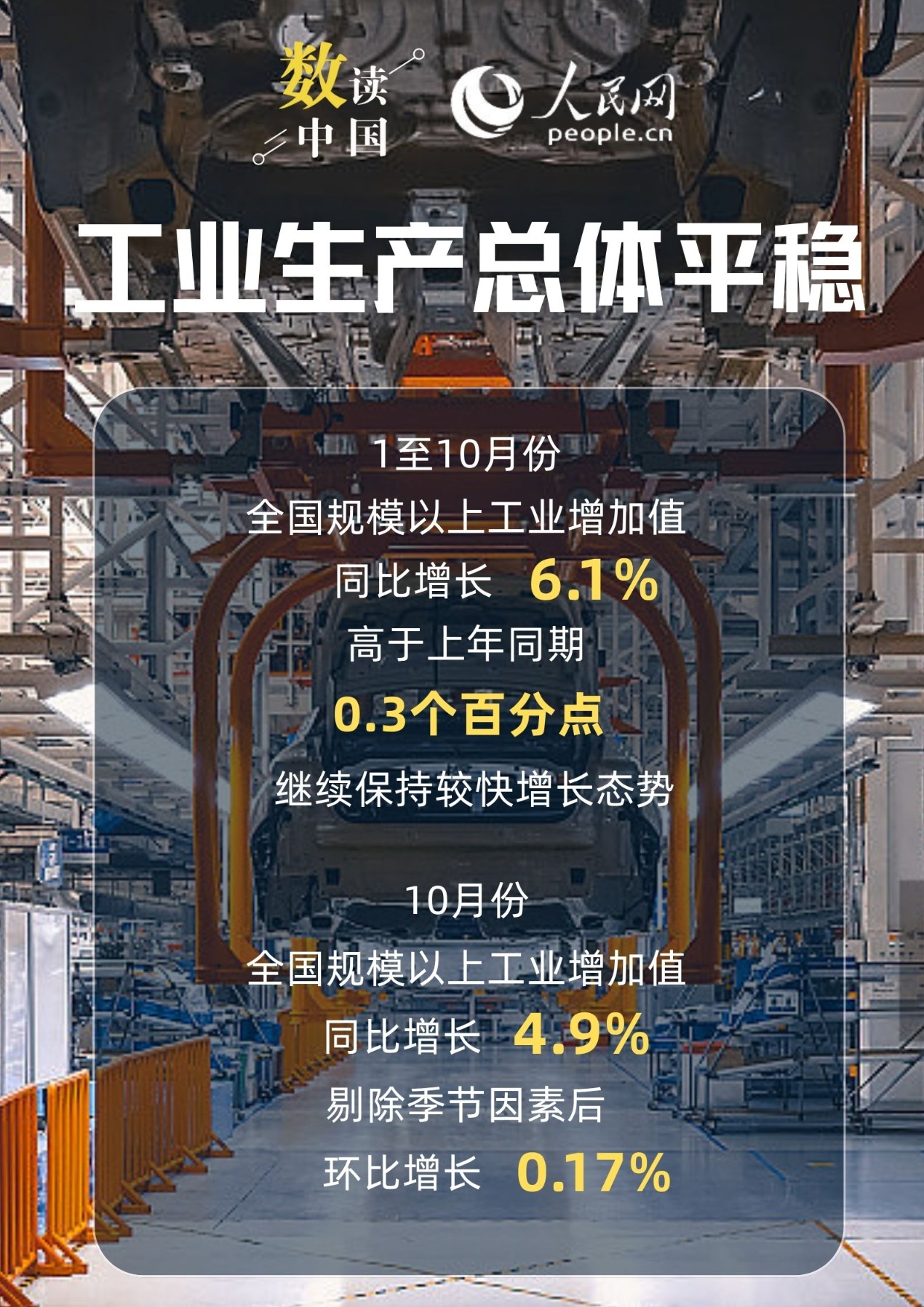
Group 1 - The industrial value-added of large-scale industries in China increased by 6.1% year-on-year from January to October, indicating steady industrial production and optimization of industrial structure [1] - In October, the value-added of large-scale equipment manufacturing increased by 8.0% year-on-year, accounting for 36.1% of the total value-added of large-scale industries, which is an increase of 1.5 percentage points compared to the full year of 2024 [2] - All eight sectors within the equipment manufacturing industry achieved growth in October [3] Group 2 - The value-added of the petroleum processing industry increased by 10% in October, with biomass fuel processing growing by 19.1%, contributing to the overall growth of the petroleum processing sector [6][7] - The high-tech manufacturing industry saw a year-on-year increase of 7.2% in October, with digital product manufacturing growing by 6.7%, surpassing the overall growth of large-scale industries by 2.3 and 1.8 percentage points respectively [8] - The production of new energy vehicles increased by 19% year-on-year in October, driving a 30.4% growth in lithium-ion batteries for automotive use [9]
苏州市一般贸易和加工贸易齐头并进
Su Zhou Ri Bao· 2025-11-19 00:33
Core Insights - Suzhou's total import and export value reached 2.28 trillion yuan in the first ten months of the year, marking a 6% year-on-year increase, accounting for 6.1% of the national and 46.7% of the provincial foreign trade [1] Trade Performance - Exports amounted to 1.43 trillion yuan, growing by 7%, while imports were 852.96 billion yuan, with a growth of 4.5% [1] - General trade and processing trade both saw growth, with general trade increasing by 7.3% and processing trade by 5.8%, together representing 42.7% of the city's foreign trade [1] - Bonded logistics grew by 2%, making up 13.4% of the total, while foreign-invested equipment imports surged to 990 million yuan, a remarkable increase of 165% [1] Trade Partners and Belt and Road Initiative - The city’s trade with countries and regions involved in the Belt and Road Initiative reached 1.02 trillion yuan, a 15.7% increase, constituting 44.7% of the total foreign trade [1] - Trade with ASEAN countries grew by 26%, now representing 19.1% of the city's foreign trade, an increase of 3 percentage points [1] - Trade with the Middle East, India, and Africa saw increases of 20.8%, 34%, and 24.6% respectively [1] Export Product Structure - The export structure is increasingly high-end, with equipment manufacturing exports totaling 1.11 trillion yuan, a growth of 7.3%, accounting for 77.7% of total exports [1] - The contribution of equipment manufacturing to the city's export growth exceeded 80% [1] - Notable growth was observed in electrical machinery and equipment manufacturing exports, which rose by 13.3%, and in the railway, shipbuilding, aerospace, and other transportation equipment manufacturing sectors, which grew by 22% [1]