
电影

Search documents
【文体市场面面观】从“一高一深”看消费潜力
Sou Hu Cai Jing· 2026-01-11 05:06
Core Insights - The Chinese film market is projected to achieve a box office of 51.832 billion yuan and 1.238 billion viewers by 2025, both reflecting over 20% growth [2] - The film consumption market is characterized as "experiential" and "emotional," indicating a strong connection to consumer enthusiasm and cultural aspirations [2] Group 1: Market Dynamics - The "high" market consists of economically developed regions like Guangdong, Jiangsu, Zhejiang, and Shanghai, which have high per capita income and strong cultural consumption willingness, serving as the main contributors to national box office revenue [2][3] - Guangdong has consistently been the top box office contributor, exemplified by its significant contribution of over 1.65 billion yuan to the record-breaking 15.4 billion yuan box office of "Ne Zha" [2] - The "deep" market includes third and fourth-tier cities, which have seen a rising share of box office revenue, reaching the highest contribution in five years in 2025, with over 58% of box office revenue coming from these areas during the 2025 Spring Festival [3] Group 2: Future Opportunities - To unlock further consumption potential, it is essential to understand the characteristics of both "high" and "deep" markets, focusing on their inherent demands [4] - The high-demand from developed regions will drive the film industry to enhance production quality and content innovation, promoting high-quality development [4] - The enthusiasm from the vast lower-tier markets and their emotional resonance with local narratives provide a solid foundation for domestic films, encouraging the emergence of diverse and relatable content [4]


2026青葱青年影展(广州)开幕
Xin Lang Cai Jing· 2026-01-11 04:50
Core Viewpoint - The 2026 Qing Cong Youth Film Festival opened in Guangzhou, featuring the film "The Siege of Kowloon Walled City" as its opening film, directed by Zheng Baorui [1][3]. Group 1: Event Details - The festival is hosted by the China Film Directors Association and is held at the China Film International Cinema in Guangzhou [1][3]. - The opening ceremony was presided over by Jia Zhangke, the president of the China Film Directors Association, with notable attendees including Zheng Baorui, Wang Hongwei, and other filmmakers [3]. - The festival will last for four days and will showcase 22 films, including titles like "Catching the Wind," "The Girl," and "The First Part of Fengshen: Chaoge Wind and Cloud" [3][4]. Group 2: Film Highlights - "The Siege of Kowloon Walled City" is set to be released in 2024 and features actors such as Louis Koo and Lin Feng, depicting a story of a young man caught in a conflict within the Kowloon Walled City during the 1980s [3]. - The film has received critical acclaim, winning nine awards at the 43rd Hong Kong Film Awards, including Best Film and Best Director [3]. - Zheng Baorui emphasized the film's aim to retain the authentic atmosphere of the Walled City, focusing on characters relatable to the audience rather than traditional heroes [3]. Group 3: Youth Film Initiative - The Qing Cong Youth Film Festival is part of the Qing Cong Plan, which supports young filmmakers in China [4]. - Previous events under the Qing Cong Plan include various themed film exhibitions and online short film screenings, aimed at fostering connections between established and emerging filmmakers [4].

海南启动电影促消费活动
Zheng Quan Shi Bao Wang· 2026-01-11 04:04
Core Viewpoint - The Hainan Province film promotion activity officially launched on January 10, aiming to boost consumer spending in the film industry through ticket discounts for local users [1] Group 1 - The event is organized by the Hainan Provincial Film Bureau and undertaken by Hainan Film Co., Ltd [1] - The promotional activity utilizes a single ticket discount method, providing daily viewing benefits to users in Hainan [1]
经济日报:从“一高一深”看消费潜力
Xin Lang Cai Jing· 2026-01-11 03:48
Core Insights - The Chinese film market is projected to achieve a box office of 51.832 billion yuan and 1.238 billion viewers by 2025, both reflecting over 20% growth [1] - The film consumption market is characterized as "experiential" and "emotional," indicating a strong connection to consumer sentiment and cultural aspirations [1] Group 1: Market Dynamics - The film market's vitality showcases the resilience and potential of China's domestic demand, especially in the context of broader consumption challenges [1] - The "high" market consists of economically developed regions like Guangdong, Jiangsu, Zhejiang, and Shanghai, which are key contributors to box office revenue due to high income levels and mature viewing habits [2] - Guangdong has consistently been the top box office contributor, exemplified by its significant contribution of over 1.65 billion yuan to the record-breaking 15.4 billion yuan box office of "Ne Zha" [1][2] Group 2: Emerging Markets - The "deep" market refers to the growing influence of third and fourth-tier cities, which have seen an increasing share of box office revenue, reaching the highest contribution in five years by 2025 [2] - During the 2025 Spring Festival, box office revenue from third and fourth-tier cities exceeded 58%, establishing them as the primary revenue source [2] - The development of infrastructure and commercial activities in these areas is expected to further enhance viewing demand, transforming them into innovative spaces for new consumption habits and industry ecosystems [2] Group 3: Future Opportunities - To unlock further consumption potential, it is essential to understand the unique characteristics of both "high" and "deep" markets [3] - The high expectations for film quality in developed regions will drive the film industry towards higher production standards and content innovation [3] - The enthusiasm for local narratives in the deep market provides a solid foundation for domestic films, encouraging the emergence of diverse and relatable content [3] - Both market segments can mutually reinforce each other, creating a sustainable growth engine for film consumption and enhancing the market transformation of Chinese stories [3]
开年电影市场“新”观察·按下“启动键”!透过10亿元票房看消费市场活力足、潜力大
Yang Shi Wang· 2026-01-11 03:38
Core Insights - The Chinese film market has shown strong momentum and significant growth potential, achieving over 1.09 billion yuan in box office revenue within the first ten days of January 2026, marking a more than 10% increase compared to the same period last year [2][4]. Group 1: Box Office Performance - The box office performance during the typically slow season between New Year's and the Spring Festival has defied expectations, indicating a robust start for the Chinese film market in 2026 [4]. - The 1 billion yuan box office is attributed to multiple films performing well rather than a single blockbuster, showcasing a diverse range of offerings [8]. Group 2: Film Content and Variety - A rich supply of creative content has contributed to the box office success, with a variety of genres including suspense, realistic themes, classic IPs, and family-friendly films being released [6]. - Notable films such as "The Killing," "The Sky of Our Fathers," "The Hidden Kill," and "The Qin Chronicles" have collectively driven audience interest, alongside popular imported films like "Zootopia 2" and "Avatar 3" [8][10]. Group 3: Consumer Engagement and Market Dynamics - The 1 billion yuan box office serves as a clear signal of the vibrant and expansive potential of the Chinese consumer market, with the film industry leading the charge towards future growth [12]. - The cinema experience has evolved beyond mere film screenings, becoming a catalyst for a broader consumption chain, supported by initiatives from various government bodies to promote film-related activities and consumer engagement [13].

2025,银幕内外气象万千
Xin Lang Cai Jing· 2026-01-11 02:48
Core Insights - The Chinese film market experienced significant growth in 2025, with total box office revenue reaching 51.832 billion yuan, of which domestic films accounted for 41.293 billion yuan, representing 79.67% of the total [1][2] - Animation films had a historic breakthrough, generating over 24.5 billion yuan in box office revenue, nearly half of the total annual revenue, with key titles like "Nezha: The Devil's Child" and "The Little Monster of Langlang Mountain" leading the charge [2][3] - The audience's expectations for "good movies" have increased, with a shift towards seeking deeper, more meaningful experiences rather than mere entertainment [3][4] Film Market Dynamics - The film market's scheduling engine remains strong, with distinct periods like the Spring Festival, summer, and National Day showcasing diverse genres and styles, leading to a record audience satisfaction score of 85.4 during the National Day period [2] - High-quality and diverse content is essential for maintaining audience engagement, as evidenced by the long-tail effects of well-received films [2][3] Technological Advancements - Upgraded technology, such as CINITY LED and immersive experiences like VR and XR, enhances the viewing experience, contributing to the perception of value for ticket prices [3][4] - The integration of technology allows for expanded expression and development of film IPs, creating new opportunities in the consumer ecosystem [3][5] Cultural and Economic Integration - The film industry has evolved into a significant cultural and economic force, with movie tickets becoming gateways to a broader ecosystem encompassing tourism, retail, and emotional experiences [5][6] - Collaborative efforts across departments have fostered innovative models like "film + tourism" and "film + food," promoting deeper integration of cinema with the national economy [5][6] IP and Derivative Markets - The market for IP derivatives has shifted from merely selling merchandise to building comprehensive ecosystems, with successful titles launching numerous related products and experiences [6] - Emotional engagement has become the core driver of derivative consumption, as seen with projects like "The Little Monster of Langlang Mountain" and its extensive range of merchandise [6]
数读2025:动画电影票房超250亿,中国电影的未来究竟在哪?
Xin Lang Cai Jing· 2026-01-11 02:00
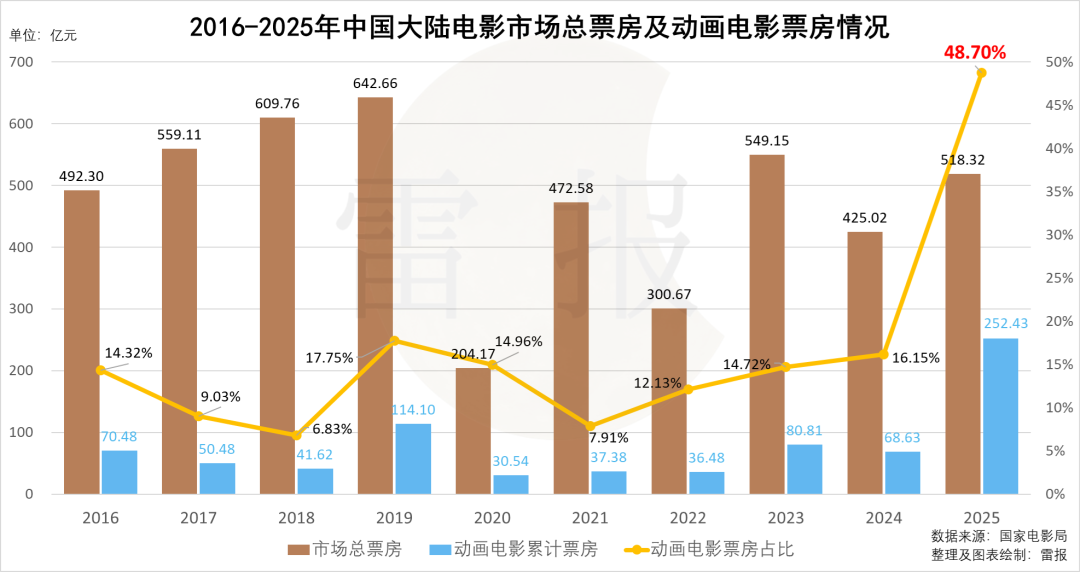
Core Insights - The Chinese film market in 2025 set numerous records, with a total box office of 51.832 billion yuan, a year-on-year increase of 21.95%, and 1.238 billion cinema admissions, up 22.57% from the previous year. However, it still fell short of the 2019 peak by over 12 billion yuan [1][3]. Animation Film Performance - Animation films were the standout category, achieving a total box office of 25.243 billion yuan, a staggering increase of 268% year-on-year, and capturing nearly 50% of the market share [3][4]. - Major hits included "Nezha: The Devil's Child" with a box office of 15.446 billion yuan, accounting for 30% of the annual total, and "Zootopia 2," which surpassed 4.26 billion yuan in just five days [3][4]. - Despite the success of top films, the overall industry faced challenges such as audience attrition and an imbalance in film types, with a significant drop in the under-25 demographic from 39% in 2017-2019 to 15% in 2025 [3][4]. Box Office Trends - The year saw four films surpassing 3 billion yuan, collectively accounting for over half of the total box office, but only 51 films crossed the 100 million yuan mark, indicating a growing gap in mid-tier films [4][9]. - The animation sector released 57 films, with "Nezha 2" leading the box office, yet many domestic animated films struggled to reach the 100 million yuan threshold, highlighting a persistent ceiling in the industry [6][9]. Audience Engagement and Ratings - The average Douban rating for films in 2025 was 7.1, slightly down from the previous year, with 16 films rated above 8, including several re-releases of classic films [13]. - The top-rated new films included "The Legend of Hei 2" and "Demon Slayer: Mugen Train," indicating a strong performance for recent releases [13]. Industry Challenges - The animation sector's reliance on a few major players has led to a "head and shoulders" market structure, with a lack of mid-tier creative output contributing to the industry's challenges [9][11]. - Despite the overall box office growth, the number of films grossing over 100 million yuan decreased, reflecting a decline in the mid-tier film market [9][11]. IP and Revenue Diversification - The film industry is increasingly moving towards a model that emphasizes IP commercialization beyond box office revenue, with companies exploring merchandise and licensing opportunities [21][22]. - Successful films like "Nezha 2" have generated significant revenue from merchandise, with projections suggesting sales could reach hundreds of billions [22][25]. - Companies like Wanda Film and Shanghai Film are actively investing in derivative product lines and diversifying revenue streams through IP collaborations [23][25]. Conclusion - The animation film sector is becoming a leader in the commercialization of film IP, transitioning from a single revenue model to a more integrated approach that combines content, experience, and supply chain management [30].


2026中国电影市场“淡季不淡”实现开门红
Yang Shi Wang· 2026-01-11 00:06
Core Insights - The Chinese film market has shown strong momentum and significant growth potential as it enters 2026, marking a positive start to the year [1] Industry Summary - The Chinese film market is experiencing a robust opening in 2026, indicating its strong dynamics and vast growth potential [1]
银幕内外气象万千
Jing Ji Ri Bao· 2026-01-10 21:57
Core Insights - The Chinese film market experienced significant growth in 2025, with total box office revenue reaching 51.832 billion yuan, of which domestic films accounted for 41.293 billion yuan, representing 79.67% of the total [1] - Animation films had a historic breakout year, contributing over 24.5 billion yuan to the total box office, nearly half of the annual revenue [2] - The audience's expectations for "good movies" have increased, with a shift towards seeking deeper, more meaningful experiences rather than mere entertainment [4] Group 1: Market Performance - In 2025, the total box office reached 51.832 billion yuan, with domestic films making up 79.67% of the total [1] - Animation films generated over 24.5 billion yuan, marking a significant portion of the overall box office [2] - The audience satisfaction during the National Day holiday reached a four-year high of 85.4 points, indicating a successful engagement between diverse film types and viewers [3] Group 2: Audience Expectations - The term "value" became a key descriptor for audience evaluations of films in 2025, reflecting a shift towards seeking profound experiences [4] - High-rated films, such as "Nanjing Photo Studio" and "The Little Monster of Langlang Mountain," demonstrated strong box office performance and long-tail effects, indicating a growing market return cycle for quality films [4] - Emotional resonance and visual effects were identified as primary drivers for audience attendance, while narrative flaws were a major deterrent [5] Group 3: Industry Innovations - The film industry is increasingly integrating with tourism and retail, creating a multi-billion yuan ecosystem that enhances consumer experiences [6] - Collaborative efforts across departments have led to innovative models like "film + tourism" and "film + food," promoting deeper integration with the national economy [6] - The IP derivative market is evolving from merely selling merchandise to building comprehensive ecosystems, with projects like "The Little Monster of Langlang Mountain" launching over 800 derivative products [7]
从“一高一深”看消费潜力
Jing Ji Ri Bao· 2026-01-10 21:42
Core Insights - The Chinese film market is projected to achieve a box office of 51.832 billion yuan and 1.238 billion admissions by 2025, both reflecting over 20% growth [1] - The film consumption market is characterized as "experiential" and "emotional," indicating a strong connection to consumer sentiment and cultural aspirations [1] Group 1: Market Dynamics - The film market's vitality showcases the resilience and potential of China's domestic demand, especially in the context of broader consumption challenges [1] - The "high" market refers to economically developed regions like Guangdong, Jiangsu, Zhejiang, and Shanghai, which have high per capita income and strong cultural consumption willingness, contributing significantly to national box office revenues [2] - Guangdong has consistently been a leading box office contributor, exemplified by its 16.5 billion yuan contribution to the 154 billion yuan box office of "Ne Zha" and its 1.13 billion yuan box office during the 2026 New Year holiday [1] Group 2: Emerging Markets - The "deep" market encompasses third and fourth-tier cities, where the box office contribution has been rising, reaching its highest level in five years in 2025 [2] - During the 2025 Spring Festival, third and fourth-tier cities accounted for over 58% of the box office, establishing themselves as the primary revenue source [2] - The development of infrastructure and commercial activities in these areas is expected to further unleash viewing demand, transforming them into innovative spaces for new consumption habits and operational models [2] Group 3: Future Opportunities - To unlock further consumption potential, it is essential to understand the characteristics of both "high" and "deep" markets, focusing on their intrinsic demands [3] - The high-quality expectations from developed regions will drive the film industry to enhance production standards and content innovation, promoting high-quality development [3] - The enthusiasm for local narratives in the deep market provides a solid foundation for domestic films, encouraging the emergence of diverse and relatable content [3] - Both market segments will mutually reinforce each other, creating a sustainable growth engine for film consumption and expanding the space for cultural dissemination of Chinese stories [3]