
私募

Search documents
牛市催生新一轮“公奔私”浪潮!头部私募老将复胜陆航、望正王鹏辉三连榜
私募排排网· 2025-09-25 10:00
Core Viewpoint - The article discusses the increasing trend of public fund managers transitioning to private equity, driven by changes in incentive mechanisms, a shift away from star managers, and a bullish market environment since 2025 [1]. Group 1: Public to Private Transition - As of September 19, 2023, a total of 307 public fund managers have left their positions this year, marking a five-year high, with several star managers rumored to join private equity firms [1]. - Notable managers who have transitioned include Zhou Haidong from Huashang Fund and Bao Wuke from Invesco Great Wall, both reportedly joining Hillhouse Capital's Lingren Investment [1]. Group 2: Performance of Transitioned Managers - Among the 859 former public fund managers, those who have moved to private equity have shown strong performance, with average returns of 28.26%, 57.63%, and 58.89% over the past year, three years, and since the beginning of the year, respectively [1]. - The top-performing managers in the current year include Wang Penghui from Wangzheng Asset, who leads with an average return of ***% [2][4]. Group 3: Top Managers by Performance - In the current year, the top 10 "public to private" fund managers have a performance threshold of ***%, with 9 being from subjective private equity and only 1 from quantitative private equity [2]. - Wang Penghui from Wangzheng Asset ranks first, with an average return of ***% across three products [4]. - The only quantitative manager in the top ranks is Nie Shouhua from Hanrong Investment, with an average return of ***% [5]. Group 4: Yearly and Three-Year Performance - In the past year, Zeng Weijiang from Beijing Zhenke Private Equity achieved the highest average return of ***%, with 8 out of the top 10 managers being from subjective private equity [6][7]. - Over the past three years, Zeng Weijiang also leads with an average return of ***%, with Wang Penghui and Lu Hang appearing in the top ranks multiple times [9][10].


BD上半场还未结束!30年投资老将深谈创新药投资,以及当下迎接稳牛的姿势……
聪明投资者· 2025-09-25 07:04
Core Viewpoint - The article discusses the significant growth of the Hong Kong innovative drug sector, which has seen indices rise over 100% this year, and emphasizes the importance of understanding the underlying companies rather than just focusing on standout products [2][4]. Group 1: Research Perspective - The research approach taken by Chen Jialin focuses on the governance structure of companies, which is crucial for identifying sustainable growth and avoiding potential pitfalls [5][17]. - Chen emphasizes the importance of filtering out noise from public information while still valuing the insights gained from company reports and management discussions [6][7]. - The need to consider the buyer's perspective in the BD (business development) model is highlighted, as issues with large overseas buyers could impact the Chinese innovative drug market [7][60]. Group 2: Market Dynamics - The innovative drug sector is currently experiencing a phase of structural differentiation, with a shift towards capturing alpha opportunities as the market stabilizes after a period of rapid growth [4][12]. - The article notes that the innovative drug industry is in a long-term growth trajectory, with significant potential for returns, particularly in the context of global market dynamics and China's increasing share in the sector [14][66]. - Chen points out that the current market environment is characterized by high uncertainty, which poses challenges for sustaining excess returns [16][70]. Group 3: Investment Strategy - The investment strategy discussed involves a balanced approach between aggressive and defensive positions, with a focus on minimizing errors rather than chasing opportunities [9][10]. - Chen advocates for a trading strategy that capitalizes on human behavioral biases, allowing for the identification of mispriced opportunities in the market [42][43]. - The importance of understanding the broader geopolitical and economic landscape is emphasized, as these factors can significantly influence market conditions and investment outcomes [16][66]. Group 4: Future Outlook - The article suggests that the current phase of the BD model is not yet complete, with ongoing developments in the innovative drug sector expected to yield further opportunities [64][65]. - Chen expresses optimism about the future of Chinese innovative drug companies, citing their competitive advantages in R&D efficiency and market access [68][69]. - The potential risks associated with external factors, such as regulatory changes and market sentiment, are acknowledged, but the overall trend remains positive for the sector [60][63].
量化CTA新规实施在即!最新十强揭晓!信弘天禾、会世私募、双隆投资等夺冠!
私募排排网· 2025-09-25 07:00
Core Viewpoint - The article discusses the regulatory developments in quantitative trading in China's securities and futures markets, highlighting the growth and performance of quantitative CTA strategies in the private equity sector amidst market fluctuations [1][3]. Regulatory Developments - The China Securities Regulatory Commission (CSRC) introduced the "Securities Market Algorithmic Trading Management Measures" in 2024, marking the beginning of standardized development for quantitative trading in the stock market [1]. - The new regulations for algorithmic trading in the futures market, which have been in trial since June, will officially take effect on October 9 [1]. Performance of Quantitative CTA Strategies - Quantitative CTA strategies have gained popularity among investors due to their low correlation with stocks and bonds, especially in volatile market conditions [1]. - From 2021 to the end of 2024, quantitative CTA strategies significantly outperformed subjective long and quantitative long strategies during a turbulent market [1]. Year-to-Date Performance Comparison - As of September 19, 2023, the average return for 399 quantitative CTA products was 10.84%, while subjective long strategies averaged 34.59% and quantitative long strategies averaged 37.05% [3]. - Among private equity firms managing over 5 billion, the average return for quantitative CTA products was 7.63%, with 87.10% showing positive returns [3]. Top Performing Quantitative CTA Products - The article lists the top-performing quantitative CTA products for the year, with the leading product managed by 信弘天禾 (Xinhong Tianhe) achieving a return of ***% [4][5]. - Other notable products include those managed by 宏锡基金 (Hongxi Fund) and 洛书投资 (Luoshu Investment), which also performed well [4][5]. Performance in Different Fund Sizes - For private equity firms with assets between 20-50 billion, the average return for quantitative CTA products was 6.42%, with a positive return rate of 93.94% [6]. - In the 10-20 billion category, the average return was 11.04%, with a positive return rate of 97.56% [9]. - For firms managing 5-10 billion, the average return was 7.45%, with 84.21% showing positive returns [11]. - In the smallest category (0-5 billion), the average return was 14.15%, with 83.05% of products achieving positive returns [13]. Conclusion on Market Trends - The article emphasizes the potential for growth in the quantitative trading market in China, suggesting that it is still in a phase of rapid development with significant future opportunities [5].

茂源量化:近三年百亿量化领先!平台化建设+实业级管理,长跑出复利 | 量化私募风云录
私募排排网· 2025-09-25 04:07
Core Viewpoint - The article highlights the rapid rise of quantitative investment in the absence of strong beta market trends, emphasizing its ability to efficiently capture alpha returns through mathematical models and algorithms [2] Group 1: Company Overview - Maoyuan Quantitative was established in 2013 and has grown to manage over 20 billion yuan, focusing on quantitative trading across various asset classes including stocks, futures, and bonds [5] - The company has received multiple awards, including recognition as one of the "Top 50 Private Securities Institutions (Quantitative Strategy)" in China, showcasing its consistent performance over the years [5][9] Group 2: Leadership and Team - The founder and CEO, Guo Xuewen, has a strong academic background and entrepreneurial experience, which has influenced the company's management and operational strategies [7][13] - The team is characterized by a high proportion of IT and research personnel, with over 75% of the workforce coming from leading tech companies, enhancing the company's engineering capabilities [14][17] Group 3: Investment Strategies and Products - Maoyuan Quantitative offers a diverse product matrix tailored to different investor needs, including tool-type products for experienced investors and solution-type products for those seeking comprehensive investment strategies [20] - The company emphasizes the importance of risk-return characteristics in its product offerings, aiming to provide stable excess returns while exploring new product lines [18][20] Group 4: Risk Management - The company has established a comprehensive risk management framework that includes both broad and narrow risk assessments, ensuring systematic oversight of operational and investment risks [21] - Risk management processes are integrated into all stages of investment, from pre-trade analysis to post-trade evaluations, enhancing overall effectiveness [21] Group 5: Future Outlook - The article suggests that the quantitative investment industry in China is on a path to becoming globally competitive, with Maoyuan Quantitative aiming to enhance its management practices and research capabilities [22][23] - The company is focused on continuous improvement and innovation, with plans to expand its investment strategies beyond domestic markets [23]

金融活水润民生,银河证券携手私募共助“心青年”
Zhong Guo Zheng Quan Bao· 2025-09-24 11:47
Group 1 - The charity concert organized by Galaxy Securities aimed to raise funds for employment support for individuals with intellectual disabilities, highlighting the importance of corporate social responsibility [1][2] - The concert featured performances by individuals from the intellectual disability community, showcasing their resilience and deepening the understanding of social responsibility among financial professionals [1][2] - Galaxy Securities emphasizes its commitment to "political and people-oriented" principles, reflecting its role as a state-owned financial enterprise in serving the public [1][2] Group 2 - The concert raised awareness about the challenges faced by individuals with intellectual disabilities, with estimates indicating that there are between 12 million to 25 million such individuals in China, including 100,000 to 200,000 in Beijing [2] - The funds raised will primarily be used to hire professional employment counselors to assist these individuals in integrating into the workforce [2] - Financial institutions are increasingly participating in charitable activities as part of their commitment to inclusive finance and serving the real economy [2][5] Group 3 - Private equity firms, such as Ming Stone Fund and Quantum Finance, actively participated in the concert, demonstrating the deep connection between charity and investment [3] - The concept of long-term commitment is emphasized, with firms expressing the need for sustained efforts in both investment and charitable activities [3] - Financial institutions are exploring collaborations with social organizations to enhance the effectiveness of their charitable contributions [5] Group 4 - The financial sector's involvement in charity is expected to evolve from voluntary actions to more institutionalized and standardized practices [5] - Galaxy Securities launched the "Star Charity Plan" in 2022 to encourage participation from charitable organizations and individuals, aiming to extend social responsibility to special groups [5] - The collaboration between financial institutions and social organizations is seen as a way to optimize resource allocation and ensure effective use of funds [5]
私募仓位飙升至年内新高
Guo Ji Jin Rong Bao· 2025-09-24 02:19
| | | | 近一个月不同规模股票私募仓位指数统计 | | | | | --- | --- | --- | --- | --- | --- | --- | | 日期 | | | 100亿以上 50-100亿 20-50亿 10-20 亿 5-10 亿 5 亿以下 | | | | | 2025-09-12 | 78. 22 | 86. 49 | 74.22 | 75. 88 | 76.28 | 78. 85 | | 2025-09-05 | 67.11 | 82. 12 | 73.78 | 73. 31 | 74.21 | 76.77 | | 2025-08-29 | 75. 40 | 82. 86 | 73. 59 | 72. 50 | 73.65 | 76. 63 | | 2025-08-22 | 78. 11 | 82. 23 | 71. 89 | 72.04 | 71.92 | 76. 84 | | 2025-08-15 | 82. 29 | 78. 68 | 68. 75 | | 72.16 70.74 | 75.04 | | | | | 数据来源:私募排排网,截至 2025年9月22 日 | | ...
金融活水润民生:银河证券携手私募共助“心青年”
Zhong Guo Zheng Quan Bao· 2025-09-23 20:16
Core Viewpoint - The charity concert organized by Galaxy Securities aims to raise funds for individuals with intellectual disabilities, highlighting the importance of corporate social responsibility in the financial sector [1][2]. Group 1: Event Overview - The charity concert was held in Beijing, with participation from various private equity managers who contributed donations [1]. - The event focused on a special group of "heart youth"—individuals with intellectual disabilities—who showcased their resilience through music [1]. Group 2: Social Responsibility - Galaxy Securities emphasizes its commitment to "political and people-oriented" corporate missions, reflecting its responsibility as a state-owned financial enterprise [1]. - The concert aims to raise employment support funds for individuals with intellectual disabilities, promoting awareness and understanding of this group [1][2]. Group 3: Employment Challenges - The head of the supporting organization,融爱融乐, stated that individuals with intellectual disabilities face significant barriers to employment, which is their most pressing need [2]. - The funds raised will primarily be used to hire professional employment counselors to assist these individuals in integrating into the workforce [2]. Group 4: Financial Sector's Role - The financial industry is actively promoting various financial initiatives, including inclusive finance, as a means to fulfill its social responsibilities [2]. - Private equity managers, such as鸣石基金, express the importance of giving back to society and investing in education and healthcare as long-term commitments [2]. Group 5: Long-term Commitment - The financial sector's involvement in charity is seen as a reflection of its commitment to long-term social responsibility, aligning with the principles of sustainable investment [3][4]. - Galaxy Securities has previously launched the "Star Good Plan" to encourage participation in social responsibility initiatives, indicating a shift towards institutionalized and standardized charitable actions [3].
量化交易如何做市场效率提升者?
Shang Hai Zheng Quan Bao· 2025-09-23 18:04
Core Insights - Quantitative trading is expanding at an unprecedented pace, with quantitative long strategies being particularly popular in the market [1][3] - The average new fundraising scale for quantitative managers has exceeded 1 billion yuan this year, indicating strong demand for quantitative products [1][3] - Quantitative private equity has become a significant player in the capital market, with its strategies attracting more individual investors [2][3] Group 1: Market Performance - Quantitative long strategy products have shown a strong performance, with top institutions reporting absolute returns exceeding 40% this year [3] - As of the end of August, the average return for 1,303 quantitative long strategy private equity products was 31.84%, compared to 25.62% for subjective long strategy products [3] - The number of new quantitative private equity products registered this year reached 3,584, a year-on-year increase of 100.34%, accounting for 45.33% of new registrations in the securities category [3] Group 2: Market Impact - The average turnover rate for quantitative private equity has been around 80 times, with some leading firms reporting rates between 40 to 60 times [4] - The management scale of quantitative private equity has surpassed 1 trillion yuan, with daily trading volume estimated at around 200 billion yuan, representing over 20% of total market trading volume [4] - Quantitative strategies are particularly influential in trading small-cap stocks, contributing nearly 40% to the trading volume in this segment [4] Group 3: Future Trends - The growth of quantitative trading is expected to enhance market liquidity and potentially transform quantitative private equity into a long-term investor in the capital market [2][7] - Regulatory guidance has led to a more standardized development of the quantitative private equity industry, with firms focusing on optimizing strategies and reducing trading frequency [6][7] - Many leading private equity firms are now emphasizing fundamental factors, with annual turnover rates dropping below 50 times, indicating a shift towards long-term investment strategies [7]
大幅加仓!私募:无需过度担忧短期波动
券商中国· 2025-09-23 05:35
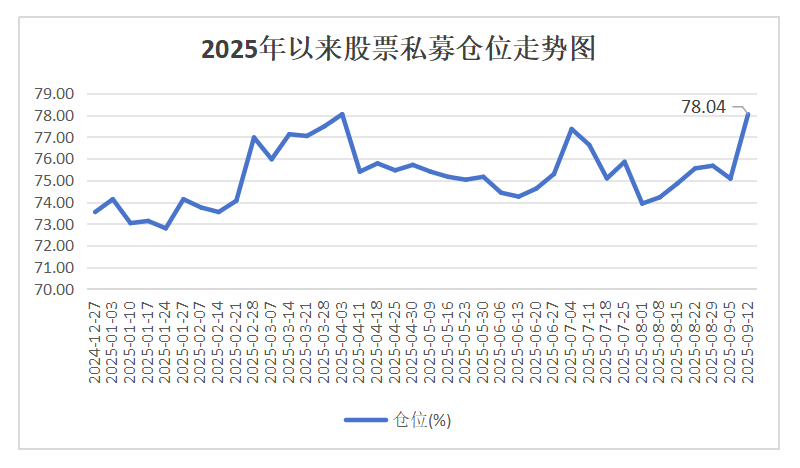
Core Viewpoint - The article highlights the significant increase in the positions of private equity firms in the A-share market, indicating a strong confidence among major institutions in the market's continued upward trend [2][3]. Group 1: Private Equity Positioning - The overall stock private equity position has surged to a new high for the year, with large private equity firms increasing their positions by 11.11% in a single week [2][5]. - As of September 12, 2025, the stock private equity position index reached 78.04%, up 2.96 percentage points from the previous week, reflecting an acceleration in overall allocation enthusiasm among private equity firms [3][4]. - 60.02% of stock private equity firms are fully invested, while 23.34% maintain moderate positions, indicating a strong market participation sentiment [3][6]. Group 2: Reasons for Increased Positions - The recent continuous rise in the A-share market has created a noticeable profit effect, providing direct motivation for private equity firms to increase their positions [4]. - Market sentiment has improved, with investor confidence steadily increasing and risk appetite rising [4]. - Emerging industries such as AI, semiconductors, and new energy are seen as having broad development prospects, presenting structural investment opportunities that are attracting institutional focus [4]. Group 3: Differentiation Among Private Equity Firms - The position indices for private equity firms of various sizes as of September 12 are as follows: over 100 billion, 78.22%; 50-100 billion, 86.49%; 20-50 billion, 74.22%; 10-20 billion, 75.88%; 5-10 billion, 76.28%; and below 5 billion, 78.85% [5]. - The highest position is held by private equity firms in the 50-100 billion range, reaching 86.49%, marking a three-year high, indicating their strong flexibility and research capabilities [5][6]. - Over 54.04% of large private equity firms are fully invested, reflecting a proactive market stance among leading institutions [6]. Group 4: Market Outlook and Volatility - Despite recent market fluctuations, with the CSI 300 down 0.44% and the Shanghai Composite Index down 1.3%, market activity remains vibrant, as evidenced by rising transaction volumes [7]. - The current market is viewed as being in a bull trend, with structural differentiation leading to potential short-term corrections in individual stocks, but the overall market trend remains positive [7][8]. - The article suggests that while some sectors have seen significant gains, the rotation among sectors is driven by the overall market valuation rising rather than fundamental changes in high-valuation stocks [8].

私募仓位升至年内新高 百亿私募加仓力度大
Zhong Guo Jing Ji Wang· 2025-09-23 01:11
Group 1 - The core viewpoint of the articles indicates that stock private equity in the A-share market has significantly increased its positions, reaching a new high for the year, reflecting optimistic expectations for future market trends [1][2] Group 2 - As of September 12, the stock private equity position index reached 78.04%, a substantial increase of 2.96% from the previous week’s 75.08%, indicating a notable rise in overall allocation enthusiasm [1] - The distribution of positions shows that 60.02% of stock private equity is fully invested, while 23.34% maintain moderate positions, and less than 20% are in low or empty positions, suggesting a majority of private equity firms are actively positioning themselves in the market [1] Group 3 - Different scales of stock private equity exhibit varied positioning characteristics, with the largest firms showing particularly strong performance; for instance, the position index for firms with over 100 billion is 78.22%, while those between 50 billion and 100 billion have the highest at 86.49%, marking a three-year peak [1][2] - The increase in positions among large private equity firms is significant, with a week-on-week rise of 11.11% for those managing over 100 billion, where over 54% are fully invested [2]