
脑机接口

Search documents
脑机接口板块高开,创新医疗4连板
Mei Ri Jing Ji Xin Wen· 2026-01-08 01:48
每经AI快讯,1月8日,脑机接口板块高开,创新医疗4连板创新高,爱朋医疗、南京熊猫、海南海药、 岩山科技、菲沃泰跟涨。 (文章来源:每日经济新闻) ...

双融日报-20260108
Huaxin Securities· 2026-01-08 01:38
Market Sentiment - The current market sentiment score is 78, indicating a "relatively hot" market condition, which suggests strong investor confidence [4][7][19]. Hot Themes Tracking - **Robotics Theme**: The establishment of a national standard organization for humanoid robots and embodied intelligence marks a transition from "technical exploration" to "industrial collaboration" and "scale implementation," which is expected to accelerate technology deployment and ecosystem formation. Related stocks include Sanhua Intelligent Control (002050) and Wolong Electric Drive (600580) [4]. - **Banking Theme**: Bank stocks exhibit high dividend characteristics, with the CSI Bank Index yielding 6.02%, significantly higher than the 10-year government bond yield. This makes bank stocks important investment targets for long-term funds like insurance and social security, especially during economic slowdowns. Related stocks include Agricultural Bank of China (601288) and Ningbo Bank (002142) [4]. - **Brain-Computer Interface Theme**: Neuralink plans to begin large-scale production of brain-computer interface devices in 2026, with a projected global market size of $12.4 billion by 2034 and a CAGR of 17% from 2025 to 2034. Related stocks include Apogee Medical (300753) and Maipu Medical (301033) [4]. Capital Flow Analysis - The top ten stocks with the highest net inflow include Aerospace Development (000547) with a net inflow of 193.34 million, Greenme (002340) with 126.57 million, and Northern Huachuang (002371) with 125.67 million [8]. - The top ten stocks with the highest net outflow include Leike Defense (002413) with a net outflow of -210.86 million, Haige Communication (002465) with -197.38 million, and Sanhua Intelligent Control (002050) with -192.55 million [10]. Industry Insights - The banking sector is highlighted for its stability and high dividend yield, making it a preferred choice for long-term investors during periods of economic uncertainty [4]. - The robotics industry is poised for significant growth due to the establishment of standards that will facilitate collaboration and reduce development costs, indicating a shift towards large-scale applications [4]. - The brain-computer interface market is expected to grow rapidly, driven by advancements in technology and increasing demand for innovative medical solutions [4].
A股开盘:沪指跌0.2%、创业板指跌0.63%,脑机接口、光刻胶概念股走高,稀土永磁及金属板块调整
Jin Rong Jie· 2026-01-08 01:37
Market Overview - On January 8, A-shares opened lower across the board, with the Shanghai Composite Index down 0.2% at 4077.72 points, the Shenzhen Component down 0.42% at 13971.89 points, and the ChiNext Index down 0.63% at 3308.74 points [1] - The rare earth permanent magnet sector saw initial declines, with Huaxin Environmental falling over 4% and Zhongke Magnetic down over 3% [1] - The brain-computer interface sector was active, with Innovation Medical hitting a new high after four consecutive trading limits, and several other related stocks also rising [1] - The industrial metals sector experienced declines, with China Aluminum, Tianshan Aluminum, and Jiangxi Copper all down over 2% [1] Company News - Fenglong Co., Ltd. experienced a continuous trading limit from December 25, 2025, to January 7, 2026, with a cumulative increase exceeding 100%, indicating significant market deviation and potential speculation risks [2] - Sumida plans to acquire 60 million shares of Blue Science and Technology from its controlling shareholder at a price of 6.71 yuan per share, totaling 403 million yuan, which will increase its stake to 21.72% [2] - Kecuan Technology's subsidiary has built production capacity for optical modules and completed the first silicon photonic chip trial, although it has not yet generated significant revenue [2] Industry Insights - Prit's LCP film products are suitable for use as flexible electrode materials in brain-computer interfaces, with the company being the only domestic entity to achieve significant breakthroughs in this technology [3] - The global transformer market is expected to reach $103 billion by 2031, driven by increased demand for electrical equipment and significant investments in global power grids [11] - The liquid cooling market is projected to reach $16.5 billion by 2026, with a compound annual growth rate of approximately 59% [8] Financial Projections - Zhongke Blue News expects a net profit of 1.4 to 1.43 billion yuan for 2025, a year-on-year increase of 366.51% to 376.51%, with revenue projected at 1.83 to 1.85 billion yuan [4] - Fuhua Co., Ltd. plans to raise up to 700 million yuan through convertible bonds for various projects, including a production base in Vietnam and energy storage systems [5] - Anpei Long intends to raise up to 544 million yuan through a targeted stock issuance for expansion projects related to pressure sensors and MEMS sensor chip development [6]


机构:脑机接口全球市场规模有望迎来爆发式增长
Zheng Quan Shi Bao Wang· 2026-01-08 00:54
Core Viewpoint - The brain-computer interface (BCI) industry is at a critical juncture of transitioning from technological breakthroughs to commercial viability, driven by policies, technology, and application scenarios [1] Group 1: Industry Developments - The "2026 Brain-Computer Interface Developer Conference" is scheduled to be held in Tianjin on February 3-4, 2026, organized by the Brain-Computer Interface Industry Alliance, the Human-Machine Interaction and Co-Integration Haihe Laboratory, and Tianjin University [1] - The industry is benefiting from policy incentives such as the "14th Five-Year Plan," medical insurance coding, and the establishment of medical device standards, which are expected to catalyze significant growth in the global market [1] Group 2: Product Insights - Invasive BCI products are still undergoing clinical trials, while non-invasive products have started to enter the market, including medical rehabilitation systems and consumer sleep aids [1] - The development of chips, electrodes, and algorithms, along with the continuous improvement of regulations and standards, is expected to lead to a surge in commercialized BCI products in the coming years [1] Group 3: Investment Opportunities - The BCI industry, characterized as a high-growth sector integrating multiple cutting-edge technologies, is moving towards a critical phase of large-scale application, supported by strong policy backing and ongoing technological advancements [1] - Domestic companies have achieved parity with international leaders in certain areas, demonstrating notable performance in device miniaturization, signal transmission rates, and safety [1] - There are promising investment opportunities in the mid-to-long term across the related industry chain [1]
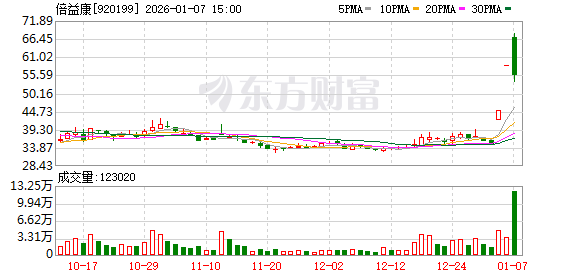
四川脑机接口产业爆发 倍益康连续上涨
Zheng Quan Shi Bao· 2026-01-07 18:09
Core Insights - The brain-computer interface (BCI) sector is experiencing significant growth, particularly in Sichuan, where the establishment of the "Implantable Brain-Computer Interface Sichuan Engineering Research Center" has led to substantial stock price increases for involved companies like Beiyikang, which saw a rise of over 60% in three trading days [2] - The Sichuan BCI industry is projected to reach a scale of 1 billion yuan by 2024, with related investments of 500 million yuan and R&D expenditures of 300 million yuan, positioning it among the top in the country [2] Group 1: Industry Development - The Sichuan Provincial Economic and Information Technology Department, along with eight other departments, issued the "Sichuan Province Brain-Computer Interface and Human-Machine Interaction Industry Breakthrough Action Plan (2025-2030)," detailing 13 measures aimed at enhancing the province's competitiveness in the BCI sector by 2030 [3] - The province has established a comprehensive industrial chain ecosystem, including upstream core components, midstream system integration, and downstream application scenarios, with a steady increase in the localization rate of key components and software [4] Group 2: Technological Advancements - Sichuan has achieved international advanced levels in non-invasive BCI technologies, including cloud brain information processing and real-time decoding techniques, showcasing significant technological innovation [4] - The province is focusing on core technology breakthroughs through the establishment of innovation platforms, joint laboratories, and engineering centers, while also enhancing the verification and registration of medical devices [5] Group 3: Company Initiatives - The establishment of Gestalt Technology, the first BCI company in China focusing on ultrasound technology, marks a significant development in the sector, aiming to accelerate the clinical application of BCI technologies [6] - The company was co-founded by notable figures in the tech industry, indicating strong leadership and potential for innovation in the BCI field [6]

二级市场“狂欢” 脑机接口走进现实
Bei Jing Shang Bao· 2026-01-07 15:39
Core Insights - The brain-computer interface (BCI) sector is gaining significant attention in the A-share market, with a notable surge in stock prices since January 5, 2026, leading to a cumulative increase of approximately 18% over three trading days [1][3] - Experts predict that 2026 will be a pivotal year for the commercialization of BCI technology, driven by advancements in technology, influx of capital, and market expectations [1] Market Performance - The human brain engineering sector experienced a cumulative increase of 17.98% over the first three trading days of 2026 [3] - Notable stocks such as Innovation Medical and Nanjing Panda have achieved consecutive trading limits, with Innovation Medical's stock price reaching 28.63 yuan per share on January 7, 2026 [4][3] Key Developments - Elon Musk's Neuralink plans to begin large-scale production of BCI devices in 2026, transitioning to a more streamlined and automated surgical process [3] - Strong Brain Technology recently completed approximately 2 billion yuan in financing, marking it as the second-largest financing in the BCI sector after Neuralink [3] Company Insights - Innovation Medical holds a 68.36% stake in Bole Brain Technology, which is involved in the medical-grade BCI rehabilitation sector [4] - Meihua Medical, a leading global supplier of cochlear implants, is exploring synergies between invasive BCI products and cochlear implant technologies [4] Technology Landscape - BCI technology is categorized into three main types: invasive, semi-invasive, and non-invasive, each with distinct advantages and challenges [6] - Invasive BCIs, like those developed by Neuralink, offer high precision but come with significant surgical risks [6] - Non-invasive BCIs are more accessible and cost-effective but face limitations in signal resolution [6] Policy and Industry Outlook - The Ministry of Industry and Information Technology has set ambitious goals for the BCI industry, aiming to cultivate globally influential companies and a competitive ecosystem by 2030 [7] - Current challenges in BCI commercialization include high-precision neural signal decoding, safety of invasive devices, and ethical considerations [7] Commercialization Challenges - Many companies, including Weisi Medical and Sanbo Brain Science, have indicated that their BCI products are still in the early stages of market development and have not yet achieved significant sales [8] - The market is witnessing speculative investments, with some companies lacking substantial technology or products, leading to potential valuation bubbles [9] Evaluation Criteria - Companies in the BCI sector should be assessed based on their technological barriers, clinical and commercialization capabilities, and overall financial health [10]

涉脑机接口热点信息披露不准确、不完整,亚辉龙及董事会秘书遭上交所监管警示
Bei Jing Shang Bao· 2026-01-07 15:19
Group 1 - The Shanghai Stock Exchange issued a regulatory warning to YHLO (688575) and its then Secretary of the Board, Wang Mingyang, due to discrepancies in the company's disclosures regarding a strategic cooperation framework agreement with Shenzhen Brain Machine Starlink Technology Co., Ltd. [1] - YHLO announced a strategic cooperation with Brain Machine Starlink, focusing on product development, market promotion, and equity investment, highlighting the company's engagement in artificial intelligence and non-invasive/invasive technology paths [1][2] - Following media attention, YHLO issued a supplementary announcement clarifying that Brain Machine Starlink's current research products are based solely on non-invasive technology, with some products still in early development or preclinical stages [1][2] Group 2 - The "brain-computer interface" is currently a hot market concept, attracting significant investor interest, which led to a 6.52% increase in YHLO's stock price and a 299% rise in trading volume on the day of the announcement [2] - The Shanghai Stock Exchange emphasized the need for YHLO to ensure that disclosures regarding the cooperation with Brain Machine Starlink are accurate, complete, and not misleading, particularly given the inconsistencies in the statements about the invasive technology path [2] - The exchange noted that YHLO's announcements failed to adequately address key investor concerns regarding the feasibility and uncertainties of the collaboration, leading to the regulatory warning [2]

电广传媒:在脑机接口方面 达晨财智及其管理的基金投资了博睿康技术
Xin Lang Cai Jing· 2026-01-07 14:39
Core Viewpoint - The company Electric Wide Media is focusing on the strategic development direction of "New Cultural Tourism + Large Asset Management" and emphasizes this as a key area for business development [1] Group 1: Investment Strategy - The company’s subsidiary, Dacheng Caizhi, manages a fund with a scale of nearly 66 billion yuan, having cumulatively invested in over 800 enterprises [1] - The main investment areas include intelligent manufacturing, artificial intelligence, information technology, life sciences, and national defense [1] Group 2: Specific Investments - In the field of brain-computer interfaces, Dacheng Caizhi and its managed funds have invested in Borui Kang Technology (Shanghai) Co., Ltd., although the company holds a relatively small proportion of shares [1]

电广传媒:在脑机接口方面 达晨财智及其管理的基金投资了博睿康技术(上海)股份有限公司
Zheng Quan Shi Bao Wang· 2026-01-07 14:23
Group 1 - The core strategic direction of the company is "New Cultural Tourism + Large Asset Management" [1] - The company’s subsidiary, Dacheng Caizhi Management Fund, has a scale of nearly 66 billion yuan and has invested in over 800 enterprises [1] - Key investment areas include intelligent manufacturing, artificial intelligence, information technology, life sciences, and national defense [1] Group 2 - In the field of brain-computer interfaces, Dacheng Caizhi and its managed funds have invested in Borui Kang Technology (Shanghai) Co., Ltd. [1] - The company holds a small proportion of shares in the invested entity [1]
计算机事件点评:Neuralink量产在即,国产脑机链有望充分受益
Guohai Securities· 2026-01-07 14:15
Investment Rating - The industry investment rating is "Recommended" (maintained) [1] Core Insights - Neuralink is set to begin large-scale production in 2026, transitioning to a more streamlined and fully automated surgical process [7] - The brain-computer interface (BCI) market is projected to reach approximately $3.19 billion by 2025, with significant growth expected in medical applications, potentially reaching $40 billion by 2030 and $145 billion by 2040 [9] - The Chinese BCI market is anticipated to exceed 3.8 billion yuan by 2025, with a compound annual growth rate of around 20% [10] - The report emphasizes the strong demand in the medical sector, particularly for spinal cord injury rehabilitation, and the increasing interest in consumer electronics and industrial applications [10] Summary by Sections Industry Performance - The computer industry has shown a relative performance of 5.7% over the last month, -3.9% over the last three months, and 33.3% over the last year, outperforming the CSI 300 index [5] Investment Highlights - Neuralink aims to achieve full human-AI connectivity through its three product lines, with plans to increase electrode counts significantly by 2028 [8] - The report identifies key applications such as telepathy for motor function disorders, blindsight for visual reconstruction, and deep brain stimulation for neurological conditions [9] Policy and Technological Support - The Chinese government has established a comprehensive support system for the BCI industry, with initiatives aimed at fostering innovation and establishing a competitive ecosystem by 2030 [11] - Significant technological advancements have been made in the BCI field, including successful clinical trials and innovations in both invasive and non-invasive technologies [12] Related Companies - The report highlights several companies that are expected to benefit from the growth in the BCI sector, including Yanshan Technology, Entropy Technology, and others [12]