
支付

Search documents
敲警钟!支付机构“罕见”因变更高管未经批准被罚
Bei Jing Shang Bao· 2025-09-15 10:47
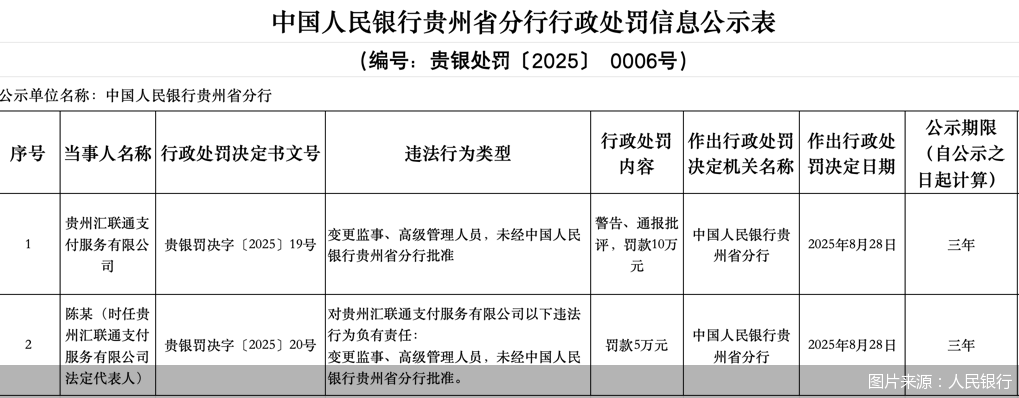
Core Viewpoint - The recent penalty imposed on Guizhou Huiliantong Payment Service Co., Ltd. highlights a rare violation in the payment industry regarding the unauthorized change of supervisors and senior management without approval from the People's Bank of China [1][4]. Regulatory Actions - Guizhou Huiliantong was fined 100,000 yuan for changing supervisors and senior management without the necessary approval, while the legal representative, Chen, was fined 50,000 yuan for being responsible for the violation [1][3]. - The penalty was issued by the Guizhou branch of the People's Bank of China on August 28, 2025, and the public disclosure period for the penalty is three years [3]. Industry Context - The penalty reflects a growing trend of stricter regulatory oversight in the payment industry, where compliance has become a critical aspect of operational integrity [5]. - Common violations in the payment sector typically include breaches of account management regulations and anti-money laundering obligations, rather than governance issues like unauthorized management changes [4][5]. Compliance and Governance - The recent incident underscores the importance of robust corporate governance within payment institutions, emphasizing that compliance should extend beyond operational aspects to include governance processes [5]. - The "Implementation Rules for the Supervision and Administration of Non-Bank Payment Institutions" effective from July 2024 mandates that any changes in management must be submitted for approval to the People's Bank of China [4][5]. Management Changes - There has been a notable increase in management changes among payment institutions since 2025, indicating a shift towards enhancing compliance and adapting to current industry trends [6]. - Frequent changes in senior management can potentially impact the stability and strategic execution of payment institutions, despite the intention to strengthen compliance [6].

中国支付产业出海进程再加速,CoGoLinks结行国际在阿联酋获支付业务许可
Jing Ji Guan Cha Wang· 2025-09-15 10:05
Core Insights - CoGoLinks International has officially obtained a money service license in the UAE, allowing it to operate payment accounts, process payment transactions, and issue payment tools within the region [1] Company Summary - The overseas entity of CoGoLinks submitted acceptance materials that have successfully passed the review by the Dubai Financial Services Authority (DFSA) [1] - This achievement marks CoGoLinks as the first Chinese cross-border payment platform to receive a formal payment license in the UAE [1]
人民银行北京市分行:超137个国家和地区用户使用银行卡拍卡过闸约190万人次
Bei Jing Shang Bao· 2025-09-15 09:59
Core Viewpoint - The People's Bank of China is enhancing financial services for the upcoming China International Fair for Trade in Services, scheduled for September 10-14, 2025, in Beijing, aiming to create a smart, convenient, diverse, and efficient payment environment for exhibitors and visitors [1] Payment Services Development - As of now, the two major airport payment service demonstration zones have served 38,000 international guests, processing nearly 1.9 million transactions with a total amount close to 1 billion yuan [1] - In addition to supporting UnionPay cards and QR code payments, the system has been expanded to include VISA, MasterCard, JCB, and American Express for subway access, allowing cardholders to easily tap their cards at 523 subway stations in Beijing [1] User Engagement and Transaction Volume - Over 1.37 million users from more than 137 countries and regions have utilized UnionPay, VISA, MasterCard, JCB, and American Express for subway access, with approximately 1.9 million transactions amounting to over 9.7 million yuan [1]


三类业务受惠!数字人民币跨境支付迎重磅利好,有机构年化交易量翻倍
Hua Xia Shi Bao· 2025-09-15 09:32
Group 1: Digital Currency Development - The National Internet Information Office released a draft regulation encouraging the use of electronic documents in trade, logistics, and finance, promoting the digitalization of business operations and the use of digital RMB for cross-border payments [1][2] - The global cross-border payment landscape is dominated by the SWIFT agent model, but the digital RMB and related systems like CIPS are expected to see growth opportunities [1][2] Group 2: Market Growth and Trends - Licensed cross-border payment institutions have reported strong growth, with annual transaction amounts doubling this year, driven by policy incentives for digital RMB usage [1][2] - Airwallex has expanded its global presence, establishing 26 offices and a local team of over 1,800, with annual revenue reaching $900 million, a 89% increase year-on-year [6] Group 3: Regulatory Environment and Compliance - The European market prioritizes consumer protection, data privacy, and financial system stability, presenting a high compliance threshold for companies [7] - Airwallex is adapting to European regulations by integrating local and global operational frameworks to meet diverse market needs [7][8]


支付产业报告:卡组织驱动支付产业变革
2 1 Shi Ji Jing Ji Bao Dao· 2025-09-15 04:37
Core Insights - The report by China UnionPay and Visa outlines the current state and trends of the global and Chinese payment industry, highlighting that China's payment ecosystem is now characterized by global scale, deep technological integration, and diverse coexistence [1][2] Group 1: Global Payment Industry Trends - The global payment industry is undergoing profound changes, with trends of fragmentation and infrastructure development coexisting [2] - New technologies such as AI, big data, cloud computing, blockchain, and biometrics are reshaping payment processes and user experiences [2] - New payment models like account-to-account payments, buy now pay later, and encrypted wallet payments are rapidly emerging [2] Group 2: Characteristics of China's Payment Industry - The parallel issuance of physical and digital cards has become the mainstream model, with digital wallets emerging as core payment tools [3] - A variety of payment methods, including card swiping, QR codes, NFC, palm scanning, and facial recognition, are widely adopted across multiple high-frequency transaction scenarios [3] - Collaboration among diverse market participants, including commercial banks, card organizations, and non-bank payment institutions, is enhancing operational efficiency [4] Group 3: Challenges in the Payment Industry - The industry is transitioning from a phase of rapid expansion to one focused on structural transformation, necessitating an emphasis on quality and optimization [5] - There is an imbalance in development between the account side and acceptance side, with small acquiring institutions facing significant operational pressures [6] - The lack of unified rules and standards for barcode payments and the need for improved interoperability are limiting further industry growth [6] Group 4: Innovation by Card Organizations - Card organizations like China UnionPay and Visa are actively transforming by leveraging technological innovation and ecosystem development [7] - These organizations are expanding their roles beyond traditional payment processing to include information handling, traffic guidance, and value-added services [7] - China UnionPay is designing differentiated payment solutions tailored to specific scenarios, aligning with government consumption promotion policies [7] Group 5: Future Outlook - The payment industry is entering a new development stage characterized by high-level openness, a multi-faceted market structure, and the transformative impact of new technologies [8] - Continuous collaboration, technological advancement, and international cooperation are essential for achieving high-quality development in the payment industry [8]
加密货币行业反对英国央行拟议的稳定币持有上限计划
Ge Long Hui· 2025-09-15 04:27
Core Viewpoint - The cryptocurrency industry is urging the Bank of England to abandon its proposal to limit the amount of stablecoins individuals can hold, which would impose stricter regulations than those in the US or EU [1] Group 1: Regulatory Concerns - The Bank of England plans to implement a holding limit for all systemic stablecoins, with individual limits set between £10,000 and £20,000, and corporate limits at £10 million [1] - This proposal reflects the Bank of England's concerns that such digital currencies could undermine financial stability by siphoning deposits from the banking system [1] Group 2: Industry Response - The proposal has faced criticism from the cryptocurrency and payments industry, which argues that it would place the UK at a competitive disadvantage compared to other countries and regions [1] - Industry representatives highlight the challenges of implementing such regulations, citing high costs and difficulties in enforcement [1]
影响市场重大事件:国家网信办公开征求意见,探索使用数字人民币等新型支付方式开展跨境支付;两部门表态,项目新能源上网电量不纳入新能源可持续发展价格结算机制
Mei Ri Jing Ji Xin Wen· 2025-09-14 22:32
Group 1 - The National Internet Information Office is soliciting public opinions on regulations to promote and standardize the application of electronic documents, aiming to enhance the digitalization of cargo trade and logistics, and reduce logistics costs [1] - The regulations encourage institutions and enterprises in cargo trade, logistics, and finance to recognize and use electronic documents, thereby improving digital application levels [1] - The exploration of using digital RMB and other new payment methods for cross-border payments is highlighted, along with the promotion of financial product and service model innovations [1] Group 2 - Fifteen departments, including the State Administration for Market Regulation, released guidelines to accelerate the digital development of quality certification, focusing on key digital equipment and product quality certification services [2] - The guidelines emphasize the development of certification systems for smart agricultural equipment, industrial robots, and other digital products, aiming to meet diverse consumer demands [2] Group 3 - The China National Space Administration announced the successful completion of the second tethered ignition test for the Long March 10 series rocket, which lasted 320 seconds and tested the capabilities of the rocket's engines [3] - The test was conducted at the Wenchang Space Launch Site and involved simultaneous ignition of seven engines, gathering complete test data [3] Group 4 - The People's Bank of China reported that in the first eight months, RMB loans increased by 13.46 trillion yuan, with a notable increase in medium to long-term loans [4] - The total RMB deposits increased by 20.5 trillion yuan during the same period, with a year-on-year growth of 8.6% [4] Group 5 - The Fujian Provincial Government issued an action plan to accelerate the green transformation of the economy, supporting the market-oriented allocation of marine resource factors and the establishment of a marine resource trading platform [5] Group 6 - The Ministry of Finance announced the issuance of 500 billion yuan in special government bonds to inject capital into banks, which is expected to stimulate approximately 6 trillion yuan in credit [6] Group 7 - Morgan Asset Management's CSI A500 Index Fund raised over 2 billion yuan, marking the largest initial fundraising scale for such products this year [7][8] Group 8 - The National Development and Reform Commission and the National Energy Administration issued a notice to improve pricing mechanisms for renewable energy, ensuring equal market participation for projects [9] Group 9 - The Fujian Provincial Government's action plan aims to achieve breakthroughs in data intelligence, hydrogen energy, advanced materials, and health and new medicine sectors, targeting a scale of 300 billion yuan for the energy-saving and environmental protection industry by 2030 [10] Group 10 - The National Internet Information Office is drafting regulations for large online platforms to establish personal information protection supervisory committees to oversee personal information protection [11]
先买后付、加密货币钱包支付快速发展,全球支付呈现四大趋势
Sou Hu Cai Jing· 2025-09-14 12:59
Core Viewpoint - The global payment industry is undergoing significant transformation, driven by technological innovation and evolving regulatory frameworks, with a focus on enhancing service to the real economy [1][3]. Group 1: Global Payment Industry Trends - The report identifies four major trends in the global payment industry: regionalization and infrastructure development, accelerated application of technologies like AI and blockchain, a focus on regulatory consistency, and the emergence of new payment models such as A2A payments and BNPL [3][4]. - The shift from traditional transaction processing to more intelligent financial infrastructure highlights the growing importance of payment systems within the financial ecosystem [3][5]. Group 2: China's Payment Industry Development - China's payment industry is characterized by its leading global scale, with a focus on ecological, open, and compliant development following the explosive growth of mobile payments [6][7]. - The industry has formed a diverse ecosystem, integrating both physical and digital card issuance, with digital wallets becoming central payment tools [7][8]. - As of the second quarter of 2025, non-bank payment institutions in China processed 333.845 billion network payment transactions, amounting to 82.11 trillion yuan [7]. Group 3: Innovation and Competition - The payment industry is experiencing a homogenization of services, leading institutions to seek new growth points through technological advancements [5][8]. - The competitive landscape is shifting towards financial technology and value-added services, with institutions focusing on digitalization and tailored solutions for specific industries [8].

美国运通中国合资公司举办合作伙伴峰会
Zhong Guo Jing Ji Wang· 2025-09-14 05:56
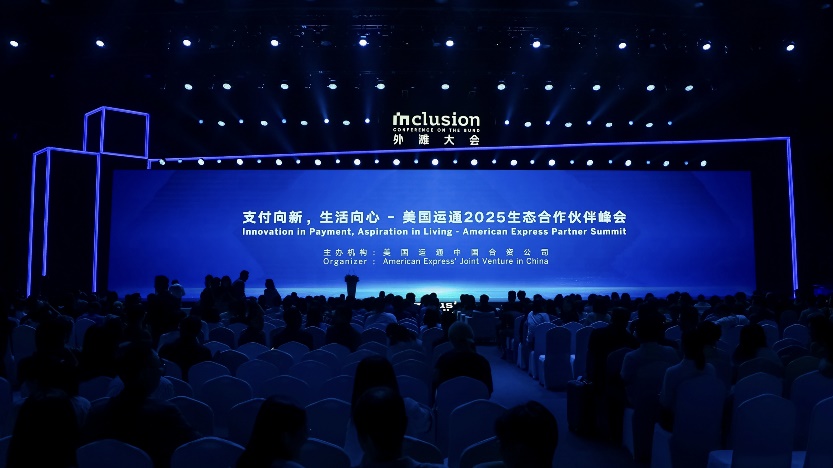
Core Insights - The partnership between American Express and Lianlian Digital, through their joint venture Lian Tong (Hangzhou) Technology Service Co., aims to enhance payment innovation and support domestic partners in China [1][2] - The recent summit at the 2025 Inclusion Bund Conference gathered nearly 400 representatives from various sectors, focusing on payment innovation and improving cardholder experiences [1] Group 1 - The summit featured keynote speeches from industry leaders, including Kartik Mani, President of Global Network Services at American Express, emphasizing collaboration and innovation in the payment sector [1] - Lian Tong introduced a new corporate payment solution called the Centralized Payment Account, which allows companies to manage travel-related expenses more effectively by integrating with multiple banks and expense management platforms [1] - This solution represents a successful localization of American Express's global corporate payment offerings in mainland China, showcasing the company's commitment to enhancing service for local partners [1] Group 2 - CEO Zhu Yaming highlighted the importance of the Bund Conference as a platform for discussing payment innovation and enhancing customer experiences for American Express cardholders and domestic merchants [2] - The focus on differentiated services aims to support the steady development of the payment industry in China [2]
服贸会拓展服务贸易新空间
Ren Min Ri Bao· 2025-09-13 21:50
Group 1 - The 2025 China International Service Trade Fair aims to inject new momentum into global service trade development, showcasing China's commitment to high-level opening up and promoting high-quality service trade growth [1] - The theme of this year's fair is "Digital Intelligence Leading, Service Trade Renewed," highlighting innovations in artificial intelligence (AI) and big data [2] - The fair features various innovative products, including the FWH-3000 heavy-duty drone for logistics and medical rescue, and advanced nuclear power construction technologies [2] Group 2 - China's travel service exports grew by 62.9% in the first seven months of the year, driven by policies such as visa exemptions and payment facilitation [4] - China Bank announced a new "immediate refund" tax refund service for outbound travelers, enhancing its brand recognition in the tax refund sector [4] - Tencent showcased cross-border payment services for foreign visitors, allowing users from countries like Malaysia and Singapore to use their wallets for in-store purchases in China [4] Group 3 - The fair attracted participation from 54 countries and 21 international organizations, creating opportunities for collaboration [6] - Australian companies presented innovative products, including a 3D interactive product that can be applied in various fields such as healthcare and education [6] - The event emphasizes mutual cooperation and shared prosperity, aiming to expand bilateral and regional service trade partnerships [7]