共享经济

Search documents
济南充电宝市场探访:3C认证成标配,共享充电宝也换“新装”
Qi Lu Wan Bao Wang· 2025-08-19 06:49
Core Viewpoint - The new 3C certification regulations for mobile power lithium batteries have been implemented since August 15, prohibiting the production, import, or sale of products without this certification, leading to significant market changes [1]. Group 1: Market Changes - The implementation of the new regulations has resulted in a market shift where only certified products are allowed for sale, with increased scrutiny from regulatory bodies [2]. - Prices for certified power banks have increased, with some brands raising prices by approximately 10% due to higher production costs associated with certification and improved material quality [2][3]. - Consumers are increasingly inquiring about 3C certification before purchasing, indicating a heightened awareness and demand for certified products [2]. Group 2: Product Availability - Both personal and shared power banks are now required to display 3C certification, with many brands ensuring compliance by replacing older stock with new certified products [4]. - Online platforms are also reflecting this trend, with many listings highlighting 3C certification and compliance with international transport standards, enhancing consumer trust [4]. Group 3: Consumer Awareness - Consumers are advised on how to identify genuine 3C certification marks, including visual checks and online verification through the China Quality Certification Center [5]. - The importance of 3C certification is emphasized as a protective measure for consumer safety and environmental standards [5].
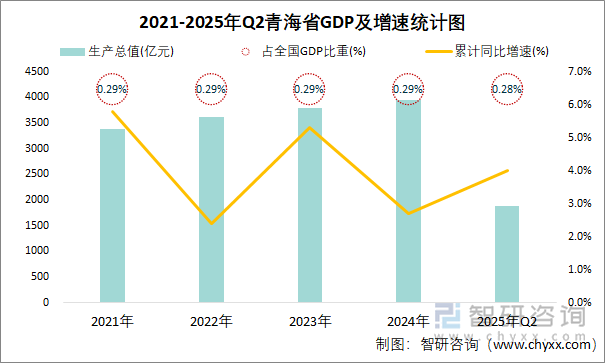
2021-2025年Q2青海省GDP统计分析:2025年Q2青海省GDP为1875.68亿元,同比增长4%
Chan Ye Xin Xi Wang· 2025-08-17 01:39
Core Insights - In Q2 2025, Qinghai Province's GDP reached 187.568 billion yuan, accounting for 0.28% of the national GDP, a decrease of 0.01 percentage points compared to the same period last year [1] - The cumulative year-on-year growth of GDP, calculated at constant prices, was 4% [1] - The value added by the three major industries in Q2 2025 was 5.695 billion yuan, 80.813 billion yuan, and 101.06 billion yuan, representing 3%, 43.1%, and 53.9% of GDP respectively [1] - The per capita GDP in Qinghai Province was 31,600 yuan, an increase of 1,200 yuan compared to the same period last year [1] - The year-on-year growth rates for the three major industries, calculated at constant prices, were 5.4%, 4.8%, and 3.3% respectively [1]

量质齐升稳住就业大盘
Jing Ji Ri Bao· 2025-08-14 22:14
Group 1 - The employment situation in China is stable, with 6.95 million new urban jobs created in the first half of the year, achieving 58% of the annual target [1] - The urban survey unemployment rate in June was 5.0%, unchanged from the same period last year, indicating resilience in the economy [1] - There is a need to enhance domestic demand and address employment pressures among key groups such as youth and migrant workers, emphasizing the importance of maintaining employment stability [1] Group 2 - The integration of digital technology across various industries has led to the emergence of new sectors such as platform and sharing economies, creating vast employment opportunities [2] - In the second quarter, recruitment in industries like humanoid robots, new materials, and smart hardware saw year-on-year increases of 398.1%, 72.1%, and 50.3% respectively [2] - High-quality employment is essential, focusing not only on quantity but also on the quality of jobs, which should provide a platform for personal value realization [2] Group 3 - The ongoing advancement of China's manufacturing sector towards high-end, intelligent, and green development requires a significant number of skilled talents with international perspectives and innovative capabilities [2] - Skills training should be organized in fields with high employment capacity and significant supply-demand imbalances, such as advanced manufacturing and modern services [2] - Achieving high-quality employment will transform it from merely meeting basic needs to becoming a driving force for high-quality economic development [2]
今时不同往日!年轻人的“反向消费”火了,老一辈直呼:看不懂
Sou Hu Cai Jing· 2025-08-13 11:33
Core Viewpoint - The younger generation, previously labeled as "spending enthusiasts," has transformed into savvy "money-saving masters," utilizing second-hand goods, shared economy, and creative cost-cutting strategies to redefine their consumption habits [1][5]. Group 1: Changes in Consumption Behavior - The user group aged 25-35 has seen a 217% increase in second-hand transaction volume over the past two years [3]. - Young professionals are now more focused on finding high-value second-hand office equipment rather than the latest smartphones, leading to a decline in foot traffic at fast fashion brands while second-hand luxury stores experience long queues [7]. - The consumption of gold among the 18-35 age group in China reached 42% in 2023, marking a historical high, while the value of diamond rings has depreciated by 60% [9]. Group 2: Innovative Money-Saving Techniques - Young individuals are developing various money-saving hacks, such as using a "plate rack" instead of expensive storage boxes and optimizing shopping routes for discounted groceries [5]. - The trend of "spongeing" off older generations has emerged, with young people attending community classes aimed at seniors, resulting in a 240% year-on-year increase in 90s generation tourists for senior travel packages [11]. Group 3: Rise of Sharing Economy - A shared kitchen named "Hour of Time" has become popular among office workers, allowing users to cook for 30 yuan per hour, saving 40% compared to takeout [13]. - The wedding dress rental market is projected to exceed 10 billion yuan in 2023, with 70% of customers being cost-conscious individuals born in the 1990s [14]. Group 4: Social Dynamics and New Value Systems - The "stooping" culture, which involves collecting discarded items, has gained popularity, with over 500,000 posts on Xiaohongshu and a reading volume exceeding 300 million [16]. - Social interactions among young professionals have shifted from showcasing luxury purchases to sharing money-saving strategies, with "help me bargain" becoming a common conversation starter [18]. - Notes tagged with "money-saving challenge" on Xiaohongshu have 3.2 times the interaction of unboxing reviews, indicating a shift in social currency towards frugality [20]. Group 5: Impact on Relationships and Social Perception - Users who mention "financial management skills" in their dating profiles see a 27% increase in matching success, while those showcasing luxury items experience a 43% decrease in private messages received [23].

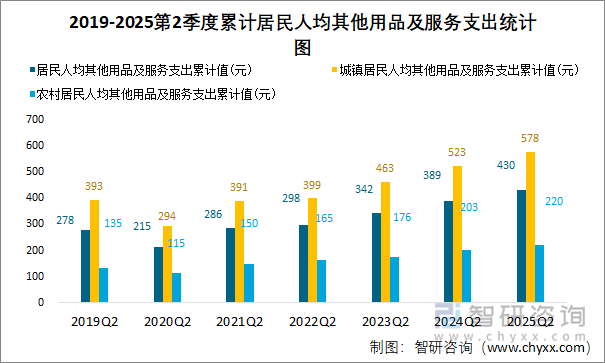
2025第2季度居民人均其他用品及服务支出累计为430元,累计增长10.4%
Chan Ye Xin Xi Wang· 2025-08-13 03:22
Group 1 - The total per capita expenditure on other goods and services for residents nationwide in Q2 2025 reached 430 yuan, reflecting a cumulative growth of 10.4% [1] - The per capita expenditure on other goods and services for urban residents was 578 yuan, with a cumulative growth of 10.5% [1] - The per capita expenditure on other goods and services for rural residents amounted to 220 yuan, showing a cumulative growth of 8% [1]
2025第2季度居民人均可支配财产净收入累计为1825元,累计增长2.5%
Chan Ye Xin Xi Wang· 2025-08-13 03:17
Group 1 - The core viewpoint indicates that in the second quarter of 2025, the net disposable income per capita for residents nationwide reached 1825 yuan, reflecting a cumulative growth of 2.5% [1] - Urban residents had a net disposable income per capita of 2864 yuan, with a cumulative growth of 1.4% [1] - Rural residents experienced a net disposable income per capita of 355 yuan, showing a significant cumulative growth of 6.6% [1]

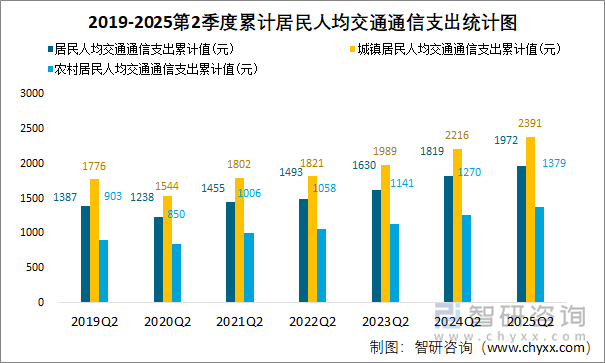
2025第2季度居民人均交通通信支出累计为1972元,累计增长8.4%
Chan Ye Xin Xi Wang· 2025-08-13 03:17
Group 1 - The core viewpoint indicates that in the second quarter of 2025, the per capita expenditure on transportation and communication for residents nationwide reached 1972 yuan, reflecting a cumulative growth of 8.4% [1] - Urban residents had a per capita expenditure of 2391 yuan, with a cumulative growth of 7.9% [1] - Rural residents' per capita expenditure was 1379 yuan, showing a cumulative growth of 8.6% [1]
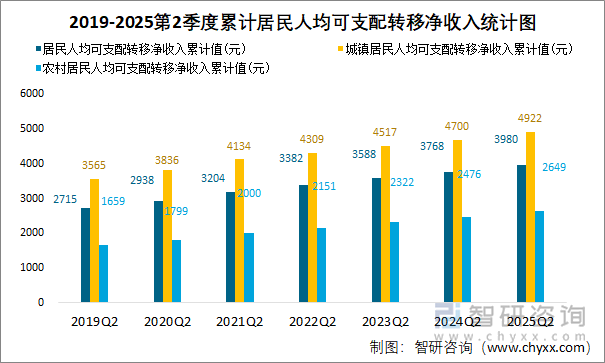
2025第2季度居民人均可支配转移净收入累计为3980元,累计增长5.6%
Chan Ye Xin Xi Wang· 2025-08-13 03:17
2025第2季度,全国居民人均可支配转移净收入累计为3980元,累计增长5.6%;城镇居民人均可支配转 移净收入累计为4922元,累计增长4.7%;农村居民人均可支配转移净收入累计为2649元,累计增长 7%。 相关报告:智研咨询发布的《2025-2031年中国共享经济行业市场研究分析及投资前景预测报告》 数据来源:国家统计局 数据来源:国家统计局 ...
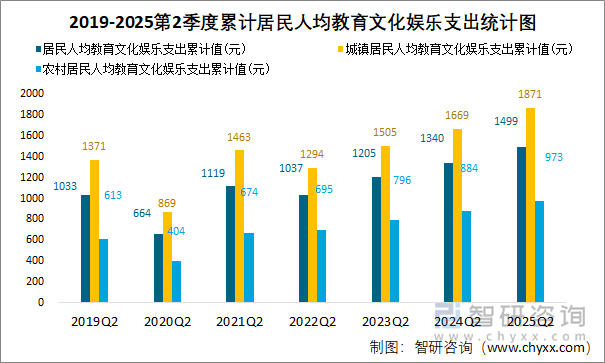
2025第2季度居民人均教育文化娱乐支出累计为1499元,累计增长11.8%
Chan Ye Xin Xi Wang· 2025-08-13 03:17
相关报告:智研咨询发布的《2025-2031年中国共享经济行业市场研究分析及投资前景预测报告》 2025第2季度,全国居民人均教育文化娱乐支出累计为1499元,累计增长11.8%;城镇居民人均教育文 化娱乐支出累计为1871元,累计增长12.1%;农村居民人均教育文化娱乐支出累计为973元,累计增长 10.1%。 数据来源:国家统计局 数据来源:国家统计局 ...
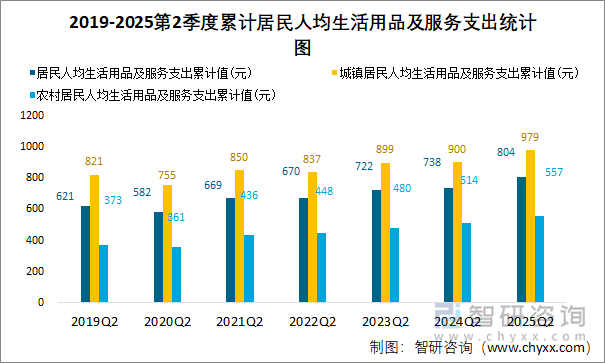
2025第2季度居民人均生活用品及服务支出累计为804元,累计增长9%
Chan Ye Xin Xi Wang· 2025-08-13 03:17
Group 1 - The core viewpoint indicates that in the second quarter of 2025, the per capita expenditure on daily goods and services for residents nationwide reached 804 yuan, reflecting a cumulative growth of 9% [1] - Urban residents had a per capita expenditure of 979 yuan, with a cumulative growth of 8.8% [1] - Rural residents' per capita expenditure was 557 yuan, showing a cumulative growth of 8.5% [1]