基金代销

Search documents
公募“降费潮”来临
21世纪经济报道· 2025-08-08 08:28
Core Viewpoint - The wealth management industry is undergoing significant transformation in 2025, driven by regulatory changes and increased competition among financial institutions [1][2]. Regulatory Changes - A series of policies have been introduced to strengthen the regulatory framework for wealth management product sales, including the "Commercial Bank Agency Sales Management Measures" effective from October 1, 2025, which clarifies the responsibilities of banks as sales agents [5]. - The "Financial Institutions Product Appropriateness Management Measures," effective from February 1, 2026, aims to enhance consumer protection by helping consumers identify risks and choose suitable products based on their needs and risk tolerance [6]. Market Dynamics - The public fund sales sector is facing dual challenges of shrinking income and insufficient professional services, necessitating a shift in business models and service concepts [2][9]. - The ongoing fee reduction reforms in public funds are expected to save investors approximately 45 billion yuan annually starting in 2025, further pressuring sales channels [9]. Sales Channel Evolution - The sales landscape for wealth management products is shifting from a sales-oriented approach to a service-oriented model, emphasizing digitalization and refined services to meet diverse investor needs [2][18]. - The number of institutions selling wealth management products has increased, with 569 institutions involved in the distribution of products by mid-2025, reflecting a growing trend towards multi-channel distribution [14][15]. Industry Competition - The competition in the wealth management product distribution market is intensifying, with banks expanding their distribution channels amid declining net interest margins [13][14]. - The traditional commission-based sales model is under pressure due to declining trailing commissions, leading to a market shakeout where smaller institutions are being eliminated [10][11]. Service Transformation - Wealth management firms are increasingly focusing on providing tailored services to meet the specific needs of different investor segments, moving away from a one-size-fits-all approach [19]. - Some institutions are launching innovative products that emphasize risk management and stability, such as the "TREE Long-term Profit Plan" by China Merchants Bank, which offers risk parity-based asset allocation solutions [19].



降费潮倒逼财富管理转型 代销机构从拼规模到拼服务
2 1 Shi Ji Jing Ji Bao Dao· 2025-08-07 10:16
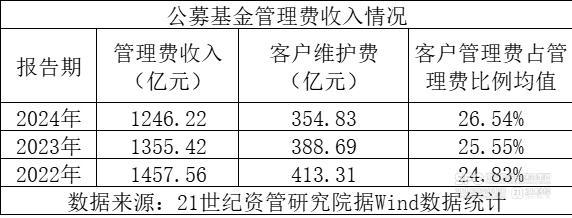
Core Viewpoint - The year 2025 is identified as a crucial transformation year for the wealth management industry, driven by regulatory changes and increased competition among financial institutions [1] Regulatory Changes - The "Commercial Banks Agency Sales Business Management Measures" will be implemented on October 1, 2023, emphasizing the responsibilities of banks as agency sales institutions [2] - The "Financial Institutions Product Appropriateness Management Measures" will take effect on February 1, 2026, focusing on consumer rights protection and risk identification [3] Market Dynamics - The public fund industry is experiencing a decline in management fees, with a projected 8% decrease in overall management fee income from 2023 to 2024, leading to reduced tail commission income [5][6] - The traditional agency sales model, heavily reliant on tail commissions, is under pressure as major players like China Merchants Bank and Ant Fund report revenue declines despite increased sales volumes [7] Competitive Landscape - The wealth management product distribution market is witnessing a significant reshuffle, with many small and medium-sized institutions exiting the market due to compliance issues and the need for transformation [7] - The proportion of wealth management products distributed by established financial institutions is increasing, with 89.61% of the market share held by 32 licensed wealth management companies as of mid-2025 [8] Strategic Shifts - Wealth management institutions are increasingly focusing on direct sales and expanding their distribution channels, with a notable increase in the number of cooperative distribution institutions [9][10] - The industry is moving towards a more diversified and digital approach, with a shift from sales-driven to service-oriented models, emphasizing investor education and tailored product offerings [11][12]
京东,放大招!
中国基金报· 2025-06-20 02:14
Core Viewpoint - JD.com has launched a new initiative allowing PLUS members to purchase funds without any subscription fees, marking a significant move in the fund distribution sector among internet giants [2][4]. Summary by Sections Initiative Details - The JD Financial App has introduced a program where PLUS members can enjoy unlimited fund purchases with zero subscription fees, excluding certain fund types [5][6]. - The program allows for direct fee waivers or refunds in the form of JD Beans for certain funds, enhancing the attractiveness of the offer [6][7]. Market Context - The initiative aligns with the China Securities Regulatory Commission's recent policy aimed at reducing investor costs in public funds, indicating a broader trend in the industry towards lowering fees [2][8]. - Other financial institutions, such as China Merchants Bank, have also implemented similar fee reductions, suggesting a competitive shift in the fund sales market [13][14]. Customer Acquisition and Challenges - While the zero subscription fee initiative may attract existing PLUS members, the effectiveness in acquiring new customers remains uncertain due to the hidden nature of the financial services section within the JD.com app [10][11]. - The current market dynamics indicate that merely reducing fees may not be sufficient to shift investor habits, as many users are accustomed to other platforms [10][14]. Industry Trends - The overall trend in the fund sales market is towards decreasing fees, with various channels competing to enhance their offerings and attract more investors [12][14]. - The market is expected to evolve into a more diversified landscape, where institutions that provide quality products and services will stand out [14].


说不干就不干?民商基金主动放弃一半客户,签约两个多月就“反悔”
Hua Xia Shi Bao· 2025-06-14 07:02
Core Viewpoint - A significant number of public funds, totaling 40, have terminated their sales agreements with Minshang Fund, indicating a strategic shift in the fund's operations and a potential industry-wide restructuring [2][4][10]. Group 1: Termination of Agreements - On June 12, 40 public fund companies announced the termination of their sales agreements with Minshang Fund, which represents half of the total fund companies that previously collaborated with Minshang [4][10]. - Minshang Fund has stated that the terminations are a result of their proactive decision to adjust their business strategy, focusing on private fund sales rather than public fund sales [7][8]. - The number of fund companies collaborating with Minshang Fund has decreased from 72 to 36, and the number of funds sold has dropped from 2726 to 1629 within a short period [4][10]. Group 2: Business Focus and Strategy - Minshang Fund, established in 2016, primarily focuses on asset management and wealth management, serving small to medium financial institutions and affluent individuals [5]. - The company has paused its "Zhenhao Investment" platform for over five years, indicating a shift in its operational focus [6]. - Industry insiders suggest that the decision to terminate public fund sales may be a strategic move to concentrate resources on more profitable private fund sales [7][10]. Group 3: Industry Context and Trends - The fund distribution industry is undergoing significant changes, with many sales institutions ending partnerships with fund companies due to cost-effectiveness, compliance risks, and a shift towards larger, more capable sales organizations [10][11]. - The recent regulatory framework emphasizes long-term investor returns over short-term sales, which may lead to a consolidation of the industry, favoring institutions with strong compliance and service capabilities [11].

民商基金遭遇密集解约,公募代销渠道面临重塑
Di Yi Cai Jing· 2025-06-10 11:30
Group 1 - The core viewpoint is that public fund managers are restructuring their channel cooperation strategies, with the cost-effectiveness of channels becoming a key consideration amid a transformation period in the public fund distribution industry [1][3] - As of June 10, multiple public funds, including Changcheng Fund, Furong Fund, and Puyin Ansheng Fund, announced the termination of their sales cooperation with Minshang Fund, reflecting a broader trend where nearly 40 institutions have ended partnerships with Minshang Fund since late May [2][3] - The number of fund distribution companies has decreased to 41, indicating a significant contraction in the market, with at least eight distribution institutions having terminated sales cooperation with public funds this year [2][4] Group 2 - The phenomenon of independent fund distribution institutions facing a wave of contract terminations highlights a deep transformation in the public fund distribution industry, driven by both industry-level changes and stricter regulatory requirements [3][5] - The "Matthew Effect" in the fund distribution industry is becoming more pronounced, with larger institutions dominating the market, as evidenced by the top ten independent sales institutions holding a significant share of the total fund distribution [4][5] - Many independent sales institutions are choosing to exit the market voluntarily, which may lead to a healthier market structure and a shift in investor selection criteria towards evaluating compliance qualifications, research capabilities, and service systems of public fund distribution institutions [5]
谁在掌控你的基金选择丨蚂蚁基金的流量盛宴后
经济观察报· 2025-05-15 11:42
Core Viewpoint - Ant Fund faces significant challenges despite efforts to enhance services through upgraded screening mechanisms, optimized admission rules, and strengthened risk management due to its complex business model and market environment [1][3][4]. Group 1: Background and Rise - Ant Fund originated from Yu'ebao, launched in June 2013, which quickly gained traction by embedding money market fund products into Alipay, providing a convenient investment option [6][7]. - Within minutes of its launch, Yu'ebao attracted over 180,000 users, and by the end of June 2013, it had over 2.5 million users, surpassing the total client base of the top ten money market funds in 2012 [8]. - By 2014, Yu'ebao's user base exceeded 100 million, with total assets surpassing 574.2 billion yuan, demonstrating the potential of the fund distribution business [8][9]. Group 2: Fund Distribution Dynamics - The fund distribution industry is undergoing profound changes, with Ant Fund needing to balance traffic and service while providing professional, personalized wealth management services [4][22]. - Ant Fund's platform, Wealth Number, allows fund companies to directly reach a vast number of Alipay users, enhancing service precision through data analysis and operational tools [10][11]. - As of the end of 2024, Ant Fund has distributed over 18,000 funds, accounting for 82% of the total public funds available in the market [11]. Group 3: Challenges and Controversies - The "Gold Selection" model introduced by Ant Fund in July 2020 initially attracted significant investor interest but faced criticism as market conditions changed, leading to substantial losses for many recommended funds [13][14]. - For instance, the fund managed by Guo Lan saw its shares increase from 39.3 billion to 143.15 billion within a year but later suffered a 42 billion share decline by early 2025 [14][22]. - Critics argue that the Gold Selection model is product sales-centric rather than client-centric, raising concerns about potential conflicts of interest due to Ant Fund's revenue model based on sales commissions from fund companies [15][22]. Group 4: Recent Developments and Future Outlook - In 2022, Ant Fund updated its admission rules for equity funds, requiring products to be established for over a year and have a minimum scale of 200 million yuan, ensuring a level of market experience [20]. - The fund has also implemented a comprehensive risk management framework using data analysis and AI models to monitor market fluctuations and set differentiated risk thresholds [21]. - The effectiveness of these measures in delivering solid returns for investors remains to be seen, as the fund distribution industry continues to evolve [22].

格局生变!基金代销三巨头,业绩曝光!
券商中国· 2025-03-29 10:15
Core Viewpoint - The performance of major fund distribution giants, including Ant Fund, China Merchants Bank, and Tian Tian Fund, has been mixed in 2024, with Ant Fund showing significant growth while the others faced declines in revenue and profit [1][5]. Ant Fund Performance - Ant Fund reported a revenue of 16.291 billion yuan and a net profit of 450 million yuan in 2024, both showing a year-on-year increase of approximately 29% [1]. - The growth is attributed to the rising popularity of bond funds and index funds, as well as a balanced product structure that encourages users to diversify their investments [2][1]. China Merchants Bank Performance - China Merchants Bank's wealth management fee and commission income decreased by 22.7% to 22.005 billion yuan in 2024, with fund agency income dropping by 19.58% to 4.165 billion yuan [3]. - The decline is primarily due to reduced fees for funds and a decrease in the scale of equity funds, although the bank's non-cash asset scale grew by 176.9 billion yuan [3][4]. Tian Tian Fund Performance - Tian Tian Fund's revenue fell by 21.56% to 2.853 billion yuan, and net profit decreased by 27.4% to 151 million yuan in 2024 [6]. - Despite a more than 10% increase in non-monetary fund scale, the equity fund scale declined, indicating that growth was mainly driven by bond funds [5][6]. Industry Trends - The bond fund scale reached 6.8 trillion yuan by the end of 2024, marking a nearly 29% year-on-year growth, while passive index funds surpassed active equity funds for the first time [2]. - Ant Fund's non-monetary fund scale increased by 180.6 billion yuan compared to 2023, with the growth primarily coming from bond funds [2].