政府财政

Search documents
美国经济衰退到底有多猛烈?当3件大事同时爆发,崩溃就开始了
Sou Hu Cai Jing· 2025-06-26 09:21
好的,我将会根据您的要求对文章进行改写,同时保持原有的语义,并适度增加一些细节描述。下面是改写后的文章: --- 在您开始阅读本文之前,恳请您点击"关注"按钮,这样您可以方便地接收我们未来的文章更新,也能与我们进行更多的讨论与分享。您的支持将是我们持续 创作的动力源泉! 与此同时,美联储的加息政策也没有丝毫停歇,持续的加息使得美国社会的通货膨胀率居高不下,生活成本不断上涨。失业率也呈现出急剧上升的趋势,许 多曾经辉煌一时的企业纷纷宣布倒闭或开始收缩规模。美国社会正笼罩在一种前所未有的萧条气氛中。 有金融专家分析指出,当前美国经济距离彻底崩溃的时刻并不遥远。如果三件重大事件发生,美国的衰退与崩盘将不可避免。这些因素可能将彻底改变全球 的经济格局,甚至导致新的世界秩序的诞生,原本由美国主导的全球生态位,必将被其他国家所瓜分。 那么,美国经济衰退的情况究竟有多严重呢?又是哪三件关键事件将推动美国走向崩盘的边缘?在这个过程中,中国又能获得怎样的利益呢?接下来,我们 将一一揭晓。 美国经济陷入衰退 2024年7月31日,央视网和其他媒体同时发布了令人震惊的消息:美国国债总额已经超过了35万亿美元。这一数据标志着美债面临 ...

法国公共债务突破3.3万亿欧元 占国内生产总值的114%
news flash· 2025-06-26 09:17
Core Viewpoint - France's public debt has surpassed €3.3 trillion, reaching 114% of its GDP, indicating ongoing challenges in managing fiscal deficits and public spending despite recent budget cuts [1] Group 1: Public Debt Overview - As of the first quarter of 2025, France's total public debt stands at €33,458 billion, which is an increase of 0.7 percentage points from the end of the previous year [1] - The rise in debt is primarily attributed to increased borrowing by the central government and a widening deficit in social security funds [1] Group 2: Government Response - In response to the fiscal deficit exceeding the EU's prescribed limits, the French government has announced a reduction of €10 billion in public spending [1] - Despite these measures, the pressure to control debt and deficits remains significant for the French government [1]
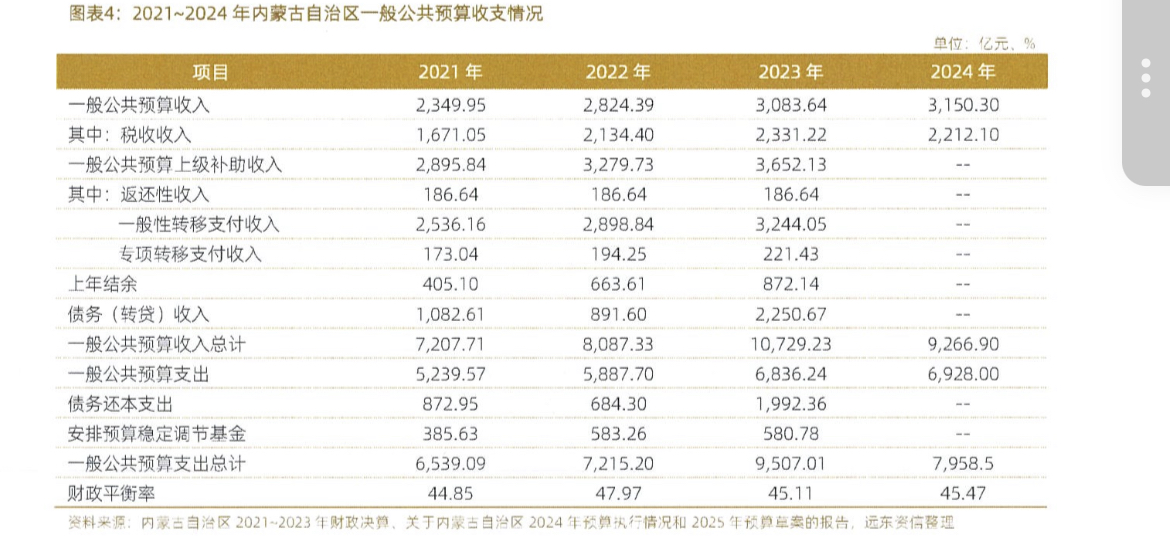
内蒙古出专项债新规,有何看点?
Di Yi Cai Jing· 2025-06-25 05:41
Group 1 - The core viewpoint of the news is that Inner Mongolia is optimizing its special bond management mechanism to enhance the effectiveness of fund allocation and usage while preventing risks associated with special bond repayment [1][2][3] Group 2 - Inner Mongolia's new policy mandates that at least 50% of the special bond quota must support ongoing projects to avoid incomplete projects [1][3] - The region's special bond issuance for 2024 is only 24.5 billion yuan, accounting for approximately 0.6% of the total new special bond issuance in the country [1] - The focus of special bond funding will be on key projects such as high-speed railways, government toll roads, and infrastructure for industrial parks [1][2] Group 3 - The new policy emphasizes prioritizing special bonds for national strategic tasks and local economic development initiatives, including the "Five Major Tasks" [2] - In 2022, spending on the "Five Major Tasks" reached 238.08 billion yuan, representing 34.4% of the general public budget expenditure [2] Group 4 - Inner Mongolia's total government debt is projected to be 1,209.96 billion yuan by the end of 2024, with general debt accounting for 65.5% and special debt for 34.5% [3] - The region received 171.7 billion yuan from the national refinancing bond quota to replace hidden debts, significantly alleviating local debt pressure [3] Group 5 - The new policy allows for the use of general public budget funds to repay special bonds if the corresponding government fund revenues are insufficient [6] - Special bond funds must be disbursed quickly, with a requirement for funds to be allocated within six working days to local governments [6]
美国财政部拍卖三个月期国债,得标利率4.195%(6月16日为4.240%),投标倍数3.49(前次为2.99)。拍卖六个月期国债,得标利率4.120%(6月16日为4.155%),投标倍数2.70(前次为2.73)。
news flash· 2025-06-23 15:37
Summary of Key Points Core Viewpoint - The U.S. Treasury conducted auctions for three-month and six-month Treasury bills, with notable changes in bid rates and bid-to-cover ratios, indicating investor demand and market conditions [1]. Group 1: Three-Month Treasury Bill Auction - The awarded yield for the three-month Treasury bill was 4.195%, a decrease from 4.240% on June 16 [1]. - The bid-to-cover ratio for the three-month bill was 3.49, an increase from the previous ratio of 2.99, suggesting stronger investor interest [1]. Group 2: Six-Month Treasury Bill Auction - The awarded yield for the six-month Treasury bill was 4.120%, down from 4.155% on June 16 [1]. - The bid-to-cover ratio for the six-month bill was 2.70, slightly lower than the previous ratio of 2.73, indicating stable but slightly reduced demand [1].
美国财政部拍卖四周期国债,得标利率4.080%(6月5日报4.170%),投标倍数3.22(前次为3.26)。拍卖八周期国债,得标利率4.380%(6月5日报4.225%),投标倍数2.67(前次为3.38)。
news flash· 2025-06-12 15:34
Group 1 - The U.S. Treasury auctioned four-year and eight-year bonds with notable bid rates and bid-to-cover ratios [1] - The four-year bond had a winning yield of 4.080%, down from 4.170% reported on June 5, with a bid-to-cover ratio of 3.22, slightly lower than the previous 3.26 [1] - The eight-year bond had a winning yield of 4.380%, an increase from 4.225% reported on June 5, with a bid-to-cover ratio of 2.67, down from the previous 3.38 [1]
美国财政部拍卖三个月期国债,得标利率4.250%(6月2日为4.250%),投标倍数2.69(前次为2.68)。拍卖六个月期国债,得标利率4.150%(6月2日为4.150%),投标倍数2.74(前次为3.13)。
news flash· 2025-06-09 15:38
Group 1 - The U.S. Treasury auctioned three-month Treasury bills with a winning yield of 4.250%, unchanged from June 2 [1] - The bid-to-cover ratio for the three-month bills was 2.69, slightly up from the previous auction's ratio of 2.68 [1] - The auction of six-month Treasury bills had a winning yield of 4.150%, also unchanged from June 2 [1] Group 2 - The bid-to-cover ratio for the six-month bills was 2.74, down from the previous auction's ratio of 3.13 [1]
北大汇丰智库:2025年赤字、债务及中国财政可持续性研究报告
Sou Hu Cai Jing· 2025-06-07 02:48
Group 1 - The report defines fiscal sustainability as the long-term stability or decline of the debt-to-GDP ratio, or the future public revenue being sufficient to cover all public expenditures and accumulated debt [1][14]. - As of the end of 2023, China's explicit government debt reached 56.14% of GDP, while implicit debt accounted for 11.34%, leading to a total debt of 67.48% of GDP. Local government financing platform debt constituted 57.24% of GDP [2][16]. - The report emphasizes that maintaining fiscal sustainability does not require a zero deficit, but rather that the deficit should not exceed sustainable thresholds to avoid increasing the debt-to-GDP ratio [2][14]. Group 2 - The report highlights that reasonable uses of debt include infrastructure construction and counter-cyclical adjustments, but long-term reliance on debt for regular expenditures is unsustainable [3][20]. - Key factors for fiscal sustainability include economic growth and inflation, with nominal GDP growth being crucial. The report warns against deflation, which could exacerbate debt burdens [4][15]. - Structural reforms are necessary, including reducing administrative expenditures, optimizing the tax system, and improving social security systems to narrow structural deficits [4][5]. Group 3 - The report suggests that China should learn from international experiences, such as the EU's establishment of debt and deficit warning lines, to assess long-term risks while controlling debt levels [6]. - It emphasizes that China's fiscal issues are fundamentally structural, requiring tax optimization, expenditure restructuring, and market-oriented reforms for sustainable fiscal and economic interaction [6][24]. - The report concludes that while challenges such as high local debt and slowing growth exist, a reasonable policy mix can prevent a debt crisis and lay the foundation for long-term development [6].

美国财政部拍卖四周期国债,得标利率4.170%(5月29日报4.215%),投标倍数3.26(前次为2.92)。拍卖八周期国债,得标利率4.225%(5月29日报4.225%),投标倍数3.38(前次为3.07)。
news flash· 2025-06-05 15:34
Core Insights - The U.S. Treasury conducted auctions for both four-week and eight-week Treasury bills, with notable results in bid rates and bid-to-cover ratios [1] Group 1: Four-Week Treasury Bill Auction - The awarded yield for the four-week Treasury bill was 4.170%, a decrease from the previous auction's yield of 4.215% [1] - The bid-to-cover ratio for the four-week bill was 3.26, an increase from the prior ratio of 2.92, indicating stronger demand [1] Group 2: Eight-Week Treasury Bill Auction - The awarded yield for the eight-week Treasury bill remained stable at 4.225%, unchanged from the previous auction [1] - The bid-to-cover ratio for the eight-week bill was 3.38, up from the previous ratio of 3.07, reflecting increased investor interest [1]
中美印负债断崖式差距:美国36万亿,印度160万亿,中国令人意外
Sou Hu Cai Jing· 2025-05-21 23:11
Core Insights - The latest data reveals that the US external debt has reached a record high of $36 trillion, while India's external debt stands at 160 trillion rupees, equivalent to approximately $2.1 trillion [1][16]. - The article discusses the transformation of the US from a net creditor to the world's largest debtor, highlighting the underlying economic issues and fiscal mismanagement [7][9]. US External Debt Situation - As of May, the US external debt has surpassed its annual fiscal revenue, indicating a severe debt crisis exacerbated by economic downturns and internal fiscal deficits [7]. - The US Treasury reported that China has reduced its holdings of US Treasury bonds by $27.5 billion, dropping from the second to the third largest holder of US debt [3][4]. - The investment community perceives the reduction in US Treasury holdings by China as a negative signal, suggesting that US debt is becoming a high-risk investment [4][5]. China's External Debt Management - China's external debt ratio is significantly lower at 12.8%, well below the international average, attributed to effective macroeconomic management and a strong trade surplus [11]. - The country maintains a robust foreign exchange reserve of approximately $3 trillion, allowing it to cover its external debt comfortably [14][11]. - China's ability to manufacture most of its domestic needs contributes to its trade advantage, minimizing reliance on imports and enhancing its economic stability [13][11]. India's External Debt Context - India's external debt is relatively low at $2.1 trillion, primarily due to its service-oriented economy, which faces challenges in export competitiveness [16][18]. - The country has a foreign exchange reserve of only $400 billion, limiting its capacity to purchase US Treasury bonds [18][16]. - Recent increases in India's external debt are linked to domestic economic development investments rather than improvements in trade balance [22][20].