
资本市场服务

Search documents
国家统计局:1月份制造业采购经理指数(PMI)为49.3%
Xin Lang Cai Jing· 2026-01-31 01:56
Group 1: Manufacturing PMI Overview - In January, the Manufacturing Purchasing Managers' Index (PMI) was 49.3%, a decrease of 0.8 percentage points from the previous month, indicating a decline in manufacturing activity [1] - Large enterprises had a PMI of 50.3%, down 0.5 percentage points, while medium and small enterprises had PMIs of 48.7% and 47.4%, down 1.1 and 1.2 percentage points respectively, both below the critical point [1] - The production index was 50.6%, down 1.1 percentage points but still above the critical point, indicating continued expansion in manufacturing production [1] - The new orders index was 49.2%, down 1.6 percentage points, suggesting a slowdown in market demand for manufacturing [1] - The raw materials inventory index was 47.4%, down 0.4 percentage points, indicating a continued decrease in major raw material inventories [1] Group 2: Non-Manufacturing PMI Overview - In January, the Non-Manufacturing Business Activity Index was 49.4%, a decrease of 0.8 percentage points from the previous month [2] - The construction industry business activity index was 48.8%, down 4.0 percentage points, while the service industry business activity index was 49.5%, down 0.2 percentage points [2] - The new orders index for non-manufacturing was 46.1%, down 1.2 percentage points, indicating a decline in market demand [2] - The input prices index was 50.0%, down 0.2 percentage points, indicating stable input prices for non-manufacturing activities [3] - The sales prices index was 48.8%, up 0.8 percentage points, indicating a narrowing decline in overall sales prices [3] Group 3: Employment and Expectations - The employment index for manufacturing was 48.1%, down 0.1 percentage points, indicating a slight decline in employment conditions [2] - The employment index for non-manufacturing was 46.1%, stable compared to the previous month, indicating stable employment conditions [3] - The business activity expectation index for non-manufacturing was 56.0%, down 0.5 percentage points but still in a high optimism range [3] Group 4: Composite PMI Overview - The Composite PMI Output Index was 49.8% in January, down 0.9 percentage points, indicating a general slowdown in production and business activities compared to the previous month [5]
国家统计局:制造业生产保持扩张、服务业运行稳定
Xin Lang Cai Jing· 2026-01-31 01:55
格隆汇1月31日|国家统计局服务业调查中心首席统计师霍丽慧解读2026年1月中国采购经理指数指出, 制造业采购经理指数有所下降,生产继续保持扩张。1月份,部分制造业行业进入传统淡季,加之市场 有效需求仍显不足,制造业PMI为49.3%,景气水平较上月下降。非制造业商务活动指数有所回落,金 融市场活跃度较高1月份,受建筑业等行业景气度下降等因素影响,非制造业商务活动指数为49.4%, 比上月下降0.8个百分点,非制造业总体景气水平有所回落。服务业景气度小幅回落。服务业商务活动 指数为49.5%,比上月下降0.2个百分点。从行业看,货币金融服务、资本市场服务、保险等行业商务活 动指数均高于65.0%,市场活跃度较高;房地产业商务活动指数降至40.0%以下,景气水平总体偏弱。 从市场预期看,服务业业务活动预期指数为57.1%,比上月上升0.7个百分点,表明服务业企业对近期市 场发展信心有所增强。 ...
国家统计局:制造业生产保持扩张
Di Yi Cai Jing· 2026-01-31 01:53
国家统计局服务业调查中心首席统计师霍丽慧解读2026年1月中国采购经理指数,制造业采购经理指数 有所下降,生产继续保持扩张,1月份,部分制造业行业进入传统淡季,加之市场有效需求仍显不足, 制造业PMI为49.3%,景气水平较上月下降。非制造业商务活动指数有所回落,金融市场活跃度较高。1 月份,受建筑业等行业景气度下降等因素影响,非制造业商务活动指数为49.4%,比上月下降0.8个百分 点,非制造业总体景气水平有所回落。服务业景气度小幅回落。服务业商务活动指数为49.5 %,比上月 下降0.2个百分点。从行业看,货币金融服务、资本市场服务、保险等行业商务活动指数均高于65.0%, 市场活跃度较高;房地产业商务活动指数降至40.0%以下,景气水平总体偏弱。从市场预期看,服务业 业务活动预期指数为57.1%,比上月上升0.7个百分点,表明服务业企业对近期市场发展信心有所增强。 (文章来源:第一财经) ...
国家统计局:1月份中国制造业采购经理指数为49.3%
Di Yi Cai Jing· 2026-01-31 01:45
Group 1: Manufacturing PMI - In January, the Manufacturing Purchasing Managers' Index (PMI) is at 49.3%, a decrease of 0.8 percentage points from the previous month, indicating a decline in manufacturing activity [3][6] - Large enterprises have a PMI of 50.3%, down 0.5 percentage points, remaining above the critical point; while medium and small enterprises have PMIs of 48.7% and 47.4%, down 1.1 and 1.2 percentage points respectively, both below the critical point [6] - The production index is at 50.6%, down 1.1 percentage points but still indicates expansion in manufacturing production [6] - The new orders index is at 49.2%, down 1.6 percentage points, suggesting a slowdown in market demand for manufacturing [6] - The raw materials inventory index is at 47.4%, down 0.4 percentage points, indicating a continued decrease in major raw material inventories [6] - The employment index is at 48.1%, down 0.1 percentage points, reflecting a slight decline in employment conditions in manufacturing [6][7] Group 2: Non-Manufacturing PMI - In January, the Non-Manufacturing Business Activity Index is at 49.4%, a decrease of 0.8 percentage points from the previous month [8] - The construction industry business activity index is at 48.8%, down 4.0 percentage points, while the service industry business activity index is at 49.5%, down 0.2 percentage points [8] - The new orders index for non-manufacturing is at 46.1%, down 1.2 percentage points, indicating a decline in market demand [8] - The input prices index is at 50.0%, down 0.2 percentage points, indicating stable input prices for non-manufacturing activities [8] - The sales prices index is at 48.8%, up 0.8 percentage points, indicating a narrowing decline in overall sales prices [9] - The employment index for non-manufacturing is at 46.1%, remaining stable, with the construction employment index at 41.1%, up 0.1 percentage points [10] Group 3: Composite PMI - The Composite PMI Output Index is at 49.8%, down 0.9 percentage points, indicating a general slowdown in production and business activities compared to the previous month [10]

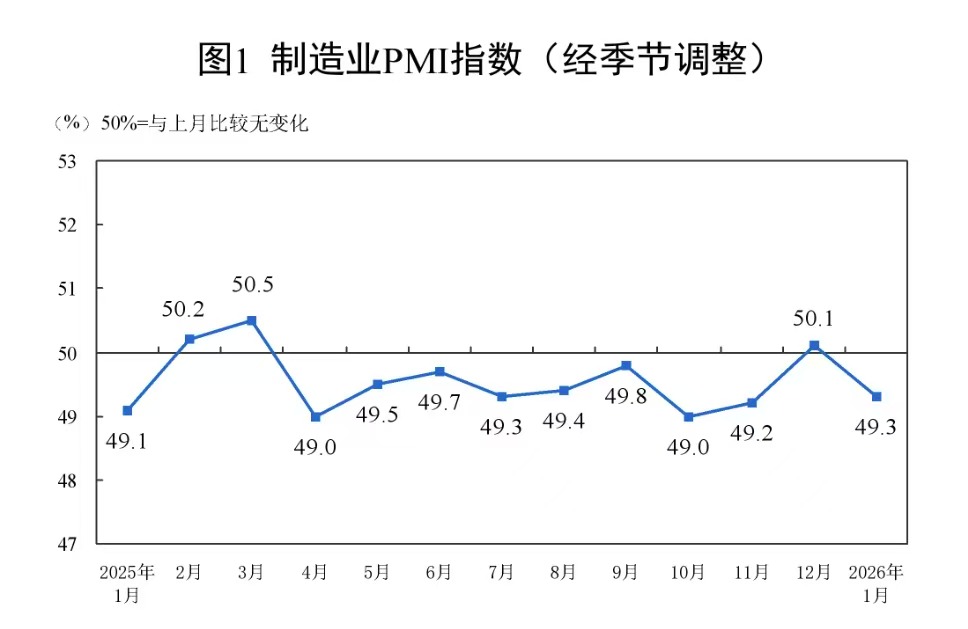
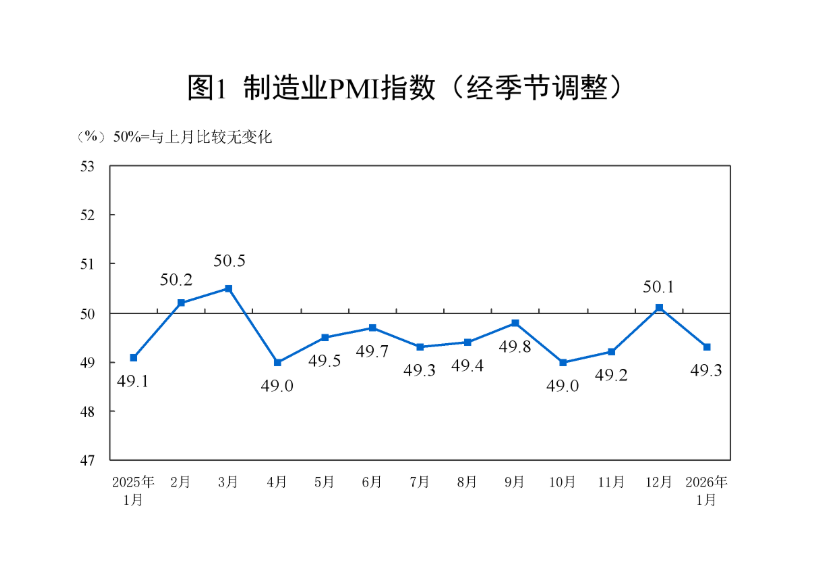
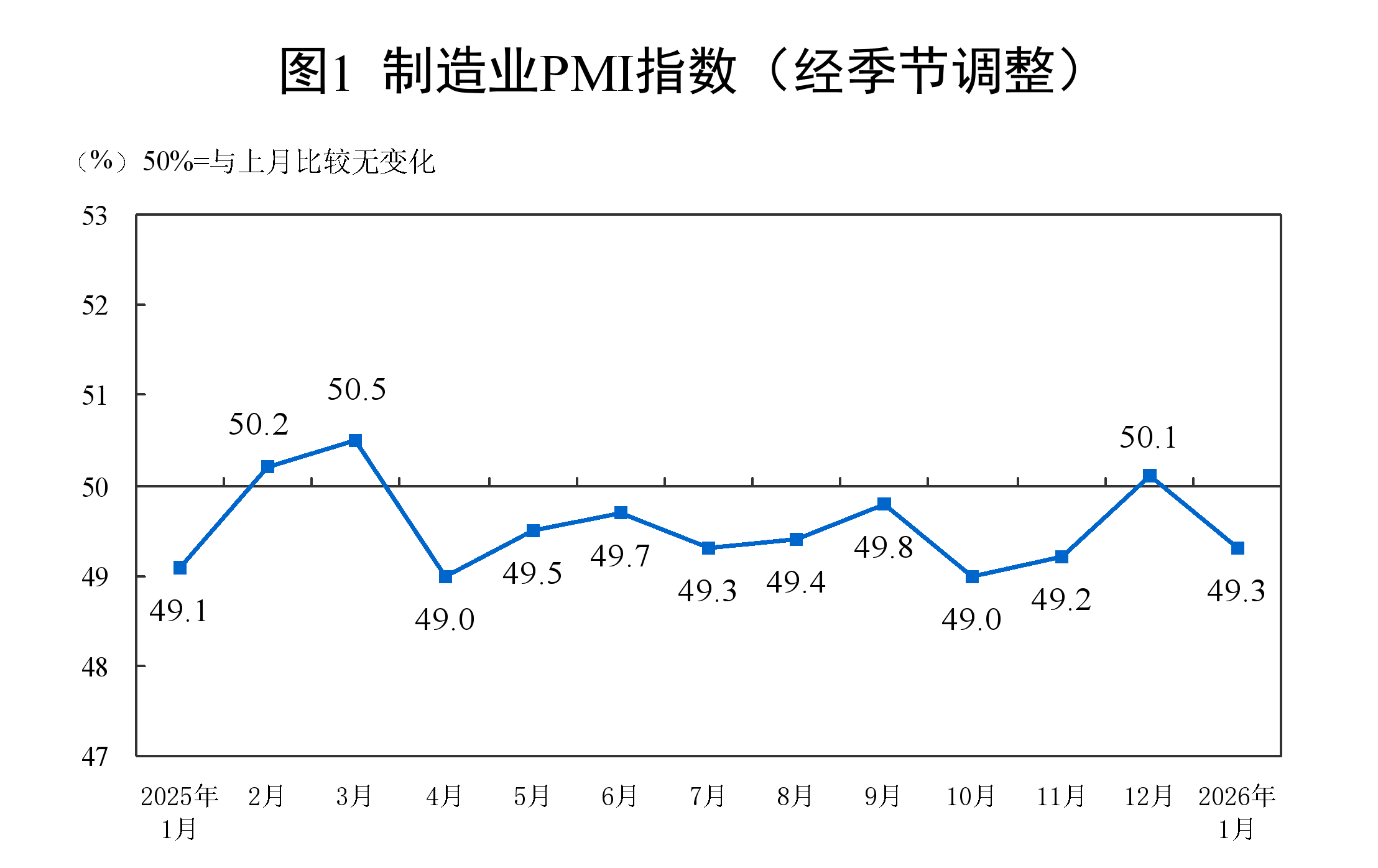
国家统计局:1月制造业PMI为49.3% 景气水平较上月下降 生产继续保持扩张
Guo Jia Tong Ji Ju· 2026-01-31 01:42
Group 1: Manufacturing PMI Overview - In January 2026, the Manufacturing Purchasing Managers' Index (PMI) was reported at 49.3%, a decrease of 0.8 percentage points from the previous month, indicating a tightening in market demand while production continues to expand [1][5] - The production index stood at 50.6%, remaining above the critical point, suggesting ongoing expansion in manufacturing production despite a decline in new orders index to 49.2% [5][6] - High-tech manufacturing PMI was recorded at 52.0%, indicating a sustained positive trend, while equipment manufacturing PMI was at 50.1%, also in the expansion zone [7] Group 2: Non-Manufacturing PMI Overview - The Non-Manufacturing Business Activity Index was reported at 49.4%, down 0.8 percentage points from the previous month, reflecting a general decline in non-manufacturing sector activity [3][8] - The service sector's business activity index was at 49.5%, with financial services and capital market services showing high activity levels above 65.0%, while the real estate sector dropped below 40.0% [8] - The construction sector's business activity index fell to 48.8%, a significant decrease of 4.0 percentage points, indicating a notable decline in construction activity [8] Group 3: Comprehensive PMI Insights - The Comprehensive PMI Output Index was at 49.8%, down 0.9 percentage points from the previous month, suggesting a slowdown in overall business activities [3][9] - The manufacturing production index and non-manufacturing business activity index contributed to the comprehensive PMI, recorded at 50.6% and 49.4% respectively [9]
国家统计局:2026年1月份非制造业PMI为49.4%,比上月下降0.8个百分点
Guo Jia Tong Ji Ju· 2026-01-31 01:39
1月份,非制造业商务活动指数为49.4%,比上月下降0.8个百分点。分行业看,建筑业商务活动指数为 48.8%,比上月下降4.0个百分点;服务业商务活动指数为49.5%,比上月下降0.2个百分点。从服务业行 业看,货币金融服务、资本市场服务、保险等行业商务活动指数均高于65.0%;批发、住宿、房地产等 行业商务活动指数均低于临界点。 资讯编辑:费斐 021-26093397 资讯监督:乐卫扬 021-26093827 资讯投诉:陈跃进 021-26093100 免责声明:Mysteel发布的原创及转载内容,仅供客户参考,不作为决策建议。原创内容版权归Mysteel所有,转载需取得Mysteel书面授 权,且Mysteel保留对任何侵权行为和有悖原创内容原意的引用行为进行追究的权利。转载内容来源于网络,目的在于传递更多信息,方 便学习与交流,并不代表Mysteel赞同其观点及对其真实性、完整性负责。 ...
国家统计局服务业调查中心首席统计师霍丽慧解读2026年1月中国采购经理指数
Guo Jia Tong Ji Ju· 2026-01-31 01:35
——国家统计局服务业调查中心首席统计师霍丽慧解读2026年1月中国采购经理指数 2026年1月31日国家统计局服务业调查中心和中国物流与采购联合会发布了中国采购经理指数。对此, 国家统计局服务业调查中心首席统计师霍丽慧进行了解读。 1月份,制造业采购经理指数、非制造业商务活动指数和综合PMI产出指数分别为49.3%、49.4%和 49.8%,比上月下降0.8个、0.8个和0.9个百分点,经济景气水平有所回落。 一、制造业采购经理指数有所下降,生产继续保持扩张 1月份,部分制造业行业进入传统淡季,加之市场有效需求仍显不足,制造业PMI为49.3%,景气水平较 上月下降。 (一)企业生产继续扩张。生产指数为50.6%,高于临界点,制造业生产保持扩张;新订单指数为49.2%, 市场需求有所回落。从行业看,农副食品加工、铁路船舶航空航天设备等行业生产指数和新订单指数均 高于56.0%,产需释放较快;石油煤炭及其他燃料加工、汽车等行业两个指数均低于临界点,相关行业 市场需求放缓,企业生产有所回落。 1月份中国采购经理指数有所回落 (四)高技术制造业持续领跑。高技术制造业PMI为52.0%,连续两个月位于52.0%及以上 ...
2026年1月中国采购经理指数运行情况
Guo Jia Tong Ji Ju· 2026-01-31 01:32
国家统计局服务业调查中心 中国物流与采购联合会 一、中国制造业采购经理指数运行情况 1月份,制造业采购经理指数(PMI)为49.3%,比上月下降0.8个百分点,制造业景气水平有所回落。 从企业规模看,大型企业PMI为50.3%,比上月下降0.5个百分点,仍高于临界点;中、小型企业PMI分别为48.7%和47.4%,比上月下降1.1个和1.2个百分 点,低于临界点。 从分类指数看,在构成制造业PMI的5个分类指数中,生产指数和供应商配送时间指数均高于临界点,新订单指数、原材料库存指数和从业人员指数均低于 临界点。 生产指数为50.6%,比上月下降1.1个百分点,仍高于临界点,表明制造业生产活动保持扩张。 新订单指数为49.2%,比上月下降1.6个百分点,表明制造业市场需求有所放缓。 原材料库存指数为47.4%,比上月下降0.4个百分点,表明制造业主要原材料库存量继续减少。 从业人员指数为48.1%,比上月下降0.1个百分点,表明制造业企业用工景气度略有回落。 供应商配送时间指数为50.1%,比上月下降0.1个百分点,仍高于临界点,表明制造业原材料供应商交货时间持续加快。 表1 中国制造业PMI及构成指数(经季节 ...
市值增长25%!广西上市公司2025年投资价值持续提升
Xin Hua Cai Jing· 2026-01-29 08:14
新华财经南宁1月29日电(记者范超)记者29日从广西南宁举行的2025年广西金融运行情况新闻发布会 上了解到,2025年广西支持上市公司用好"并购六条"、市值管理等政策工具,通过回购增持、现金分红 等方式持续提升企业投资价值和市场吸引力,上市公司总市值较上年末增长25%。 截至2025年12月末,广西共有A股上市公司42家,新三板挂牌公司33家,IPO在审企业4家,辅导备案企 业9家。2025年1至12月,广西企业通过资本市场直接融资845.83亿元,同比增长74.31%。根据沪深证券 交易所发布的数据,2025年1至12月,广西证券交易额为14.27万亿元,同比增长27.11%。 (文章来源:新华财经) 数据显示,2025年,广西有9家上市公司实施增持、回购合计41.42亿元,8家公司申请回购增持专项贷 款46.85亿元,23家公司实施现金分红41.08亿元,1家公司完成重大资产置换,2家公司长期破净问题得 到解决,上市公司总市值较上年末增长25%。 ...
去年我市利用多层次资本市场融资3140亿元
Xin Lang Cai Jing· 2026-01-28 22:02
Group 1 - Tianjin aims to utilize multi-level capital markets to raise 314 billion yuan by 2025, with a strong focus on supporting the local economy and enhancing the development of the real economy [1] - The successful issuance of 5.04 billion yuan in ABS by China State Construction's commercial property marks the fourth successful issuance of institutional REITs in Tianjin, highlighting the city's growing capital market [1] - By the end of 2025, six institutional REITs in Tianjin were approved, with four successfully issued, raising a total of 4.5 billion yuan, positioning Tianjin among the top in the nation for issuance scale [1] Group 2 - In 2025, Tianjin's capital market supported technological innovation, with Dana Biotechnology becoming the first company listed through the Beijing Stock Exchange's direct review mechanism [2] - The year saw a significant increase in financing through innovative debt instruments, with 32.3 billion yuan raised through tech and green bonds, a 60% increase year-on-year [2] - The establishment of the first futures bonded delivery warehouse in Tianjin and the addition of six new delivery warehouses contributed to the efficient operation of idle resources [2] Group 3 - By the end of December 2025, the total market capitalization of 71 listed companies in Tianjin reached nearly 1.64 trillion yuan, a 15% year-on-year increase [3] - The scale of bonds issued by 110 issuers in the exchange market exceeded 1.32 trillion yuan, reflecting a 13% year-on-year growth [3] - The combined wealth management scale of eight securities, fund, and futures companies, along with 307 private fund managers, surpassed 2.12 trillion yuan, marking a 3% year-on-year increase [3]