
石油煤炭及其他燃料加工

Search documents
2026年3月PMI数据点评
Ping An Securities· 2026-04-01 02:33
Group 1: PMI Overview - The comprehensive PMI for March 2026 in China rose to 50.5%, an increase of 1.0 percentage points from the previous month[3] - The manufacturing PMI improved to 50.4%, up 1.4 percentage points, indicating a return to the expansion zone[3] - The service sector's business activity index reached 50.2%, rising by 0.5 percentage points[3] Group 2: Manufacturing Sector Insights - Manufacturing production index increased by 1.8 percentage points to 51.4%, while new orders index rose by 3.0 percentage points to 51.6%[3] - New export orders index saw a significant increase of 4.1 percentage points, reaching 49.1%[3] - The purchasing price index for raw materials surged to 63.9%, up 9.1 percentage points, indicating a notable rise in manufacturing costs[3] Group 3: Service and Construction Sector Analysis - The construction sector's business activity index improved by 1.1 percentage points to 49.3%, with new orders index increasing by 1.3 percentage points[3] - Service sector new orders index and business activity expectations both declined slightly, by 0.4 and 1.0 percentage points respectively[3] - The service sector's input and sales price indices both increased by 1 percentage point, reflecting rising costs[3]
2026年3月PMI分析:需求回暖强于生产,价格波动明显放大
Yin He Zheng Quan· 2026-03-31 11:39
Economic Indicators - The manufacturing PMI for March 2026 is 50.4%, up 1.4 percentage points from the previous month, indicating expansion[1] - The production index recorded 51.4%, an increase of 1.8 percentage points, while the new orders index reached 51.6%, up 3.0 percentage points, marking the first time in 23 months that new orders exceeded production[3] Demand and Supply Dynamics - Demand recovery is stronger than production, with new orders showing significant improvement driven by high-tech manufacturing, equipment manufacturing, and consumer goods[1][4] - New export orders increased by 4.1 percentage points to 49.1%, the highest since May 2024, indicating resilient external demand despite geopolitical tensions[3] Price Trends - The main raw materials purchase price index rose to 63.9%, a significant increase of 9.1 percentage points, while the factory price index increased to 55.4%, up 4.6 percentage points[4][6] - Brent crude oil averaged $98.71 per barrel in March, up 42% month-on-month, contributing to rising costs in logistics and raw materials[6] Inventory and Procurement - The procurement index rose to 50.9%, indicating a return to expansion, while raw materials inventory index remained at 47.7%, indicating a cautious approach to inventory replenishment[7] - Finished goods inventory index decreased to 46.7%, reflecting limited recovery in stock levels despite improved procurement activities[7] Sector Performance - The PMI for high-tech manufacturing reached 52.1%, while equipment manufacturing and consumer goods sectors recorded PMIs of 51.5% and 50.8%, respectively, indicating broad-based sectoral recovery[4][8] - Small and medium enterprises showed marginal improvement, with PMIs of 49.3% and 49.0%, respectively, still below the expansion threshold[8]
1月制造业PMI继续回落
Zhong Guo Hua Gong Bao· 2026-02-04 01:20
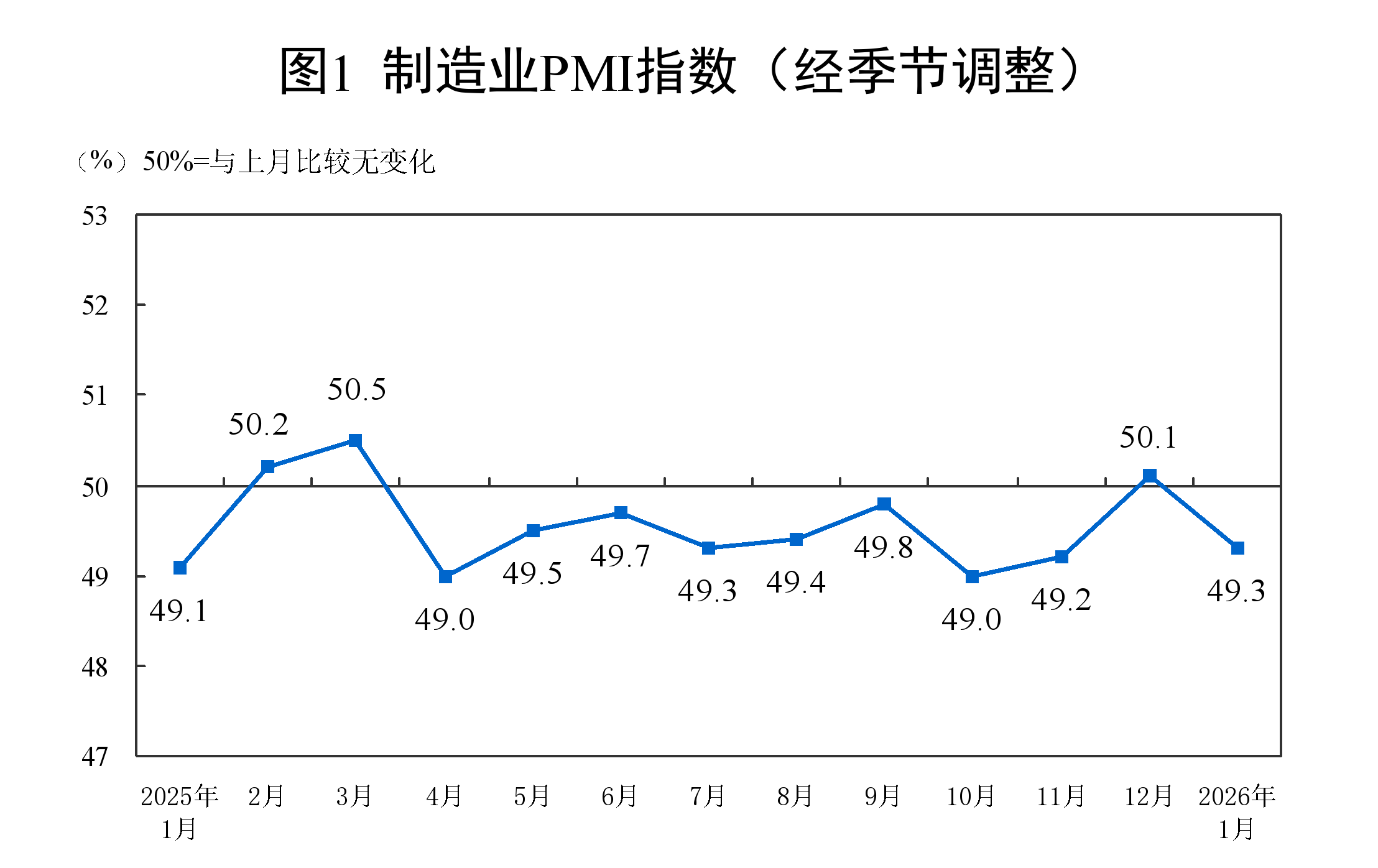
Core Viewpoint - In January, China's Manufacturing Purchasing Managers' Index (PMI) decreased to 49.3%, down 0.8 percentage points from the previous month, indicating a decline in manufacturing activity [1] Group 1: Manufacturing Activity - Manufacturing production continues to expand, but certain sectors like petroleum, coal, and automotive are below the critical point, indicating a slowdown in market demand and production [1] - The price indices for major raw materials and factory prices rose to 56.1% and 50.6%, respectively, reflecting an overall improvement in manufacturing market price levels [1] Group 2: Company Size and Sector Performance - The PMI for large enterprises remains above the critical point at 50.3%, demonstrating ongoing support for the manufacturing sector [1] - High-tech manufacturing continues to lead with a PMI of 52.0%, indicating a positive development trend in related industries [1] Group 3: Business Expectations - Business expectations remain optimistic, with the production and operation activity expectation index at 52.6%, continuing to exceed the critical point [1]
1月制造业景气水平有所回落
Zhong Guo Hua Gong Bao· 2026-02-03 02:55
Core Viewpoint - In January, China's manufacturing Purchasing Managers' Index (PMI) decreased to 49.3%, reflecting a decline in manufacturing activity and indicating a contraction in the sector [1] Group 1: Manufacturing Activity - The manufacturing sector is experiencing a seasonal downturn, with some industries entering a traditional off-peak period and insufficient market demand contributing to the decline in PMI [1] - Production continues to expand in certain sectors, but industries such as petroleum, coal, and automotive are showing reduced market demand, leading to a decrease in production [1] Group 2: Price Indices - The price indices for major raw materials and factory output have both increased, with the purchasing price index at 56.1% and the factory price index at 50.6%, marking rises of 3 percentage points and 1.7 percentage points respectively from the previous month [1] Group 3: Enterprise Size and Performance - Large enterprises maintain a PMI above the critical point at 50.3%, indicating ongoing support for the manufacturing sector [1] - High-tech manufacturing continues to lead with a PMI of 52.0%, suggesting a positive development trend in related industries [1] Group 4: Business Expectations - Enterprises remain optimistic about future production and operational activities, with the production and business activity expectation index at 52.6%, continuing to exceed the critical point [1]
1月份我国制造业PMI为49.3% 比上月下降0.8个百分点
Xin Hua She· 2026-02-02 23:44
Group 1 - The manufacturing Purchasing Managers' Index (PMI) for January is reported at 49.3%, a decrease of 0.8 percentage points from the previous month, indicating a decline in manufacturing activity [1] - The production index stands at 50.6%, indicating expansion, while the new orders index is at 49.2%, reflecting a drop in market demand [2] - Certain industries such as agricultural processing and aerospace have production and new orders indices above 56.0%, indicating rapid release of production and demand, while sectors like petroleum and automotive show indices below the critical point, signaling a slowdown in market demand [2] Group 2 - The PMI for large enterprises is at 50.3%, remaining in the expansion zone, while the PMIs for medium and small enterprises are at 48.7% and 47.4%, respectively, showing a decline in their economic performance [3] - High-tech manufacturing continues to lead with a PMI of 52.0%, maintaining a strong growth trend for two consecutive months [3] - The production expectations index is at 52.6%, indicating that businesses remain optimistic about future operations, particularly in sectors like agricultural processing and beverages, which have high confidence levels [3]
全球贵金属迎来“史诗级”暴跌;证监会召开资本市场“十五五”规划上市公司座谈会|每周金融评论(2026.1.26-2026.2.1)
清华金融评论· 2026-02-02 11:25
Group 1: Global Precious Metals Market - The global precious metals market experienced a historic drop on January 30, with spot gold falling over 12% to $4,682 per ounce, marking the largest single-day decline in 40 years [6] - Spot silver saw a 36% drop, reaching $74.28 per ounce, the largest single-day decline on record [6] - The volatility in gold and silver prices was triggered by the appointment of a hawkish Federal Reserve chair, leading to a strong dollar and profit-taking sell-offs [7] Group 2: Regulatory Developments in Capital Markets - The China Securities Regulatory Commission (CSRC) held a meeting on January 30 to discuss the "14th Five-Year Plan" for capital markets, emphasizing risk prevention, strong regulation, and high-quality development [8] - Key focuses include optimizing listing rules, enhancing capital operation efficiency, attracting long-term funds, improving corporate governance, and supporting global development of listed companies [8] - The CSRC plans to reform the ChiNext and refinancing systems, signaling a shift towards more inclusive regulatory frameworks [8] Group 3: Service Consumption Growth - The State Council issued a work plan to accelerate the cultivation of new growth points in service consumption, targeting sectors like transportation, home services, and inbound consumption [9] - The plan aims to optimize service supply, innovate consumption scenarios, and strengthen talent development to stimulate economic growth [9] - Emphasis is placed on enhancing standards, credit systems, and financial support for service consumption [9] Group 4: Strategic Investor Regulations - The CSRC proposed amendments to expand the types of strategic investors and clarify minimum shareholding requirements, with a proposed minimum of 5% for strategic investors [10] - The revisions aim to strengthen the relationship between strategic investors and listed companies, reducing short-term speculative activities [11] - The regulatory changes are expected to inject new variables into the nearly trillion-yuan refinancing market [11] Group 5: Manufacturing PMI Insights - In January, China's manufacturing PMI was reported at 49.3%, a decrease of 0.8 percentage points from the previous month, indicating a slight contraction in the manufacturing sector [12] - The production index was at 50.6%, indicating expansion, while the new orders index fell to 49.2%, suggesting a decline in market demand [12] - Large enterprises maintained a PMI of 50.3%, while small and medium enterprises showed lower PMIs of 48.7% and 47.4%, respectively, indicating a downturn in their economic conditions [12]


1月份制造业PMI为49.3%
Ren Min Ri Bao Hai Wai Ban· 2026-02-02 01:48
Group 1 - The manufacturing Purchasing Managers' Index (PMI) for January is 49.3%, a decrease of 0.8 percentage points from the previous month, indicating a decline in manufacturing activity due to seasonal factors and insufficient market demand [2] - The production index stands at 50.6%, indicating continued expansion in manufacturing production, while the new orders index is at 49.2%, reflecting a drop in market demand [2] - Certain industries such as agricultural processing and aerospace have production and new orders indices above 56.0%, indicating strong demand, while sectors like petroleum and automotive show indices below the critical point, suggesting a slowdown in market demand [2] Group 2 - The main raw materials purchasing price index and the factory price index are at 56.1% and 50.6%, respectively, both showing increases from the previous month, with the factory price index rising above the critical point for the first time in nearly 20 months [3] - Large enterprises maintain a PMI of 50.3%, indicating continued expansion, while medium and small enterprises show PMIs of 48.7% and 47.4%, reflecting a decline in their economic performance [3] - High-tech manufacturing leads with a PMI of 52.0%, remaining above 52.0% for two consecutive months, while consumer goods and high-energy industries show lower PMIs of 48.3% and 47.9%, indicating a decrease in their economic conditions [3] Group 3 - The production and business activity expectation index is at 52.6%, indicating optimism among enterprises, particularly in agricultural processing and food industries, which have indices above 56.0% [4] - The non-manufacturing business activity index for January is 49.4%, a decrease of 0.8 percentage points from the previous month, indicating a decline in overall non-manufacturing activity [4] - The service industry business activity index is at 49.5%, down 0.2 percentage points, with sectors like financial services showing high activity indices above 65.0%, while the real estate sector drops below 40.0%, indicating weak performance [4]
1月份中国采购经理指数有所回落
Guo Jia Tong Ji Ju· 2026-02-02 01:05
Group 1: Manufacturing Sector - The manufacturing Purchasing Managers' Index (PMI) decreased to 49.3% in January, indicating a decline in economic sentiment compared to the previous month [1][2] - The production index remained above the critical point at 50.6%, suggesting continued expansion in manufacturing production, while the new orders index fell to 49.2%, indicating a drop in market demand [2] - Large enterprises maintained a PMI of 50.3%, indicating ongoing expansion, while small and medium-sized enterprises saw declines in their PMIs to 48.7% and 47.4%, respectively [3] - High-tech manufacturing continued to lead with a PMI of 52.0%, reflecting a positive development trend in this sector [3] - The price indices for major raw materials and factory prices rose to 56.1% and 50.6%, respectively, indicating an overall improvement in market price levels [2] Group 2: Non-Manufacturing Sector - The non-manufacturing business activity index fell to 49.4%, reflecting a decrease in overall economic sentiment in this sector [1][4] - The service industry business activity index was at 49.5%, with significant activity in financial services, while the real estate sector's index dropped below 40.0%, indicating weak sentiment [4] - The construction industry experienced a notable decline, with its business activity index at 48.8%, influenced by adverse weather and the upcoming holiday [4] - Despite the decline in current activity, the service industry business activity expectation index rose to 57.1%, indicating increased confidence among service sector enterprises [4] Group 3: Composite PMI - The composite PMI output index was recorded at 49.8%, showing a slight decrease from the previous month, indicating a general slowdown in production and business activities [1][5] - The manufacturing production index and non-manufacturing business activity index were 50.6% and 49.4%, respectively, contributing to the overall composite PMI output index [5]
1月制造业PMI49.3%,制造业市场价格总体改善
2 1 Shi Ji Jing Ji Bao Dao· 2026-02-01 02:29
Core Viewpoint - The manufacturing Purchasing Managers' Index (PMI) in China for January is reported at 49.3%, indicating a decline of 0.8 percentage points from the previous month, reflecting a downturn in manufacturing activity [1][5][8]. Manufacturing PMI Analysis - The decline in manufacturing PMI is attributed to seasonal factors as some industries enter a traditional off-peak period, coupled with insufficient market demand [1][8]. - The production index stands at 50.6%, indicating continued expansion in manufacturing production, while the new orders index is at 49.2%, showing a decrease in market demand [6][8]. - High-tech manufacturing PMI remains strong at 52.0%, indicating sustained positive development in related industries [1][8]. Price Index Improvement - The overall price level in the manufacturing sector has improved, with the main raw materials purchasing price index at 56.1% and the factory price index at 50.6%, both showing increases from the previous month [2][14]. - The factory price index has risen above the critical point for the first time in nearly 20 months, suggesting a general improvement in manufacturing market prices [2][14]. Employment and Inventory Trends - The employment index is reported at 48.1%, indicating a slight decline in hiring conditions within the manufacturing sector [12]. - The raw materials inventory index is at 47.4%, reflecting a continued decrease in major raw material stocks, while finished goods inventory has increased, suggesting accelerated production activities ahead of the Spring Festival [13][12]. Future Expectations - The production and business activity expectation index is at 52.6%, remaining above the critical point, although it marks the lowest level since the second half of 2025 [15]. - There is a noted concern regarding the decline in new export orders, which fell to 47.8%, indicating a contraction in external demand and potential challenges for future manufacturing activity [7][15].
2026 年 1 月 PMI 数据点评:PMI 淡季回落,价格回升
GUOTAI HAITONG SECURITIES· 2026-01-31 13:34
Group 1: Manufacturing PMI Insights - In January 2026, the manufacturing PMI was 49.3%, a decrease of 0.8 percentage points from the previous month[9] - The production index was 50.6%, down 1.1 percentage points, indicating cautious expansion due to demand decline[16] - New orders and new export orders indices were 49.2% and 47.8%, respectively, both declining by 1.6 and 1.2 percentage points[16] Group 2: Price and Inventory Trends - The main raw materials purchase price index rose to 56.1%, an increase of 3.0 percentage points, while the factory price index reached 50.6%, marking the first time in 20 months above the critical point[19] - Raw material inventory and finished goods inventory indices were 47.4% and 48.6%, respectively, indicating a decrease in raw material stock[21] Group 3: Non-Manufacturing Sector Performance - The service sector's business activity index was stable at 49.5%, with significant divergence among industries[22] - The construction sector's business activity index fell to 48.8%, down 4.0 percentage points, reflecting seasonal slowdowns[24] Group 4: Economic Outlook and Risks - The macroeconomic policy is expected to be more proactive, with a focus on boosting overall demand and ensuring spending increases[27] - A risk remains in the real estate sector, where demand needs to be stimulated[28]