
医美

Search documents
爱美客202509004
2025-09-04 14:36
Summary of Aimeike's Conference Call Company Overview - Aimeike has established a leading position in the niche market with its Hi-Tech series, particularly the neck wrinkle injection product [2][3] - The company has been continuously launching new indication products such as Panda Needle and Thai Bubble Needle to strengthen its technological and channel advantages [2] Core Insights and Arguments - **Performance Decline**: Since Q1 2023, Aimeike's growth rate has slowed down, and its valuation has decreased due to a lack of blockbuster new products, weak consumer demand, and increased competition from upstream products like hyaluronic acid, leading to over 20% declines in gel and solution products [2][4][5] - **Acquisition of Regen**: In March 2023, Aimeike acquired Regen, which is expected to enhance production capacity and expand international channels in the short term. Regen reported a revenue of 80 million RMB and a profit of 50 million RMB in 2023 [2][6][7] - **Product Capacity Expansion**: The acquisition is projected to increase the production capacity of S-FILM products by five times, driving rapid growth in product offerings [2][8] - **Market Trends**: The medical aesthetics market is expected to improve, with Aimeike's profits projected to be 1.72 billion RMB in 2025, a decline of about 10%, but expected to exceed 2 billion RMB in 2026 with a growth rate close to 20% [4][9] Future Development Outlook - **International Expansion**: Aimeike plans to leverage Regen's international production capacity and channels to launch existing products like Hightide and Bonida globally, marking a significant step towards internationalization [2][9] - **New Product Cycle**: Aimeike is entering a new product cycle, with botulinum products expected to be approved and sold in Q4 2023 or Q1 2024. Following a low performance in 2025 due to high base effects from 2024, a gradual improvement is anticipated in Q3 and Q4 of 2025, leading to steady growth starting in 2026 [9][10] - **Valuation Impact**: The integration of Regen is expected to influence Aimeike's valuation, with projected multiples of 30x in 2025 and around 25x in 2026, driven by core product fundamentals, R&D pipeline, and international acquisition synergies [4][10] Additional Important Points - **Market Competition**: The domestic market has over 80 approved hyaluronic acid products, intensifying competition in the regenerative materials market [5] - **Sales Channel Development**: Aimeike is working on reclaiming domestic distribution rights and has a sales network covering 4,000 to 5,000 institutions nationwide, with good growth momentum for SFE products in both domestic and international markets [8]

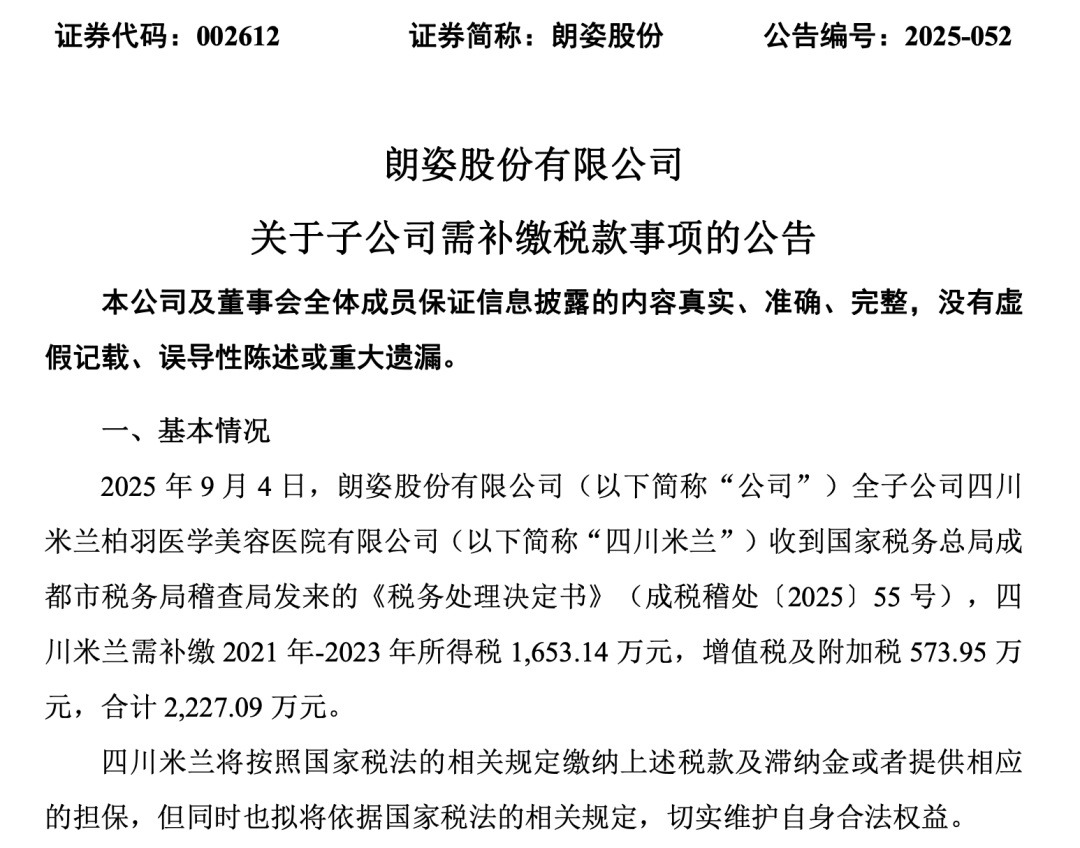
朗姿股份子公司补缴3年税款,合计2227万元!
Shen Zhen Shang Bao· 2025-09-04 12:50
Group 1 - The company announced that the tax payment and late fees will be recorded in the 2025 fiscal year, expected to reduce the net profit attributable to shareholders by approximately 30.82 million yuan [4] - The management of the company is taking the matter seriously and will enhance management practices, training, and awareness of tax laws to protect the interests of the company and its shareholders [4] - The tax issue will not have a significant impact on the company's normal operations [4] Group 2 - In the first half of the year, the company achieved operating revenue of 2.788 billion yuan, a year-on-year decrease of 4.30% [4] - The net profit attributable to shareholders was 274 million yuan, a year-on-year increase of 64.09%, while the net profit excluding non-recurring items was 136 million yuan, a year-on-year decrease of 2.70% [4] - The company reduced its holdings in RuYueChen, generating a net investment income of approximately 166.41 million yuan, which impacted the current net profit by 141.44 million yuan, accounting for 54.99% of the audited net profit for the last fiscal year [4] Group 3 - The company applied for a total of 110 million yuan in working capital loans from two banks, with guarantees provided by the controlling shareholder and actual controller [5]


三天涨超12%后微跌,金发拉比的“营收狂欢”难掩盈利困局
Guan Cha Zhe Wang· 2025-09-04 12:08
Core Viewpoint - The stock price of Jinfa Labi has shown significant volatility despite a substantial increase in revenue, leading to confusion among industry experts regarding the company's financial health and future prospects [1][2][3]. Financial Performance - In the first half of 2025, Jinfa Labi achieved a revenue of 158 million yuan, representing a year-on-year growth of 101.99% [1]. - The revenue from maternal and infant products was 123 million yuan, accounting for 77.64% of total revenue, with a year-on-year increase of 62.34% [1]. - The medical beauty segment generated 33 million yuan, contributing to 21.03% of total revenue, with a year-on-year growth of 100% [1][2]. Cost and Profitability - The company's operating costs surged to 100 million yuan, a year-on-year increase of 183.11%, primarily due to the expansion of e-commerce channels and the consolidation of the medical beauty business [2]. - Sales expenses rose by 72.52% to 37.78 million yuan, while management expenses increased by 11.45% to 20.19 million yuan [2]. - Jinfa Labi reported a net loss attributable to shareholders of 17.92 million yuan, worsening from a loss of 2.75 million yuan in the same period of 2024 [2][5]. Market Dynamics - The stock price fluctuations are influenced by market sentiment and speculative trading, particularly in light of government policies promoting childbirth and the growth of the maternal and infant sectors [3]. - The integration of the medical beauty business is seen as a strategic move to create a dual growth engine alongside maternal and infant products, which has garnered market interest [3][5]. Company History and Challenges - Jinfa Labi, listed in June 2015, has faced a prolonged period of declining profits, with significant losses reported in recent years, raising concerns about its potential delisting [4]. - The company has seen a reduction in its store count from 1,133 in 2019 to 587 in 2024, indicating operational challenges [4].


医美企业半年成绩单:巨子领跑、华熙敷尔佳求变,行业转型加速
Bei Jing Shang Bao· 2025-09-04 05:22
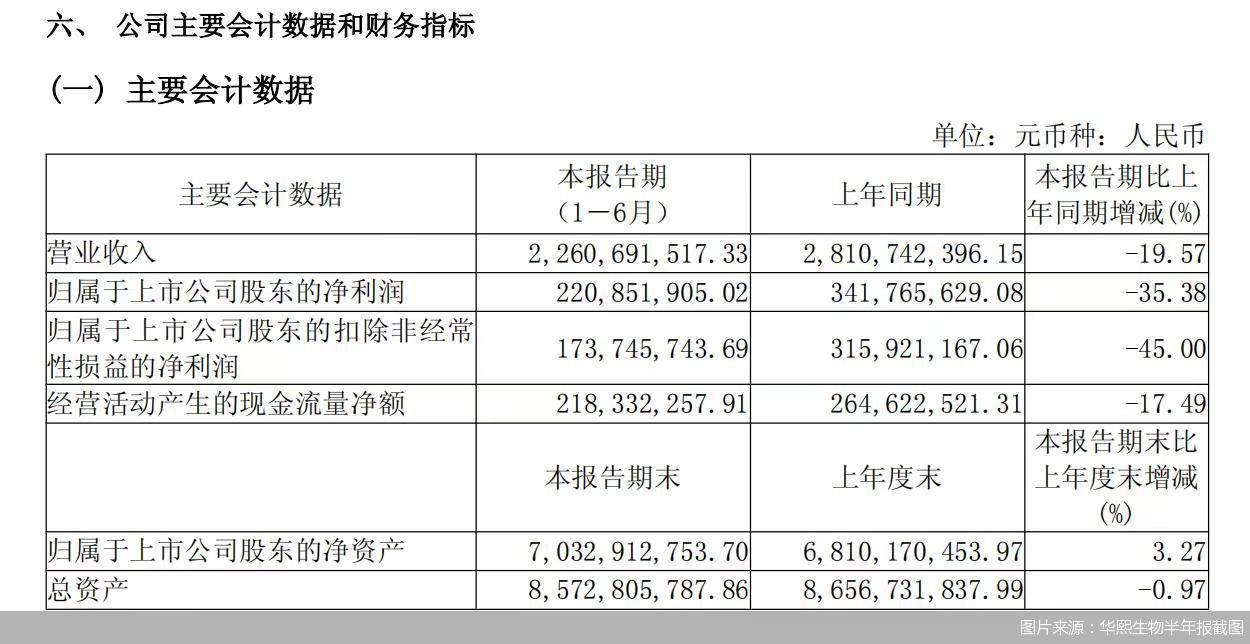
Core Viewpoint - The development paths of medical beauty companies are diverging amid industry adjustments, with three leading companies—Hua Xi Bio, Juzi Bio, and Fulejia—reporting significantly different half-year results, reflecting a shift from "traffic dividends" to "technical barriers" in the industry [1] Group 1: Company Performance - Juzi Bio led with a revenue of 31.13 billion yuan and a year-on-year growth rate of 22.5% [4] - Hua Xi Bio reported a revenue of 22.61 billion yuan, a decline of 19.57% year-on-year, marking its worst interim report since listing [2][3] - Fulejia's revenue was 8.63 billion yuan, down 8.15% year-on-year, with a net profit drop of 32.54% [3][4] Group 2: Strategic Adjustments - Hua Xi Bio attributed its revenue decline to a drop in income from its skin science innovation transformation business, which saw a 33.97% decrease to 9.12 billion yuan [5][6] - Fulejia's revenue drop was linked to offline channel optimization, which increased sales expenses by 39.56% to 4.2 billion yuan [5][9] - Juzi Bio's growth was driven by the sales increase of professional skin care products, contributing 99.7% of its revenue [10][11] Group 3: Market Dynamics - The medical beauty industry is experiencing a shift, with the competition now focusing on research and development capabilities, patent layouts, and compliance [17] - The market for recombinant collagen products is projected to grow at a compound annual growth rate of 44.93%, reaching 58.57 billion yuan by 2025 [15] - Hua Xi Bio is expanding into recombinant collagen while maintaining its position in hyaluronic acid, indicating a dual strategy to adapt to market changes [15][16]

策略 25年中报业绩分析
2025-09-03 14:46
Summary of Key Points from the Conference Call Industry Overview - The overall profitability of A-shares has turned positive for the first time after years of negative growth, with a net profit growth of 11% in Q1 2025, but a decline in Q2 [1][2] - The Sci-Tech Innovation Board, financial, oil, and petrochemical sectors have negatively impacted overall profitability, while the ChiNext Board has played a positive role [2] Financial Performance - Non-financial and non-oil A-shares showed a slight improvement in operating cash flow year-on-year, but the absolute scale remains low compared to the past three years, indicating unstable cash generation capabilities [1][5] - Capital expenditure has been negative for five consecutive quarters, but the decline has narrowed, with contract liabilities showing a year-on-year growth rate decline, reflecting insufficient recovery in terminal demand [1][6] Leverage and Financial Ratios - The ratio of interest-bearing debt to shareholder equity has slowly increased to a new high since 2022, while financial expenses as a percentage of total revenue have reached a historical low, indicating effective transmission of monetary easing policies to enterprises [1][7] - The return on equity (ROE) for non-financial and non-oil A-shares was 6.44% in Q2, showing signs of stabilization, but total asset turnover has declined, indicating weakened ability to convert assets into revenue [1][8] Sector Performance - Industries with better year-on-year profit changes include agriculture, forestry, animal husbandry, steel, building materials, electronics, and computers [3][9] - The TMT sector, including electronics and computers, performed relatively well on a quarter-on-quarter basis, while cyclical sectors experienced fluctuations due to the transition of old and new driving forces [3][10] Emerging Sectors - The AI sector has shown the best performance among new tracks, with high growth rates in optical modules and copper-clad laminates, while semiconductor equipment has seen negative growth [11] - In the pharmaceutical sector, innovative drugs and medical services have improved significantly, but medical device revenues and profits have declined [12] Investment Opportunities and Risks - The financial sector shows a stable overall performance, with city commercial banks and rural commercial banks leading the growth with 6.7% and 4.4% respectively, making them more attractive compared to large state-owned banks [18][19] - The insurance industry has shown stable performance with double growth in revenue and profit, indicating a positive outlook [20] Cash Flow and Capital Expenditure - Industries with good cash flow and stable growth include education publishing, kitchen appliances, and construction, while sectors like pre-processed food and liquor need to be monitored for cash flow deterioration [21] - The current capital expenditure remains in negative growth, but the decline is narrowing, indicating potential recovery in the future [14] Market Dynamics - Large and mid-cap stocks have performed better than small-cap stocks, with mid-cap stocks showing stronger growth in both revenue and profit [22] - Different scales of enterprises show significant performance disparities, with large enterprises generally outperforming small ones in technology and manufacturing sectors [23][24] This summary encapsulates the key insights from the conference call, highlighting the performance of various sectors, financial metrics, and potential investment opportunities and risks.
四环医药再涨超8% 上半年实现扭亏为盈 AI+医美战略布局进入实质性阶段
Zhi Tong Cai Jing· 2025-09-03 03:06
Group 1 - The core viewpoint of the article highlights the significant performance improvement of Four Seasons Pharmaceutical, with a notable increase in stock price and positive financial results [1] - The company reported a revenue of 1.15 billion yuan for the first half of the year, representing a year-on-year growth of 20.7% [1] - The overall gross margin improved to 66.1%, an increase of 2 percentage points compared to the previous year, driven by the high-margin medical aesthetics business [1] Group 2 - Research and development expenses decreased by 21.9% to 150 million yuan, a reduction of 43 million yuan year-on-year, indicating significant cost management improvements [1] - The company achieved a net profit of 66 million yuan, with a net profit attributable to shareholders of 103 million yuan, marking a turnaround from losses in the previous year [1] - Four Seasons Pharmaceutical announced a framework agreement with Deep Origin Pharmaceutical to establish an AI research and development company, focusing on the application of AI technology in the medical aesthetics sector [1]
港股异动|四环医药涨超9.3%创逾三年半新高,中报扭亏转盈,布局AI+医美创新赛道
Ge Long Hui· 2025-09-03 02:38
Core Insights - Four Seasons Pharmaceutical (0460.HK) saw its stock price rise over 9.3% during trading, reaching a high of HKD 1.64, the highest since February 2022. The stock has increased over 140% year-to-date [1] Financial Performance - The company reported a mid-year revenue of CNY 1.146 billion, representing a year-on-year growth of 20.7% [1] - The net profit attributable to shareholders was CNY 103 million, marking a turnaround from losses in the previous year [1] - Overall gross margin improved to 66.1%, an increase of 2 percentage points year-on-year [1] - The medical aesthetics segment performed exceptionally well, generating revenue of CNY 590 million, a year-on-year increase of 81.3%, with segment profit reaching CNY 310 million, up 215.3% [1] - The company declared an interim cash dividend of CNY 0.0099 per share [1] Strategic Developments - Four Seasons Pharmaceutical has signed a framework agreement with Deep Origin Pharmaceutical Biotechnology (Beijing) Co., Ltd. to promote the application of artificial intelligence in the development of medical beauty products [1] - The partnership aims to establish an AI research and development company led by Four Seasons, focusing on exploring AI-driven new medical beauty product development, marking a significant step in the company's strategic layout in the AI + medical aesthetics innovation sector [1]
胶原蛋白锦波生物、巨子生物
2025-09-02 14:41
Summary of Conference Call on Recombinant Collagen Industry Industry Overview - Recombinant collagen technology has gained popularity in the beauty and skincare industry due to its ability to reduce allergic reactions associated with animal-derived collagen and optimize production costs [1][2] - The industry has seen significant supply-side innovations since 2022, with advancements in gene engineering technology facilitating the commercial production of recombinant collagen [2] Key Companies Jinbo Biotechnology - Jinbo Biotechnology is a leading player in the recombinant collagen medical aesthetics sector, with revenue projected to grow from 160 million yuan in 2020 to 1.44 billion yuan in 2024, achieving a compound annual growth rate (CAGR) of over 70% [1][5] - The company's profit is expected to reach 730 million yuan in 2024, with a CAGR exceeding 100% [5] - Jinbo's new low-temperature gel filler product, approved in 2025, is anticipated to capture market share from animal-derived and regenerative materials [6] - The company plans to implement precise marketing strategies and product innovations to promote new products in the second half of the year [6] Juzhi Biotechnology - Juzhi Biotechnology has made significant strides in the functional skincare sector with products like the "collagen stick" and is expanding into niche markets such as scalp and intimate care [1][7] - The company benefits from national policy support, which has solidified its leading position in the industry [7] - Juzhi has transitioned to direct-to-consumer (DTC) online channels, enhancing sales performance through partnerships with top influencers on platforms like Tmall and Douyin [3][13] Jingbo Biotechnology - Jingbo has achieved progress in the research and certification of recombinant collagen products, accelerating its international market expansion [1][8] - The company has received certifications for functional skincare products in the U.S., Saudi Arabia, and Thailand, contributing to significant revenue growth [8] - Profit forecasts for Jingbo indicate 1.05 billion yuan in 2025 and 1.4 billion yuan in 2026, with a valuation of approximately 30 times earnings in 2025, decreasing to below 25 times in 2026 [9][10] Market Trends and Future Outlook - The acceptance of new products and materials by consumers is increasing, leading to the emergence of industry leaders like Jinbo and Juzhi in the medical aesthetics and functional skincare sectors [4] - The market for recombinant collagen is expected to grow as companies continue to innovate and expand their product offerings [6][7] - The focus on online sales channels and influencer marketing is driving growth in the skincare sector, with Juzhi's online sales showing exceptional performance [3][13] Important Considerations - Future performance indicators to watch include sales growth during the September and October periods, particularly around the Double Eleven shopping festival [16] - The approval of new medical aesthetic products will serve as a significant catalyst for growth, as current valuations primarily reflect cosmetics business performance [16][17] - Jinbo and Juzhi's advancements in recombinant collagen technology position them well for sustained growth in the evolving beauty and skincare market [18]
新氧20250902
2025-09-02 14:41
Summary of the Conference Call for Xinyang Industry Overview - The medical aesthetics industry is characterized by a single-store profit margin of approximately 10% for mature institutions. Xinyang focuses on the anti-aging sector, reducing service product units (SPU), and targeting middle-class consumers with an average spending of over 2,000 yuan to meet annual anti-aging needs [2][4]. Key Points and Arguments - **Profitability Enhancement**: Xinyang aims to improve profitability through economies of scale and reduced customer acquisition costs. The user referral rate is increasing, which helps maintain low acquisition costs. Mature stores in first-tier cities have profit margins of about 10% to 15%, while stores in the ramp-up phase achieve around 10% net profit margin [2][6]. - **Supply Chain Strategy**: The company plans to increase its self-supply ratio from the current 15% to 30%-40% within the next three to four years, significantly lowering material costs. This is part of a broader strategy to enhance profit margins by controlling supply chain costs [7][8]. - **Store Expansion Plans**: Xinyang plans to open 50 stores by the end of 2025, primarily in first- and second-tier cities, with a focus on direct management and exploring a fully managed franchise model. By 2026, the company expects to open at least 30 more stores, bringing the total to over 80 [4][19]. - **Cost Structure**: In mature medical aesthetic institutions in first-tier cities, material costs account for about 45% of revenue, while labor costs (including doctors, nurses, and managers) range from 25% to 27%. Marketing costs stabilize around 10% after a year of operation [3][10]. - **Market Positioning**: Xinyang targets middle-class consumers with annual spending on aesthetic treatments between 10,000 to 20,000 yuan. The company aims to encourage 4 to 6 treatments per year to cover annual anti-aging needs [5][24]. - **Customer Retention and Product Strategy**: The company focuses on educating users about domestic products that offer similar quality at lower prices. This strategy is expected to help retain existing customers and attract new ones [12][24]. - **Profit Margin Goals**: Xinyang is confident in achieving a net profit margin of 20% in the long term, especially after increasing the self-supply ratio [24]. Additional Important Insights - **Challenges in Expansion**: The medical aesthetics industry faces challenges such as regional differences and reliance on high-quality store managers. Xinyang is addressing this through digital management to reduce dependence on high-salary managers [16][17]. - **Competitive Landscape**: The company believes its model is difficult to replicate due to its comprehensive system and established brand presence, which creates a flywheel effect for customer acquisition [18]. - **Performance in Second-Tier Cities**: Xinyang is testing its operational model in second-tier cities, with plans to open new stores and validate its approach based on experiences from first-tier cities [15][22]. - **Customer Spending Trends**: There has been a 20% increase in average spending per visit from existing customers in 2025, indicating a positive trend in customer engagement [23]. - **Future Strategic Focus**: The company will continue to prioritize offline chain operations, recognizing that the medical aesthetics sector requires a slower expansion pace compared to other industries like fast food [26]. This summary encapsulates the key insights and strategic directions discussed during the conference call, highlighting Xinyang's focus on profitability, supply chain management, and market positioning within the medical aesthetics industry.

轻医美上瘾后,一个中产女孩的生活面临失控
Hu Xiu· 2025-09-02 10:30
Core Viewpoint - The article explores the psychological and financial implications of cosmetic procedures, highlighting the shift from rational decision-making to compulsive behavior in the pursuit of beauty, and the resulting anxiety and dissatisfaction that can arise from such choices [1][19][32]. Group 1: Personal Experience with Cosmetic Procedures - The subject, Xiaoman, has been engaged in cosmetic procedures for six years, starting with a focus on her nose due to childhood trauma [3][4]. - Initially, Xiaoman was rational in her choices, carefully selecting materials and practitioners, and adhering to a budget [7][8]. - The rise of "light medical beauty" has made non-invasive procedures more popular, surpassing traditional surgical options in market value since 2022 [10]. Group 2: Psychological Impact and Behavioral Changes - Xiaoman's experience reflects a broader trend where cosmetic procedures become a coping mechanism for personal crises, leading to excessive spending and a loss of control [13][19]. - After a breakup and increased work stress, Xiaoman's rational approach deteriorated, resulting in impulsive decisions regarding cosmetic treatments, leading to significant financial expenditure [17][18]. - The article discusses the concept of "spiritual essence," suggesting that while individuals may enhance their appearance, they risk losing their unique qualities [21][23]. Group 3: Industry Dynamics and Consumer Behavior - The cosmetic industry has shifted from exploiting information asymmetry to creating a cycle of anxiety and dependency on procedures [27][34]. - Consumers are becoming more informed and discerning, often researching specific treatments and practitioners before making decisions, which has led to a decrease in prices for certain procedures [26]. - The industry's focus on enhancing beauty standards perpetuates a cycle of demand, where individuals feel compelled to continuously invest in their appearance to meet societal expectations [35][36].