智能手机

Search documents
户外轻旗舰荣耀Power2发布,跨越式升级4大旗舰级能力
Jing Ji Wang· 2026-01-06 08:39
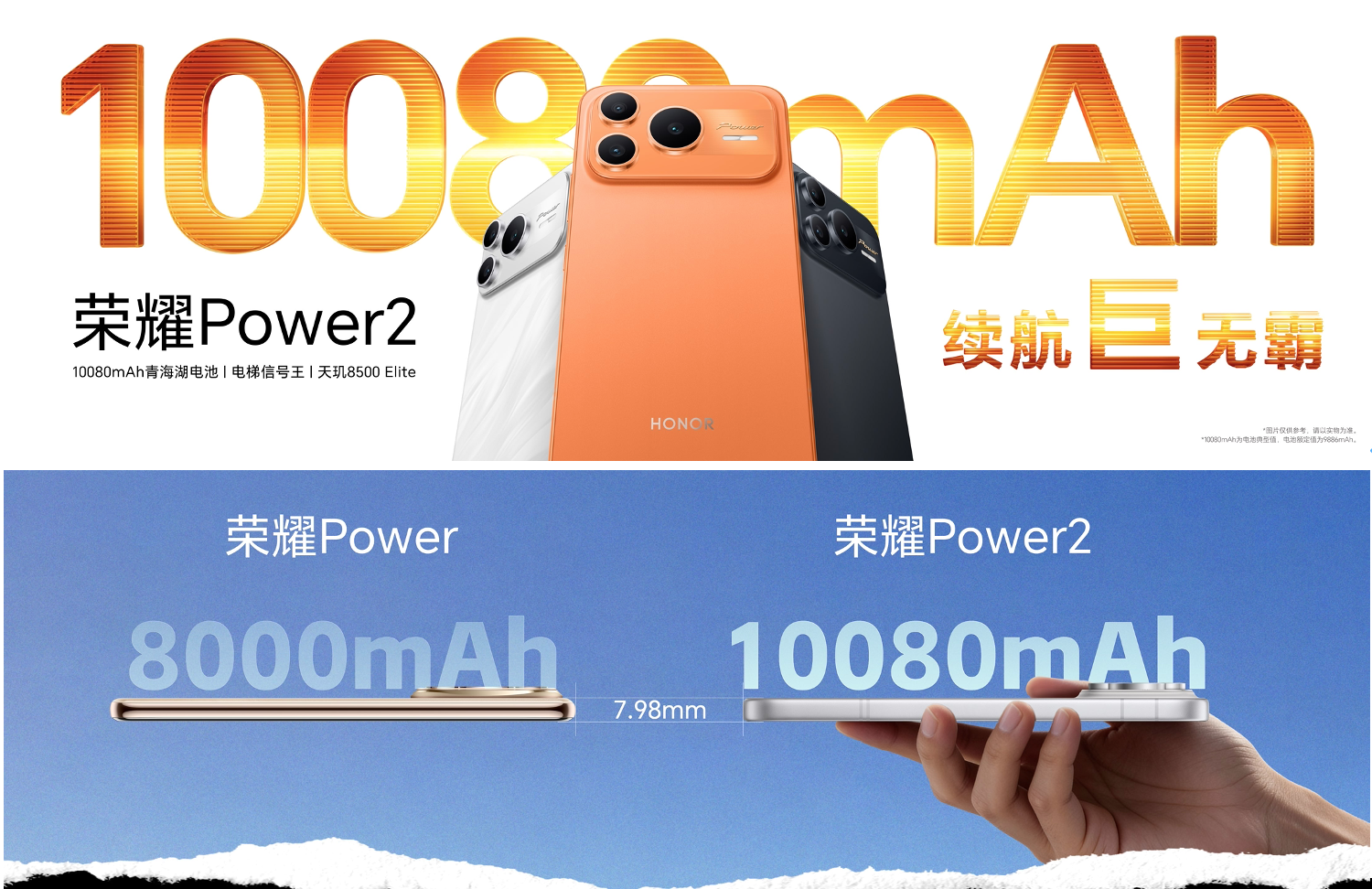
Core Viewpoint - Honor has launched the upgraded outdoor flagship device, Honor Power2, which significantly enhances performance in battery life, communication, and reliability, providing users with a premium experience that surpasses typical flagship offerings [1]. Group 1: Battery Performance - The Honor Power2 features an industry-leading 10080mAh battery, increasing capacity by 2080mAh compared to its predecessor, achieving the longest battery life in comprehensive testing [3]. - The device supports 80W super fast charging and 27W reverse charging, allowing for quick recharging and the ability to charge other devices [3]. - The battery's energy density is rated at 926Wh/L, with a thickness of only 7.98mm, maintaining a slim profile while enhancing battery performance [3]. Group 2: Communication Capabilities - Honor Power2 introduces a parallel dual-track antenna design, featuring 25 antennas and achieving 100% mid-frame antenna coverage, leading to a 200% improvement in weak signal performance [5]. - The device has received a five-star certification for signal strength and precise navigation in challenging environments, such as elevators and subways [5]. - It utilizes a new multi-source fusion positioning engine, supporting dual-band GPS and BeiDou three-band, optimizing navigation across various scenarios [5]. Group 3: Performance Specifications - The device is the first to feature the Dimensity 8500 Elite chip, offering a 25% increase in GPU performance and superior multitasking capabilities [7]. - It includes an advanced cooling system with a total heat dissipation area exceeding 40000mm², ensuring stable performance during prolonged use [7]. Group 4: Reliability and Design - The Honor Power2 has enhanced durability with a 25% increase in drop resistance and a 22% increase in bend resistance, certified for high durability standards [9]. - It features IP68, IP69, and IP69K ratings for dust and water resistance, capable of withstanding extreme outdoor conditions [9]. - The device includes a 6.79-inch 1.5K eye-care display with a peak brightness of 8000 nits and various eye protection features [9]. Group 5: Pricing and Availability - The Honor Power2 is available in three colors: "Sunrise Orange," "Snow White," and "Phantom Black," with pricing set at 2699 yuan for the 12GB + 256GB version and 2999 yuan for the 12GB + 512GB version, with potential discounts available [10].

年度趋势:告别大单品时代
3 6 Ke· 2026-01-06 04:57
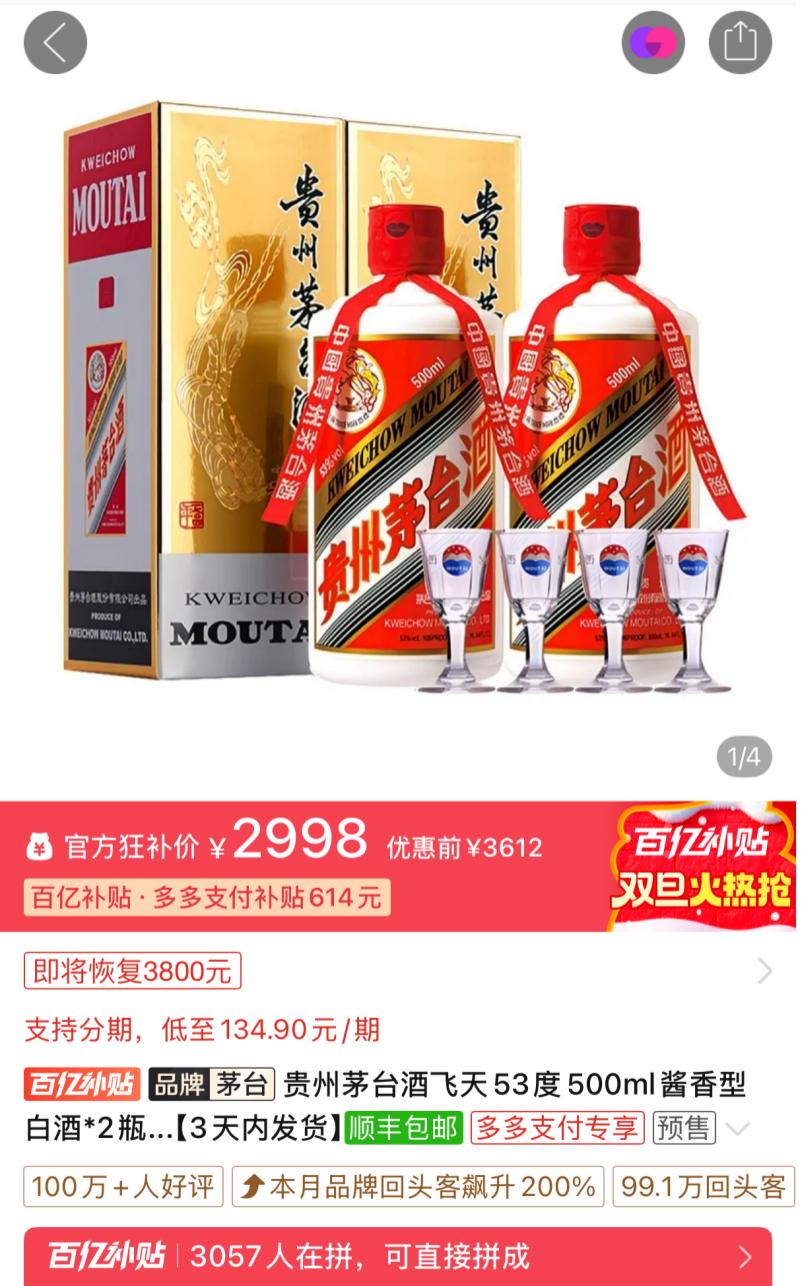
Core Insights - The article discusses the shift in business strategy from focusing on a single flagship product to managing a diverse product matrix due to increasing market complexity and competition [2][5][6] Group 1: Single Product Strategy - The allure of a single product strategy lies in its efficiency and scale, with examples like Moutai, Red Bull, Apple, and Tesla demonstrating significant revenue contributions from flagship products [2][4][7] - Moutai's focus on its flagship product, the 53-degree Feitian Moutai, has allowed it to dominate the market, achieving a gross margin of over 90% and a net profit margin exceeding 50% [7][9] Group 2: Challenges of Single Product Strategy - The success stories of single product strategies are becoming rarer as market conditions change, with factors like the saturation of traffic, fragmented consumer attention, and highly diversified channels posing challenges [5][6] - Moutai is currently facing challenges as its core attributes of investment and social status are being questioned, leading to a decline in its market price from a peak of over 3000 yuan per bottle [11][9] Group 3: Emergence of Multi-SKU Strategy - The article suggests that the era of single product dominance may be ending, with new companies needing to adopt multi-SKU strategies to thrive in a competitive landscape [6][20] - Successful new brands often emerge from niche markets, leveraging unique products to establish themselves before expanding their product lines over time [15][19] Group 4: Strategic Considerations for Companies - Companies must evaluate their market position, resources, and long-term goals when deciding between a single product or multi-SKU strategy [21][28] - The choice of strategy should align with market dynamics, consumer needs, and the company's capabilities, with a focus on rapid adaptation to changing conditions [22][30]




全球龙头企业凭规模优势可抵御存储成本上涨压力 高盛力荐联想!
Ge Long Hui· 2026-01-06 04:01
Group 1: AI and Technology Trends - Goldman Sachs forecasts significant growth in AI servers driven by strong ASIC performance and high-speed connections (800G/1.6T) boosting supply chain growth [1] - The demand for optical modules is expected to benefit from the AI infrastructure cycle and technology migration, including advancements in 800G/1.6T, silicon photonics, and co-packaged optics (CPO) [1] - Increased penetration of liquid cooling solutions is anticipated, particularly in the ASIC AI server sector [1] Group 2: ODM and Manufacturing - ODMs with strong commitments and capacity planning in the U.S. market, such as Hon Hai Precision, Wistron, and Quanta, are expected to perform well [1] - Leading suppliers with robust design and manufacturing capabilities will be favored as AI server complexity increases and chip platform diversification occurs [1] Group 3: Personal Computers and Smartphones - Global leaders in the PC market are expected to show resilience amid rising storage costs, with high-end PCs being less price-sensitive [2] - The upcoming 2026 CES is anticipated to showcase more AI PCs, potentially featuring the latest Panther Lake platform with performance up to 180 TOPS [2] - In the smartphone sector, Apple suppliers are expected to stand out in 2026, while Android smartphone demand may remain weak in 2024-2025 [2] Group 4: Semiconductor Industry - Domestic leaders in the semiconductor sector, such as SMIC and Hua Hong Semiconductor, are pursuing ambitious expansion plans in advanced processes, which will benefit local semiconductor equipment companies [3] - The capital expenditure for China's semiconductor industry is projected to remain high at $45-46 billion from 2026 to 2030, driven by a shift towards more storage and advanced process technologies [3] Group 5: Autonomous Driving and Satellite Technology - Continuous upgrades in L4 autonomous driving chips and robotaxi services are expected to drive growth for chip, software, and sensor suppliers [3] - The acceleration of satellite launches and performance improvements in rockets are projected to lower launch costs and enhance satellite constellation infrastructure [3]

小米终止与争议KOL合作,徐洁云公开致歉
Guan Cha Zhe Wang· 2026-01-06 01:51
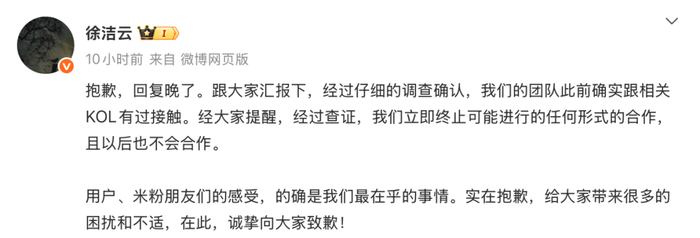
【#小米立即终止与相关KOL合作#】1月5日晚,小米集团董事长特别助理、战略市场部副总经理徐洁 云在社交平台发文致歉称:"经过仔细的调查确认,我们的团队此前确实跟相关KOL有过接触。经大家 提醒,经过查证,我们立即终止可能进行的任何形式的合作,且以后也不会合作。" 徐洁云还表示:"用户、米粉朋友们的感受,的确是我们最在乎的事情。实在抱歉,给大家带来很多的 困扰和不适,在此,诚挚向大家致歉。" 他还表示:"看到徐洁云表示辟谣只是刚刚开始,我觉得这又算是公关行业的一个创新吧,这种全新的 交流方式能不能起到更好的效果?能不能解决小米面临的问题?我觉得值得拭目以待。" 雷军在1月3日晚的拆车直播中回应了外界关于小米的诸多质疑,第二天一早,徐洁云发文称:"关于集 中辟谣,昨晚只是个开始。" 此前,小米投放KOL"万能的大熊"的消息在米粉中引发巨大争议,在徐洁云和雷军的微博下,众多网友 留言抵制,"支持小米和其他博主投放商单合作,但不能投放给每天都抹黑小米的大V。" 资料显示,"万能的大熊"本名宗宁,中国知名自媒体人及畅销书作者,代表作包括《格局逆袭:普通人 的制胜之道》《腾讯若投资京东,等于宣布退出电商》《支付宝微信支 ...

豆包AI眼镜被曝将出货,官方否认/黄仁勋宣布最强「核弹」芯片全面生产/雷军回应小米 YU7「丢轮保车」
Sou Hu Cai Jing· 2026-01-06 01:36
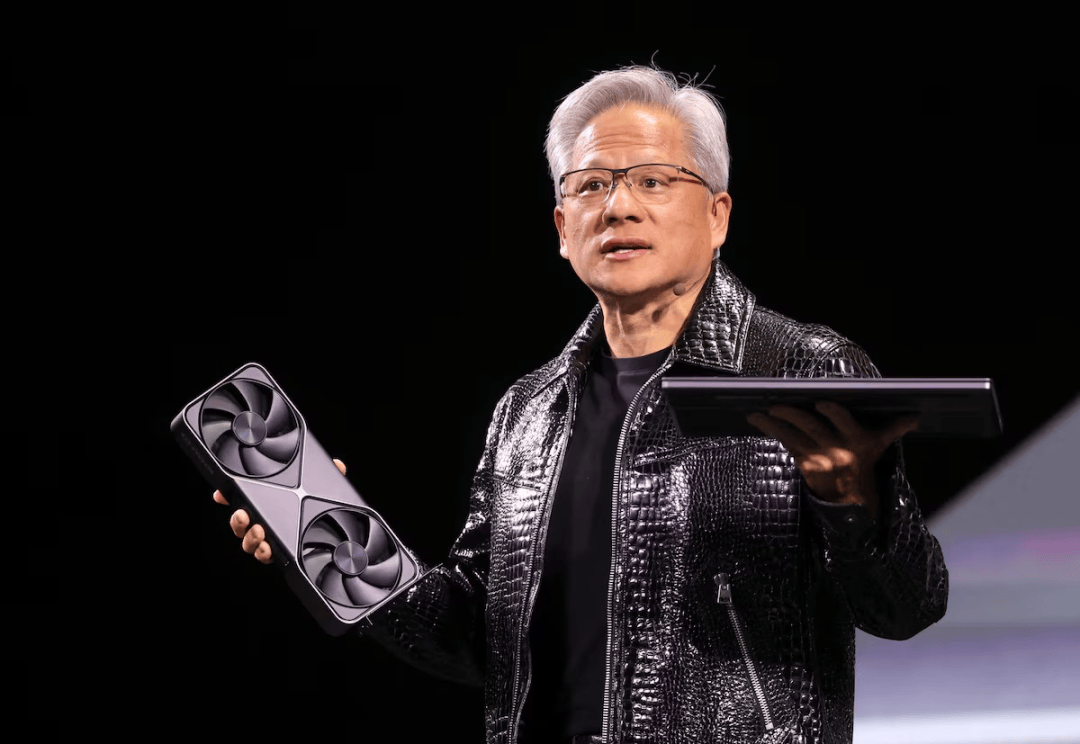
Group 1 - Nvidia's next-generation AI chip, named "Rubin," has entered full production and is expected to launch later this year, offering AI computing performance five times that of its predecessor [3] - The Rubin platform consists of six independent Nvidia chips, with the flagship device featuring 72 GPUs and 36 CPUs, capable of connecting over 1,000 Rubin chips in clusters [3] - Key innovations include Context Memory Storage for faster responses in long conversations and Co-packaged Optics for enhanced networking capabilities [3] Group 2 - Nvidia announced a broader release of its "Alpamayo" software for autonomous vehicles, which aids in path decision-making and provides engineers with decision-making data [4] - The company remains a leader in AI model training but faces increasing competition in the inference segment from traditional rivals like AMD and Google [4] Group 3 - AI hardware startup Looki has completed over $20 million in Series A funding, led by Ant Group, with plans to focus on talent development, model iteration, product R&D, and supply chain integration [6] - Looki's first product, the Looki L1 wearable AI hardware, has seen rapid sales, with global sales nearing 10,000 units [6][7] Group 4 - Looki L1 features proactive AI capabilities that provide real-time suggestions based on user behavior, set to be showcased at CES [7] Group 5 - Xiaomi's CEO Lei Jun responded to discussions about the safety design of the YU7 vehicle, emphasizing the maturity of the "wheel detachment" safety concept, which has been used since 1959 [11][12] Group 6 - The CEO of Raybird announced plans to launch the first dual-eye AR glasses with eSIM technology, indicating a shift towards independent AR devices [16] - The company aims to implement a "charge phone bill, get glasses" model, similar to the smartphone adoption phase [16] Group 7 - Boston Dynamics showcased its next-generation Atlas robot, which has transitioned to an all-electric system and is now performing real manufacturing tasks [23] - The new Atlas robot features significant upgrades in structure, materials, and intelligence, allowing it to perform complex tasks in a factory environment [23][24] Group 8 - LG introduced its CLOiD home robot at CES, designed to assist with household chores, demonstrating basic capabilities such as placing items in a washing machine [26] Group 9 - WeChat launched an AI application growth plan, offering developers free access to cloud resources, AI computing power, and monetization support, aiming to make 2026 the "year of AI applications" [41][42] Group 10 - The collaboration between GAC Group and Huawei aims to enhance smart cockpit and AI technology, focusing on the integration of the HarmonyOS ecosystem and AI innovations [49][50]

联想moto X70 Air Pro将搭载骁龙8 Gen5 支持8K拍摄与AI手写笔
Xin Lang Cai Jing· 2026-01-06 01:12
Core Insights - Lenovo is set to launch the new smartphone model, moto X70 Air Pro, which emphasizes a lightweight design and features a metal frame with a textured back for aesthetic appeal and grip comfort [2][3] - The device will be powered by the fifth-generation Snapdragon 8 mobile platform, specifically the Snapdragon 8 Gen5 processor, offering robust computing capabilities and supporting 8K resolution for photography and video recording [2][3] - The imaging system has been optimized with a main camera sensor comparable to those found in mainstream flagship models, aiming to enhance image quality and establish the device as a "lightweight imaging flagship" in the market [2][3] - The moto X70 Air Pro will include a stylus that activates various AI functions, enhancing user interaction and versatility in usage scenarios [2][3] Previous Model Reference - The previous model, moto X70 Air, was released in October 2023, featuring an ultra-thin design at 5.99 mm and weighing 159 grams [2][3] - Key specifications of the moto X70 Air include the fourth-generation Snapdragon 7 chip, a 6.67-inch 1.5K OLED display, a triple-camera system with 50MP sensors on both front and back, a 4800mAh battery, 68W wired fast charging, 15W wireless charging, and IP68 and IP69 water and dust resistance ratings, with a starting price of 2399 yuan [2][3]
Redmi Turbo 5 Max发布:旗舰芯+百瓦快充,2.5K档新标杆
Xin Lang Cai Jing· 2026-01-06 01:12
Core Viewpoint - The REDMI Turbo 5 series has officially launched with the introduction of the REDMI Turbo 5 Max, which offers comprehensive upgrades in performance, battery life, materials, and overall experience, positioning it as a flagship choice within its price segment [2][3] Product Features - The Turbo 5 Max is the first model in its price range to feature the Dimensity 9 series processor, providing a significant advantage over competitors that typically use mid-range or sub-flagship platforms [2][3] - The Turbo series has become the core product line for the brand in the 2000 to 3000 yuan price range, following the upgrade of the REDMI K90 series to a higher-end "champion flagship" [2][3] - The hardware specifications of the Turbo 5 series have been enhanced, including a 1.5K resolution display, 3D ultrasonic fingerprint recognition, a metal frame, and a glass back, which are design elements commonly found in high-end models [2][3] Audio and Battery - The new model features a symmetrical dual-speaker layout to enhance stereo sound experience, while the vibration motor has been standardized to a conventional X-axis linear motor [2][3] - The Turbo 5 series supports 100W fast charging technology and is equipped with the largest battery capacity to date from the brand, further strengthening daily power assurance [2][3]
华为畅享70X活力版直降,低至1019元
Xin Lang Cai Jing· 2026-01-06 01:12
在天猫精选店铺,华为畅享 70X活力版 8GB + 256GB版 本开启优惠活动啦!这款手机原价2199元,现在立减900 元,还能使用年货消费券满1000元减100元,部分地区还 有15%的国家补贴,实际到手仅需1019.15元。华为畅享 70X活力版拥有8GB运行内存和256GB大存储,无论是日 常使用各类软件,还是存储大量照片、视频等资料都绰 绰有余,能为你带来流畅且丰富的使用体验。近期有购 机需求的朋友可别错过。 在天猫精选店铺,华为畅享 70X活力版 8GB + 256GB版本开启优惠活动啦!这款手机原价2199元,现 在立减900元,还能使用年货消费券满1000元减100元,部分地区还有15%的国家补贴,实际到手仅需 1019.15元。华为畅享 70X活力版拥有8GB运行内存和256GB大存储,无论是日常使用各类软件,还是存 储大量照片、视频等资料都绰绰有余,能为你带来流畅且丰富的使用体验。近期有购机需求的朋友可别 错过。 ...
一加Turbo 6V现身:8760mAh电池+5000万双摄
Xin Lang Cai Jing· 2026-01-06 01:12
Core Viewpoint - A new OnePlus 5G device, likely named OnePlus Turbo 6V, is set to be officially launched on January 8, 2026, following its appearance on a telecommunications equipment terminal website [1][4]. Group 1: Device Specifications - The device features a front camera with 16 million pixels and a rear dual-camera setup consisting of a 50 million pixel main camera and a 2 million pixel auxiliary lens [3][4]. - It is equipped with a large 8760mAh battery that supports 80W wired fast charging, indicating strong power performance [3][4]. - The display is a 6.78-inch AMOLED screen with a resolution of 2772×1272 pixels, capable of displaying 1,073,741 colors for a rich visual experience [3][4]. - The dimensions of the device are 162.46mm in height, 77.45mm in width, and 8.65mm in thickness, with a weight of approximately 215 grams, providing a solid grip [3][4]. - Storage options include RAM variants of 8GB, 12GB, and 16GB, along with internal storage choices of 128GB, 256GB, and 512GB to cater to different user needs [3][4]. Group 2: Design and Features - The Turbo 6 series will feature a centered single punch-hole display and a straight edge design, with no antenna injection molding on the frame and no custom AI button [5]. - Color options for the Turbo 6 series include Light Silver, Wilderness Green, and Solo Black, while the Turbo 6V will offer Fearless Blue, New Star White, and Solo Black [5].
直播中被拆掉的小米YU7能否再装回去?雷军回应;特斯拉开除产线组长?原因:提议「加强工作时间以提升产量」;雷鸟创新完成超10亿融资
雷峰网· 2026-01-06 00:40
Group 1 - Tesla terminated a production line leader for suggesting to extend working hours to increase output, which was deemed a violation of company policy against harming or pressuring employees [4][5] - The incident sparked discussions about corporate culture, contrasting Tesla's approach with the prevalent "996" overtime culture in traditional car manufacturers [5] Group 2 - ByteDance announced a comprehensive salary increase for interns across various positions, with the highest increase reaching 150%, effective from January 1, 2026 [11][12] - The salary adjustments are primarily applicable to first-tier cities and vary based on job type and business line [11] Group 3 - Xiaomi faced backlash after allegations surfaced that it had engaged a controversial influencer known for criticizing the brand, leading to a public apology from the company's PR manager [7][9] - The incident highlighted a significant trust crisis for Xiaomi, with many fans expressing feelings of betrayal [8][9] Group 4 - MiniMax, a Chinese AI unicorn, plans to set its Hong Kong IPO price at HKD 165, aiming to raise over HKD 4.2 billion, driven by strong demand from institutional investors [22][23] - The IPO is seen as a critical step for MiniMax in the global AGI arms race, backed by Alibaba and the Abu Dhabi sovereign wealth fund [22] Group 5 - Thunderbird Innovation completed a financing round exceeding 1 billion yuan, with participation from China Mobile and China Unicom, and signed a long-term strategic cooperation agreement [12][13] - The funding will support various initiatives, including eSIM technology and cloud services [12] Group 6 - Microsoft is reportedly planning a significant round of layoffs in January 2026, potentially affecting 10,000 to 15,000 employees, as part of ongoing organizational restructuring [38] - The layoffs reflect challenges in AI commercialization and internal management issues, alongside a push for a flatter organizational structure [38] Group 7 - Huawei's executive Yu Chengdong visited GAC Group to discuss collaboration on the HarmonyOS cockpit system, indicating a strategic focus on automotive applications of their technology [17][18] - The Harmony cockpit has evolved to version HarmonySpace 5, featuring over 30 new capabilities [18] Group 8 - Ant Group and Meituan invested in AI hardware startup Looki, which raised over USD 20 million in its A-round financing, aiming to accelerate product development and talent acquisition [27] - Looki's products focus on next-generation interactive devices, leveraging AI technology [27] Group 9 - Neta Auto's founder has been listed as a person subject to enforcement due to financial issues, highlighting the company's struggles after a peak in sales [29] - Neta Auto's parent company reported significant losses over the past three years, leading to operational challenges and potential bankruptcy [29] Group 10 - Porsche China terminated its authorization with the Zhengzhou Zhongyuan dealership due to operational issues, affecting customer services and vehicle deliveries [30][31] - The situation has raised concerns among consumers regarding their rights and the handling of deposits and vehicle documentation [31]