
饮料

Search documents
KKR入主,大窑汽水创始人退出
Guo Ji Jin Rong Bao· 2025-12-23 12:20
Core Viewpoint - The recent management changes at Dayao Beverage, a rising player in the domestic soda market, signify a critical shift in control as KKR deepens its involvement in the company through both equity and management layers [2][3]. Group 1: Management Changes - Dayao Beverage has undergone significant leadership changes, with founder Wang Qingdong stepping down from key positions, including legal representative and chairman [1][2]. - The new chairman and financial officer, Dai Cheng, is seen as a key figure from KKR, bringing experience in post-investment management and corporate integration [2][3]. - Following these changes, only three executives remain at Dayao, indicating a substantial shift in the company's governance structure [3]. Group 2: KKR's Investment Strategy - KKR has been actively investing in the Chinese consumer sector since 2007, with a portfolio that includes notable brands like Mengniu and others, suggesting a strategic focus on enhancing Dayao's operational capabilities [5]. - The acquisition of an 85% stake in Dayao's parent company, Yuanjing International, allows KKR to exert control over the beverage company [2][3]. Group 3: Market Dynamics - Dayao's competitive edge lies in its strong presence in the restaurant channel, which accounts for over 85% of its sales, but the market is becoming increasingly competitive with new entrants [5][6]. - The carbonated beverage market is experiencing stagnation, with ready-to-drink tea surpassing carbonated drinks as the leading category, indicating a need for Dayao to innovate and diversify its product offerings [6]. - New product launches by Dayao, such as prebiotic juice soda and birch juice soda, aim to create a second growth curve amidst a challenging market environment [6].


韧行2025:企业家画像|钟睒睒:沉默中天亮了
Mei Ri Jing Ji Xin Wen· 2025-12-23 12:10
Core Viewpoint - In 2025, Zhong Shanshan has transformed from a public figure facing intense scrutiny in 2024 to a successful entrepreneur, regaining his status as a leading billionaire and restoring the market value of his company, Nongfu Spring [8][10]. Group 1: Public Image and Reputation Management - In 2024, Zhong faced significant public backlash following the death of a competitor, leading to various accusations and a decline in his company's market value [4][6]. - He responded to the criticisms by clarifying his relationship with the late founder of Wahaha and addressing concerns about his son's nationality, emphasizing that Nongfu Spring remains a Chinese enterprise [5][6]. - Despite his efforts, the company's market value halved, and its revenue dropped by 21.3%, indicating a severe impact on its brand image [7]. Group 2: Financial Recovery and Business Performance - By 2025, Zhong's net worth reached 530 billion yuan, making him the richest person in China for the fourth time, while Nongfu Spring's market value surpassed 500 billion HKD, with stock prices hitting a four-year high [8][10]. - The company's gross margin returned to over 60%, and new product lines, such as Oriental Leaf tea, significantly contributed to revenue, with tea beverage sales reaching 10.089 billion yuan, accounting for nearly 40% of total revenue [8][11]. Group 3: Strategic Business Initiatives - Zhong's long-term strategy focused on enhancing brand value and operational efficiency, including the development of multiple water source projects, which solidified Nongfu Spring's competitive advantage [11][12]. - The company shifted its market strategy away from price competition towards elevating industry standards, promoting sustainable practices, and supporting local farmers, thereby creating a mutually beneficial ecosystem [12][13]. - This approach not only improved the company's supply chain resilience but also aligned with social responsibility, marking a mature transition in its competitive logic [13][14].


香飘飘:计划投建泰国液体即饮饮料生产基地,项目总投资额3800万美元
Cai Jing Wang· 2025-12-23 10:41
Core Viewpoint - The company plans to establish wholly-owned subsidiaries in Singapore and Thailand to invest in a liquid ready-to-drink beverage production base in Thailand, with a total investment of $38 million (approximately 268 million RMB) [1] Group 1: Company Expansion - The company’s wholly-owned subsidiary, Xiangpiaopiao Sichuan Food Co., Ltd., intends to set up a wholly-owned subsidiary in Singapore named SENPURE FOOD (INTERNATIONAL) PTE. LTD. [1] - The company also plans to establish a subsidiary in Thailand named YONG MI GUO FOODS (THAILAND) CO., LTD. [1] Group 2: Investment Details - The total investment for the project is $38 million, which will be used for establishing and operating overseas companies, purchasing land, constructing factories, and procuring equipment [1] - The actual investment amount will be subject to approval by local authorities in China, Thailand, and Singapore [1]

香飘飘(603711.SH):子公司拟3800万美元在新加坡设立全资孙公司
Ge Long Hui A P P· 2025-12-23 10:17
Group 1 - The company Xiangpiaopiao (603711.SH) announced plans to establish wholly-owned subsidiaries in Singapore and Thailand through its subsidiary Xiangpiaopiao Sichuan [1] - The Singapore subsidiary is tentatively named SENPURE FOOD (INTERNATIONAL) PTE. LTD., while the Thailand subsidiary is tentatively named YONG MI GUO FOODS (THAILAND) CO., LTD. [1] - The company aims to invest in the construction of a liquid ready-to-drink beverage production base in Thailand with an investment amount of $38 million, approximately 268 million RMB, based on an exchange rate of 1:7.05 [1]
香飘飘:拟2.68亿元投资建设泰国液体即饮饮料生产基地
Xin Lang Cai Jing· 2025-12-23 10:03
Core Viewpoint - The company Xiangpiaopiao announced plans to establish a wholly-owned subsidiary in Singapore and a subsidiary in Thailand to invest in a liquid ready-to-drink beverage production base, with a total investment of $38 million [1] Group 1: Investment Details - The total investment amount for the project is $38 million, equivalent to approximately 268 million RMB [1] - The company will contribute 10% of the investment through its wholly-owned subsidiary in Singapore, while the remaining 90% will be funded by the new subsidiary [1] - The project is expected to commence construction on May 1, 2026, with a construction period of 12 months [1] Group 2: Financial Projections - The anticipated internal rate of return (IRR) for the investment is 13% [1] Group 3: Regulatory Considerations - The investment is subject to relevant approvals, indicating potential uncertainties [1]
景顺长城张欢:2026年新消费投资或向两端迁徙
Zheng Quan Shi Bao Wang· 2025-12-23 09:30
Core Viewpoint - The investment in new consumption is expected to shift towards two ends by 2026, focusing on early-stage categories and those with balanced supply and demand [1] Group 1: Early-stage Categories - Investment will target categories with emerging market demand, such as new efficacy health products, oral health products, innovative materials in medical aesthetics, and pet health products [1] Group 2: Balanced Supply and Demand Categories - Investment will also focus on categories where supply is orderly and may clear, including functional beverages, low-sugar health food and drinks, traditional golden products, bulk snacks, and high-end beauty services, particularly those from small and medium enterprises [1] - Preference will be given to single-brand or platform companies with high growth certainty [1]
李子园:聘任金函辉为董事会秘书
Cai Jing Wang· 2025-12-23 09:29
Core Viewpoint - The company announced the appointment of Jin Hanhui as the secretary of the board of directors, with the term lasting until the end of the current board's tenure [1] Group 1: Appointment Details - The fourth meeting of the third session of the company's board of directors will be held on December 23, 2025 [1] - The nomination committee has approved the appointment of Jin Hanhui as the board secretary [1] - The Shanghai Stock Exchange has reviewed and raised no objections to Jin Hanhui's qualifications for the position [1]


中国国家队与华润饮料合作迈入新阶段
Zhong Guo Jing Ying Bao· 2025-12-23 08:36
Group 1 - The core partnership between China National Team and China Resources Beverage continues, providing high-quality health drinks to over 70 national teams, including basketball, volleyball, table tennis, badminton, and football [2][3] - The collaboration aims to promote the integration of national fitness and health, contributing to the construction of a strong sports nation and a healthy China [2][3] - China Resources Beverage has been the first official partner of the China National Team since 2019, reflecting a deep resonance from product attributes to the spirit of sports [3][4] Group 2 - In the previous cooperation cycle, China Resources Beverage supplied 65 million bottles of high-quality drinks, covering 22 provinces, 4 autonomous regions, 4 municipalities, and 2 special administrative regions, as well as international locations like Tokyo and Paris [5] - The company combines the professional needs of the national teams with trends in consumer upgrades, focusing on the sports health sector through its diverse brand matrix [5] - Social responsibility initiatives included activities like the "Olympic Athletes Public Service Campaign" and "Champion Sports Classroom," benefiting over one million youth and sports enthusiasts [6]
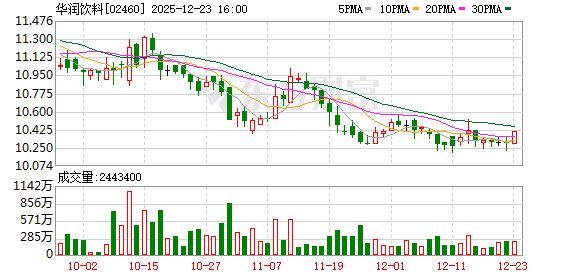
圣元环保:目前已开发多款“牛磺酸+”功能性饮品
Mei Ri Jing Ji Xin Wen· 2025-12-23 01:08
(记者 胡玲) 每经AI快讯,圣元环保(300867.SZ)12月23日在投资者互动平台表示,公司目前已开发多款"牛磺酸 +"功能性饮品,并将根据实际情况持续提升产品品质、丰富产品种类,优化产品容量、包装等方面设 计。 ...

创新高不是终点?大摩在高位继续看多怪兽饮料(MNST.US)
智通财经网· 2025-12-22 13:37
Group 1 - Morgan Stanley maintains a bullish outlook on Monster Beverage (MNST.US) as retail scan data in the US and Western Europe shows strong performance, exceeding market expectations, contrasting with the overall sluggishness in the consumer packaged goods sector [1] - The firm has raised its revenue and earnings per share forecasts for Monster Beverage for 2026 and increased the target price from $81 to $87, maintaining an "overweight" rating [1] - Analyst Dara Moshenyian highlights that Monster Beverage is entering a new development phase characterized by enhanced data analytics capabilities and a stronger management team, with a clearer strategic direction amid sustained growth in the energy category [1] Group 2 - The ongoing collaboration with Coca-Cola (KO.US) is expected to enhance Monster Beverage's international market expansion, leveraging a robust and mature non-alcoholic beverage distribution network [1] - Bottlers are anticipated to benefit from adding a high-growth, high-margin brand to their product portfolio through this partnership [1] - Monster Beverage's stock has risen 45% year-to-date, reaching a historical high of $77.17 last Friday, with a consensus "buy" rating from Seeking Alpha and Wall Street analysts [1]
