
纺织业

Search documents
【省工业和信息化厅】陕西新增2项国家工业遗产
Shan Xi Ri Bao· 2025-11-05 00:13
Core Viewpoint - The Ministry of Industry and Information Technology has officially announced the seventh batch of national industrial heritage sites, with two projects from Shaanxi province being recognized, highlighting the importance of industrial heritage preservation and its role in showcasing the region's industrial history [1] Group 1: New Recognitions - The Chang'an Dahua Textile Factory and the Huangniupu site of the Aerospace 7107 Factory have been added to the national industrial heritage list, marking new landmarks for industrial heritage in Shaanxi [1] - The Chang'an Dahua Textile Factory, established in 1935, is noted as the earliest and largest ethnic textile enterprise in Xi'an and Northwest China, playing a pivotal role in the development of the textile industry in the region [1] - The Huangniupu site of the Aerospace 7107 Factory was part of the "First Inertial Device Factory" during the third-line construction period, reflecting the dedication of early aerospace workers [1] Group 2: Heritage Protection Achievements - Since the initiation of the national industrial heritage recognition work in 2017, Shaanxi province has seen significant achievements in the protection and inheritance of industrial heritage, with a total of 11 projects recognized as national industrial heritage [1] - These recognized heritage sites span key sectors such as aerospace, textile industry, time research, and salt production, outlining the historical trajectory of modern industrial development in the province [1] - The industrial heritage serves as a "living fossil" of industrial civilization evolution, providing crucial support for the innovative development of industrial culture [1]
广交会“含新量”“智造力”齐升 印证中国外贸价值创新
Zhong Guo Xin Wen Wang· 2025-11-04 17:26
Core Insights - The 138th China Import and Export Fair (Canton Fair) showcased a significant increase in "new content" and "intelligent manufacturing," reflecting the ongoing optimization of China's foreign trade structure and the accelerated growth of new productive forces [1] Group 1: Intelligent and Green Innovation - High "intelligent content" and sustainable green products have become focal points for global buyers, with Zhejiang enterprises attracting attention for their eco-friendly products made from recycled materials [2] - Dongfeng Liuzhou Automobile's self-developed intelligent configurations and leading aerodynamic performance contributed to a 20% year-on-year increase in export volume for the first three quarters [2] - The transition from "Made in China" to "Created in China" is evident, with advancements in technology and quality standards reaching world-class levels [2] Group 2: Strength of Chinese Products - Turkish buyers noted a visible improvement in the quality of Chinese products, which has shifted their perception from merely cost-effective to high-quality offerings [3] - The robust vitality of the Chinese market and its advanced supply chain capabilities are enhancing procurement visions for global buyers [3] - Participation in the Canton Fair has led to millions of dollars in potential orders and valuable partnerships, facilitating industry upgrades and supply chain optimization [3] Group 3: Traditional and Emerging Markets - Approximately 26% of electromechanical enterprises at the fair reported acquiring new customers and orders, with 36.9% optimistic about export performance in Q1 2026 [4] - Traditional markets like Europe and the U.S. remain core profit sources for Chinese foreign trade enterprises, with significant orders coming from these regions [4] - Emerging markets, particularly those involved in the Belt and Road Initiative, showed vibrant growth, with contracts signed for high-end products to fill market gaps in North Africa [4]
毛毯龙头真爱美家筹划控制权易主 与华鼎股份为同一实控人|速读公告
Xin Lang Cai Jing· 2025-11-04 15:01
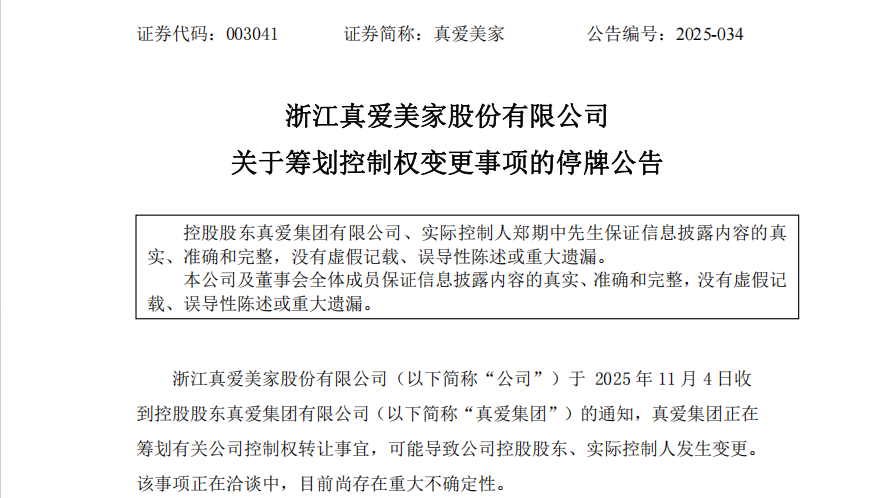
Core Viewpoint - Zhejiang carpet manufacturer Zhenai Meijia (003041.SZ) is planning a change of control, with its controlling shareholder Zhenai Group holding 46.37% of the shares. The actual acquirer has not been disclosed yet, and the company's stock will be suspended from trading starting November 5 for up to two trading days [1][2]. Group 1: Company Performance - Zhenai Meijia has faced significant operational pressure in recent years, primarily relying on carpet exports. The company's net profit attributable to shareholders for the first three quarters of 2023 was 230 million yuan, a year-on-year increase of 310.28%, largely due to compensation from factory demolition, while actual business profit remains at a historically low level [1]. - Despite operational challenges, Zhenai Meijia's stock price has risen significantly since November 2024, maintaining a relatively high level [2]. Group 2: Shareholder Actions - In July, shareholder Yiwu Boxin Investment Co., Ltd. announced plans to reduce its stake by 3%, but did not execute the transaction by the end of October, leading to speculation prior to the announcement of the control change [2]. Group 3: Related Corporate Actions - Concurrently with the control transfer, Zhenai Group is conducting a new round of private placement for Huading Co., aiming to raise approximately 708 million yuan, fully subscribed by Zhenai Group. The funding sources include 40% from Zhenai Group's own funds and 60% from bank loans [2][3]. - The private placement plan was first disclosed in November 2024 but has faced scrutiny from the Shanghai Stock Exchange regarding the necessity of the fundraising projects and the sources of subscription funds [3].

停牌!003041,实控人拟易主
Zhong Guo Ji Jin Bao· 2025-11-04 12:17
Core Viewpoint - The control of Zhenai Meijia may change as its controlling shareholder, Zhenai Group, is planning to transfer its control, leading to a potential change in the company's major shareholder and actual controller [1][2]. Group 1: Shareholding and Control - As of the end of Q3 2025, Zhenai Group directly holds 66.76 million shares of Zhenai Meijia, accounting for 46.37% of the total shares, with 33.7 million shares pledged, representing 50.48% of Zhenai Group's holdings [4][6]. - Zhenai Group's action partner, Yiwu Boxin Investment Co., Ltd., holds 16.69 million shares, representing 11.59% of Zhenai Meijia, with 10 million shares pledged, which is 59.93% of Boxin Investment's holdings [4][6]. Group 2: Financial Performance - Zhenai Meijia has experienced significant fluctuations in performance since its listing on April 6, 2021 [8]. - The net profit attributable to the parent company from 2021 to 2024 was 108 million, 155 million, 106 million, and 75.8 million yuan, respectively, with the net profit after deducting non-recurring gains and losses being 98 million, 108 million, 91.7 million, and 59.3 million yuan [9]. - For the first three quarters of 2025, the net profit attributable to the parent company increased by 310.28% to 230.32 million yuan, with a net profit after deducting non-recurring gains and losses increasing by 43.37% to 58.86 million yuan [12][14]. Group 3: Industry Context - The textile industry is facing severe challenges, including intense competition from low-cost Southeast Asian countries and rising shipping costs, which pose significant challenges for Zhenai Meijia's product exports [14]. - The substantial increase in net profit for the first three quarters of 2025 is attributed to compensation received from the expropriation of land and buildings at Zhenai Meijia's subsidiary, resulting in a post-tax gain of 162 million yuan [14].

停牌!003041,实控人拟易主
中国基金报· 2025-11-04 12:14
Core Viewpoint - The control of Zhenai Meijia may change as its controlling shareholder, Zhenai Group, is planning to transfer its control, which could lead to a change in the company's actual controller [2][8]. Group 1: Control Transfer and Shareholding - Zhenai Meijia announced a suspension of trading starting November 5, with an expected duration of no more than two trading days. As of November 4, the stock price was 30.82 CNY per share, with a total market capitalization of 4.438 billion CNY [5]. - As of the end of Q3 2025, Zhenai Group directly held 66.7656 million shares of Zhenai Meijia, accounting for 46.37% of the total shares. Among these, 33.7 million shares were pledged, representing 50.48% of Zhenai Group's holdings [10][11]. - Zhenai Group's action partner, Yiwu Boxin Investment Co., Ltd., held 16.686 million shares, representing 11.59% of the total shares, with 10 million shares pledged, which is 59.93% of Boxin's holdings [10][11]. Group 2: Financial Performance - Zhenai Meijia has experienced significant fluctuations in performance since its listing on April 6, 2021. The net profit attributable to shareholders from 2021 to 2024 was 108 million CNY, 155 million CNY, 106 million CNY, and 75.7955 million CNY, respectively [15]. - In the first three quarters of 2025, Zhenai Meijia's net profit attributable to shareholders increased by 310.28% to 230 million CNY, with a non-recurring profit increase of 43.37% to 58.858 million CNY [16][18]. - The company's revenue for 2024 was approximately 878.62 million CNY, a decrease of 7.77% compared to 2023, while the net profit attributable to shareholders decreased by 28.46% to 75.8 million CNY [16][18]. Group 3: Industry Context - The textile industry is facing severe challenges, including intense competition from low-cost Southeast Asian countries and rising shipping costs, which pose significant challenges for Zhenai Meijia's product exports [18]. - The company specializes in home textiles, primarily blankets, carpets, and bedding products, and has faced difficulties due to the international textile supply chain adjustments [18].

晚间公告|11月4日这些公告有看头
Di Yi Cai Jing· 2025-11-04 10:24
Group 1 - Jilin Chemical Fiber's controlling shareholder, Jilin Chemical Fiber Group, completed a capital increase and share expansion, raising registered capital from 809 million to 2.508 billion yuan, with the State-owned Assets Supervision and Administration Commission's shareholding increasing to 67.09% [2] - Lepu Medical's subsidiary received NMPA registration approval for a rechargeable implantable deep brain stimulation system, aimed at assisting patients with advanced Parkinson's disease [3] - Zhenai Home announced a potential change in control, leading to a stock suspension starting November 5, 2025, due to ongoing negotiations [4] Group 2 - Yutong Bus reported a 5.62% year-on-year decline in October sales, with total sales for the year increasing by 5.87% [11] - Qianli Technology's October sales surged by 111.44%, with significant growth in both new energy and other vehicle categories [12] - Sike Xide's major shareholder completed a reduction of 825,195 shares, raising a total of approximately 22.84 million yuan [14] Group 3 - Far East Holdings' subsidiary secured contracts exceeding 1 billion yuan in October, which is expected to positively impact future performance [24] - Quan Yang Quan's subsidiary won a 1.48 billion yuan project for airline drinking water supply, anticipated to enhance future earnings [25] - Guoji Automobile's subsidiary won an 8.09 billion yuan project for a lightweight component factory, expected to positively influence operational performance [26]


真爱美家:筹划控制权变更事项,11月5日起停牌
Mei Ri Jing Ji Xin Wen· 2025-11-04 10:06
每经头条(nbdtoutiao)——中国这个行业爆了!海外订单猛增246%,覆盖50多国和地区,企业家提 醒:有人正以亏本价销售,警惕恶性竞争扩至海外 (记者 王晓波) 每经AI快讯,真爱美家(SZ 003041,收盘价:30.82元)11月4日晚间发布公告称,浙江真爱美家股份 有限公司于2025年11月4日收到控股股东真爱集团有限公司的通知,真爱集团正在筹划有关公司控制权 转让事宜,可能导致公司控股股东、实际控制人发生变更。该事项正在洽谈中,目前尚存在重大不确定 性。为维护广大投资者利益,避免公司股价异常波动,经公司向深圳证券交易所申请,公司股票自2025 年11月5日(星期三)开市起停牌,停牌时间预计不超过2个交易日。 2025年1至6月份,真爱美家的营业收入构成为:纺织业占比100.0%。 截至发稿,真爱美家市值为44亿元。 ...
从1家“开枝散叶”到3000余家 湖北汉川纺织服装产业集群是如何“织”成的?
Zhong Guo Jing Ying Bao· 2025-11-04 06:55
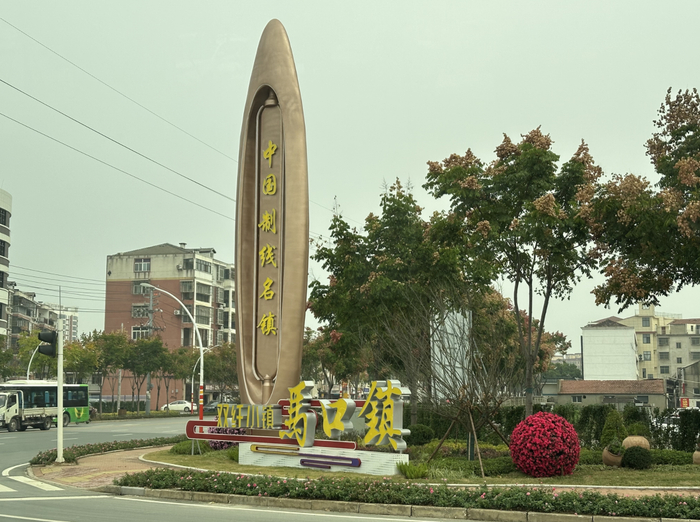
Core Insights - The article highlights the transformation of the textile industry in Machou Town, Hanchuan City, which has been recognized as "China's Line Manufacturing Town" and is a significant player in the national textile sector [3][4]. Group 1: Industry Overview - Machou Town has 40 textile enterprises above designated size, accounting for 36% of the national capacity in the same category, and has established a production base for 15 million core kilometers of optical fiber and cable [3][4]. - Hanchuan City has over 3,000 textile and apparel companies, producing nearly 800 million garments annually, with sewing thread production capturing two-thirds of the national market share [3][4]. Group 2: Company Development - Jihua 3509 Textile Co., Ltd., established in 1950, has evolved from producing military socks and towels to becoming a national high-tech enterprise, showcasing a successful transition from traditional textile manufacturing [3][5]. - The company has invested 54 million yuan in advanced German technology, implementing smart production processes that significantly reduce labor requirements [5][7]. Group 3: Technological Advancements - Jihua 3509 has introduced advanced equipment from Japan, the USA, Belgium, and Germany, achieving a leading level in domestic technology and enhancing production efficiency [7][8]. - The company holds over 293 national patents, including 58 invention patents, and has been recognized as a national-level "green factory" and a specialized "little giant" enterprise [7][8]. Group 4: Economic Impact - Hanchuan City's GDP reached 94 billion yuan in 2024, with a goal to become a "trillion-level" county, supported by a modern industrial system that includes textiles, food processing, and equipment manufacturing [11][12]. - The textile and apparel industry generated 616 billion yuan in output value in 2023, accounting for nearly 40% of the city's industrial output, with a projected growth of 10% in 2024 [11][12]. Group 5: Future Goals - Hanchuan City aims to create a textile and apparel industry cluster worth 100 billion yuan within three years, alongside other significant industrial clusters [12].

【头条评论】 中国产业转移的三大格局与未来挑战
Zheng Quan Shi Bao Wang· 2025-11-04 02:44
Core Insights - The article discusses the trends of industrial transfer in China over the past 15 years, highlighting three main patterns of relocation for enterprises. Group 1: Intra-Provincial Migration - A significant trend is the migration of manufacturing enterprises from Shenzhen to surrounding cities within Guangdong Province, with nearly 70% of Shenzhen's manufacturing firms relocating to nearby cities [1] - This intra-provincial migration is closely linked to regional economic collaboration, achieving industrial upgrades through supply chain extension and resource integration, particularly in the electronics information sector [1] Group 2: Inter-Provincial Migration - The second trend involves the transfer of industries to other provinces, driven by the "streamline administration and delegate power" policy, which has reduced over 1,000 administrative approval items, thereby lowering operational costs for businesses [2] - The "dual circulation" development pattern promotes the flow of industrial factors and regional cooperation, leading to a significant increase in projects and investments in central and western regions, such as Henan and Sichuan, forming clusters in electronics and new materials [2] - The migration reflects a shift from "cost-driven" to "cluster collaboration," with traditional manufacturing accelerating inward migration while core industries steadily transfer, restructuring the national spatial layout [2] Group 3: Overseas Expansion - The article outlines three phases of Chinese enterprises' overseas expansion: 1. From 2010 to 2017, labor-intensive industries led the way, primarily targeting ASEAN countries [3] 2. From 2018 to 2023, there was an acceleration in equipment manufacturing exports due to trade tensions, with growth rates of 10-20% in machinery and electrical equipment sectors [3] 3. From 2024 onwards, a focus on global capacity layout, particularly in automotive and battery sectors, with a growth rate of around 30% in overseas factory establishment [3] - The overseas expansion has transitioned from labor-intensive to equipment manufacturing leadership, with investment focus shifting from Latin America and Europe to ASEAN, particularly Thailand and Vietnam [3] Group 4: Challenges and Opportunities - Despite the successful industrial transfer, companies face challenges such as insufficient innovation conversion, talent supply imbalance, and increased supply chain uncertainties due to geopolitical conflicts and tariff barriers [4] - The resilience of domestic industrial chains has improved, aided by logistics cost reductions through initiatives like the China-Europe Railway Express [4] - Companies are expected to enhance their ability to seize opportunities and address challenges in both domestic and international markets, supported by government leadership and entrepreneurial spirit [4]
【头条评论】中国产业转移的三大格局与未来挑战
Zheng Quan Shi Bao· 2025-11-03 17:57
Core Insights - The article discusses the trends of industrial transfer in China over the past 15 years, highlighting three main patterns of relocation for enterprises [1][2][3][4]. Group 1: Domestic Industrial Transfer Patterns - The first pattern is the migration of manufacturing enterprises to nearby cities within the same province, particularly from Shenzhen to cities like Dongguan, Zhongshan, Foshan, and Jiangmen, with nearly 70% of Shenzhen's manufacturing firms relocating to these areas [1]. - The second pattern involves transferring to other provinces, driven by the "streamlining administration and delegating power" policy, which has reduced over 1,000 administrative approvals, thereby lowering operational costs for businesses. This has led to a significant increase in projects and investments in central and western regions, forming industrial clusters in areas like Henan and Sichuan [2]. - The third pattern is characterized by the overseas expansion of Chinese enterprises, which has evolved through three stages: initial labor-intensive exports to ASEAN countries, followed by accelerated equipment manufacturing exports due to trade tensions, and currently focusing on global capacity layout in sectors like automotive and battery manufacturing [3]. Group 2: Factors Driving Industrial Transfer - Two main factors are driving domestic industrial transfer: cost factors, including high industrial land costs in eastern regions (2-3 times higher in Shenzhen compared to western regions), labor cost differences of 30%-40%, and tax incentives in the west; and the elevation of industrial levels, where the focus has shifted from low-end production to regional optimization of the industrial chain [3]. - The article notes that the domestic industrial transfer has transitioned from "cost-driven" to "cluster collaboration," with a clear division of labor where eastern regions focus on high-end manufacturing and R&D, while central and western regions handle mid-stage production and component supply [2][3]. Group 3: Challenges and Future Outlook - Despite the positive trends, Chinese enterprises face challenges such as insufficient innovation conversion, talent supply imbalances (e.g., a 50,000 talent gap in Xi'an's semiconductor sector), and increased supply chain uncertainties due to geopolitical conflicts and tariff barriers [4]. - The article concludes that Chinese enterprises are improving their ability to seize opportunities and respond to challenges in both domestic and international markets, with expectations for continued optimization of industrial layouts under strong government leadership and entrepreneurial spirit [4].