
卫星产业

Search documents
格林大华期货早盘提示-20260116
Ge Lin Qi Huo· 2026-01-15 23:38
1. Report Industry Investment Rating No relevant information provided. 2. Core View of the Report - On Thursday, the main indices of the two markets oscillated and adjusted to repair technical indicators, with the semiconductor equipment sector leading the gains. International investors are accelerating the allocation of Chinese assets, and multiple foreign - funded institutions are optimistic about the performance of Chinese assets in 2026. The Chinese stock market has a high probability of rising in 2026, and the growth - type indices are expected to end the adjustment and resume the upward trend on Friday or early next week. Long - term index futures positions should be held, and investors can choose to buy out - of - the - money long - term call options on the CSI 1000 Index [1][2][3] 3. Summary by Relevant Catalogs 3.1 Market Review - On Thursday, the trading volume of the two markets was 2.90 trillion yuan, showing a rapid contraction. The CSI 500 Index closed at 8223 points, down 4 points or - 0.05%; the CSI 1000 Index closed at 8240 points, down 16 points or - 0.20%; the SSE 50 Index closed at 3105 points, down 6 points or - 0.21%; the SHSZ 300 Index closed at 4751 points, up 9 points or 0.20%. The funds in stock index futures for the CSI 1000, SHSZ 300, CSI 500, and SSE 50 indices had net outflows of 7.1 billion, 4.4 billion, 3.6 billion, and 1.3 billion yuan respectively [1] - Among industry and theme ETFs, the top gainers were semiconductor equipment ETFs, while the top losers were satellite industry ETFs. Among the sector indices of the two markets, the glass - fiber, rubber, and other sectors led the gains, and the industrial Internet, aerospace equipment, and other sectors led the losses [1] 3.2 Important Information - The central bank lowered the interest rates of various structural monetary policy tools by 0.25 percentage points and will lower the minimum down - payment ratio for commercial housing mortgages to 30%. There is still room for reserve requirement ratio and interest rate cuts this year [1] - China's "demand shortage" is mainly "consumer demand shortage", with the consumption - to - GDP ratio about 20 percentage points lower than the global average, and this gap needs to be corrected [1] - More than 10 billion yuan of funds continuously entered the market through ETFs. From January 9th to 13th, the net subscription amount of equity ETFs exceeded 12 billion yuan for three consecutive trading days, with a total net subscription amount exceeding 47 billion yuan. On January 14th, the trading volume of many broad - based ETFs increased significantly, and many newly issued funds announced the early end of fundraising [1] - China shows strong R & D potential and a clear technology iteration path. The relaxation of the H200 export policy by the US indicates that it can no longer block China's technological take - off [1] - Nvidia's new AI inference context memory storage (ICMS) architecture is expected to significantly exacerbate the global shortage of NAND flash memory, bringing additional demand equivalent to 2.8% and 9.3% of the global total NAND demand in 2026 and 2027 respectively [1] - The global explosion in AI chip demand is constrained by TSMC's production capacity, with a supply - demand gap of three times for its most advanced processes. Although TSMC is adjusting production lines and expanding production globally, the shortage cannot be alleviated in the short term, and the advanced packaging link has become a key bottleneck [2] - Deutsche Bank believes that the cost gap between space deployment and ground construction is shrinking rapidly, and in the next decade, the cost of building a space data center will approach that of ground construction [2] - OpenAI signed a three - year agreement with Cerebras, promising to purchase up to 750 megawatts of computing power, all using Cerebras' wafer - scale chips, with a transaction value exceeding $10 billion [2] - Trump launched fiscal, monetary, and credit stimulus, which may lead to debt out - of - control, financial risk accumulation, and a future debt crisis and market crash [2] - Wall Street financial institutions are entering the prediction market, and this emerging market has evolved into a sports - contract - based betting platform [2] - Citi's research report indicates that the commodity market is at a turning point. Crude oil is driven by geopolitics in the short term with a target of $70, but faces long - term oversupply pressure. Precious metals are bullish, with a target of $100 for silver and $5000 for gold. Among industrial metals, the target for aluminum is $3400 - 3500, and the copper price is expected to reach $14000, but January may be the annual high [2] 3.3 Market Logic - International investors are accelerating the allocation of Chinese assets. Many foreign - funded institutions are optimistic about the performance of Chinese assets in 2026. The continuous improvement of corporate profits, continuous technological innovation breakthroughs, and increasing valuation attractiveness provide a solid foundation for the continuous rise of Chinese assets [2] - In 2025, the stock market had a net inflow of 2.26 trillion yuan. In 2026, insurance, wealth management, and pensions are expected to be the three major sources of incremental funds, with institutional incremental funds in the stock market reaching 3.1 trillion yuan, and the scale of public fixed - income + products at least doubling [2] - More international funds are turning their attention to the AI track outside the US. China's technology sector, with its valuation advantages, complete industrial ecosystem, and large - scale manufacturing capabilities, is becoming a new destination for global funds in the AI field [2][3] 3.4 Market Outlook - The trading - type investors are actively increasing their positions in Chinese assets, and the allocation - type investors are optimizing the weight of Chinese assets in the global portfolio. The application for satellite frequency and orbit resources has risen to the national strategic level, and the upward trend of the Chinese market is expected to continue in 2026 [3] - The risk of a significant rise in the Chinese stock market in 2026 is much higher than that of a significant decline. The acceleration of AI applications, anti - involution, and the re - allocation of domestic liquidity from deposits to the stock market are positive factors [3] - The return of the US to the Monroe Doctrine will accelerate the flow of global funds to the Chinese capital market. The Fed's interest rate cut and balance - sheet expansion, along with the appreciation of the RMB, will lead to the return of a large amount of US dollars held by foreign trade enterprises overseas, and funds will flow from enterprise accounts to resident accounts and then to securities accounts [3] - China's application for 200,000 low - orbit satellites has shocked the market, indicating that the Sino - US space infrastructure competition has become a key area of technological competition. The adjustment of growth - type indices is expected to end on Friday or early next week, and the upward trend will resume [3] 3.5 Trading Strategy - For stock index futures directional trading, the policy hopes for a bull market but also a slow one. With a large amount of off - market funds still flowing in, the upward trend driven by market funds remains unchanged. Long - term stock index futures positions should be held [3] - For stock index option trading, investors can choose to buy out - of - the - money long - term call options on the CSI 1000 Index [3]
罕见!21只ETF成交额超百亿元
Zhong Guo Zheng Quan Bao - Zhong Zheng Wang· 2026-01-15 12:46
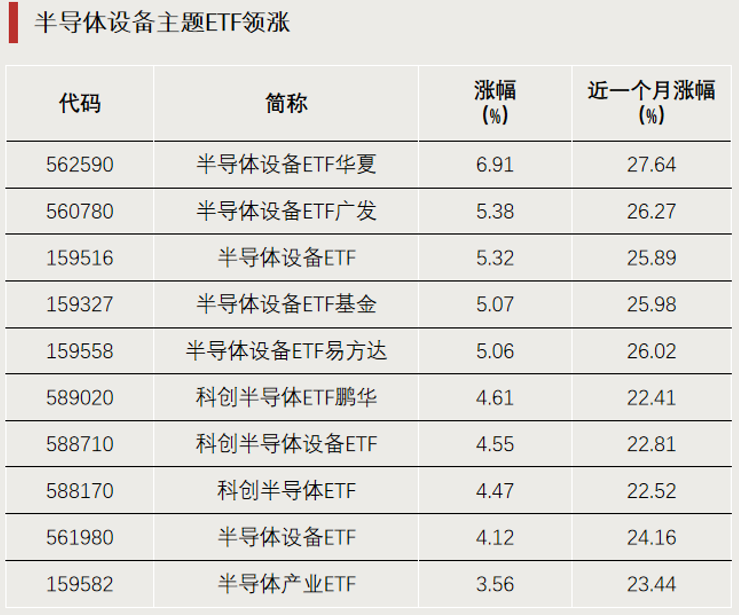
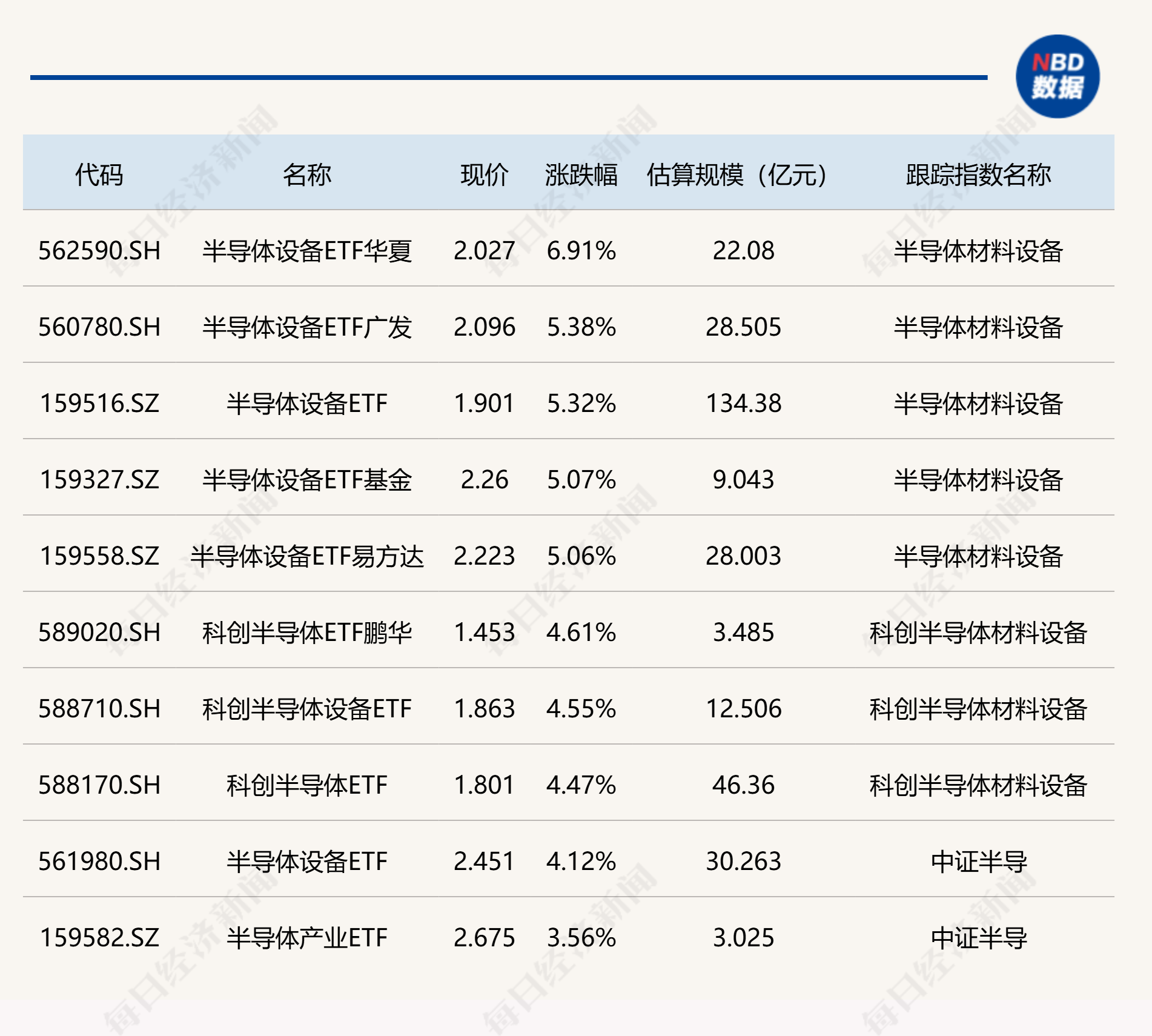
Group 1 - The semiconductor equipment ETFs experienced a counter-trend increase, with several related ETFs rising over 5% on January 15, despite a general market adjustment [1][4][10] - The largest gain was seen in the Huaxia Semiconductor Equipment ETF, which rose by 6.91%, while other semiconductor ETFs also showed significant increases [4][5][14] - The strong performance of the semiconductor equipment sector is attributed to the clear expansion plans of Chinese wafer fabs, leading to a substantial order backlog for domestic equipment manufacturers, with some orders extending to 2027 [4][10] Group 2 - On January 15, the ETF market was very active, with 21 ETFs exceeding a transaction volume of 10 billion yuan [2][11][18] - The majority of the ETFs with transaction volumes over 10 billion yuan were broad-based ETFs, including the CSI 500 ETF and the CSI 300 ETF, both surpassing 20 billion yuan in volume [2][7][18] - The inflow of funds into industry ETFs was notable, with software and satellite ETFs seeing net inflows exceeding 2 billion yuan on January 14 [3][12][20] Group 3 - The satellite-related ETFs, which had previously seen significant gains, experienced declines on January 15, with several products dropping over 9% [1][16][17] - The satellite industry ETFs, including the Satellite Industry ETF and the E Fund Satellite ETF, reported declines of 9.68% and 9.66%, respectively [6][17] - The general aviation ETFs also faced declines, with drops exceeding 6% [16][17] Group 4 - The market outlook remains positive, with expectations of continued inflows due to favorable macroeconomic conditions, including the appreciation of the RMB and the influx of insurance capital [10][21] - Investment strategies should focus on quality growth themes, particularly in semiconductor and advanced manufacturing sectors, as well as renewable energy [10][21]

ETF今日收评 | 半导体设备相关ETF涨超5%,卫星相关ETF跌超9%
Sou Hu Cai Jing· 2026-01-15 07:37
Market Overview - The A-share market showed mixed performance with the Shanghai Composite Index briefly falling below 4100 points, while the ChiNext Index rebounded in the afternoon [1] - The semiconductor sector strengthened in the afternoon, with several semiconductor equipment-related ETFs rising over 5% [1] Sector Performance - The tourism and hotel sectors performed actively, while AI applications and commercial aerospace sectors saw significant declines [1] - Specific ETFs related to semiconductor equipment showed notable gains, with the following performance: - 华夏 Semiconductor Equipment ETF rose by 6.91% - 广发 Semiconductor Equipment ETF increased by 5.38% - Other ETFs also reported gains ranging from 4.12% to 5.32% [2] Industry Insights - Analysts suggest that the demand for advanced semiconductor production lines will continue to grow in the context of the AI wave and domestic production initiatives, positioning domestic semiconductor equipment companies for potential growth opportunities [3] - Conversely, satellite-related ETFs experienced declines, with the Satellite Industry ETF dropping by 9.68% [4] Future Outlook - A brokerage firm indicated that China is at a pivotal moment similar to SpaceX's network development phase from 2018 to 2020, with satellite manufacturing transitioning from custom lab production to assembly line production [6] - Companies providing generalized power, communication, and attitude control systems are expected to achieve performance milestones first [6]
超73亿资金,“跑了”
Zhong Guo Ji Jin Bao· 2026-01-15 05:55
Group 1 - On January 14, the A-share market experienced a significant drop, with the three major indices showing mixed results, and the ChiNext index falling nearly 2% [2] - The total net outflow of funds from the stock ETFs exceeded 7.3 billion yuan, indicating a cooling market as some investors chose to cash out [5] - Despite the overall outflow, 49 stock ETFs saw net inflows of over 100 million yuan, with the software ETF, satellite ETF, and non-ferrous metals ETF leading the inflows [5][8] Group 2 - As of January 14, the total scale of stock ETFs reached 5.07 trillion yuan, marking the first time it surpassed the 5 trillion yuan threshold [3] - The total trading volume of stock ETFs on that day was 387.15 billion yuan, an increase of over 76 billion yuan compared to the previous trading day [3] - The software, big data, and cloud computing sectors led the gains among stock ETFs, while sectors like electric grid and innovative pharmaceuticals performed poorly [3][4] Group 3 - The top three stock ETFs by net inflow included the software ETF with 31.67 billion yuan, the D-star ETF with 26.48 billion yuan, and the non-ferrous metals ETF with 13.52 billion yuan [6] - Conversely, the top three stock ETFs by net outflow were the ChiNext ETF with 35.60 million yuan, the CSI 300 ETF with 28.26 million yuan, and the STAR 50 ETF with 15.42 million yuan [7] - Head fund companies like E Fund and Huaxia Fund saw significant inflows into their ETFs, with E Fund's software ETF and artificial intelligence ETF attracting 3.76 billion yuan and 3.73 billion yuan respectively [8]
突破百亿天量!卫星产业ETF(159218)8日成交109亿,逾60家机构抢滩万亿太空赛道
Sou Hu Cai Jing· 2026-01-15 02:38
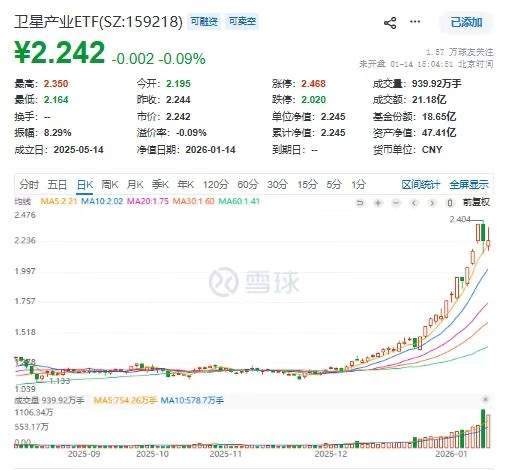
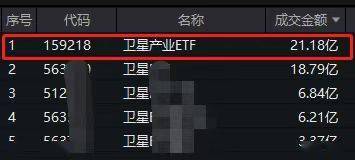
商业航天热度持续爆表,市场交投创下里程碑式纪录。数据显示,两融标的卫星产业ETF(159218)在 2026年开年仅8个交易日内,累计成交额已突破百亿大关,高达109.41亿元,其中1月14日单日成交额便 达21.2亿元,领跑全市场同标的ETF,彰显资金关注度与市场流动性。 作为全市场首只收益翻倍的卫星主题ETF,卫星产业ETF(159218)持续天量的成交,正是资本市场对 这场由国家力量主导、市场力量驱动的"太空经济"黄金浪潮,所投下的最具说服力的信心票。它已成为 投资者分享这一确定性时代红利的核心金融载体。 【免责声明】本文仅代表作者本人观点,与和讯网无关。和讯网站对文中陈述、观点判断保持中立,不 对所包含内容的准确性、可靠性或完整性提供任何明示或暗示的保证。请读者仅作参考,并请自行承担 全部责任。邮箱:news_center@staff.hexun.com 资金狂热涌入的背后,是产业基本面的历史性跃迁。最新消息显示,超过60家机构已向国际电信联盟 (ITU)提交了卫星资料申报,积极布局未来频轨资源。参与方阵容堪称"国家队"领衔的全明星阵容: 既包括中国星网、中国卫通等国家队主力,也有清华大学、中科院等顶 ...
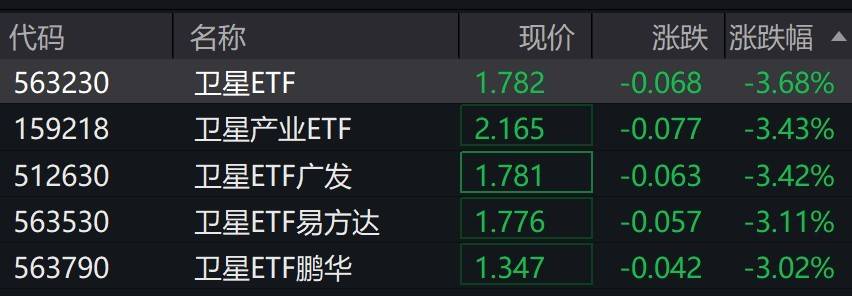
卫星概念股开盘走低,卫星相关ETF跌超3%
Sou Hu Cai Jing· 2026-01-15 01:46
卫星概念股开盘走低,航天电子、中科星图跌超8%,中国卫通跌超6%。 有券商表示,从时间角度看,中国正处于类似Space X 2018-2020年的组网前夜。随着G60千帆与GW国网进入密集发射 期,卫星制造正从实验室定制向汽车流水线式生产转型。能提供通用化电源、通信、姿控系统的配套商将率先兑现业 绩。 每日经济新闻 | 代码 | 名称 | 现价 | | 涨跌 涨跌幅 ▲ | | --- | --- | --- | --- | --- | | 563230 | 卫星ETF | 1.782 | -0.068 | -3.68% | | 159218 | 卫星产业ETF | 2.165 | -0.077 | -3.43% | | 512630 | 卫星ETF广发 | 1.781 | -0.063 | -3.42% | | 563530 | 卫星ETF易方达 | 1.776 | -0.057 | -3.11% | | 563790 | 卫星ETF鹏华 | 1.347 | -0.042 | -3.02% | 受盘面影响,卫星相关ETF跌超3%。 ...
破100亿!两融标的卫星产业ETF(159218)8个交易日累计成交109.41亿元,逾60家机构申报卫星资料!
Sou Hu Cai Jing· 2026-01-15 01:24
Group 1 - Over 60 institutions have submitted satellite data applications to the International Telecommunication Union (ITU), indicating a significant shift of China's low-orbit satellite industry from a national strategy to a market-oriented competitive phase [2][3] - The competition for frequency resources, a strategic asset, has led to a multi-layered development structure in China, involving "national teams, research institutions, and commercial companies" [3] - Analysts suggest that low-orbit satellite constellations have become a core battleground in the space competition among major powers, with the satellite industry market expected to exceed one trillion yuan in the next decade [3] Group 2 - The satellite industry ETF (159218) has seen explosive trading activity, with a transaction amount exceeding 2.1 billion yuan on January 14, leading the sector, and a cumulative transaction of 10.941 billion yuan over the first eight trading days of the year [1][2] - The ETF is recognized as the first satellite-themed product to double its returns, reflecting strong market confidence in the golden development period of commercial aerospace [3]
逾60家机构入局卫星产业万亿赛道!两融标的卫星产业ETF(159218)日成交破20亿领跑同类
Sou Hu Cai Jing· 2026-01-15 01:13
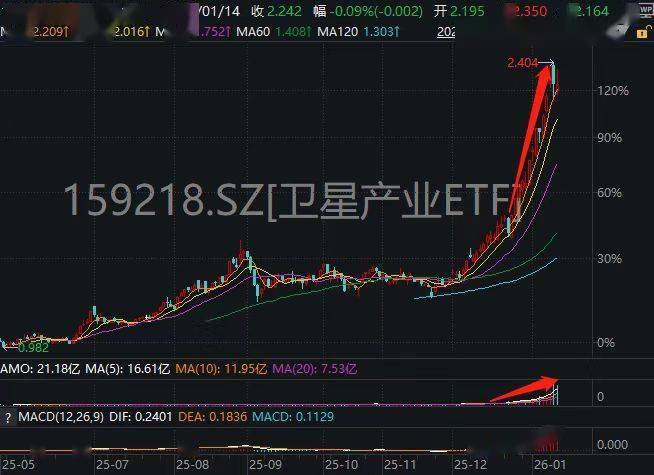
Group 1 - The satellite industry sector continues to experience high volatility, with the satellite industry ETF (159218) reaching an intraday increase of 4.72% before closing slightly down by 0.09%. The trading volume reached 2.12 billion, leading its peers and breaking the 2 billion mark for two consecutive trading days, setting a new trading record [1] - The trading activity has shown a significant increase, with average daily trading volumes over the past 5 days, 10 days, and 20 days being 1.66 billion, 1.2 billion, and 750 million respectively, indicating a sustained rise in investor interest [1] Group 2 - Over 60 institutions have submitted satellite data declarations to the International Telecommunication Union (ITU), showcasing a diverse range of participants including state-owned enterprises, top research institutions, and commercial companies. Notably, several companies have reported satellite constellations reaching the scale of tens of thousands [2] - Analysts suggest that China's low Earth orbit satellite industry has transitioned from a national strategic level to a market-oriented competitive stage. The country has established a multi-layered development structure involving "national teams, research capabilities, and commercial companies" in the global competition for frequency resources [3] - Low Earth orbit satellite constellations are becoming a core battleground in major power space competition, with the satellite industry market expected to exceed 10 trillion in scale over the next decade. The active trading performance of the satellite industry ETF reflects strong market confidence in the golden development period of commercial aerospace [3]
2026年卫星入轨有望迈向“航班化”时代,一键布局卫星全产业链的卫星ETF广发(512630)涨超4%
Xin Lang Cai Jing· 2026-01-14 05:12
Group 1 - The successful launch of the Long March 8A rocket on January 13, 2023, marks a significant achievement in China's commercial space endeavors, with 18 low-orbit satellite internet satellites deployed into their designated orbits [1] - The Long March 8A rocket's testing process has been streamlined to 18 days, with future goals set for a "7 days launch, 7 days recovery" cycle [1] - The Sichuan Province's "14th Five-Year" basic surveying and mapping plan aims to enhance the Beidou satellite navigation system's service capabilities and coverage [1] Group 2 - China has submitted plans for multiple satellite constellations to the International Telecommunication Union, totaling 203,000 satellites, indicating an accelerated strategic layout in the low-orbit satellite sector [2] - The year 2026 is projected to be a pivotal year for China's commercial space launches, with an expected increase in launch frequency to over 100 times [2] - Breakthroughs in rocket recovery technology are anticipated to reduce launch costs by 70% to 90%, facilitating a shift towards a more routine satellite deployment model [2] Group 3 - As of January 14, 2026, the CSI Satellite Industry Index has risen by 4.23%, with the Guangfa Satellite ETF increasing by 4.33%, reflecting strong market performance [3] - The Guangfa Satellite ETF has reached a new high of 2.045 billion yuan in scale, with a total of 1.109 billion shares, indicating robust investor interest [3] - The CSI Satellite Industry Index focuses on the upstream manufacturing segment of the satellite industry, with over 25% weight in aerospace equipment, positioning it to benefit from industry acceleration [4] Group 4 - The top three constituent stocks of the CSI Satellite Industry Index account for nearly 30% of the index, indicating a concentrated investment in leading companies [4] - Higher consensus growth expectations for the index suggest a greater potential for explosive returns as the industry matures [4] - Continuous advancements in high-capacity rockets are expected to alleviate operational bottlenecks, further enhancing the certainty of industry growth [4]
卫星ETF鹏华(563790)涨近3%,机构称现阶段仓位大于个股选择,ETF是较优参与方式
Xin Lang Cai Jing· 2026-01-14 03:54
Core Viewpoint - The satellite industry is experiencing a significant surge, driven by frequent commercial space launches and positive policy support, indicating a long-term growth potential for the sector [1][2]. Group 1: Market Dynamics - The recent market downturn was attributed to three main factors: the definition of the current market cycle, the need for a healthy market correction, and the focus on protecting investor interests rather than suppressing market activity [1]. - The satellite ETF has shown strong performance, with a notable increase in its value, reflecting the overall positive sentiment in the satellite industry [2]. Group 2: Industry Performance - As of January 14, 2026, the China Satellite Industry Index rose by 3.27%, with significant gains in constituent stocks such as Zhongke Xingtou (up 13.55%) and Guoguang Electric (up 11.37%) [2]. - The China Satellite Industry Index comprises 50 companies involved in various satellite-related sectors, indicating a broad representation of the industry [2]. Group 3: Investment Opportunities - The current investment strategy emphasizes a focus on ETFs over individual stock selection, suggesting that ETFs may provide a more stable investment avenue in the rapidly evolving satellite sector [1].