
工业

Search documents
4310万,海关总署2025年超高效液相色谱-三重四极杆质谱仪重新招标
仪器信息网· 2026-02-08 09:01
(三)其它要求 三 、 采 购 预 算 : 本 项 目 预 算 金 额 合 计 总 金 额 人 民 币 43,100,000.00 元 , 其 中 包 1 人 民 币 43,100,000.00元。 四、招标内容: (一)货物内容 | 包件号 | 品目名称 超高效液相 | 数量 | 单价预算(元) | 交货期 | 交货地点 | 质保期 | | --- | --- | --- | --- | --- | --- | --- | | | 色谱 - 三重 四极杆质谱 | 6 | 2,600,000.00 | | | | | | | | | | | 产品安装调 | | | 仪 N 型(配 | | | | | | | | 置 1 ) | | | | | 试经用户验 | | | 超高效液相 | | | | | 收合格当天 | | | | | | | | 起,质保期 | | 包件 1 | 色谱 - 三重 | | | 签订合同后 30 | 海关指定地 | 3 年,在质 | | | 四极杆质谱 | 9 | 2,800,000.00 | 天内 | 点 | | | | 仪 N 型(配 | | | | | 保期内,产 | | | 置 ...


56.24亿元金融活水赋能青海工业经济冲刺“开门红”
Sou Hu Cai Jing· 2026-02-08 02:01
Core Insights - The collaboration between Qinghai Provincial Department of Industry and Information Technology and the People's Bank of China Qinghai Branch resulted in a significant intention for credit cooperation amounting to 5.624 billion yuan, aimed at boosting the industrial economy in Qinghai [1] - The event reflects the commitment to high-quality development and proactive response to domestic and international economic conditions, facilitating a partnership among government, banks, and enterprises [1] Group 1 - The event led to 15 financial institutions reaching intention cooperation agreements with 53 industrial enterprises, totaling 5.624 billion yuan, demonstrating the principle of "finance for enterprises" [1] - As of the end of December 2025, the industrial loan balance in Qinghai exceeded 229.1 billion yuan, with an increase of 22.2 billion yuan year-on-year, representing a growth rate of 10.7% [1] - The proportion of industrial loans in total loans reached 28.2%, indicating the strong engagement of financial institutions in local industries [1] Group 2 - The Qinghai Provincial Department of Industry and Information Technology is focusing on addressing multiple challenges in financial support for industrial development, particularly leveraging key policies such as the 1.25% relending rate and substantial relending amounts for private enterprises and technological innovation [2] - The department aims to enhance the quality and level of work by guiding financial institutions to effectively match financial resources with industrial needs, thereby injecting continuous momentum into the transformation and upgrading of Qinghai's industrial structure [2] - The initiative is part of a broader strategy to ensure that financial resources flow into the real economy, contributing positively to the high-quality development of the provincial economy and society [2]
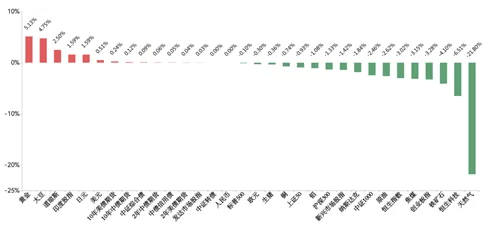
基金研究周报:消费板块走强,大宗商品回调(2.2-2.6)
Sou Hu Cai Jing· 2026-02-08 00:39
Market Overview - The A-share market faced overall pressure last week, with major indices declining, particularly the Sci-Tech 50, which dropped by 5.76%, while the ChiNext Index and ChiNext 50 fell by 3.28% and 3.68% respectively, indicating significant pullback pressure on growth sectors [1] - In contrast, the Shanghai 50 and CSI Dividend indices showed relative resilience, with declines of less than 1%, reflecting a defensive stance in value sectors [1] - The Wande Micro-Cap Index rose by 1.86%, highlighting a shift in funds towards small-cap stocks, despite overall market caution and reduced risk appetite [1] Industry Performance - The Wande primary industry indices displayed notable divergence, with daily consumer goods leading with a gain of 2.87%, followed by industrials, consumer discretionary, and financials, which rose by 1.14%, 0.77%, and 0.71% respectively [1][10] - Conversely, information technology, materials, and communication services experienced the largest declines, falling by 4.86%, 4.52%, and 3.53% respectively, indicating a preference for defensive consumer sectors over technology growth stocks [1][10] Fund Issuance - A total of 40 funds were launched last week, including 16 equity funds, 8 mixed funds, 7 bond funds, and 9 FOFs, with a total fundraising amount of 30.859 billion units [1][17] Fund Performance - The Wande All-Fund Index decreased by 1.19% last week, with ordinary equity funds dropping by 2.06% and equity-mixed funds declining by 2.39%, while bond funds remained stable [5] - The overall performance of equity funds was under pressure, contrasting with the stable performance of the bond market [1][5]
56.24亿元金融活水赋能青海工业经济冲刺“开门红”
Xin Lang Cai Jing· 2026-02-07 17:44
Group 1 - The event held on February 5, organized by the Qinghai Provincial Department of Industry and Information Technology and the People's Bank of China Qinghai Branch, resulted in a significant outcome of 5.624 billion yuan in intended credit cooperation, providing strong financial momentum for the industrial economy in Qinghai [1] - A total of 15 financial institutions and 53 industrial enterprises reached cooperation agreements, demonstrating a commitment to the principle of "finance for enterprises" and laying a solid foundation for a win-win situation among government, banks, and enterprises [1] - As of the end of December 2025, the balance of industrial loans in Qinghai exceeded 229.1 billion yuan, with an increase of 22.2 billion yuan compared to the beginning of the year, reflecting a year-on-year growth of 10.7% and accounting for 28.2% of the total loan balance [1] Group 2 - The Qinghai Provincial Department of Industry and Information Technology aims to address multiple challenges in financial support for industrial development, focusing on key policies such as the 1.25% re-lending rate and substantial re-lending amounts for private enterprises and technological innovation [2] - The department emphasizes a problem-oriented approach to enhance the quality and level of work, guiding financial institutions to leverage their advantages in funding, technology, and industry-finance cooperation [2] - Continuous efforts are being made to ensure that financial resources flow into the real economy, contributing to the transformation and upgrading of Qinghai's industrial sector and the optimization of its economic structure [2]
全方位提速追赶 高质量跨越争先
Xin Lang Cai Jing· 2026-02-06 19:58
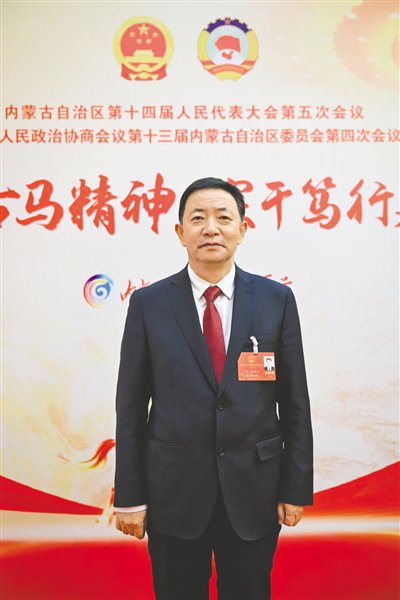
□文/本报记者 梅刚 图/本报记者 王磊 "政府工作报告通篇体现了牢记嘱托、感恩奋进的政治自觉,紧扣自治区党委'1571'工作部署绘制'施工 图',充分彰显了党委有部署、政府快行动的鲜明态度。"自治区人大代表,通辽市委副书记、市长奇· 达楞太在接受记者采访时说。 (来源:内蒙古日报) 转自:内蒙古日报 奇·达楞太表示,通辽市将把铸牢中华民族共同体意识这条主线贯穿于工作全过程各方面,实施民族团 结进步示范市创建"全域提升"工程。紧紧围绕建设"两个屏障"、"两个基地"、"一个桥头堡"战略定位和 使命任务,打好打赢科尔沁沙地歼灭战,加快推进全国肉牛产业重镇建设,推动"吨粮田"面积达到400 万亩以上。 "我们将紧紧围绕七项重点工作持续发力。"奇·达楞太介绍,今年,通辽市将实施新一轮工业倍增、农 牧业提质增效、服务业扩能提质三个行动,确保年内GDP增速达到5.5%;聚焦玉米、肉牛、生物制造 等关键领域开展科技攻关,因地制宜发展新质生产力;持续稳固投资增长良好势头,力争固投增速达到 12%以上;深入开展营商环境质量提升年行动,加快建设"企业友好型、产业友好型、创新友好型"营商 环境;全面提升城镇承载能力,补齐公共服务短 ...
特变电工(600089):中标华能云南滇东能源有限责任公司采购项目,中标金额为216.26万元
Xin Lang Cai Jing· 2026-02-06 11:25
Group 1 - The core point of the article is that TBEA Co., Ltd. has won a procurement project from Huaneng Yunnan Dian Dong Energy Co., Ltd. with a bid amount of 2.1626 million yuan [1][2] Group 2 - TBEA's revenue for 2024 is reported to be 97.867 billion yuan, with a revenue growth rate of -0.35% [1][2] - The net profit attributable to the parent company for 2024 is 4.135 billion yuan, showing a significant decline with a growth rate of -61.37% [1][2] - The return on equity (ROE) for the company is 6.44% [1][2] - In the first half of 2025, TBEA's revenue reached 48.401 billion yuan, reflecting a growth rate of 1.12% [1][2] - The net profit attributable to the parent company for the first half of 2025 is 3.184 billion yuan, with a growth rate of 5.00% [1][2] Group 3 - TBEA operates in the industrial sector, primarily focusing on products such as transformer equipment, specialized equipment, and components [1][2] - The main product composition for 2024 includes transformers (22.85%), coal (19.68%), new energy products and integrated engineering (18.94%), and power cables (16.03%) [1][2] - Other product categories include power generation business (5.73%), aluminum electronic materials and aluminum alloy products (5.73%), and transmission and transformation complete engineering (5.04%) [1][2]

强化党建引领 推动屯昌高质量发展提质增效
Hai Nan Ri Bao· 2026-02-06 07:38
屯昌县委书记 林莉 强化党建引领 推动屯昌高质量发展提质增效 2025年,屯昌县坚持以党建为统领,持续强化政治建设,暖民心实事落地见效,解决群众急难愁盼 问题1784件。产业发展成效显著,全力推动"一园三区两中心"建设,大同产业园获批省级开发区,规上 工业企业数量连续两年高位增长,11项自贸港政策集中落地见效,年招商签约额首次突破50亿元,县属 国企营收同比增长195.4%,增速位居全省第一。深入开展自贸港先锋行动,各领域基层党组织短板有 效补齐,农村产权交易平台年交易额破亿,村集体经济总收入同比增长27%,带动农村人口就业增长 18%,筑牢县域发展根基。 下一步,屯昌将持续以高质量党建引领高质量发展,锚定自贸港建设目标精准发力,紧扣党的创新 理论常态化开展党员干部思想政治教育。聚焦党组织政治功能和组织功能,重点抓好新兴领域、园区、 国企党建工作,推动党建与项目建设、产业发展等重点工作深度融合。建强头雁、党员、人才三支队 伍,着力培育村党组织书记"头雁队伍",强化党员干部教育管理监督,营造近悦远来的人才生态。健全 权责清晰的责任机制、科学精准的考评机制、贯通协同的监督机制、严管厚爱的激励约束机制,深化全 面从 ...
大连重工(002204):中标黑龙江富龙风力发电有限责任公司采购项目,中标金额为161.20万元
Xin Lang Cai Jing· 2026-02-06 05:27
Group 1 - The core point of the article is that Dalian Huari Heavy Industry Group Co., Ltd. won a procurement project from Heilongjiang Fulong Wind Power Co., Ltd. for the maintenance service of the SL1500 wind turbine gearbox, with a bid amount of 1.612 million yuan [1][2] Group 2 - Dalian Heavy Industry (002204.SZ) reported a revenue of 14.281 billion yuan for 2024, with a revenue growth rate of 18.97% and a net profit attributable to the parent company of 498 million yuan, reflecting a net profit growth rate of 37.12% [1][2] - In the first half of 2025, the company achieved a revenue of 7.453 billion yuan, with a revenue growth rate of 6.38% and a net profit attributable to the parent company of 312 million yuan, indicating a net profit growth rate of 13.88% [1][2] - The company operates in the industrial sector, with its main product types including environmental machinery, specialized equipment, and components. The revenue composition for 2024 is as follows: material handling equipment segment: 28.11%; new energy equipment segment: 27.76%; metallurgy equipment segment: 18.96%; core components segment: 12.66%; engineering general contracting projects segment: 8.64%; others: 3.88% [1][2]

上海电气(601727):中标中广核新能源长岭有限公司采购项目,中标金额为7.91亿元
Xin Lang Cai Jing· 2026-02-06 05:27
Group 1 - The core point of the news is that Shanghai Electric Group Co., Ltd. has won a procurement project from China General Nuclear Power Group for a gas power plant, with a contract value of 791 million yuan [1][2]. - The company operates in the industrial sector, with major product types including semiconductor solar photovoltaic, packaging machinery, ship parts and maintenance, low-voltage electrical equipment, power machinery, generators and auxiliary equipment, industrial control machinery, boilers and auxiliary equipment, environmental protection machinery, relay protection and dispatch automation, monitoring equipment and systems, gas turbines and auxiliary equipment, light construction machinery, flue gas desulfurization systems, heavy construction machinery, heavy trucks and special vehicles, and specialized equipment and components [2][3]. Group 2 - In 2024, the company's revenue is projected to be 116.186 billion yuan, with a revenue growth rate of 1.21%. The net profit attributable to the parent company is expected to be 752 million yuan, with a net profit growth rate of -6.33% and a return on equity of 1.42% [1][2]. - For the first half of 2025, the company reported a revenue of 54.303 billion yuan, with a revenue growth rate of 8.89%. The net profit attributable to the parent company is 821 million yuan, with a net profit growth rate of 7.32% [3]. - The main business composition for 2024 is as follows: sales of goods (76.75%), provision of services (9.94%), engineering construction (7.5%), and other businesses (5.81%) [2][3].

2025年阿塞拜疆GDP增长1.4%
Shang Wu Bu Wang Zhan· 2026-02-05 17:16
阿塞拜疆"Report"网1月19日报道,据阿塞拜疆国家统计委员会统计,2025年阿 名义GDP达1291亿马纳特(759.4亿美元),同比增长1.4%。人均GDP为12602 马纳特(7413美元)。其中,油气行业GDP下降1.6%,非油气行业GDP增长 2.7%。各行业占比如下:工业占33%,交通工具贸易和维修占11.3%,运输和 仓储占7.1%,建筑业占6.5%,农林渔业占5.9%,旅游住宿和餐饮业占2.8%, 信息和通信业占2.1%,其他行业占21.7%。工业生产中,59.6%产值来自采掘 业,33.9%来自制造业,5.5%来自电力、燃气和蒸汽的生产、分配和供应,1% 来自供水、废物处理和回收利用。油气行业工业产值下降2%,非油气行业增 长5.5%。商业石油产量下降4.8%,商业天然气产量增长0.7%。 (原标题:2025年阿塞拜疆GDP增长1.4%) ...