日常消费

Search documents
国泰海通香江策论之专题报告港股IPO、再融资及解禁对港股行情的影响:顺势而为,基本面为王
Haitong Securities International· 2026-03-08 23:30
Group 1: IPO and Fundraising Trends - Hong Kong IPOs and follow-on fundraising are closely aligned with market cycles, with peaks typically coinciding with market highs, such as in 2010 and 2015[1] - In 2025, the Hong Kong IPO market saw a significant rebound, with total IPO proceeds reaching HKD 285.7 billion, a 224% increase year-on-year, while combined IPO and follow-on fundraising totaled HKD 645.9 billion compared to HKD 192.2 billion in 2024[1][7] - The IPO fundraising in 2025 marked the highest level since 2022, indicating a recovery trend supported by favorable policies and returning international capital[2][10] Group 2: Future Projections and Market Structure - In 2026, IPO proceeds are expected to exceed HKD 300 billion, continuing the recovery trend from 2024, driven by strong demand from emerging industries and policy support[2][10] - As of late February 2026, IPO proceeds had already reached over 25% of the previous year's total, with 488 companies in the pipeline, primarily from technology and healthcare sectors[2][10] - The supply structure of IPOs is improving, which may enhance the representation of growth industries in the Hong Kong market[2][10] Group 3: Regulatory Environment and Market Impact - The Hong Kong SFC introduced five new regulatory requirements to prioritize quality over quantity in IPOs, including tighter sponsor workload limits and stricter vetting standards[3][14] - IPO waves typically create structural rather than systemic impacts on the market, with temporary supply pressures absorbed by market liquidity[3][27] - Historical data shows that the Hang Seng Index does not experience systemic declines during unlock events, but rather exhibits increased volatility before unlocks and stabilization afterward[4][28] Group 4: Unlock Supply and Market Dynamics - In 2026, the unlock supply is expected to exceed HKD 450 billion in the first half, peaking at approximately HKD 581.6 billion in September, primarily driven by Zijin Gold International[4][15] - The unlock supply is concentrated in the IT, consumer discretionary, and healthcare sectors, which may lead to sector-level volatility during the unlock period[4][28] - Macro fundamentals and global liquidity conditions remain key determinants of market trends, with unlocks reflecting structural disturbances rather than systemic risks[4][16]
基金研究周报:市场结构性分化持续,成长强势(2.9-2.13)
Sou Hu Cai Jing· 2026-02-14 23:35
Market Overview - The A-share market exhibited a structural upward trend last week, with the Shanghai Composite Index closing at 4082.07 points, remaining stable throughout the week [1] - The growth sector performed strongly, highlighted by a 3.37% increase in the STAR 50 Index, indicating robust momentum in technology and innovation themes [1] - In contrast, the value sector showed relative weakness, with the Shanghai 50 and CSI Dividend Index experiencing slight declines [1] - Internationally, the U.S. stock indices collectively fell, with the S&P 500 down 1.39%, while European markets saw moderate gains [2] - Asian markets performed strongly, with the Korean Composite Index soaring 8.21% and the Nikkei 225 rising 4.96% [2] Sector Performance - The Information Technology sector rose by 3.62%, and the Communication Services sector increased by 2.43%, showcasing strong performance [1][9] - Conversely, the Consumer Staples sector declined by 2.45%, and the Financial sector fell by 1.41%, marking the weakest performances [1][9] - The rise of AI technologies has propelled the TMT (Technology, Media, and Telecommunications) sector, leading to accelerated sector rotation during the earnings forecast period [1][9] Fund Issuance and Performance - A total of 64 funds were launched last week, including 24 equity funds, 19 mixed funds, 8 bond funds, 2 QDII funds, and 11 FOF funds, with a total fundraising amount of 58.33 billion [1][17] - The overall performance of funds was positive, with the Wind All Fund Index rising by 0.79%, and the ordinary equity fund index increasing by 1.40% [5] - The equity funds significantly outperformed bond funds, with the equity mixed fund index rising by 1.52% [5] Bond Market Overview - The bond market sentiment was warm, with the convertible bond index leading gains, and both 10-year and 30-year government bond futures slightly rising [13] - Domestic long-term interest rates remain at historically low levels, indicating a stable bond market environment [13]

基金研究周报:市场结构性分化持续,成长强势(2.9-2.13)
Wind万得· 2026-02-14 22:20
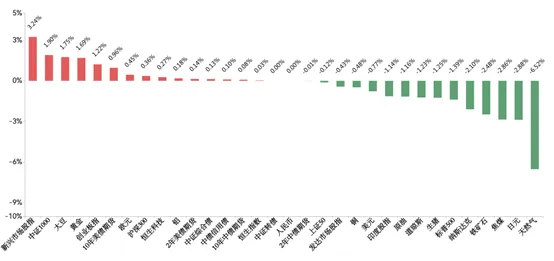
Market Overview - The A-share market exhibited a structural upward trend last week, with the Shanghai Composite Index closing at 4082.07 points, remaining stable throughout the week [2] - The Growth sector performed strongly, with the STAR 50 Index surging by 3.37%, highlighting robust momentum in technology and innovation themes [2] - In contrast, the Value sector showed relative weakness, with the SSE 50 and CSI Dividend Index experiencing slight declines [2] - The U.S. stock indices collectively fell, with the S&P 500 down by 1.39%, while European markets saw moderate gains [4] - Asian markets performed strongly, with the Korean Composite Index soaring by 8.21% and the Nikkei 225 rising by 4.96% [4] Industry Performance - The Information Technology sector rose by 3.62%, and the Communication Services sector increased by 2.43%, demonstrating strong performance [12] - Conversely, the Consumer Staples sector declined by 2.45%, and the Financial sector fell by 1.41%, indicating weaker performance [12] - The rise of AI technologies has propelled the TMT (Technology, Media, and Telecommunications) sector, leading to accelerated sector rotation during the earnings forecast period [12] Fund Issuance and Performance - A total of 64 funds were launched last week, including 24 equity funds, 19 mixed funds, 8 bond funds, 2 QDII funds, and 11 FOF funds, with a total fundraising amount of 58.33 billion [17] - The overall fund performance showed the Wind All Fund Index rising by 0.79%, with equity funds significantly outperforming bond funds [7][17] - The Wind Ordinary Equity Fund Index increased by 1.40%, while the Mixed Equity Fund Index rose by 1.52%, indicating strong performance in equity-related funds [7]

基金研究周报:消费板块走强,大宗商品回调(2.2-2.6)
Sou Hu Cai Jing· 2026-02-08 00:39
Market Overview - The A-share market faced overall pressure last week, with major indices declining, particularly the Sci-Tech 50, which dropped by 5.76%, while the ChiNext Index and ChiNext 50 fell by 3.28% and 3.68% respectively, indicating significant pullback pressure on growth sectors [1] - In contrast, the Shanghai 50 and CSI Dividend indices showed relative resilience, with declines of less than 1%, reflecting a defensive stance in value sectors [1] - The Wande Micro-Cap Index rose by 1.86%, highlighting a shift in funds towards small-cap stocks, despite overall market caution and reduced risk appetite [1] Industry Performance - The Wande primary industry indices displayed notable divergence, with daily consumer goods leading with a gain of 2.87%, followed by industrials, consumer discretionary, and financials, which rose by 1.14%, 0.77%, and 0.71% respectively [1][10] - Conversely, information technology, materials, and communication services experienced the largest declines, falling by 4.86%, 4.52%, and 3.53% respectively, indicating a preference for defensive consumer sectors over technology growth stocks [1][10] Fund Issuance - A total of 40 funds were launched last week, including 16 equity funds, 8 mixed funds, 7 bond funds, and 9 FOFs, with a total fundraising amount of 30.859 billion units [1][17] Fund Performance - The Wande All-Fund Index decreased by 1.19% last week, with ordinary equity funds dropping by 2.06% and equity-mixed funds declining by 2.39%, while bond funds remained stable [5] - The overall performance of equity funds was under pressure, contrasting with the stable performance of the bond market [1][5]
基金研究周报:消费板块走强,大宗商品回调(2.2-2.6)
Wind万得· 2026-02-07 22:30
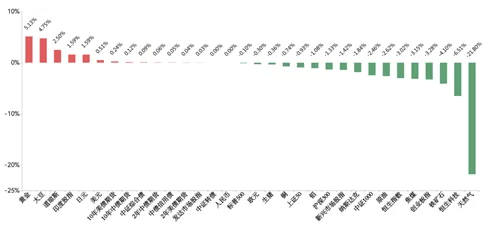
Market Overview - The A-share market faced overall pressure last week, with major indices declining, particularly the Sci-Tech 50, which fell by 5.76%. The ChiNext Index and ChiNext 50 dropped by 3.28% and 3.68%, respectively, indicating significant pullback pressure on growth sectors [2] - In contrast, the Shanghai 50 and CSI Dividend indices showed relative resilience, with declines of less than 1%, reflecting a defensive stance in value sectors. The Wind Micro Index, however, rose by 1.86%, indicating a rotation of funds towards small-cap stocks [2] - Market sentiment remains cautious, with risk appetite decreasing, despite active trading [2] Industry Performance - The performance of the Wind primary industry indices showed significant divergence. Consumer staples led with a gain of 2.87%, followed by industrials, consumer discretionary, and financials, which rose by 1.14%, 0.77%, and 0.71%, respectively. Conversely, information technology, materials, and communication services experienced the largest declines, falling by 4.86%, 4.52%, and 3.53% [11][12] - The preference for defensive consumer sectors over technology growth sectors is evident, likely driven by rising consumption expectations ahead of the Spring Festival, while tech stocks are under pressure from valuation adjustments and tightening liquidity expectations [11] Fund Issuance and Performance - A total of 40 funds were launched last week, including 16 equity funds, 8 mixed funds, 7 bond funds, and 9 FOF funds, with a total fundraising amount of 30.859 billion units [14] - The overall performance of the Wind All Fund Index declined by 1.19%, with ordinary equity funds down by 2.06% and mixed equity funds down by 2.39%. Bond funds remained stable, while equity funds faced significant pressure [7][14]

板块回调基金分化,量化数据拆解同股不同命
Sou Hu Cai Jing· 2026-02-03 20:36
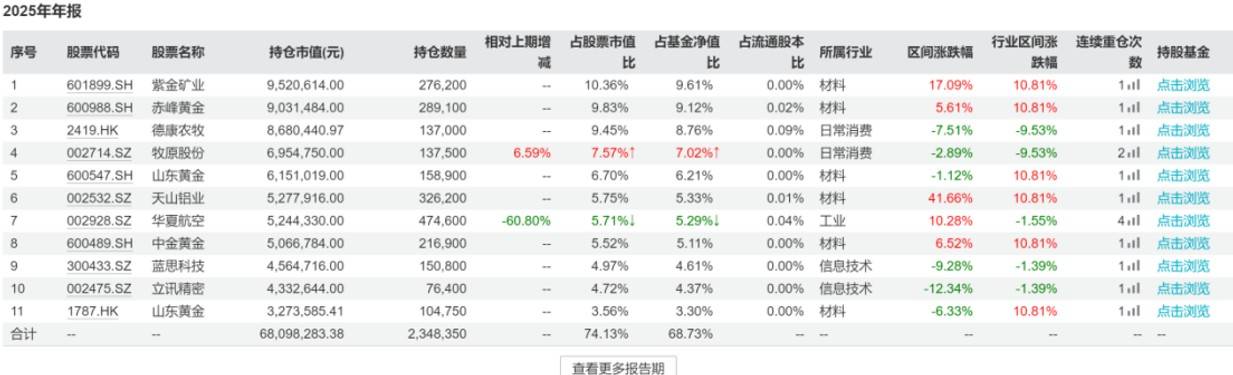
Core Viewpoint - The significant disparity in performance among gold stocks is attributed to the ability of some fund managers to adjust their portfolios in advance, avoiding major downturns, while others did not, leading to substantial losses [1][3]. Group 1: Market Dynamics - The recent decline in gold stocks has seen some funds experience minimal drawdowns, while others have nearly erased their gains from the past year, highlighting the importance of understanding the true sentiment of capital in the market [3]. - Many investors rely solely on market trends and news, which can lead to poor investment decisions, as the underlying capital participation varies significantly among stocks within the same sector [3][4]. Group 2: Case Studies - An example is provided of an investor who faced significant losses due to relying on price movements and news, illustrating the pitfalls of not recognizing the underlying trading logic [4][5]. - The investor's experience demonstrates that stocks can appear to be on the verge of collapse or recovery based solely on price charts, without considering the actual trading activity of larger funds [10][12]. Group 3: Quantitative Data Insights - Utilizing quantitative data, such as "institutional inventory," can reveal the active participation of large funds, helping investors discern market realities beyond superficial price movements [8][10]. - The analysis of institutional inventory data shows that sustained activity indicates ongoing interest from large funds, while a decline suggests a lack of interest, which can lead to misleading price movements [10][12]. Group 4: Advantages of Quantitative Tools - Quantitative tools simplify complex trading data into intuitive indicators, enabling even novice investors to make informed decisions without being swayed by emotional reactions to market fluctuations [13]. - The proactive adjustments made by fund managers using quantitative analysis exemplify the effectiveness of this approach in navigating market volatility [13][14]. Group 5: Long-term Investment Perspective - Recent market corrections are viewed as temporary emotional releases rather than signs of a trend reversal, encouraging a long-term investment mindset [14]. - Investors are advised to enhance their understanding of market dynamics through quantitative tools, fostering a more stable and confident approach to investment decisions [14].
港股市场估值周报-20260203
Zhe Shang Guo Ji Jin Rong Kong Gu· 2026-02-03 06:30
Valuation of Hong Kong Stock Market - The report analyzes the valuation of major indices in the Hong Kong stock market, including the Hang Seng Composite Index (HSCI), Hang Seng Index (HSI), and Hang Seng Tech Index (HSTECH) [8][9][13][17]. - The report highlights that there are no industries currently undervalued with a PE valuation percentile below 20% [24]. - Industries with PE valuation percentiles below 50% include Consumer Discretionary, Consumer Staples, and Utilities [24]. Industry Valuation Levels - The report indicates that industries with relatively high PE valuations (above 50%) include Energy, Materials, Industrials, Healthcare, Financials, Information Technology, and Telecommunications [24]. - For PB valuation, no industries are currently undervalued with a percentile below 20% [24]. - Industries with PB valuation percentiles below 50% are Consumer Staples, Utilities, and Real Estate [24]. AH Share Premium/Discount Levels - The report includes a trend analysis of the Hang Seng AH Share Premium Index, showing fluctuations over time [34]. - The average value and standard deviations of the AH Share Premium Index are provided, indicating market sentiment towards AH shares [34].
柳药集团(603368):中标广西壮族自治区妇幼保健院采购项目,中标金额为476.00万元
Xin Lang Cai Jing· 2026-01-28 12:53
Group 1 - The core point of the news is that Guangxi Liuyuan Group Co., Ltd. won a procurement project from the Guangxi Zhuang Autonomous Region Maternal and Child Health Hospital, with a bid amount of 4.76 million yuan [1][2] Group 2 - In 2024, the company's operating revenue was 21.182 billion yuan, with a growth rate of 1.78% [2] - The net profit attributable to the parent company for 2024 was 855 million yuan, with a growth rate of 0.62% [2] - The return on equity was 11.62% [2] - In the first half of 2025, the company's operating revenue was 10.301 billion yuan, with a decline of 3.21% [2] - The net profit attributable to the parent company for the first half of 2025 was 429 million yuan, with a decline of 7.52% [2] Group 3 - The company operates in the daily consumer industry, with main product types including biological diagnostic reagents, organic chemical pesticides, diagnostic treatment equipment, and traditional Chinese medicine pieces [2] - The main business composition in 2024 was: pharmaceuticals 85.41%, medical devices 13.45%, others 0.74%, and other businesses 0.4% [2]

全球股市立体投资策略周报1月第4期:地缘风险频发,避险资产领涨
GUOTAI HAITONG SECURITIES· 2026-01-27 10:25
Market Performance - Emerging markets saw a narrowing increase of 0.9%, while developed markets declined by 0.6%, with the MSCI Global index down 0.4%[9] - The Japanese 10Y government bond yield rose by 7.1 basis points, while the French yield saw the largest decline of 2.3 basis points[9] - COMEX silver and gold prices increased by 14.5% and 8% respectively, indicating strong performance in precious metals[9] Investor Sentiment - Trading volume in the A-share and Hong Kong markets decreased, with the Hang Seng Index trading volume down to 143 billion shares and $639 billion[21] - The short-selling ratio in Hong Kong increased to 13.1%, indicating a slight rise in bearish sentiment among investors[21] Earnings Expectations - The earnings forecast for the Hang Seng Index for 2025 was revised down from 2069 to 2065, while the S&P 500's forecast was adjusted up from 273 to 274[69] - The financial sector in Hong Kong saw the largest upward revision in earnings expectations, while the consumer staples sector experienced the most significant downward adjustment[69] Economic Outlook - The U.S. economic surprise index rose, reflecting a potential recovery, while the European index declined amid trade tensions[69] - Market expectations indicate that the Federal Reserve is unlikely to cut interest rates in January, with a projected average of 1.8 rate cuts for 2026[52] Capital Flows - Recent capital inflows into the Hong Kong market totaled HKD 155 billion, with stable foreign capital contributing HKD 184 billion[64] - The overall liquidity in the U.S. is expected to remain stable, with the SOFR-OIS spread widening, indicating a slight increase in liquidity risk[52]
港股IPO市场扩容背后 30家企业退市或异常停牌 经营合规风险及保荐督导机制待解
Xin Lang Cai Jing· 2026-01-23 10:26
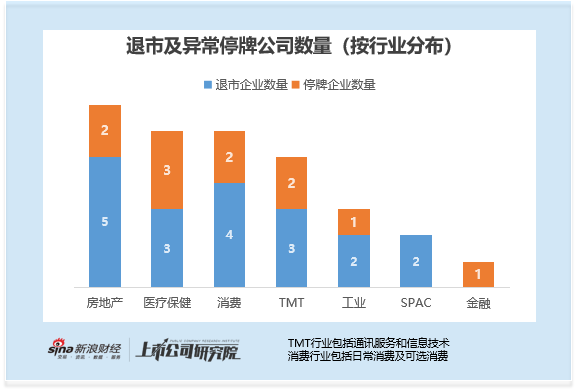
Core Viewpoint - The article highlights the challenges faced by companies listed on the Hong Kong stock market, particularly focusing on the high number of delistings and abnormal suspensions, with real estate being the most affected sector due to compliance issues and operational pressures [1][12]. Industry Overview - A total of 589 companies are projected to list on the Hong Kong stock market from 2020 to 2025, with over 19 companies already delisted and 11 under abnormal suspension [1][12]. - The real estate sector has the highest number of delistings and suspensions, with 7 companies affected, indicating significant operational and compliance challenges [2][13]. - Other sectors such as healthcare, consumer goods, and TMT (Technology, Media, and Telecommunications) also show a notable number of delistings and suspensions, reflecting broader market risks [2][13]. Delisting Reasons - Nine companies have opted for voluntary delisting through privatization, often due to low stock prices, loss of financing capabilities, and high regulatory costs associated with being publicly listed [4][15]. - Eight companies faced mandatory delisting due to violations of exchange regulations, primarily for failing to publish annual or semi-annual results on time, often linked to internal control failures and governance issues [5][16]. Case Studies - The case of Hong Jiu Fruit Products illustrates the severe consequences of governance failures, as the company was delisted after failing to publish financial reports and facing criminal charges against its executives [7][18]. - The delisting process for several companies has raised concerns about the timeliness and effectiveness of the regulatory framework, as some companies remained suspended for over 18 months before being delisted [7][18]. Sponsor Involvement - The involvement of both major and minor brokerage firms in the delisting and suspension of companies challenges the perception that larger firms provide lower risk [10][20]. - The regulatory framework for sponsors in Hong Kong lacks clarity regarding ongoing oversight responsibilities post-listing, contributing to instances of companies facing severe operational issues shortly after IPOs [10][21].