
水利

Search documents
苦干实干争先进位——“十四五”甘肃经济社会高质量发展综述
Xin Lang Cai Jing· 2025-12-22 00:51
金川集团镍合金有限公司的产品"整装待发"(资料图)。新甘肃·甘肃日报通讯员 张俊成 甘肃地区生产总值4年连跨4个千亿台阶 从2020年的9016亿元到2024年的1.3万亿元 预计到2025年底,全省公路总里程将达到16万公里 其中,高速及一级公路通车里程达到8600公里,比"十三五"末增加2600公里 原标题:苦干实干争先进位——"十四五"甘肃经济社会高质量发展综述 2025年全省粮食总产量达1309.25万吨,首次突破1300万吨大关 5年来,甘肃粮食产量连续稳定在1200万吨以上 新甘肃·甘肃日报记者 刘健 "十四五"收官在即。回望五年,陇原大地硕果累累、满目锦绣。 "十四五"以来,在以习近平同志为核心的党中央坚强领导下,省委、省政府以习近平新时代中国特色社会主 义思想为指引,带领陇原儿女全面贯彻落实习近平总书记视察甘肃重要讲话重要指示精神,牢记嘱托、感恩 奋进,改革创新、主动作为,攻坚克难、勇毅前行,在中国式现代化建设中跳起摸高、争先进位,取得一系 列历史性的成就、标志性的成果、突破性的变革。 纵向看,甘肃地区生产总值4年连跨4个千亿台阶,从2020年的9016亿元到2024年的1.3万亿元;横向比, ...


固定资产投资突破千亿元
Xin Lang Cai Jing· 2025-12-20 17:58
Group 1 - The core focus of the article is on the significant investment achievements in Hainan Autonomous Prefecture during the "14th Five-Year Plan" period, with a total fixed asset investment of 1,027 billion yuan, marking a historical high [1] - Clean energy investment reached 749 billion yuan, showing a growth of 12% and 91% compared to the "13th Five-Year Plan" [1] - The clean energy sector is emphasized as a key support area, with major projects like the Qingyu Direct Current and Yangqu Hydropower Station being prioritized to dominate the fixed asset investment landscape [1] Group 2 - A total of 598 projects have been implemented with a total investment of 188.58 billion yuan, including 100.93 billion yuan from central and provincial funds, which is a 25% increase from the "13th Five-Year Plan" [1] - Over 50% of the projects are in infrastructure, focusing on upgrades in water conservancy, transportation, energy, and public service facilities [1] - The implementation of 337 major provincial and state-level projects has an opening rate exceeding 96%, contributing over 85% to fixed asset investment with a total investment of 855 billion yuan [2]
钱江水利:2026年1月6日召开2026年第一次临时股东会
Zheng Quan Ri Bao Wang· 2025-12-18 14:13
证券日报网讯12月18日晚间,钱江水利(600283)发布公告称,公司将于2026年1月6日召开2026年第一 次临时股东会。 ...

中国能建:公司聚焦能源电力、水利核心主业
Zheng Quan Ri Bao Wang· 2025-12-18 09:45
证券日报网讯 12月18日,中国能建(601868)在互动平台回答投资者提问时表示,公司始终聚焦能源 电力、水利核心主业,持续深耕重大领域开发与拓展,全力推进高质量发展。关于四季度经营情况及年 度业绩表现,具体信息请关注公司后续发布的年度报告。 ...

能源早新闻丨2026年我国新能源汽车销量有望达到2000万辆!
中国能源报· 2025-12-17 22:33
Group 1: Coal and Energy Policy - Six departments, including the National Development and Reform Commission, have released guidelines to align with the strictest domestic and international coal pollution emission standards, enhancing benchmark levels for clean and efficient coal utilization by 2025 [2] - The National Development and Reform Commission and the National Energy Administration have issued a notice to establish a national unified electricity market evaluation system, promoting efficient circulation of electricity across provinces and enhancing overall grid operation efficiency [2] Group 2: New Energy Vehicles - The China Electric Vehicle Hundred People Association forecasts that by 2026, domestic new energy vehicle sales are expected to reach 20 million units, with a market growth of 2% and an increase in the ownership ratio from 10% in 2025 to 15% in 2026 [2] Group 3: Regional Developments - Chongqing is promoting the development of "AI+" smart connected new energy vehicles, focusing on AI applications in areas such as assisted driving and vehicle detection [3] - In Henan, the electricity, heat, gas, and water production and supply industry saw a decline of 1.3% in November, while coal mining and washing industries grew by 7.2% [3] Group 4: Infrastructure Investments - Xinjiang has completed over 40 billion yuan in water conservancy project investments by 2025, exceeding its annual investment target [4] Group 5: International Energy Agreements - Hungary signed a liquefied natural gas procurement agreement with Chevron, totaling 2 billion cubic meters over five years, marking the first inclusion of U.S. LNG in Hungary's energy supply [6]
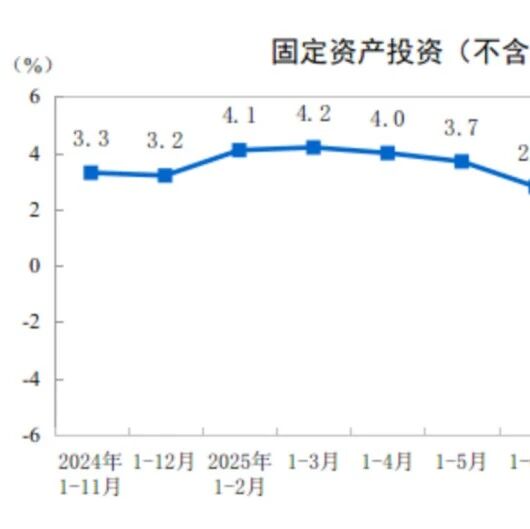
【数据发布】2025年1—11月份全国固定资产投资基本情况
中汽协会数据· 2025-12-16 09:04
Core Viewpoint - The fixed asset investment in China (excluding rural households) for January to November 2025 is 444,035 billion yuan, showing a year-on-year decline of 2.6% [1][4]. Investment by Industry - Investment in the primary industry reached 8,770 billion yuan, with a year-on-year growth of 2.7% [3][4]. - The secondary industry saw an investment of 162,243 billion yuan, growing by 3.9% year-on-year, with industrial investment specifically increasing by 4.0% [3][4]. - The tertiary industry experienced a decline in investment to 273,022 billion yuan, down 6.3% year-on-year [3][4]. Secondary Industry Breakdown - Mining investment grew by 4.0%, while manufacturing investment increased by 1.9% [3][4]. - Notable growth was observed in the electricity, heat, gas, and water production and supply industry, which saw a 10.7% increase [3][4]. Tertiary Industry Breakdown - Infrastructure investment (excluding electricity, heat, gas, and water production and supply) decreased by 1.1% [3][4]. - Specific sectors such as pipeline transportation and water transportation saw increases of 16.8% and 8.9%, respectively [3][4]. Regional Investment Analysis - Eastern regions experienced a significant decline in investment by 6.6%, while central and western regions saw decreases of 1.7% and 0.2%, respectively [3][4]. - The northeastern region faced the largest drop at 14.0% [3][4]. Investment by Registration Type - Domestic enterprises' fixed asset investment fell by 2.6%, while investment from Hong Kong, Macau, and Taiwan enterprises decreased by 2.2% [3][4]. - Foreign enterprises experienced a substantial decline in investment by 14.1% [3][4].
李连成:构建现代化基础设施体系
Bei Jing Ri Bao Ke Hu Duan· 2025-12-15 02:17
Core Viewpoint - The 20th Central Committee's Fourth Plenary Session emphasizes the construction of a modern infrastructure system as a crucial task for building a modern industrial system and strengthening the foundation of the real economy [1] Group 1: Importance of Modern Infrastructure - Infrastructure plays a strategic, foundational, and leading role in national development, significantly impacting economic and social progress [2] - The Central Committee has consistently promoted the construction of a modern infrastructure system, recognizing its importance for long-term national development [2] - Infrastructure is essential for industrial development and serves as a critical component of the modern industrial system, reflecting a country's development level and civilization [2] Group 2: New Quality Productivity - The development of a modern infrastructure system is vital for nurturing new quality productivity, as historical innovations have relied on corresponding infrastructure [3] - Modern infrastructure networks facilitate the flow of technological innovation and production factors, enhancing efficiency and reducing costs [3] Group 3: Current Challenges - There are significant gaps in China's infrastructure compared to developed countries, with issues such as insufficient coordination and resilience in key areas [4] Group 4: Characteristics of Modern Infrastructure - The modern infrastructure system must be advanced, systematic, efficient, safe, and green, aligning with the needs of a socialist modernized nation [5] - Emphasis on integrating advanced technology with economic benefits is crucial for modern infrastructure development [5] Group 5: Transition to Systematic Planning - There is a need to shift from single-domain planning to cross-domain systematic planning for infrastructure, addressing imbalances and structural issues [6][7] Group 6: Development Direction - The development of modern infrastructure should focus on intelligence, greenness, and integration, leveraging new technologies for enhanced efficiency and sustainability [8] Group 7: Key Tasks for the 14th Five-Year Plan - The 14th Five-Year Plan aims to consolidate and expand China's infrastructure advantages, focusing on modernizing transportation and energy systems while enhancing safety and resilience [9][12] Group 8: New Energy Infrastructure - The new energy infrastructure will prioritize non-fossil energy sources and develop a new power system, aiming for a significant increase in clean energy supply [12] Group 9: Modern Water Network - The construction of a modern water network is essential for national public service systems, focusing on flood control and efficient water resource management [13] Group 10: Urban Infrastructure Resilience - Enhancing urban infrastructure to support both daily functions and emergency responses is critical for improving resilience and sustainability [14]
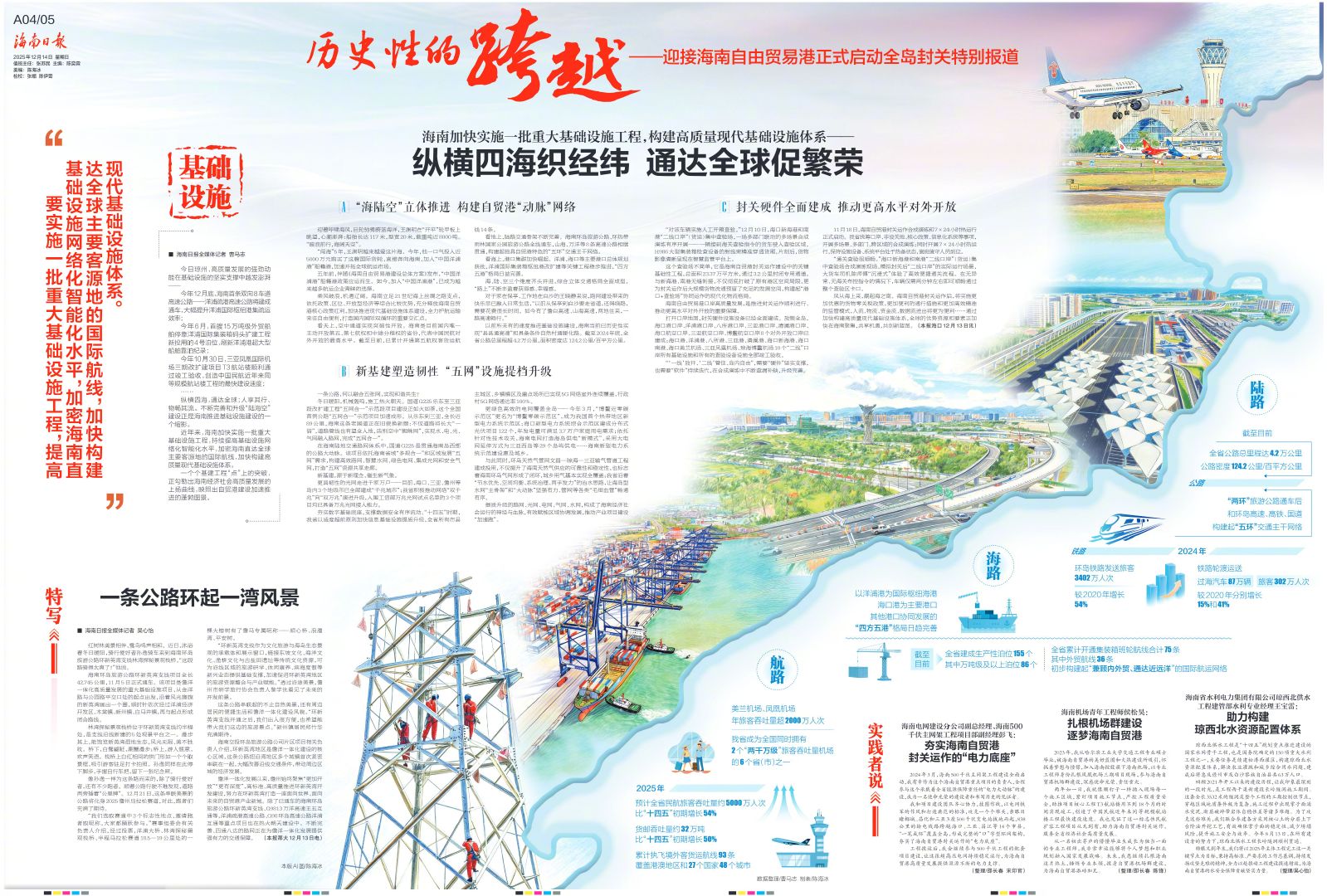
历史性的跨越丨海南加快实施一批重大基础设施工程,构建高质量现代
Hai Nan Ri Bao· 2025-12-14 04:12
Core Viewpoint - Hainan is accelerating the implementation of major infrastructure projects to build a high-quality modern infrastructure system, enhancing connectivity and supporting economic development [6][19]. Infrastructure Development - The completion of the Yangpu Port Expressway by the end of December will significantly improve the efficiency of transportation to and from the Yangpu International Hub Port [6]. - The first 15,000-ton foreign trade vessel docked at the newly expanded container terminal at Yangpu, setting a record for the port [6]. - The third phase expansion of Sanya Phoenix International Airport has been completed, marking the fastest construction speed for a terminal of its scale in recent years [6][19]. Transportation Network - Hainan is enhancing its "land, sea, and air" transportation network, with the completion of various highways and the opening of new international flight routes [8][10]. - The island has achieved "county-level expressway access" and plans to exceed 42,000 kilometers of total road mileage by the end of 2024 [10]. - The G225 national road is undergoing a "five networks integration" project, which will enhance its capacity and efficiency [11]. Digital and Energy Infrastructure - Hainan has established "gigabit cities" in three major cities and is advancing towards "dual ten-gigabit" networks [12]. - The province has achieved 100% 5G network coverage in administrative villages, enhancing digital infrastructure [12]. - The construction of a new power grid system is underway, which will support the energy needs of the Hainan Free Trade Port [22]. Port and Customs Facilities - Hainan's customs facilities have been fully constructed, supporting the high-quality development of its ports and enhancing international trade [16]. - The new inspection area at Haikou New Port and South Port is designed to facilitate efficient customs operations post-closure [15][17]. Economic and Social Impact - The infrastructure projects are expected to drive economic growth and improve the quality of life for residents by enhancing connectivity and access to services [20][21]. - The integration of transportation and tourism infrastructure is anticipated to boost local economies and promote cultural tourism [20][21].
中国能建:公司始终坚守能源电力、水利主责主业
Zheng Quan Ri Bao Zhi Sheng· 2025-12-10 13:41
证券日报网讯 12月10日,中国能建在互动平台回答投资者提问时表示,公司始终坚守能源电力、水利 主责主业,全面推进精益管理、强化运营管控,不断提升发展质量,2025年前三季度,管理费用同比下 降3.64%,利息费用同比下降4.51%;由于加大市场开发、业务规模扩大等因素,销售费用和财务费用 有所增加,但两者在营收中的占比分别下降约0.02个百分点和0.09个百分点。关于公积金缴存和企业年 金,公司严格按照国家规定和财务会计政策进行处理。公司将继续加大科技创新和产业创新,提升盈利 水平和投资价值,更好回报全体股东。 (编辑 王雪儿) ...
盐城市水利局:深化“放管服”改革 优化营商环境
Yang Zi Wan Bao Wang· 2025-12-09 03:24
"请限期拆除违法建筑,恢复河道原貌"。近日,在江苏省盐城市水利局召开的项目洪水影响评价报告审 查会上,一部关于防洪法的动画视频,通俗形象地介绍了常见违法行为。"我们在行政审批和报告审查 时,组织相关单位观看典型案例,做到以案释法、以案明纪。"盐城市水利局局长周岚表示,这是盐城 打造"水·利万企"服务品牌的举措之一,旨在通过审批提质、普法增效、监管优化、执法规范等方式, 为企业提供更高效、更便捷的涉水许可支持。 打造"水·利万企"服务品牌,是盐城市水利局深化"放管服"改革、优化营商环境的创新实践。今年以 来,该局按照"服务企业面对面、解决问题在一线"的工作理念,联动推进行政许可、普法宣传、监管检 查、行政执法"四位一体"新实践,聚焦企业涉水事项办理"少跑腿、办理快,少花钱、成本低,少受 累、态度好"的需求,全力打造"水·利万企"服务品牌,服务盐城经济社会高质量发展。 行政许可便利化 为将行政许可便利化落到实处,盐城市水利局认真梳理流程,细化服务环节。 事前主动服务。发挥政务大厅窗口作用,主动收集项目信息,提前向企业发送审批提醒告知函和审批服 务指南,一次性告知需办理的水行政许可事项、材料清单及流程,避免"事后补 ...