
电子商务

Search documents
巴黎仓库失窃折合超3亿元,京东:绝大多数被盗物资已顺利追回
Bei Jing Qing Nian Bao· 2026-02-14 08:05
Core Viewpoint - JD.com has successfully recovered most of the stolen goods from its warehouse in the Paris region, following a theft incident that occurred on December 22 last year, with significant support from the French police and the Chinese embassy in France [1] Group 1: Theft Incident and Recovery - The theft involved over 50,000 units of 3C digital devices, including smartphones, computers, and tablets, with a total value of approximately €37 million, equivalent to about 306 million yuan [1] - JD.com is fully cooperating with the Paris police for the recovery and handover of the stolen goods [1] Group 2: Global Expansion and Logistics - JD.com is accelerating its "Global Network Plan," having established over 130 overseas warehouses across 23 countries and regions [1] - The company's logistics network, JoyExpress, has recently launched in Europe, and the retail brand Joybuy will offer same-day delivery for a wide range of products in multiple countries, including France, the UK, the Netherlands, and Germany, starting in March [1] Group 3: Commitment to France - JD.com plans to deepen its investment in France and operate in compliance with local regulations, aiming to build a more robust super supply chain to provide efficient, stable, and high-quality services to consumers and businesses in France and Europe [1]

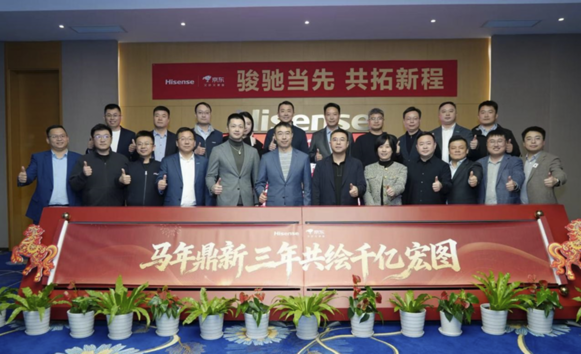
三年全渠道销售目标1000亿元 京东与海信达成战略合作协议
Sou Hu Wang· 2026-02-14 07:36
Group 1 - JD and Hisense have signed a strategic cooperation agreement with a target of achieving 100 billion yuan in sales over the next three years through online and offline channels [1] - JD's extensive online and offline channel resources are crucial for Hisense's performance growth, with plans to establish over 100 "JD-Hisense co-branded stores" and conduct more than 8,300 joint exhibitions nationwide by 2025 [3] - Hisense is expected to maintain strong growth across multiple product categories, leading the market in 100-inch TVs and enhancing its brand presence through collaborative marketing efforts with JD [5] Group 2 - The partnership will focus on high-end product offerings, marketing collaboration, and channel integration, aiming to accelerate the development of high-end RGB-MiniLED TVs, laser TVs, and gaming TVs [5] - Both companies will leverage immersive experiences and integrated services to enhance consumer engagement and brand recognition for Hisense products [5] - The goal is to steadily progress towards the 100 billion yuan target over the next three years by solidifying their competitive advantages [5]


京东:巴黎仓库绝大多数被盗物资已被追回
Xin Jing Bao· 2026-02-14 07:12
Group 1 - The core issue involves a theft incident at JD.com's warehouse in Paris, France, which has been addressed with the support of local police and the Chinese embassy [1] - The investigation has made significant progress, with most of the stolen goods successfully recovered [1] - JD.com is committed to cooperating with Paris police for the proper handling and transfer of the recovered items [1] Group 2 - JD.com's European online retail business, Joybuy, is set to officially launch in March this year [1]
京东巴黎仓库盗窃案告破
Mei Ri Jing Ji Xin Wen· 2026-02-14 07:04
Group 1 - The core incident involves a theft at JD.com's warehouse located in the Paris region, which occurred on December 22, 2025, and has seen significant progress in recovery efforts with most stolen goods being retrieved [1] - JD.com’s European online retail brand, Joybuy, is set to officially launch in March this year, focusing on a wide range of products including electronics, home appliances, beauty and personal care, and daily household items [1]

京东巴黎仓库盗窃案侦破,绝大多数被盗物资顺利追回
Mei Ri Jing Ji Xin Wen· 2026-02-14 03:55
Group 1 - JD's warehouse in the Paris region was robbed on December 22, 2025, but most of the stolen goods have been successfully recovered with the help of the Paris police and the Chinese embassy in France [1] - JD's European online retail brand, Joybuy, is set to officially launch in March this year, focusing on a wide range of products including electronics, home appliances, beauty and personal care, and daily household items [1]
京东春节消费观察:“每逢佳节胖3斤” 75%的消费者接受体重小幅增加并会进行温和管理
Zhong Jin Zai Xian· 2026-02-14 03:46
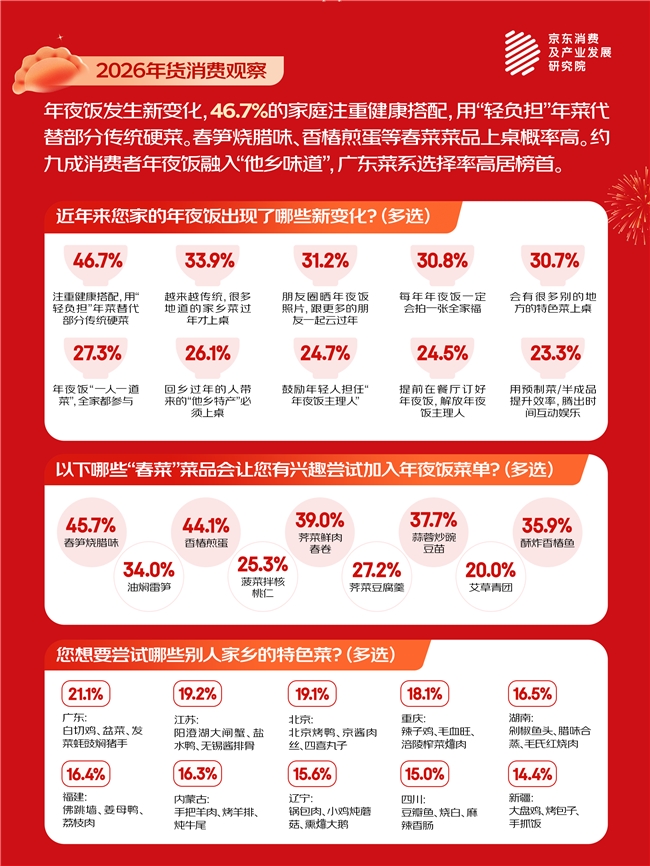
Core Insights - The upcoming Spring Festival is seeing a shift in consumer preferences towards diverse and healthier dining options, with a significant interest in incorporating regional flavors into traditional meals [6][9][11]. Group 1: Dining Trends - Approximately 90% of families plan to include "regional flavors" in their New Year's Eve dinner, with over half starting preparations early [6][9]. - Health-conscious choices are on the rise, with 46.7% of families opting for "light burden" dishes that are low in fat and sugar, and high in protein [11]. - Spring vegetables are gaining popularity, with 87.1% of consumers interested in including them in their New Year's Eve menu, particularly spring bamboo shoots, pea shoots, and asparagus [2][11]. Group 2: Family Dynamics - 75% of families have elders responsible for meal preparations, but 24.8% of younger individuals are taking on this role, leading to more diverse preparation methods [12]. - Younger generations prefer ordering takeout or using semi-finished products, while elders favor preparing all dishes from fresh ingredients [12]. Group 3: Weight Management Attitudes - 75% of consumers are accepting of slight weight gain during the holiday, with only 10% willing to accept an increase of more than 3 pounds [13][15]. - Various approaches to weight management during the holiday season are evident, with 32.8% maintaining healthy habits, while 31.1% choose to indulge fully [15][16]. Group 4: Travel Preferences - 45.2% of respondents plan to celebrate the New Year at home, while 42.1% are considering travel, with a focus on family bonding and creating memories [4][17]. - Popular travel destinations include warm locations like Sanya and cultural experiences in rural areas, reflecting a desire for both relaxation and cultural immersion [17][19]. Group 5: New Year Goods - Emotional and technological gifts are becoming increasingly popular, with 44.9% of respondents valuing items that enhance relaxation and festive atmosphere [5][20]. - AI products are viewed positively for their potential to ease social awkwardness during family gatherings, with 79.3% of consumers believing they can help alleviate uncomfortable questions [20][22]. Group 6: Home Services - Over 90% of consumers are likely to book home services for the New Year, prioritizing transparency in pricing and service quality [23]. - The integration of traditional and modern customs is evident, with a growing interest in local traditions and unique cultural practices [24].
京东集团:感谢巴黎警方对仓库被盗案件侦破的努力 将进一步加大在法投资
Zheng Quan Ri Bao Wang· 2026-02-14 03:45
Core Viewpoint - The theft incident at JD's warehouse in the Paris region has been largely resolved, with most stolen goods recovered, highlighting the collaborative efforts of local police and the Chinese embassy in France [1] Group 1: Incident Overview - JD's warehouse in the Paris region was robbed, prompting a swift investigation by local authorities [1] - The company expressed gratitude for the support received from law enforcement and the Chinese embassy [1] Group 2: Recovery Efforts - The majority of the stolen goods have been successfully recovered [1] - JD will cooperate fully with Paris police for the proper handling and transfer of the recovered items [1] Group 3: Business Expansion - JD has accelerated its "Global Network Plan," establishing over 130 overseas warehouses in 23 countries and regions [1] - The company's logistics network, JoyExpress, has launched in Europe, providing faster delivery options for its retail brand Joybuy [1] Group 4: Marketing Initiatives - Joybuy has initiated a "New Year Flavor at Home" festival in France, offering digital and home appliance coupons to enhance the shopping experience for European consumers [1] Group 5: Future Commitment - JD plans to deepen its investment in France, focusing on compliance and building a robust super supply chain to deliver efficient and high-quality services to consumers and businesses in France and Europe [1]
从囤货到提货:京东自提改写春节消费底层逻辑,即提即走成2026新年俗
Jin Rong Jie· 2026-02-14 03:24
Core Insights - The trend of consumer behavior during the Spring Festival is shifting from "advance stocking and planned purchasing" to "immediate pick-up and scenario-triggered consumption" [3][4] - JD's self-pickup service is transforming consumer behavior from a passive receiving model to an active integration into offline shopping experiences, becoming a key driver of this consumption habit evolution [3][4] Group 1: Changes in Consumer Behavior - This year's Spring Festival has seen a significant increase in instant consumption and scenario-based purchasing, with consumers prioritizing "buying accurately and picking up conveniently" over "buying early and stocking up" [4][6] - Consumers are now making purchases on-the-go, such as ordering gifts for relatives just before arriving at their homes, indicating a shift towards more efficient and less time-consuming shopping methods [4][6] Group 2: JD's Self-Pickup Value Proposition - JD's self-pickup service redefines the time logic of Spring Festival shopping, allowing consumers to complete purchases as part of their travel plans rather than as a separate task [6][8] - For merchants, self-pickup offers a low-cost fulfillment method with high customer conversion rates, leading to significant increases in sales and order volumes [6][8] Group 3: Market Impact and Promotions - The self-pickup service is not just a substitute for delivery but serves as a new entry point for foot traffic to physical stores, enhancing brand trust and customer engagement [8][9] - JD is launching promotional activities to attract consumers, such as discounted food items for self-pickup, further driving engagement and sales during the festive season [9]

京东政企业务启动春节稳价保供专项行动 全力保障企业生产运营不断档
Sou Hu Wang· 2026-02-14 02:06
Core Insights - The central economic work conference emphasizes the importance of ensuring the supply of essential goods during the year-end and New Year period, with the Ministry of Commerce and nine other departments issuing a special plan for the 2026 "Spring Festival" activities to support online New Year goods festivals and provide policy guidance for stable operations during the Spring Festival [1][2] Group 1: Company Initiatives - JD's enterprise business responds to the national supply guarantee call by launching the 2026 "JD Spring Festival Delivery to Home" initiative, which includes five measures to ensure uninterrupted procurement and supply for government and enterprise clients during the Spring Festival [1] - The platform offers a "Spring Festival Care and Supply Solution" tailored for corporate procurement needs, providing employee welfare packages and emergency supplies, with negotiable pricing for bulk orders [1] Group 2: Logistics and Supply Chain - Efficient logistics is crucial for stable supply, with JD's enterprise business leveraging its logistics network to ensure delivery services across over 360 cities and more than 2,200 counties during the Spring Festival, including same-day or next-day delivery in key cities [2] - The initiative enhances the resilience of the overall supply chain during the holiday period, meeting urgent demands for employee welfare and emergency supplies while supporting the continuity of operations for enterprises [2]
华钦科技子公司拟赴美IPO,公司预计下财年营收增长10%-15%
Jing Ji Guan Cha Wang· 2026-02-13 18:58
Group 1 - The core viewpoint is that JAJI Global Incorporation, a subsidiary of Huachin Technology, has submitted an F-1 registration statement to the SEC for a proposed IPO, which could enhance the subsidiary's value and expand its global brand influence [1] Group 2 - The company expects a revenue growth of 10%-15% for the next fiscal year (FY2026), driven by sustained demand for IT consulting services and the advancement of its globalization strategy [2] - The company plans to continue deepening technological innovation in areas such as AI and automation, including the promotion of its RPA product Nibot and Web3 digital asset platform [2] Group 3 - The company aims to expand its market presence outside mainland China, particularly in Southeast Asia and North America, while strengthening its cross-industry business layout, including fintech and e-commerce, to enhance revenue resilience [3] - The overseas revenue is projected to grow approximately 90.5% year-on-year in FY2025, indicating a potential for further deepening of this strategic initiative [3]