
互联网医疗

Search documents
港股收评:恒指跌0.24%,科技股普跌,苹果概念股走弱,基建医药强势
Ge Long Hui· 2025-08-21 08:29
另一方面,再迎行业利好消息,医药类股全线拉升,互联网医疗股方向涨幅较大,叮当健康大涨近24% 领衔,券商指为完成全年预算,基建支出需加速,基建类全天强势,中国中车、时代电气涨超5%,影 视股、石油股、电信股、家电股、光伏股多数表现活跃。(格隆汇) (原标题:港股收评:恒指跌0.24%,科技股普跌,苹果概念股走弱,基建医药强势) 盘面上,作为市场风向标的大型科技股多数表现低迷,美团跌3%,百度跌2.58%,小米跌超2%,阿里 巴巴跌1.5%,京东跌超1%,腾讯勉强翻红,网易涨1%;昨日大幅上涨的苹果概念股跌幅明显,其中, 瑞声科技绩后大跌超13%,舜宇光学、鸿腾精密跌超3.5%,锂电池股、新消费概念股、汽车股、黄金 股、铜业股等有色金属齐跌,其中,新消费老铺黄金跌近4%,奈雪的茶、茶百道、蜜雪集团等饮料股 纷纷走低。 港股三大指数集体收跌,恒生科技指数午后一度跌至1.3%,最终收跌0.77%,恒生指数、国企指数分别 下跌0.24%及0.43%,午后市场情绪稍显弱势。 ...


一图读懂港股平安好医生(1833.HK)2025年中期业绩
Ge Long Hui· 2025-08-21 08:22
来源:微信公众号.平安好医生 (原标题:一图读懂港股平安好医生(1833.HK)2025年中期业绩) ...
归母净利润增长137%,平安好医生(01833.HK)解码AI医疗增长密码
Ge Long Hui· 2025-08-21 07:19
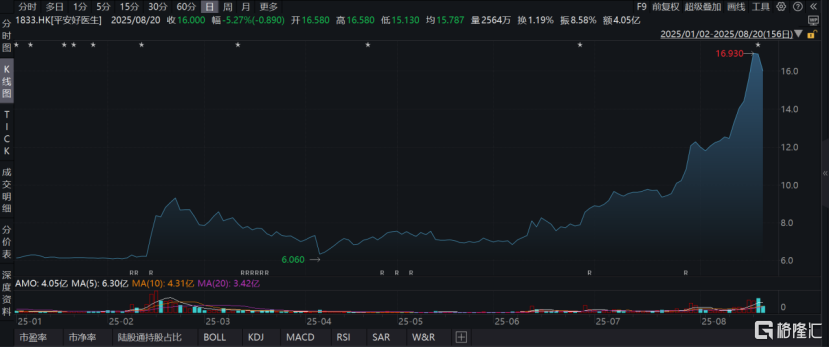
Core Viewpoint - The Hong Kong healthcare sector is undergoing a value reconstruction, with Ping An Good Doctor (01833.HK) emerging as a standout player due to its breakthrough in AI healthcare technology [1] Group 1: Financial Performance - In the first half of 2025, Ping An Good Doctor reported total revenue of 2.5 billion yuan, a year-on-year increase of 19.5%, and a net profit of 134 million yuan, up 136.8% [1] - The company's F-end and B-end business revenues grew by 30.2%, and the overall number of paying users increased by 35.1% year-on-year [1] - As of August 20, 2025, the company's stock price surged by 158.06% year-to-date, reaching a market capitalization of 34.6 billion HKD, the highest in nearly four years [1] Group 2: Industry Trends - The AI healthcare sector is entering a golden development period, driven by favorable policies and technological advancements [3] - The Chinese AI healthcare market is expected to grow at a compound annual growth rate of over 30%, reaching 97.6 billion yuan by 2028, accounting for 15.4% of the AI industry [4] Group 3: Technological Advancements - Ping An Good Doctor is enhancing its AI capabilities by building a closed-loop service model and applying AI technology across various medical scenarios [5] - The company has developed a comprehensive AI product system, including digital twins of doctors and AI family doctors, to provide intelligent decision support across the entire healthcare process [5] Group 4: Strategic Insights - Analysts from various brokerages have expressed positive evaluations of Ping An Good Doctor's strategic upgrades and profitability improvements, with revenue forecasts for 2025 and 2026 adjusted upwards [9][10] - The integration of AI technology and the establishment of a service ecosystem have positioned the company favorably for future growth [12] Group 5: Market Positioning - Ping An Good Doctor is recognized as a leader in the AI healthcare sector, with a strong focus on enhancing user engagement through its "AI + Family Doctor" model [10] - The company's innovative approaches and strategic collaborations are expected to drive significant growth in the coming years, making it an attractive option for long-term investors [14]

里昂:平安好医生为中国AI医疗主要受益者 升目标价至20港元 重申“跑赢大市”评级
Zhi Tong Cai Jing· 2025-08-21 07:12
Core Viewpoint - The report from Citi highlights that Ping An Good Doctor (01833) has shown impressive performance in the first half of the year, with a revenue increase of 19.5% to 2.5 billion RMB and a significant net profit growth of 136.8% to 134 million RMB, driven by advancements in medical AI and improved profit outlook [1] Group 1: Financial Performance - Revenue for the first half of the year increased by 19.5% to 2.5 billion RMB [1] - Adjusted net profit surged by 136.8% to 134 million RMB [1] Group 2: Market Outlook and Predictions - Citi expects the strong stock performance of Ping An Good Doctor is attributed to progress in medical AI and an improved profit outlook [1] - The target price has been raised from 10 HKD to 20 HKD based on discounted cash flow analysis, maintaining an "outperform" rating [1] - The company is seen as a major beneficiary of the growing trends in AI healthcare and commercial health insurance in China [1] Group 3: Future Projections - Revenue forecasts for 2025 to 2027 have been increased by 1.9% to 5.6% [1] - Net profit forecasts have been significantly raised based on more optimistic margin assumptions [1] - Continued enthusiasm for AI healthcare companies is anticipated as the cycle of technology investment and potential AI-driven applications gains momentum [1]
支付、服务、数据融合:医保商保协同塑造健康产业新未来
Jing Ji Guan Cha Wang· 2025-08-21 06:44
Core Insights - The article highlights the increasing collaboration between commercial health insurance and public health insurance in China, driven by recent policy initiatives and the establishment of a clearing settlement center for "医保+商保" [1][7] - The integration of commercial health insurance with innovative drug listings aims to enhance accessibility to new treatments, particularly for rare diseases and high-value drugs [1][2] - Companies like Ping An Good Doctor are leading the way in developing a comprehensive ecosystem that combines insurance, medical services, and health management [3][4][6] Policy Developments - The National Healthcare Security Administration has introduced policies to promote high-quality development in commercial health insurance, including the launch of a clearing settlement center in Beijing [1][7] - The establishment of a commercial health insurance innovative drug directory aims to facilitate the use of high-value drugs not covered by basic health insurance [1][2] Industry Trends - The trend of collaboration in the health insurance sector is expanding beyond traditional insurance companies to include pharmaceutical firms and technology platforms [2] - Ping An Group has made significant early investments in health insurance collaboration, creating a robust ecosystem that integrates financial services with healthcare [3][4][6] Company Strategies - Ping An Good Doctor has developed a unique service model that combines insurance products with health services, focusing on family doctor and elderly care services [4][5][6] - The company has seen substantial growth in its user base and service offerings, with a reported 83% increase in home care service users and a 34.6% increase in paid users [5][8] Future Outlook - The ongoing collaboration between health insurance and medical services is expected to evolve into a more integrated model that emphasizes data sharing, service fusion, and innovative payment mechanisms [10][11] - Ping An Good Doctor's approach of integrating services with insurance is seen as a sustainable path for growth, positioning the company to benefit from ongoing reforms in the healthcare system [10][11]
平安好医生涨幅扩大至13.1%,港股医药ETF (159718.SZ)强势上涨1.3%
Xin Lang Cai Jing· 2025-08-21 06:21
Group 1 - The core viewpoint highlights a significant rise in Hong Kong pharmaceutical stocks following positive earnings reports, with Ping An Good Doctor increasing by 15.06% and Hengrui Medicine rising over 1% [1] - Ping An Good Doctor reported a revenue of 2.5 billion yuan for the first half of 2025, marking a year-on-year growth of 19.5%, exceeding market expectations [1] - Hengrui Medicine's half-year report showed a revenue of 15.761 billion yuan, a year-on-year increase of 15.88%, and a net profit attributable to shareholders of 4.45 billion yuan, up 29.67% [1] Group 2 - Two leading companies in the innovative drug sector, Hengrui and China National Pharmaceutical Group, are actively increasing their shareholdings, signaling positive market sentiment [2] - Hengrui plans to repurchase A-shares using its own funds, with a total investment of no less than 1 billion yuan and not exceeding 2 billion yuan, at a price not exceeding 90.85 yuan per share [2] - The Hong Kong pharmaceutical ETF (159718.SZ) is noted for its balanced composition, including innovative drugs, CXO, internet healthcare, and innovative medical devices, making it a convenient investment tool for the sector [2]

平安好医生涨超15%股价创4年新高,上半年收入及盈利增长加速!预期AI医疗赋能和商业健康保险发展的蓬勃发展
Ge Long Hui· 2025-08-21 04:25
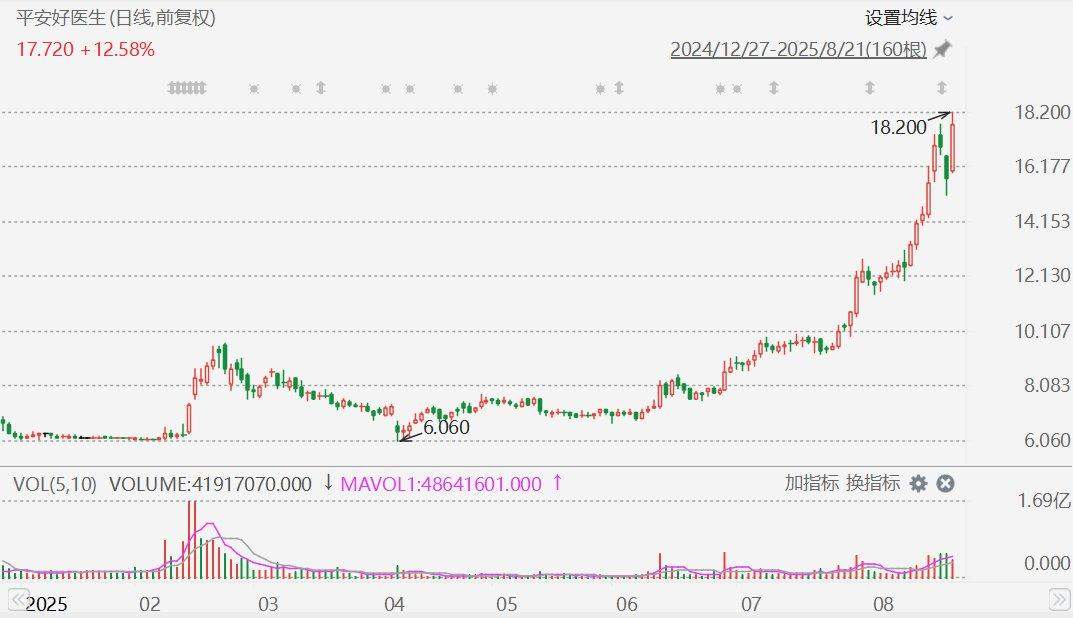
Group 1 - The core viewpoint of the article highlights the significant stock price increase of Ping An Good Doctor (1833.HK), which rose over 15% to reach HKD 18.2, marking the highest price since October 2021, with a trading volume of HKD 720 million [1][3] - On August 20, Premier Li Qiang emphasized the importance of utilizing artificial intelligence to enhance the development of the biopharmaceutical industry, focusing on improving the intelligence levels in drug research, clinical trials, diagnosis, treatment, and production [3] - Ping An Good Doctor reported a total revenue of RMB 2.5 billion for the first half of 2025, representing a year-on-year growth of 19.5%, and a net profit of RMB 134 million, which is a remarkable increase of 136.8%. The number of paying users reached approximately 24 million, up 35.1% year-on-year [3] Group 2 - After the earnings announcement, Citi released a performance review stating that the impressive results of Ping An Good Doctor are attributed to advancements in medical AI and improved profit outlook. The target price was raised from HKD 10 to HKD 20, maintaining an "outperform" rating [3] - Citi believes that Ping An Good Doctor is a major beneficiary of the growing trends in AI healthcare and commercial health insurance in China, which are gaining increasing attention in the healthcare sector [3] - Following the positive performance in the first half of the year, Citi raised its revenue forecasts for the company from 2025 to 2027 by 1.9% to 5.6%, and significantly increased net profit forecasts based on more optimistic profit margin assumptions [3]
港股午评:三大指数齐跌,科技股走低,基建股、医药股强势!叮当健康涨超21%,平安好医生涨12%,中国中车涨5%,小米、百度跌2.4%,美团跌1.49%
Ge Long Hui· 2025-08-21 04:25
Market Overview - The Hong Kong stock market experienced a collective decline in the morning session, with the Hang Seng Index down by 0.1%, the Hang Seng China Enterprises Index down by 0.32%, and the Hang Seng Tech Index down by 0.51% [1] Sector Performance - Major technology stocks mostly fell, with Xiaomi and Baidu down by 2.4%, Meituan down by 1.49%, while Alibaba and JD.com saw slight declines. Tencent and Kuaishou managed to stay in the green [1] - Pharmaceutical stocks surged, particularly internet healthcare stocks, with Dingdang Health rising over 21% and Ping An Good Doctor up by 12% [1] - Infrastructure-related stocks showed strength, especially high-speed rail construction stocks, with China CRRC rising over 5% [1] - Consumer electronics, oil, rare earth, and electric power stocks were generally active [1] Weak Performers - The film and entertainment sector, lithium battery stocks, automotive stocks, robotics concept stocks, and gold stocks mostly weakened. Notably, Changfei Optical Fiber Cable, which recently hit a historical high, fell over 12%, and "stock king" Laopu Gold dropped by 5.69% [2]


港股午评:三大指数齐跌 科技股多数走低 基建股、医药股强势
Ge Long Hui· 2025-08-21 04:09
Market Overview - The Hong Kong stock market saw all three major indices decline in the morning session, with the Hang Seng Index down by 0.1%, the Hang Seng China Enterprises Index down by 0.32%, and the Hang Seng Tech Index down by 0.51% [1] Technology Sector - Major technology stocks mostly fell, with Xiaomi and Baidu down by 2.4%, Meituan down by 1.49%, and Alibaba and JD.com experiencing slight declines. However, Tencent and Kuaishou managed to remain in the green [1] Healthcare Sector - The healthcare sector received positive news, leading to a significant rally, particularly in internet healthcare stocks. Dingdang Health surged over 21%, while Ping An Good Doctor rose by 12% [1] Infrastructure and Construction - Brokerages indicated that to meet annual budgets, infrastructure spending needs to accelerate, resulting in a noticeable strength in infrastructure stocks, especially high-speed rail construction stocks, with China CNR Corporation rising over 5% [1] Other Sectors - Various sectors such as home appliances, oil, rare earths, and electricity stocks were mostly active. Conversely, sectors like film and entertainment, lithium batteries, automotive, robotics, and gold stocks generally weakened [1] Notable Stock Movements - Longi Green Energy, which recently hit a historical high, saw a significant drop of over 12%, while the "king of stocks," Laopu Gold, fell by 5.69% [1]
港股午评|恒生指数早盘跌0.1% 互联网医疗板块走高
智通财经网· 2025-08-21 04:07
港股恒生指数跌0.1%,跌25点,报25140点;恒生科技指数跌0.51%。港股早盘成交1242亿港元。 互联网医疗板块走高,各大保险公司纷纷布局健康管理赛道,互联网医疗在很长的一段时间都是保险公 司的"战略成本中心"。叮当健康(09886)涨超21%;平安好医生(01833)涨超12%;阿里健康 (00241)涨3%;京东健康(06618)涨1.49%。 中国联通(00762)涨超3%领涨蓝筹,高盛称中期业绩承压但股息增长仍然稳健,下半年盈利压力有望缓 解。 中兴通讯(00763)A股一度涨停,H股涨5%,公司占据国内超节点方案核心位置。 易鑫集团(02858)涨超8%,SaaS收入高增驱动业绩增长,花旗上调公司盈测及目标价。 谢瑞麟(00417)再涨超40%,本周累涨逾200%,董事会称不知悉股价波动原因。 中粮家佳康(01610)涨超4%,下周一将发中期业绩,牧原股份上半年净利激增。 华住集团-S(01179)涨超6%,,中期纯利同比增长超四成,派息0.081美元。 蓝思科技(06613)涨超5%,股价再创上市新高,公司兼具新兴领域卡位优势。 晶苑国际(02232)涨超12%,中期纯利同比增长17%,下 ...