互联网

Search documents
港股科技板块AI叙事强化,恒生科技ETF(513130)2月以来累计吸金超38亿元
Xin Lang Cai Jing· 2026-02-12 06:42
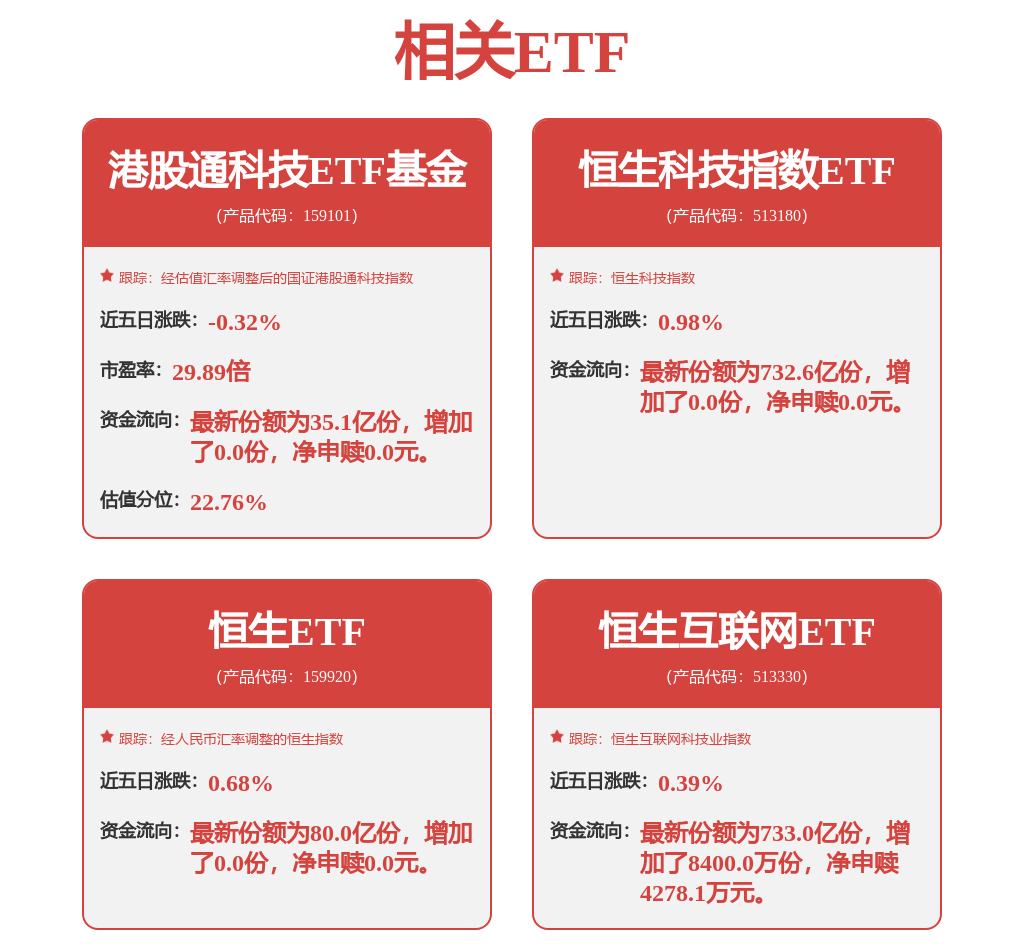
Core Viewpoint - The Hong Kong stock market is experiencing a pullback, particularly in the technology sector, influenced by strong non-farm payroll data from the US, which has tempered interest rate cut expectations [1][2]. Group 1: AI Application Competition - Major internet companies in Hong Kong are aggressively investing billions in AI application subsidies to capture traffic during the Spring Festival, indicating an escalation in competition within the AI sector [3][4]. - ByteDance's AI application Doubao has launched a new Spring Festival campaign, joining the competition for AI red envelope promotions, which is expected to drive widespread adoption of AI applications [3][4]. Group 2: Investment Trends in Technology Sector - The Hang Seng Technology ETF (513130) has seen a significant inflow of over 3.8 billion yuan since February 2026, making it one of the few ETFs in the A-share market with net inflows exceeding 3 billion yuan during the same period [3][4]. - The Hang Seng Technology Index, which the ETF tracks, includes key players like Alibaba, SMIC, BYD, Meituan, and Xiaomi, and is currently valued at a historical low with a price-to-earnings ratio of 22.68, suggesting potential for valuation recovery amid increased competition and liquidity improvements [2][4]. Group 3: Fund Management and Strategy - The fund manager of the Hang Seng Technology ETF, Huatai-PB Fund, is one of the first ETF managers in China, with a strong track record in various index categories, including broad-based and dividend-themed indices [4]. - The "Dividend Family" series managed by Huatai-PB includes several ETFs that may serve as defensive options in a "barbell strategy" [4].
港股突发!科网股,集体跳水!三大变数来袭!
券商中国· 2026-02-12 06:28
Core Viewpoint - The Hong Kong tech stocks experienced a significant decline on February 12, with major players like Tencent and Meituan seeing drops of over 3% and 4.5% respectively, indicating a clear break in technical support levels [1][3]. Market Performance - On February 12, the Hang Seng Index fell by 0.89% to 27,024.06 points, while the Hang Seng Tech Index dropped by 1.68%, later expanding to over 1.8% in the afternoon [3]. - Notable declines included Ctrip, Meituan, and NetEase, each dropping over 4%, while Bilibili, Tencent, and Baidu saw declines exceeding 3% [3]. Factors Influencing the Decline - Analysts identified three main factors contributing to the downturn: 1. The upcoming long holiday leading to a withdrawal of some funds [1]. 2. Regulatory actions impacting stock prices, particularly a recent administrative meeting regarding online train ticket sales involving major platforms [3]. 3. A noticeable siphoning effect from the Japanese and South Korean stock markets, exacerbated by unresolved dollar liquidity issues [4]. Regulatory Impact - The Beijing Municipal Market Supervision Administration held discussions with major online ticket sales platforms, emphasizing compliance requirements and prohibiting misleading advertising practices [3]. Market Sentiment and Future Outlook - The current weak market sentiment has led to a pessimistic narrative, but some analysts believe that the recent volatility is primarily due to liquidity shocks [6]. - The Hang Seng Tech Index is reportedly at a historical low valuation, suggesting potential for recovery as the regulatory environment improves compared to previous years [7]. - Analysts from China International Capital Corporation (CICC) noted that the recent 20% pullback in the Hang Seng Tech Index is a result of valuation and sentiment alignment rather than a trend reversal [7]. Investment Opportunities - Despite the current downturn, there is a belief that the tech sector in Hong Kong presents significant allocation value, with favorable factors accumulating for future growth [6]. - The focus should remain on companies' AI investment rhythms and their ability to deliver profits, particularly for leading platform enterprises [7].


网易业绩不及预期,港股科网股大跌
Di Yi Cai Jing Zi Xun· 2026-02-12 06:16
Core Viewpoint - The Hong Kong stock market, particularly technology stocks, is experiencing significant volatility and declining trading volumes, leading to investor uncertainty [3] Group 1: Market Performance - On February 12, the Hang Seng Index fell below 27,000 points, closing at 27,024 points, down 0.89%, with a trading volume of 127.2 billion HKD; the Hang Seng Tech Index dropped 1.68% to 5,407 points, with a trading volume of 35.8 billion HKD [3] - NetEase (09999.HK) reported disappointing annual results on February 11, leading to a 3.79% drop on February 12, which negatively impacted the overall performance of Hong Kong tech stocks, including Tencent Holdings (00700.HK) down 2.65% [3] Group 2: Investor Sentiment - Analysts predict that upcoming earnings reports from tech stocks may also fall short of expectations, suggesting that investors should adopt a wait-and-see approach until earnings are confirmed [3] - Concerns over price wars and declining growth rates among some tech stocks have been raised, with NetEase's gaming slowdown causing worries about other gaming companies [4] Group 3: Future Outlook - The main support for the Hong Kong stock market comes from technology (especially AI) and new consumption sectors, with ongoing discussions about the impact of new technologies on traditional business models [4] - There are over 400 companies currently in the IPO process in Hong Kong, with significant IPO lock-up expirations expected in 2026, potentially affecting market liquidity [5] - Short-term market adjustments may occur, but there is potential for upward recovery, with a mid-term profit growth forecast of 3% to 4%, which could push the Hang Seng Index towards 28,000 to 29,000 points [5]

科网股走低拖累恒科指数 春节AI红包大战再度升温 超级入口之争或成今年主旋律
Zhi Tong Cai Jing· 2026-02-12 05:53
Group 1 - The core point of the article highlights a collective decline in tech stocks, leading to a nearly 2% drop in the Hang Seng Tech Index, with notable declines in companies such as Trip.com Group (-3.99%), Tencent (-3.01%), and Alibaba (-1.56%) [1] Group 2 - The article discusses the entry of Doubao into the Spring Festival AI red envelope competition, following other AI products like Tongyi Qianwen and Tencent Yuanbao, indicating a significant milestone in the application of large models and AI assistants [1] - Galaxy Securities suggests that this AI red envelope competition could mark a pivotal shift from technical development to consumer application for AI technologies [1] - Zhongyou Securities believes that the "super entrance competition" is likely to become a main theme for AI in 2026 [1] Group 3 - According to LatePost, Alibaba's core management has identified Taobao Flash Purchase as a milestone battle for the group, with plans to increase investment over the next three years without profit pressure, focusing on the development of instant retail [1]



港股异动 | 科网股走低拖累恒科指数 春节AI红包大战再度升温 超级入口之争或成今年主旋律
Zhi Tong Cai Jing· 2026-02-12 05:53
Group 1 - The technology stocks collectively declined, causing the Hang Seng Tech Index to drop nearly 2% [1] - Ctrip Group-S (09961) fell by 3.99% to HKD 428.4, Tencent (00700) decreased by 3.01% to HKD 531.5, and Alibaba-W (09988) dropped by 1.56% to HKD 157.6 [1] Group 2 - The AI red envelope competition for the Spring Festival has expanded with Doubao officially joining on February 10, following products from Tongyi Qianwen and Tencent Yuanbao [1] - Galaxy Securities indicated that this AI red envelope competition could mark a milestone event in the transition of large models and AI assistants from technical development to consumer application [1] - Zhongyou Securities believes that the "super entrance competition" is expected to become the main theme of AI in 2026 [1] Group 3 - Alibaba's core management team stated in an internal meeting in early 2026 that Taobao Flash Sale is a milestone battle for the group, with no profit pressure for the next three years and an investment level exceeding that of 2025, focusing on the development of instant retail [1]
昆仑万维股价涨5.57%,博时基金旗下1只基金重仓,持有3.28万股浮盈赚取10.33万元
Xin Lang Cai Jing· 2026-02-12 05:51
Group 1 - The core viewpoint of the news is that Kunlun Wanwei's stock has seen a significant increase of 5.57%, reaching a price of 59.70 yuan per share, with a trading volume of 3.647 billion yuan and a turnover rate of 5.10%, resulting in a total market capitalization of 74.945 billion yuan [1] - Kunlun Wanwei Technology Co., Ltd. was established on March 27, 2008, and listed on January 21, 2015. The company is based in Beijing and primarily engages in comprehensive internet value-added services and new energy investment [1] - The revenue composition of Kunlun Wanwei includes: 38.37% from online advertising, 18.51% from Opera search services, 15.61% from short drama platforms, 13.92% from overseas social networks, 6.40% from gaming, 4.27% from casual social entertainment platforms, 1.75% from AI software technology, and 1.16% from other businesses [1] Group 2 - From the perspective of major fund holdings, one fund under Bosera Fund has a significant position in Kunlun Wanwei. The Bosera CSI Media Index Fund A (020183) reduced its holdings by 700 shares in the fourth quarter, now holding 32,800 shares, which accounts for 4.34% of the fund's net value, making it the seventh-largest holding [2] - The Bosera CSI Media Index Fund A (020183) was established on March 5, 2024, with a latest scale of 17.0756 million. Year-to-date returns are 17.06%, ranking 130 out of 5,569 in its category; the one-year return is 32.67%, ranking 2,003 out of 4,295; and since inception, the return is 51.56% [2] - The fund manager of Bosera CSI Media Index Fund A is Li Qingyang, who has been in the position for 2 years and 12 days, with total assets under management of 9.348 billion yuan. The best fund return during his tenure is 172.88%, while the worst is -4.97% [2]

网易业绩不及预期,港股科网股大跌|市场观察
Di Yi Cai Jing· 2026-02-12 05:20
Group 1 - The Hong Kong stock market is experiencing significant volatility, particularly in technology stocks, with the Hang Seng Index dropping to 27,024 points, down 0.89%, and the Hang Seng Tech Index falling 1.68% [2] - NetEase's disappointing annual performance report has raised concerns among investors, leading to a 3.79% drop in its stock price, which has negatively impacted other tech stocks like Tencent and Alibaba [2][3] - Analysts suggest that upcoming earnings reports from tech companies may also underperform, and investors are advised to adopt a cautious stance until earnings are confirmed [2][3] Group 2 - The main support for the Hong Kong stock market comes from technology, especially AI, and new consumption sectors, with ongoing discussions about the impact of new technologies on traditional business models [4] - There are over 400 companies currently in the IPO application process in Hong Kong, with significant IPO unlocks expected in 2026, potentially affecting market liquidity [4] - Short-term market adjustments may occur, but there is potential for upward recovery, with projections suggesting the Hang Seng Index could rise to between 28,000 and 29,000 points if earnings growth stabilizes around 3% to 4% [4]
豆包App正式支持Seedance 2.0,实测无法生成明星相关视频
Xin Lang Cai Jing· 2026-02-12 05:18
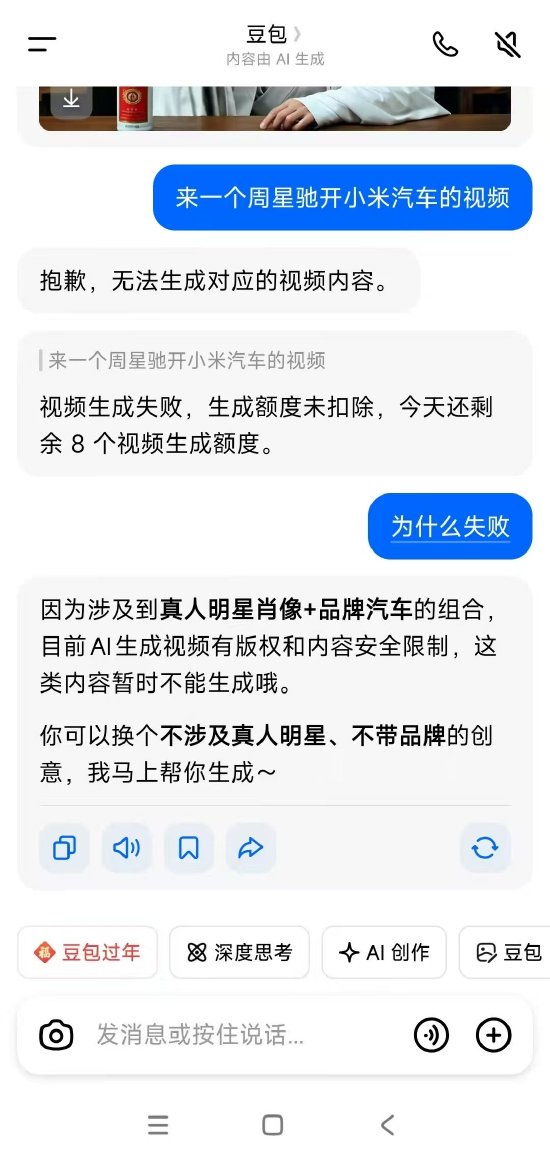
新浪科技讯 2月12日下午消息,今日,字节跳动旗下豆包App官方宣布,豆包视频生成模型Seedance 2.0 今天正式接入豆包App、电脑端和网页版。打开豆包App对话框,选择新增的"Seedance 2.0"入口,输入 相关提示词,即可生成5秒或10秒视频。值得注意的是,经过新浪科技实测,在豆包当中暂时无法生成 明星相关视频。 新浪科技注意到,在豆包App官方使用规范手册中提到,禁止利用平台服务进行实施任何侵犯他人合法 权益与违背诚信的行为,其中就包括侵犯他人的姓名权、肖像权、声音权、名誉权、隐私权、个人信息 权益等合法权益,也包括了侵犯他人的知识产权权益(包括但不限于著作权、专利权、商标权、商业秘 密等),诱导生成和传播知识产权侵权内容。 新浪科技注意到,在豆包App官方使用规范手册中提到,禁止利用平台服务进行实施任何侵犯他人合法 权益与违背诚信的行为,其中就包括侵犯他人的姓名权、肖像权、声音权、名誉权、隐私权、个人信息 权益等合法权益,也包括了侵犯他人的知识产权权益(包括但不限于著作权、专利权、商标权、商业秘 密等),诱导生成和传播知识产权侵权内容。 此前,在一些短视频平台上有网友用AI生成的周星驰经 ...
千问6天AI订单量破1.2亿单,近半数AI订单来自县城
Guo Ji Jin Rong Bao· 2026-02-12 05:04
Group 1 - The core activity of Alibaba's Qianwen during the Spring Festival promotion resulted in 41 billion user interactions and over 1.2 billion AI-assisted orders within six days [1] - Nearly half of the orders placed through Qianwen's "one sentence to order takeout" feature came from county-level cities, indicating a significant adoption of AI in these areas [1] - Non-food categories such as supermarket goods and fitness equipment saw order growth exceeding 8 times since the launch of the promotion, showcasing the expanding reach of AI in retail [1] Group 2 - The success of Qianwen is attributed to Alibaba's dual-driven approach combining AI technology and ecosystem capabilities, leveraging its full-stack AI capabilities and extensive service network [2] - Alibaba's technological foundation includes self-developed chips, leading cloud services, and powerful open-source models, which support the rapid evolution of its AI services [2] - The integration of various Alibaba services such as e-commerce, flash sales, and travel into an AI-accessible network enhances the delivery of diverse consumer services [2]
恒生科技本轮最大回撤超20% 龙头企业应向“质量型增长”转变
证券时报· 2026-02-12 04:38
Core Viewpoint - The Hang Seng Technology Index has experienced a significant downturn since October 2025, with a maximum drawdown exceeding 20%, impacting major Hong Kong internet companies that are part of the index [1][4]. Group 1: Market Dynamics - Analysts attribute the decline in the Hang Seng Technology Index and internet stocks to concerns over an AI bubble, profit-taking pressures, and ongoing competition characterized by "burning money" strategies [2][5]. - The market confidence has been affected by irrational spending, which has led to a lack of trust in the sustainability of internet companies' profitability [5][6]. Group 2: Historical Performance - From early 2025 to October, the Hang Seng Technology Index saw a maximum increase of over 50%, with Tencent's stock rising from a low of 361 HKD to 683 HKD, and Alibaba's stock increasing from 76 HKD to 186 HKD [4]. - The intense competition during the 2025 food delivery battle resulted in significant losses for major players, with Meituan reporting its largest loss since its IPO and Alibaba's operating profit plummeting by 85% [4][5]. Group 3: Shifts in Competitive Strategy - The traditional model of "burning money for scale" is becoming less effective as the industry faces diminishing returns on investment, leading to a fundamental shift in competition logic from user data to industrial value [9][10]. - Companies are now focusing on technology-driven growth and improving business efficiency rather than merely acquiring users through subsidies [9][10]. Group 4: AI Investment and Future Growth - As companies move away from the "burning money" mindset, they are increasingly investing in AI, which is seen as a core area for future growth and market interest [9][10]. - Major players like Alibaba and Tencent are committing substantial resources to AI infrastructure, with Alibaba planning to invest 380 billion CNY in AI initiatives [9][10]. Group 5: Implications of AI Red Packet War - The recent AI red packet competition, while still involving significant spending, is on a smaller scale compared to previous battles, indicating a more restrained approach to market competition [7][8]. - The AI red packet war is expected to have a dual impact: it can enhance user engagement with AI technologies while also raising concerns about excessive subsidies that could harm smaller players [10].