
生物科技

Search documents
规模最大的恒生医药ETF(159892)涨1.5%冲击三连阳,恒生科技指数ETF(513180)连续19日获资金净申购
Ge Long Hui· 2025-11-26 05:32
Group 1 - The core viewpoint is that the Hong Kong stock market has experienced a third consecutive day of gains, driven by rising expectations of interest rate cuts from the Federal Reserve and a surge in sales of flu medications, which has boosted the biotechnology sector [1] - The Hang Seng Pharmaceutical ETF rose by 1.5%, while Meituan saw a nearly 6% increase, and the Hang Seng Technology Index ETF increased by 1% [1] - The sales of flu medications have been significantly high, and the launch of the Hang Seng Biotechnology Index futures on November 28 is anticipated to further stimulate the sector [1] - The period from November to December is noted as a time of active BD transactions, with results from the 2025 innovative drug national negotiations and the first version of the commercial insurance innovative drug directory expected to be released in early December [1] - Major industry conferences such as ASH (American Society of Hematology) and SABCS (San Antonio Breast Cancer Symposium) are also scheduled for early December [1] - Alibaba's second fiscal quarter revenue exceeded expectations, with strong growth in its AI + cloud and consumer sectors, while it announced the end of the first phase of expansion for Taobao Flash Sale [1] - The innovative drug sector has seen sufficient adjustments in both time and space, with the Hang Seng Pharmaceutical ETF experiencing a cumulative decline of over 15% from September 4 to November 21, leading to a net inflow of 870 million yuan since October 10 [1] - The Hang Seng Technology Index ETF has seen net inflows for 19 consecutive trading days, totaling 5.4 billion yuan [1] Group 2 - The Hang Seng Technology Index ETF increased by 1.07%, with a latest scale of 47.771 billion, making it the largest in its category [2] - The ETF includes core Chinese technology assets such as SMIC (Semiconductor Manufacturing International Corporation), Alibaba, Tencent, Baidu, and smart hardware companies like Xiaomi and Lenovo [2]
A股,突变!直线拉升!
中国基金报· 2025-11-26 02:58
Core Viewpoint - The pharmaceutical sector is leading the market, while the consumer electronics sector is also performing actively, amidst a backdrop of fluctuating stock indices in China [1][3]. Sector Performance - The pharmaceutical sector is the top performer in the market, with notable activity in consumer electronics, semiconductors, and communication equipment sectors. Conversely, aerospace and military, banking, and chemical sectors are experiencing significant declines [3]. - Specific indices show that the SPD index increased by 2.94%, while the pharmaceutical index rose by 2.09%, indicating strong performance in these areas [4]. Stock Highlights - Anti-influenza stocks are seeing repeated activity, with companies like Yue Wannianqing hitting a 20% limit up, and Guangji Pharmaceutical achieving three consecutive trading limits. Other stocks such as Zhongheng Group and Kangzhi Pharmaceutical also reached their limits [5][9]. - The stock of Yue Wannianqing has a current price of 22.06, reflecting a 20.02% increase, with a total market capitalization of 3.517 billion [6][7]. Market Trends - As winter approaches, the flu season is becoming a focal point, with a significant increase in the purchase and attention towards antiviral medications. Data from Alibaba Health indicates that the number of buyers for flu-related medications surged over 500% in the last two weeks [9]. - The Hainan sector is also showing positive movement, with stocks like Hainan Ruize and Hainan Haiya achieving consecutive gains, supported by local government initiatives to enhance the economy and integrate into global supply chains [10][11].




恒生生物科技指数期货上市倒计时2天!
Mei Ri Jing Ji Xin Wen· 2025-11-26 01:03
Core Viewpoint - The launch of the Hang Seng Biotechnology Index futures on November 28 will provide essential risk management tools for the highly volatile biotechnology sector in Hong Kong, which is influenced by uncertainties in clinical trial results and regulatory approvals [1] Group 1: Market Dynamics - The biotechnology sector is characterized by its inherent volatility due to fundamental uncertainties such as clinical trial outcomes and regulatory approvals [1] - The introduction of the Hang Seng Biotechnology Index futures will facilitate better risk management for investors in this sector [1] Group 2: Valuation Challenges - Traditional valuation methods struggle to effectively assess the prospects of biotechnology companies, which are primarily driven by their research and development pipelines [1] - The futures market's price discovery function is expected to guide more reasonable value assessments for the biotechnology sector [1] Group 3: Global Market Expansion - In recent years, domestic biotechnology companies have actively expanded into global markets through intensive collaborations with large international pharmaceutical firms [1] - By 2025, approximately one-quarter of global drug licensing transactions will involve Chinese companies, indicating the growing recognition of Chinese innovative pharmaceutical firms within the global supply chain [1] - The continuous growth of the biotechnology ecosystem in the Hong Kong stock market is highlighted by these developments [1]
苏州致帅尊荣生物科技有限公司成立 注册资本10100万人民币
Sou Hu Cai Jing· 2025-11-26 00:49
Core Viewpoint - Suzhou Zhishuai Zunrong Biotechnology Co., Ltd. has been established with a registered capital of 101 million RMB, focusing on the production and sale of various medical devices and cosmetics [1] Company Overview - The legal representative of the company is Wang Zhiwei [1] - The registered capital is 101 million RMB [1] Business Scope - The company is involved in the production of Class II and Class III medical devices, as well as the operation of Class III medical devices [1] - It also produces personal protective equipment for medical staff (Class II medical devices) and cosmetics [1] - General business activities include technology services, development, consulting, and transfer, as well as medical research and experimental development [1] - The company engages in the sale of machinery and equipment, import and export agency, and various manufacturing activities [1] - It is authorized to conduct business in real estate leasing and labor protection products [1]
浙江亨通控股股份有限公司关于为全资孙公司提供担保的公告
Shang Hai Zheng Quan Bao· 2025-11-25 18:14
证券代码:600226 证券简称:亨通股份 公告编号:2025-054 浙江亨通控股股份有限公司 关于为全资孙公司提供担保的公告 本公司董事会及全体董事保证本公告内容不存在任何虚假记载、误导性陈述或者重大遗漏,并对其内容 的真实性、准确性和完整性承担法律责任。 重要内容提示: ● 担保对象及基本情况 (一)担保的基本情况 为支持浙江亨通控股股份有限公司(以下简称"公司")之全资孙公司亨通(内蒙古)生物科技有限公司 (以下简称"亨通生物")运营发展,近日,公司与中信银行股份有限公司苏州分行(以下简称"中信苏 州分行")签署了《保函授信额度协议》,为亨通生物向中信苏州分行申请开具保函,保函授信额度不 超过人民币5,000万元。担保期限为承担保函责任的期限,根据各具体保函分别确定。保证方式为连带 责任保证。上述担保不存在反担保。 被担保人:亨通(内蒙古)生物科技有限公司 担保方式:连带责任保证 担保金额:不超过人民币5,000万元 (二)内部决策程序 公司于2025年11月24日召开第九届董事会第二十五次会议,审议通过了《关于为全资孙公司提供担保的 议案》。根据《上海证券交易所股票上市规则》和《上海证券交易所上市公 ...

信铭生命科技发盈喜 预期中期取得利润约3.8亿港元 同比扭亏为盈
Zhi Tong Cai Jing· 2025-11-25 14:53
Core Insights - The company expects to achieve a profit of approximately HKD 380 million for the six-month period ending September 30, 2025, compared to a loss of approximately HKD 195 million in the same period of 2024 [1] Group 1 - The increase in profit is primarily due to gains from the sale of a subsidiary during the reporting period [1]
港股科技ETF(513020)收涨超0.5%,科技领域的发展前景受到关注
Sou Hu Cai Jing· 2025-11-25 10:32
Core Viewpoint - The Hong Kong stock technology ETF (513020) has seen a rise of over 0.5% as of November 25, indicating a positive trend in the market despite macroeconomic uncertainties [1] Group 1: Market Trends - The report from China Merchants Hong Kong highlights that marginal benefits for Hong Kong stocks are accumulating, with the technology and non-ferrous metal sectors showing active performance [1] - The potential for a "preventive rate cut" by the Federal Reserve may provide liquidity support to the market [1] Group 2: Technology Sector Insights - The Hong Kong stock technology ETF (513020) tracks the Hong Kong Stock Connect Technology Index (931573), which focuses on technology-themed listed companies traded through the Stock Connect channel [1] - The index covers high-growth areas such as internet services, electronic manufacturing, communication equipment, and biotechnology, selecting 30 representative companies with technological leadership and continuous innovation capabilities [1] - Key evaluation metrics for the index include research and development investment intensity and revenue growth indicators, showcasing a diversified industrial layout characterized by "software and hardware synergy, new consumption scenarios, innovative drug development, and smart vehicle technology" [1]
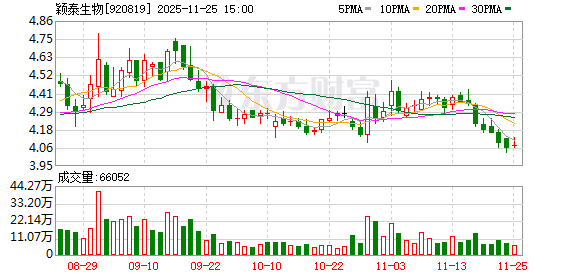
颖泰生物大宗交易成交37.80万股 成交额107.73万元
Zheng Quan Shi Bao Wang· 2025-11-25 09:59
Summary of Key Points Core Viewpoint - A significant block trade of YingTai Bio (920819) occurred on November 25, with a transaction volume of 378,000 shares and a transaction value of 1.0773 million yuan, reflecting a discount of 30.15% compared to the closing price of the day [2][3] Group 1: Block Trade Details - The block trade price was 2.85 yuan per share, which is substantially lower than the market closing price [2] - The buyer was CITIC Securities (Shandong) Co., Ltd., while the seller was Donghai Securities Co., Ltd. [2] - In the past month, YingTai Bio has recorded a total of 20 block trades, amounting to 17.4988 million yuan [3] Group 2: Stock Performance - The closing price of YingTai Bio on the day of the block trade was 4.08 yuan, with a daily increase of 0.49% [3] - The stock has experienced a cumulative decline of 3.09% over the past five days [3] - The daily turnover rate was 0.52%, with a total transaction amount of 25.4894 million yuan on that day [3] Group 3: Company Background - Beijing YingTai Jiahe Biotechnology Co., Ltd. was established on July 1, 2005, with a registered capital of 1.2258 billion yuan [3]

东莞市清衡生物科技有限公司成立 注册资本50万人民币
Sou Hu Cai Jing· 2025-11-25 09:51
Core Points - Dongguan Qingheng Biotechnology Co., Ltd. has recently been established with a registered capital of 500,000 RMB [1] - The company’s business scope includes technology services, development, consulting, and transfer, as well as manufacturing and sales of food, beverages, and pet products [1] Business Scope - The company is involved in various technology-related services such as technical service, development, consulting, exchange, transfer, and promotion [1] - It manufactures specialized equipment for food, beverages, and tea production [1] - The company engages in the sale of pre-packaged food and agricultural products, as well as pet food and supplies [1] - Additional activities include packaging services, import and export of goods, and sales of daily necessities and health food [1]
港股期指迎新成员!恒生生物科技指数期货上市倒计时3天
Mei Ri Jing Ji Xin Wen· 2025-11-25 07:01
Core Viewpoint - The launch of the Hang Seng Biotechnology Index futures on November 28 is expected to provide investors with new risk hedging tools and enhance liquidity in the biotechnology sector [1] Group 1: Index and Market Overview - The Hang Seng Biotechnology Index was launched by Hang Seng Indexes Company in 2019 to reflect the overall performance of the biotechnology sector in the Hong Kong stock market [1] - The index currently includes notable companies such as Innovent Biologics, BeiGene, WuXi Biologics, CanSino Biologics, and 3SBio, covering sub-sectors like CXO and innovative drugs [1] Group 2: Market Trends and Expectations - The introduction of the index futures is anticipated to attract foreign capital back to the biotechnology sector amid a global liquidity easing cycle initiated by the Federal Reserve's interest rate cuts [1] - The continuous inflow of southbound funds is expected to create a resonance effect, further boosting the biotechnology sector in the Hong Kong market [1]