航空航天

Search documents
集智股份:产品已在航空航天发动机核心零部件检测中广泛应用
2 1 Shi Ji Jing Ji Bao Dao· 2026-01-13 09:52
Core Insights - The company has made significant advancements in technology and market penetration, leading to the application of its products in critical aerospace engine components [1] Group 1: Product Applications - The company's products are now utilized in various aerospace engine core components, including turbine pumps, high and low-pressure compressors, high and low-pressure turbines, high-pressure shafts, core rotor assemblies, and turbine shafts [1] - This expansion indicates a broader market presence in the high-end equipment sector [1]

鉴往知来的产业脉络与机遇航图:“十五五”规划:循迹探新
Dongguan Securities· 2026-01-13 09:46
Group 1 - The "15th Five-Year Plan" emphasizes a transition from scale expansion to connotative development, focusing on high-quality growth and systemic integration [12][25] - The plan aims to establish a modern industrial system, highlighting the importance of the real economy and technological self-reliance [12][30] - Key areas of focus include technological innovation, expanding domestic demand, and building a robust security framework for industries and supply chains [12][30] Group 2 - The "15th Five-Year Plan" is positioned as a critical period for consolidating the foundation for achieving socialist modernization by 2035 [25][26] - Compared to the "14th Five-Year Plan," the "15th Five-Year Plan" places greater emphasis on quality and resilience in development, reflecting a cautious approach to international environments [25][28] - The plan outlines specific goals for economic growth, including a significant increase in the resident consumption rate and enhancing the role of domestic demand in driving economic growth [30][33] Group 3 - The capital market is expected to benefit from the policy catalysis effect of the "15th Five-Year Plan," with historical data indicating that planning periods often coincide with market uptrends [12][29] - Investment themes are centered around technological self-reliance, modernization of the industrial system, and sectors that boost domestic demand [12][30] - The manufacturing sector is anticipated to receive support from policy, funding, and fundamental improvements, particularly in advanced manufacturing [30][31]
晨曦航空(300581.SZ):汇聚科技累计减持1.0527%股份
Ge Long Hui A P P· 2026-01-13 09:21
Core Viewpoint - The company Chenxi Aviation (300581.SZ) has received a notification from Huiju Technology regarding the progress of its share reduction plan, indicating a significant decrease in shareholding by Huiju Technology and its concerted parties [1] Group 1: Share Reduction Details - From January 7, 2026, to January 12, 2026, Huiju Technology reduced its holdings by a total of 1.3058 million shares through centralized bidding and 4.485 million shares through block trading [1] - The total shares reduced represent 1.0527% of the company's total share capital [1] - The combined shareholding of Huiju Technology and its concerted party, Huanyu Xingkong, decreased from 48.93% to 47.88% of the company's total share capital, triggering a change in equity that touches the integer multiple of 1% [1]

国泰海通证券:中国航天发射创新高 军工市场迎发展新机遇
Xin Lang Cai Jing· 2026-01-13 08:58
Core Viewpoint - The military industry is poised for long-term growth due to recent global developments, including China's record space launches and the U.S. plans to significantly increase military spending, alongside the intensifying geopolitical competition among major powers [1][7]. Group 1: China's Aerospace Achievements - In 2025, China achieved a record of 92 space launches, sending over 300 satellites into orbit, marking a qualitative leap in both launch frequency and satellite deployment [2][8]. - Significant milestones include the Shenzhou 20 mission with a crew duration record of 204 days, the Shenzhou 21's rapid docking record of 3.5 hours, and the successful execution of a 16-day emergency launch protocol [2][8]. - Looking ahead to 2026, China plans to initiate various tests for its manned lunar landing project and the Chang'e 7 mission to search for water ice on the Moon [2][8]. Group 2: Global Military Dynamics - The U.S. military budget is proposed to increase from $1 trillion to $1.5 trillion for the fiscal year 2027, aimed at creating a "dream army" to address current global threats [3][9]. - The Pentagon plans to significantly boost the production of the "Patriot" missile system, increasing the annual output of the PAC-3 MSE missiles from approximately 600 to 2000 units [3][9]. - The U.S. Air Force has selected Northrop Grumman's new autonomous drone, "Reaper," as a leading candidate for collaborative combat aircraft projects [3][9]. Group 3: Military Sector Performance - The military sector showed strong performance in the week of January 5-9, 2026, with the defense and military index rising by 14.56%, outperforming the broader market by 10.74 percentage points [5][11]. - Notable stock performances include Galaxy Electronics (up 60.96%), Nanjing Panda (up 49.10%), and Zhenlei Technology (up 48.18%) [5][11]. - A significant breakthrough in domestic military technology was achieved with the successful first flight of the LQ-150 drone, which features a low-cost, multi-purpose flight control system [5][11]. Group 4: Investment Recommendations - The military sector is expected to accelerate its development during the 14th Five-Year Plan, with a focus on enhancing capabilities in aerospace and satellite internet [6][12]. - Key investment areas include assembly sectors like AVIC Shenyang Aircraft, component sectors like AVIC Optoelectronics, subsystem sectors like Aero Engine Corporation of China, and materials processing sectors like AVIC High-Tech [6][12].

2026开年最强赛道,引爆下一场星辰大海?
Ge Long Hui· 2026-01-13 08:45
近期,全球对稀缺太空战略资源争夺白热化。 中国向国际电信联盟(ITU)一次性提交了涉及约20.3万颗卫星的频谱与轨道资源申请,覆盖14个星座,创下国内单次申报纪录。 美国联邦通信委员会(FCC)也批准了SpaceX新增部署7500颗第二代星链卫星。 马斯克提出了航天业有史以来最雄心勃勃的制造目标之一:每年生产1万艘星舰飞船。 广州推动商业航天人才、资本和企业集聚广州,构建完整商业航天产业生态。 过去一个多月,航空航天板块一直是市场焦点,表现甚至超过AI等科技板块。 其中,航空航天ETF(159227)自2025年11月24日-2026年1月12日的34个交易日上涨53.33%,净值屡创新高。 航空航天的爆发,源于一场深刻且持久的产业变革,是一场由大国战略、市场爆发与技术革命共同催生的黄金机会。 基于这些逻辑,航空航天ETF(159227)入选了2026年格隆汇"全球视野 下注中国"十大核心ETF。 | of the Come In below in | 6. 1- 10 | 上星制道与应用、机大测径系统 | | --- | --- | --- | | 600118 SH | | | | 新京 FF | 6.4 ...

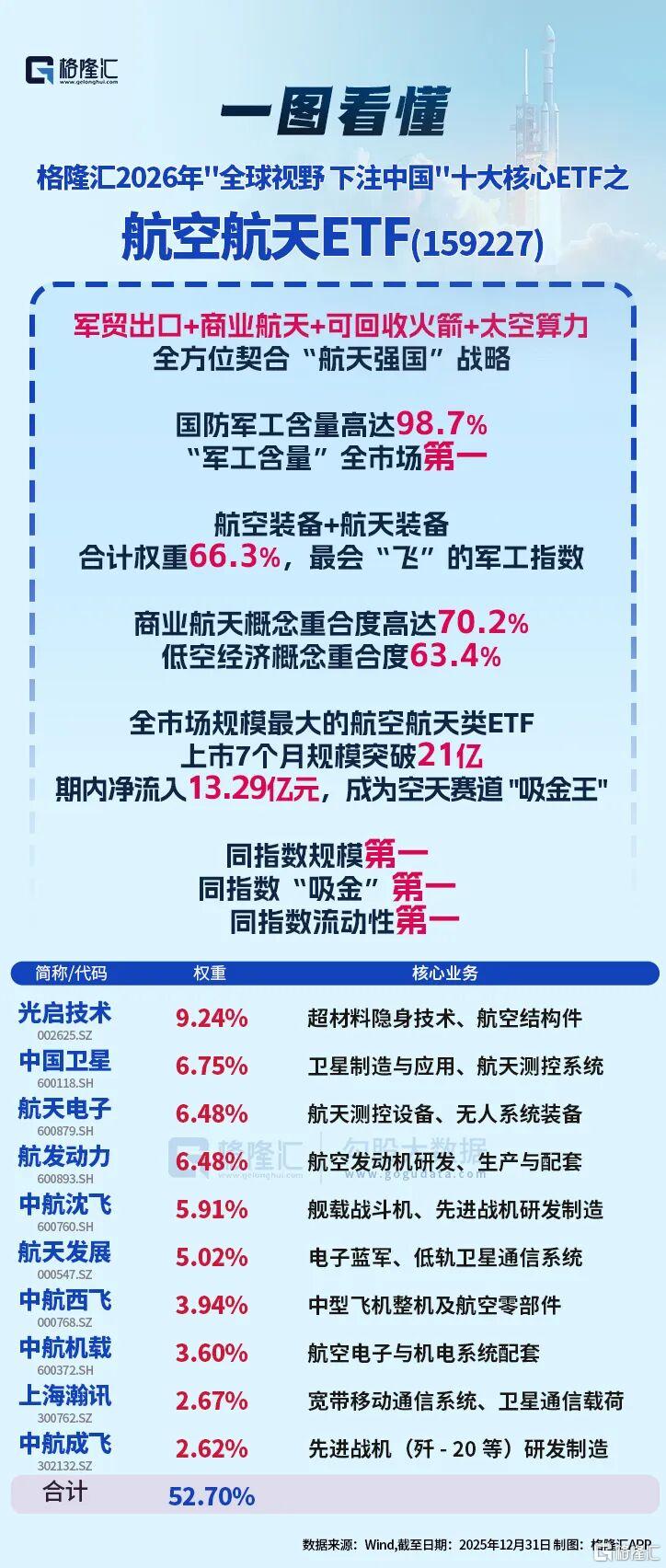
2026开年最强赛道,引爆下一场星辰大海?
格隆汇APP· 2026-01-13 08:25
Core Viewpoint - The global competition for scarce space strategic resources has intensified, with significant developments in satellite deployment and commercial space initiatives, particularly from China and the U.S. [2][3][4] Group 1: Industry Developments - China submitted a record application to the International Telecommunication Union (ITU) for approximately 203,000 satellites, covering 14 constellations [3] - The U.S. Federal Communications Commission (FCC) approved SpaceX's plan to deploy an additional 7,500 second-generation Starlink satellites [4] - Elon Musk proposed an ambitious target for the aerospace industry, aiming to produce 10,000 Starship spacecraft annually [5] Group 2: Market Performance - The aerospace sector has been a market focus, outperforming even AI and other tech sectors in recent months [7] - The Aerospace ETF (159227) saw a 53.33% increase over 34 trading days, reaching new net asset value highs [8] Group 3: Strategic Importance - Aerospace has been designated as a key emerging pillar industry by the Chinese government, with initiatives to promote commercial space and low-altitude economies [13] - The establishment of the Commercial Space Administration by the National Space Administration in November 2025 has improved administrative efficiency for launch approvals and licensing [14] Group 4: Technological Advancements - The emergence of reusable rocket technology is a significant breakthrough, drastically reducing space launch costs and facilitating the commercialization of the space economy [15] - The rapid development of technology and market dynamics has heightened competition and underscored the urgency for advancements [17] Group 5: Investment Trends - The commercial space industry in China is projected to reach a scale of 2.5 to 2.8 trillion yuan, with an annual growth rate exceeding 20% [22] - Funding for the aerospace sector is increasing, with total industry financing expected to reach 18.6 billion yuan in 2025, a 32% year-on-year increase [25] - The Aerospace ETF (159227) has become a leading investment vehicle, with significant inflows and a growing market presence [31] Group 6: Future Outlook - The aerospace sector is positioned at the intersection of national security, technological self-reliance, and new economic growth points [45] - 2026 is anticipated to be a critical year for validating China's aerospace technologies, with advancements in rocket recovery and satellite production lines [46][47] - The Aerospace ETF (159227) is well-positioned to capture investment opportunities arising from the commercial space and low-altitude economy sectors [48]




“免费场地+真金白银”广聚英才
Xin Lang Cai Jing· 2026-01-13 07:26
Core Viewpoint - The event in Putuo District aims to create a high-quality incubation environment by facilitating the efficient flow and deep integration of innovation elements such as talent, technology, and capital among cities along the Shanghai-Nanjing corridor [1] Group 1: Policy Initiatives - The "Implementation Opinions" released during the event include a series of financial incentives for innovation and entrepreneurship, such as providing up to 200 square meters of free office space for companies participating in major innovation competitions and offering matching grants up to 1:1 [2] - Start-up technology companies can receive up to 300,000 yuan per year in support for collaborative research, application scenario demonstrations, and other areas, with additional funding of up to 200,000 yuan for those attracting over 10 million yuan in equity investment within a year [2] Group 2: Support for Specific Industries - The gaming industry will receive targeted support, including up to 1 million yuan for qualifying start-ups, 100,000 yuan for each game license, and 20,000 yuan for industry qualification recognition, with funding for industry activities capped at 30,000 yuan [3] - High-level talent will be offered up to 500,000 yuan in housing subsidies, with monthly rental or mortgage interest subsidies ranging from 3,000 to 5,000 yuan for PhD and senior title holders, along with comprehensive services for settling in and education [3] Group 3: Insights and Experiences - Experts shared insights on the strategic value and breakthrough paths for high-quality incubators, practical measures for enhancing service capabilities, and personal experiences of growth within the incubation ecosystem, highlighting a collaborative development environment between government and enterprises [4] Group 4: Infrastructure Development - The inauguration of the Bochuang Building and related service centers marks a significant step in establishing a physical platform for innovation, specifically designed to support technology companies from the "Eight Cities and One District," with initial tenants in cutting-edge fields such as smart connected vehicles and new materials [5]
加快建设现代化产业体系——访工业和信息化部党组书记、部长李乐成
Ren Min Ri Bao· 2026-01-13 07:02
Core Viewpoint - The Chinese government emphasizes the integration of technological and industrial innovation to build a modern industrial system with international competitiveness, as highlighted by General Secretary Xi Jinping and the Central Economic Work Conference [1]. Group 1: Industrial Economic Development - The industrial economy in China is expected to maintain stability and growth, with a focus on four key areas: stability, expansion, innovation, and enhancement [2]. - Stability involves ensuring growth in key industries and regions, which account for 80% of the industrial total, through targeted support and policy measures [2]. - Expansion focuses on increasing effective demand by promoting flexible manufacturing and accelerating the application of new technologies [2]. - Innovation aims to enhance value creation through the revitalization of traditional industries and the development of emerging industries [3]. - Enhancement seeks to boost the vitality of business entities, particularly small and medium-sized enterprises, by improving cash flow and reducing burdens [3]. Group 2: Manufacturing Development Strategies - The Ministry of Industry and Information Technology plans to promote intelligent, green, and integrated development in manufacturing during the 14th Five-Year Plan period [4]. - Traditional industries will undergo revitalization through the implementation of targeted improvement plans and the adoption of digital and green technologies [4]. - Emerging industries will be accelerated through the establishment of demonstration bases and large-scale applications of new technologies [5]. - Future industries will be strategically developed, focusing on areas such as quantum technology and 6G, to achieve breakthroughs [5]. Group 3: Enhancing Technological Innovation - The government aims to increase high-quality technological supply and enhance the integration of technology and industry [7]. - Policies will be implemented to strengthen the role of enterprises in technological innovation, including tax incentives and support for specialized small and medium-sized enterprises [7]. - Efforts will be made to streamline the conversion of technological achievements into practical applications, including the establishment of a national service network for manufacturing [8]. Group 4: Digital Transformation in Manufacturing - The Ministry will focus on the large-scale application of industrial internet and the integration of artificial intelligence in manufacturing [9]. - A strong emphasis will be placed on building a solid digital foundation by improving data collection and utilization in key manufacturing sectors [9]. - The government will enhance network connectivity and promote the development of digital solutions tailored to specific industries and scenarios [10]. - Initiatives will be launched to implement artificial intelligence in manufacturing, fostering the development of intelligent enterprises and applications [10].
纵横股份战略投资空天智能产业基金
Zheng Quan Shi Bao Wang· 2026-01-13 06:45
Group 1 - The core viewpoint of the article is that Zongheng Co., Ltd. has recently invested in an industrial fund focusing on cutting-edge sectors such as low-altitude economy, artificial intelligence, commercial aerospace, and satellite internet applications [1] Group 2 - The investment was made in the Qiongcheng Kaisheng Aerospace Intelligent Venture Capital Partnership [1] - The industrial fund aims to capitalize on emerging trends and technologies within its targeted sectors [1]

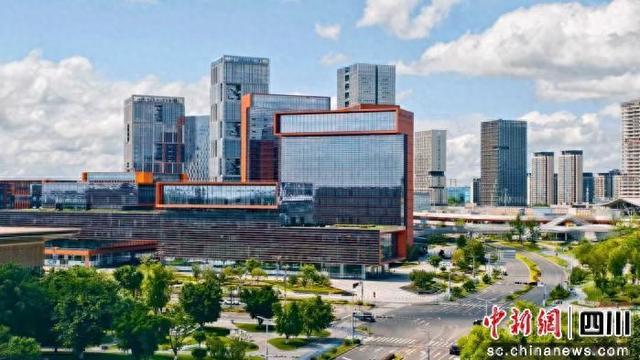
“十五五”怎么干?成都东部新区高瞻远瞩
Zhong Guo Xin Wen Wang· 2026-01-13 06:26
Core Insights - The Chengdu Eastern New Area is focusing on its "14th Five-Year Plan" achievements and is preparing for the "15th Five-Year Plan" to enhance its economic development and urban planning [1][3][4] Group 1: Economic Development - The Chengdu Eastern New Area has introduced 86 key projects with a total investment of approximately 165 billion yuan, achieving a significant transformation from an agriculture-based economy to a more diversified economic model [3][4] - The region's GDP has crossed two hundred billion yuan milestones over the past five years, with a continuous double-digit growth in industrial added value [4][9] - By 2030, the area aims to reach a GDP of 50 billion yuan, with industrial added value accounting for 20% of GDP and retail sales of consumer goods reaching 3.64 billion yuan [9][10] Group 2: Infrastructure and Urban Development - The urban built-up area has expanded by 100%, with municipal road mileage increasing by 2.19 times and total power capacity doubling [6] - The area has successfully introduced six quality educational brands, adding 26,000 new school places [6][12] - The Chengdu Eastern New Area is committed to enhancing public services and improving the quality of life for residents through various initiatives [12] Group 3: Strategic Planning and Future Goals - The "15th Five-Year Plan" is seen as a critical period for strengthening the core functions and creating new development advantages for the Chengdu Eastern New Area [7][10] - The area plans to focus on specialized industrial development, enhance its international aviation hub capabilities, and improve the integration of technology and industry [9][10] - A total of 71 livelihood projects will be implemented in 2026, with an investment of 1.104 billion yuan aimed at improving public services and social security [12]