电池

Search documents
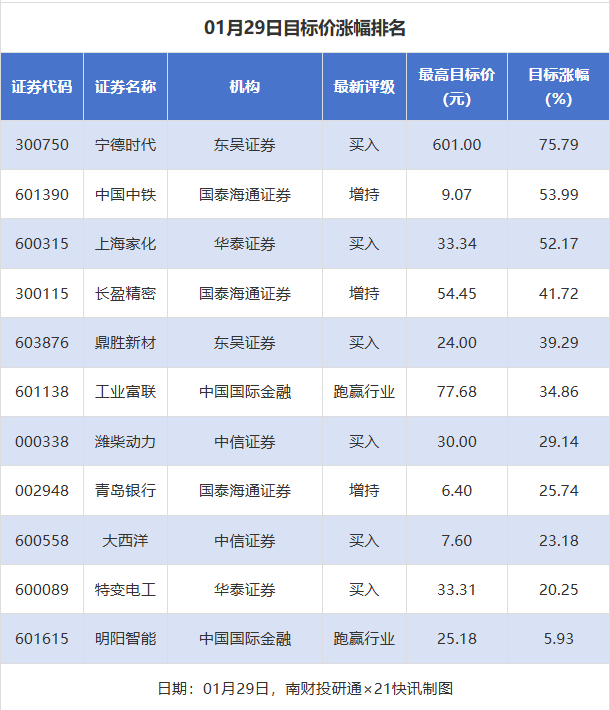
10股目标价涨幅超20%,宁德时代达75%
2 1 Shi Ji Jing Ji Bao Dao· 2026-01-30 02:20
Core Viewpoint - The brokerage firms have set target prices for listed companies, with 10 stocks showing a target price increase of over 20% based on the latest closing prices [1] Group 1: Target Price Increases - A total of 11 target price adjustments were made by brokerages for listed companies [1] - The companies with the highest target price increases include CATL (Ningde Times) at 75.79%, China Railway at 53.99%, and Shanghai Jahwa at 52.17% [1] - These companies belong to the battery, infrastructure, and cosmetics industries respectively [1]



27股获推荐 宁德时代目标价涨幅达75%丨券商评级观察
2 1 Shi Ji Jing Ji Bao Dao· 2026-01-30 01:26
Group 1 - The core viewpoint of the article highlights the target price increases for several listed companies, with notable gains for Ningde Times, China Railway, and Shanghai Jahwa, reflecting strong market confidence in these sectors [1][2]. Group 2 - On January 29, the companies with the highest target price increases were Ningde Times (75.79%), China Railway (53.99%), and Shanghai Jahwa (52.17%), indicating significant bullish sentiment in the battery, infrastructure, and cosmetics industries respectively [1][2]. - A total of 27 listed companies received broker recommendations on January 29, with Qingdao Bank receiving the most recommendations at 5, followed by Mingyang Smart Energy and Ruoyuchen with 2 each [1][3]. - Three companies had their ratings upgraded on January 29, including TBEA, which was upgraded from "Hold" to "Buy" by Huatai Securities, reflecting improved outlooks for these firms [4][6]. - Five companies received initial coverage on January 29, with Qingdao Bank rated "Recommended" by Guolian Minsheng Securities, indicating new interest from analysts in these stocks [6][7].


汰劣立规“反内卷” 中国电池产业转向价值竞争
Zhong Guo Chan Ye Jing Ji Xin Xi Wang· 2026-01-30 00:20
Core Insights - The battery industry is entering a phase of "de-involution" as government policies aim to optimize capacity planning and regulate market competition, signaling an end to the era of disorderly growth in battery production [1][2]. Group 1: Policy Changes - A joint meeting by four government departments emphasized the need to optimize capacity planning and avoid overcapacity risks in the battery sector [1]. - The Ministry of Finance and the State Taxation Administration announced a phased reduction of the export VAT rebate for battery products, decreasing from 9% to 6% from April 1, 2026, and completely eliminating it by January 1, 2027 [1][2]. - The phased approach to the export VAT rebate aims to provide a transition period for the industry, allowing for the orderly exit of low-quality production capacities [3][4]. Group 2: Industry Challenges - The reduction in export rebates is expected to increase export costs for companies, particularly affecting small and medium-sized enterprises that rely on low-price strategies [2][6]. - Current production capacity in China's battery sector exceeds 3000 GWh, while actual demand is projected to be around 1500 GWh by 2025, leading to low utilization rates [2][3]. - The price of storage systems has dropped by 80% over three years, with some battery export prices falling below production costs, resulting in negative profit margins for certain companies [2]. Group 3: Market Dynamics - Despite challenges, the demand for electric and storage batteries remains strong, with expectations for the share of storage batteries to increase from one-quarter to potentially one-half of the market [3][4]. - The new policies are expected to accelerate industry consolidation, pushing companies to focus on technological innovation and brand strength rather than price competition [2][3]. - The upcoming changes may lead to a surge in exports as companies rush to ship products before the rebate reduction takes effect, potentially causing supply chain strains [5][6]. Group 4: Globalization and Competitive Landscape - The shift away from subsidy dependence is anticipated to enhance the competitive edge of Chinese battery companies in the global market, focusing on technology, branding, and supply chain integration [9][10]. - Companies are expected to adapt by strengthening international collaborations and optimizing production strategies to mitigate the impact of rising costs due to the rebate changes [10][11]. - The long-term outlook suggests that the balance of supply and demand will increasingly depend on global market needs and technological advancements rather than just domestic production capacity [4][10].
蔚蓝锂芯:公司在钠电池上有相关技术储备
Zheng Quan Ri Bao· 2026-01-29 13:51
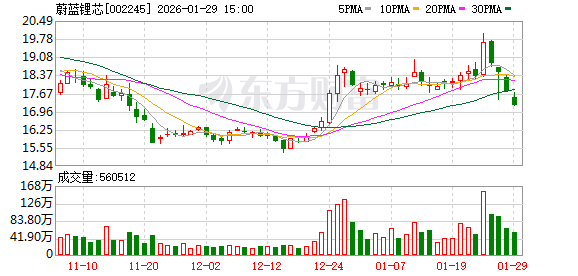
Core Viewpoint - Company indicates that sodium batteries and lithium batteries have differences in performance and cost, leading to different application scenarios, and the company has relevant technological reserves in sodium batteries [2] Group 1 - Sodium batteries and lithium batteries differ in various aspects such as performance and cost [2] - The company has technological reserves related to sodium batteries [2] - Different application scenarios exist for sodium and lithium batteries [2]

豪鹏科技:公司始终将技术创新与前瞻布局视为公司发展的核心驱动力
Zheng Quan Ri Bao Wang· 2026-01-29 12:47
Core Viewpoint - The company emphasizes that technological innovation and forward-looking layout are the core driving forces for its development, focusing on both consumer batteries and energy storage systems while exploring next-generation battery technologies [1] Group 1: Strategic Focus - The company is committed to consolidating its main business in consumer batteries and energy storage systems while actively monitoring and investing in next-generation battery technologies [1] - The company has invested in Beijing Sirui Zhe New Energy Technology Co., Ltd. to deepen its exploration and industrialization of sodium-ion battery technology [1] Group 2: Collaborative Innovation - Sirui Zhe serves as an important platform within the company's ecosystem, focusing on the research and industrial application of sodium-ion battery technology, closely aligning with the company's overall technological roadmap [1] - The company adheres to a dual-guided approach based on market demand and technological maturity, promoting a cautious and pragmatic principle through open innovation and internal-external collaboration [1] Group 3: Future Development - The company aims to establish a solid technological foundation for the extension of its future product matrix and the expansion of energy solutions, including the research and evaluation of diverse technological routes such as sodium batteries [1]

骆驼股份:公司高度重视市值管理工作
Zheng Quan Ri Bao Wang· 2026-01-29 12:47
Core Viewpoint - The company emphasizes the importance of market value management and has established a systematic mechanism to enhance shareholder returns over the next three years (2025-2027) [1] Group 1: Shareholder Return Plans - The company has released a "Shareholder Return Plan" for the next three years, focusing on stable operations, continuous dividends, equity incentives, and share buybacks to solidify long-term value [1] - An action plan titled "Quality Improvement, Efficiency Enhancement, and Return" for 2025 has also been introduced to support these goals [1] Group 2: Operational Strategies - The company is implementing a multi-channel price linkage mechanism to address fluctuations in raw material costs [1] - There is a continuous effort to expand new power source businesses to strengthen competitive advantages [1]

厦钨新能:业绩快速增长,固态电池材料布局持续推进-20260129
Guoxin Securities· 2026-01-29 10:45
Investment Rating - The investment rating for the company is "Outperform the Market" [7] Core Views - The company is expected to achieve a net profit of 755 million yuan in 2025, representing a year-on-year increase of 42%. Revenue is projected to reach 20.03 billion yuan, up 48% year-on-year [2] - The company maintains a leading position in lithium cobalt oxide, with sales expected to reach 65,300 tons in 2025, a 41% increase year-on-year, and a market share of 51%, up 7 percentage points [3] - The company is accelerating the industrialization of solid-state battery materials and new structural materials, with significant investments planned for high-performance battery materials and hydrogen energy materials [4] Financial Projections - The company is projected to have revenues of 20.03 billion yuan in 2025, with a net profit of 755 million yuan, and an EPS of 1.50 yuan [5][6] - The expected EBIT margin for 2025 is 5.4%, with a net asset return (ROE) of 7.8% [6] - The company’s dynamic PE ratio is forecasted to be 60.8 for 2025, decreasing to 37.8 by 2027 [5][6]

传艺科技(002866.SZ):预计2025年净利润7800万元–1.03亿元 同比扭亏为盈
Ge Long Hui A P P· 2026-01-29 10:40
Core Viewpoint - The company expects a net profit attributable to shareholders of 78 million to 103 million yuan for 2025, indicating a turnaround from losses, with a net profit excluding non-recurring gains and losses projected at 50 million to 75 million yuan, also showing a recovery from losses [1] Financial Performance - The expected net profit for 2025 represents a significant improvement compared to previous periods, indicating a positive trend in financial performance [1] - The company has experienced steady growth in its main business within the consumer electronics sector, contributing to enhanced operational efficiency [1] Asset Management - There has been a notable decrease in impairment losses related to sodium-ion battery business assets compared to the same period last year, which has positively impacted the overall financial outlook [1]

力华电源:笃行深耕46系大圆柱标准化,4GWh产线已投产
起点锂电· 2026-01-29 10:35
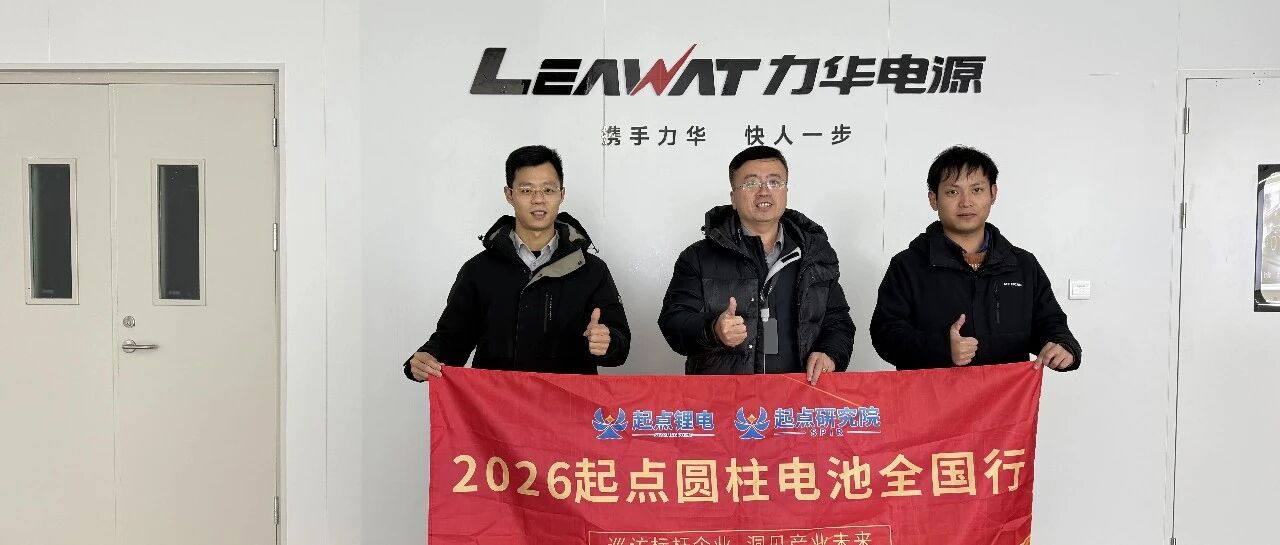
Core Viewpoint - The article emphasizes the strategic importance of cylindrical batteries, particularly the 46 series, in the evolving landscape of the new energy battery industry, highlighting their competitive advantages and the need for standardization in product dimensions [2][3]. Group 1: Market Dynamics and Product Features - The cylindrical battery market is diversifying, with various sizes emerging, but the 46 series is identified as the optimal choice for market leadership due to its proven performance [3][4]. - The 46 series batteries, particularly the 46120 model, achieve energy densities of up to 330Wh/kg, with a stable range of 310-320Wh/kg, and feature innovative designs that enhance performance [8]. - The production capacity for the 46 series is currently operating at 70%-80% of its designed capacity, with a yield rate of 92%-93%, supporting the strategic focus on this product line [8]. Group 2: Standardization and Competitive Advantage - Standardization in cylindrical batteries is seen as essential for reducing manufacturing costs and improving efficiency across the supply chain, with the 46mm diameter providing a versatile solution for various applications [10]. - The company aims to lead the 46 series market by expanding production capacity to over 12GWh by 2026 and adopting a dual strategy for domestic and international markets [14]. - The focus on standardization and technological innovation positions the company to build a unique competitive advantage in the new energy battery sector, aiming to become a global leader in battery solutions [15].
大圆柱成新“抓手”?多家锂电企业扭亏为盈
高工锂电· 2026-01-29 10:34
Core Viewpoint - The article highlights the positive performance forecasts for companies involved in the production of large cylindrical batteries, driven by the growing demand in the electric vehicle and energy storage markets [3]. Group 1: Company Performance - Multiple companies, including DLF, Boliv, and Penghui Energy, have reported turning losses into profits, particularly in the large cylindrical battery segment [3]. - DLF noted a significant increase in sales of lithium hexafluorophosphate and new energy batteries, with 95% of its battery shipments in 2025 being large cylindrical products [3]. - Boliv's performance improvement is attributed to the growth in electric motorcycle and two-wheeler battery swap businesses, alongside a recovery in the European electric bicycle market [3]. - Penghui Energy expects a net profit of 80 million to 110 million yuan, with its large cylindrical batteries achieving full production and sales [3]. Group 2: Market Dynamics - The large cylindrical battery has become a core product for these companies, with applications expanding beyond traditional passenger vehicles to include light-duty power and energy storage markets [4]. - DLF's large cylindrical battery business has become a significant growth driver, contributing 25.3% to total revenue with a growth rate of 75.4% [4]. - The global home energy storage system shipment is projected to reach approximately 35 GWh in 2025, marking a nearly 50% year-on-year increase, indicating a strong recovery in the home storage market [5]. Group 3: Application and Technology - In the home storage market, large cylindrical batteries are replacing small cylindrical ones, enhancing efficiency and capacity [5]. - The electric motorcycle sector is increasingly adopting large cylindrical batteries due to their high voltage, capacity, and performance, which align with the demand for enhanced safety and cost-effectiveness [6]. - Companies like Lihua Power and Bick Battery are actively developing large cylindrical batteries for various applications, including new energy vehicles and small energy storage [6]. Group 4: Strategic Advantages - The large cylindrical battery serves multiple applications, allowing battery manufacturers to streamline production lines and offer diverse options to customers [7].