风电

Search documents
龙虎榜 | 超7亿资金出逃金风科技,消闲派、城管希爆买雪人集团!
Ge Long Hui A P P· 2026-01-07 10:01
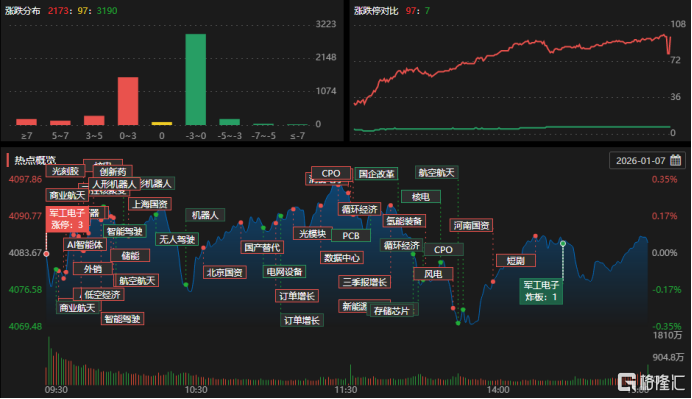
Market Overview - On January 7, the trading volume of the Shanghai and Shenzhen stock markets reached 2.85 trillion yuan, an increase of 476 billion yuan compared to the previous trading day [1] - Sectors such as storage chips, commercial aerospace, semiconductor equipment, and photoresist concepts saw significant gains, while brain-computer interfaces, titanium dioxide, and digital currency sectors experienced declines [1] Top Gainers - Shengtong Energy (001331) rose by 9.99% to 56.03 yuan, driven by a change in control and developments in robotics [2] - Fenglong Co. (002931) increased by 10.01% to 42.20 yuan, with news of a potential acquisition by UBTECH [2] - ST Dongyi (002713) gained 5.05% to 10.40 yuan, supported by restructuring expectations [2] - Lushin Investment (600783) surged by 10.00% to 26.94 yuan, linked to Blue Arrow Aerospace's IPO and AI fund developments [2] - Reco Defense (002413) rose by 10.01% to 16.71 yuan, benefiting from trends in storage chips and commercial aerospace [2] Notable Stocks - The top three net purchases on the Dragon and Tiger list were Tongyu Communication, Nanda Optoelectronics, and China First Heavy Industries, with net purchases of 404 million yuan, 342 million yuan, and 192 million yuan respectively [5] - The top three net sales were Goldwind Technology, Reco Defense, and Zhongchao Holdings, with net sales of 722 million yuan, 503 million yuan, and 197 million yuan respectively [6] Sector Highlights - Brain-computer interface stocks, such as Sanbo Brain Science, are gaining attention due to advancements in technology and clinical trials [9] - Commercial aerospace stocks, including Shunhao Co., are also in focus due to their involvement in space data center businesses and ongoing buyback plans [13] Trading Dynamics - The trading dynamics showed significant activity with stocks like Sanbo Brain Science experiencing a 10.45% increase, while Goldwind Technology faced a net sell-off despite a 10.00% rise [23][10] - The overall market sentiment appears to be influenced by sector-specific news and institutional trading behaviors, with notable net buying and selling patterns observed across various stocks [27][10]



靠投资一年狂赚19亿!金风科技押注商业航天后,又盯上了哪些硬核赛道?
Sou Hu Cai Jing· 2026-01-07 08:48
一家主业造风机的企业,左手火箭、右手具身机器人,这跨界步伐,确实有点东西。 但真正体现它投资实力的,是下面这组数字:2024年,金风科技手里攥着6家上市公司的股票,年末市 值超过17亿!更夸张的是,它全年投资收益19.62亿,甚至比主业18.6亿的净利润还高。 入股商业航天蓝箭航天后,金风科技还悄悄布局了哪些硬核公司? 最近,一家造火箭的民营企业—蓝箭航天,要上市的消息火了!但你可能想不到,它背后站着一个让人 意想不到的股东:那个我们印象中"造风力发电机"的金风科技。 没错,就是那个风电龙头。金风科技和它的关联方早早布局,拿下了蓝箭航天10%的股份。 是不是有点意外?火箭冲天,背后竟有风电巨头的身影。 而这,只是它投资故事的开始。它还通过旗下公司,投过科创板去年的明星"妖股"——上纬新材。 更关键的是,它早就悄悄押注了一大波还没上市的硬核公司:从半导体(株洲中车时代),到精密轴承 (洛阳轴承);从储能电池(厦门海辰),到通信芯片(北京晟芯);甚至还有农业种子(九圣禾)、 抽水蓄能(乌海)、氢能源(上海氢晨),行业覆盖高端制造、新能源、数字化等多个未来赛道。 看明白了吗?金风科技,早已不只是"追风者"。它是以风 ...
2026,预见|宏观篇:盈利为核,流动为翼——2026年全球温和复苏中的价值新主线
Xin Lang Cai Jing· 2026-01-07 08:16
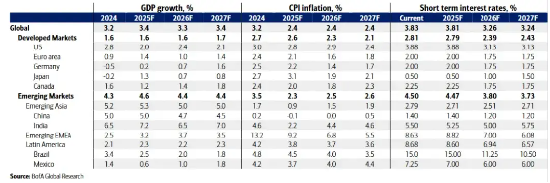
Core Viewpoint - The global economy is expected to show moderate recovery in 2026, supported by ample liquidity and a gradual recovery in inventory and profit cycles, shifting the market narrative from valuation recovery to profit support [1][30]. Group 1: Overseas Macro - The global economy will continue to recover, with K-shaped economic characteristics persisting but narrowing. Major economies are projected to have varied GDP growth rates: the US at 2.4%, Eurozone at 1.0%, Japan at 0.8%, and emerging markets at 4.2% [2][30]. - Global inflation is on a downward trend, with expectations that the Federal Reserve may cut interest rates 2-3 times in 2026, leading to a decrease in short-term rates [31][30]. Group 2: Domestic Macro - Fiscal policies are expected to drive investment recovery in major economic provinces, with a focus on infrastructure, manufacturing recovery, and a narrowing decline in real estate sales and investment [8][35]. - The Producer Price Index (PPI) is anticipated to rise initially before stabilizing, while the Consumer Price Index (CPI) may see moderate increases. The profit cycle is gradually recovering, with improvements expected in various sectors [9][35]. Group 3: Liquidity Environment - A clear trend of global liquidity easing is established, with the Federal Reserve leading improvements in overseas liquidity. Domestic monetary policy is expected to align with fiscal measures, potentially leading to interest rate cuts [12][38]. - The supply of funds is likely to be dominated by institutional capital, with private equity funds potentially driving high-net-worth individuals back into equity allocations [14][38]. Group 4: Strategic Allocation Directions - The market is expected to shift from valuation recovery to profit-driven dynamics in 2026, with Chinese assets still having room for valuation recovery [41][42]. - Key sectors to focus on include technology and advanced manufacturing, traditional export chains, and industries with increasing overseas revenue proportions [42][45]. - Future industry themes may include smart manufacturing, next-generation communications, advanced materials, and future energy solutions [47].
小摩:预计2026年反内卷政策推动的储能行业整合 对协鑫科技(03800)等予“增持”评级
智通财经网· 2026-01-07 07:39
Group 1 - Morgan Stanley reports a significant increase in solar wafer and battery prices by December 2025, primarily due to rising costs of key materials such as polysilicon and silver paste, along with some influence from anti-involution policies [1] - The establishment of a polysilicon industry consolidation platform is expected in early December 2025, with policy-driven industry consolidation anticipated to occur in 2026 [1] - The firm has given "overweight" ratings to GCL-Poly Energy (03800) and Daqo New Energy (DQ.US) [1] Group 2 - Goldwind Technology (02208) H-shares and A-shares saw price increases of 17% and 18% respectively from December 31, 2025, to January 6, 2026, while the Hang Seng China Enterprises Index rose by 4% and the Shenzhen Component Index by 3% [1] - The price surge is attributed to market expectations regarding the value release of Goldwind's 4.14% stake in Blue Arrow Aerospace, which has IPO plans [1] - Since December 31, 2025, Goldwind's market capitalization has increased by approximately 14 billion RMB, with an estimated valuation multiple for Blue Arrow Aerospace reaching 88 times the 2024 fiscal year price-to-book ratio [1] Group 3 - Siyuan Electric (002028.SZ) has signed a three-year memorandum of understanding for energy storage cooperation with CATL (03750), with a total scale of 50GWh [2] - This collaboration demonstrates Siyuan Electric's ambition to develop its energy storage system business, which could support annual revenues of approximately 20 billion RMB once fully operational [2] - Preliminary estimates suggest that this 50GWh partnership may provide over 10% upside to Siyuan Electric's market consensus earnings forecast for the fiscal years 2027 to 2028 [2]



小摩:预计2026年反内卷政策推动的储能行业整合 对协鑫科技等予“增持”评级
Zhi Tong Cai Jing· 2026-01-07 07:29
Group 1 - Morgan Stanley reports a significant increase in solar wafer and battery prices by December 2025, driven by rising costs of key materials such as polysilicon and silver paste, along with policies against internal competition [1] - The establishment of a polysilicon industry consolidation platform is expected by early December 2025, with policy-driven consolidation anticipated to occur in 2026 [1] - The firm maintains an "overweight" rating on GCL-Poly Energy (03800) and Daqo New Energy (DQ.US) [1] Group 2 - Goldwind Technology (02208) H-shares and A-shares saw price increases of 17% and 18% respectively from December 31, 2025, to January 6, 2026, outperforming the Hang Seng Index and Shenzhen Component Index [1] - The market's expectation of value release from Goldwind's 4.14% stake in Blue Arrow Aerospace, which has IPO plans, is believed to be a key factor in this price surge [1] - Goldwind's market capitalization increased by approximately 14 billion RMB since December 31, 2025, with an estimated valuation multiple for Blue Arrow Aerospace reaching 88 times the 2024 fiscal year price-to-book ratio [1] Group 3 - Siyuan Electric (002028.SZ) signed a three-year memorandum of understanding for energy storage cooperation with CATL (03750), with a total scale of 50GWh [2] - This collaboration indicates Siyuan Electric's ambition to develop its energy storage system business, potentially supporting annual revenues of around 20 billion RMB upon full capacity [2] - The partnership is expected to provide over a 10% upside to Siyuan Electric's market consensus earnings forecast for the fiscal years 2027 to 2028 [2]

时代新材2025年四季度斩获33.2亿元风电叶片订单 行业黄金周期下龙头优势凸显
Zheng Quan Ri Bao Wang· 2026-01-07 07:14
风电行业景气度持续攀升之际,行业龙头企业再传捷报。1月6日晚间,株洲时代新材(600458)料科技 股份有限公司(以下简称"时代新材")公告称,2025年10月1日至12月31日,公司与风电各大主机厂签订 《叶片销售合同》,约定销售叶片并提供相关服务,合同金额总计约合人民币33.2亿元(含税价)。 此次大额订单的落地,与风电行业的高景气度密不可分。湖南大学电气与信息工程学院黎福海教授在接 受记者采访时分析:"当前风电行业正处于'海陆并举、智慧融合'的黄金发展周期,国内头部风电叶片 企业凭借'大兆瓦叶片+海外先进产能+循环经济'的差异化策略,有望进一步巩固市场地位。时代新材作 为行业第二梯队龙头,此次大额订单的签订,充分印证了其在核心材料研发和规模化生产方面的竞争优 势。" 作为中国中车(601766)集团旗下核心新材料产业平台,风电叶片业务已成为时代新材的第一大业务板 块,近年来持续保持高速增长态势。时代新材董秘夏智在接受《证券日报》记者采访时表示:"此次四 季度集中斩获大额订单,是市场对公司叶片产品技术实力、交付能力的充分认可。依托'材料创新+产业 化'双轮驱动战略,公司风电叶片业务规模每五年上一个台阶,正 ...

金风科技回落逾4% 小摩称公司股价因蓝箭航天而上涨或反应过度
Zhi Tong Cai Jing· 2026-01-07 05:47
小摩发布研报称,金风科技AH股近期明显跑赢市场,可能归因于市场对其持有的蓝箭航天4.14%股权 价值释放的预期。该行认为金风科技股价因蓝箭航天而上涨或反应过度。自2025年12月31日以来,金风 科技的市值增加约140亿元人民币。根据该行的测算,这意味著蓝箭航天的估值倍数将达到88倍2024财 年市净率。 金风科技(002202)(02208)回落逾4%,截至发稿,跌3.63%,报15.13港元,成交额9.44亿港元。 消息面上,2025年12月31日,蓝箭航天正式提交上市申请并获得受理,有望成为"商业航天第一股"。蓝 箭航天招股书显示,金风科技子公司江瀚资产持有蓝箭航天4.14%的股份。金风科技近期表示,对蓝箭 航天的持股作为非上市权益工具的投资。 ...
中国银河证券:风光储2026年迎三重动能 全球化与技术革命成主线
Zhi Tong Cai Jing· 2026-01-07 03:56
Core Insights - The wind and solar storage industry is expected to recover profitability amidst oversupply by 2025, with overseas markets becoming a highlight for growth [1][2] - The industry is anticipated to enter a new cycle in 2026 driven by "anti-involution" and technological resonance, focusing on new technology commercialization, global expansion, and supply-demand improvements [1][2] Group 1: 2025 Review and 2026 Outlook - In 2025, the wind and solar storage sector will still face oversupply, but profitability is expected to recover due to anti-involution and increased overseas sales [2] - By December 31, 2025, the CSI 300 Index is projected to increase by 17.66%, the ChiNext Index by 49.57%, and the Electric New Energy Index by 39.47%, ranking 7th out of 30 industries [2] - The implementation of Document No. 136 will accelerate the entry of new energy into the market, with 2026 marking the beginning of a new cycle for the 14th Five-Year Plan in new energy [2] Group 2: Energy Storage - The demand for large-scale energy storage is expected to grow significantly, with North America's AIDC storage demand projected to rise from 8.9 GWh in 2025 to 190 GW by 2030, representing a CAGR of approximately 84% [3] - The demand for green electricity direct connection is anticipated to increase from 78 GWh in 2025 to 475 GW by 2030, with a CAGR of about 44% [3] - European markets are expected to see concentrated deployment in the next 3-5 years, with strong demand for industrial and commercial storage in Europe, Australia, and emerging markets [3] Group 3: Wind Power - Domestic wind power installations are projected to reach 110-120 GW for onshore and 12-16 GW for offshore by 2026, with the 14th Five-Year Plan potentially exceeding 120 GW per year for onshore and 15 GW per year for offshore [4] - The global offshore wind market is expected to grow at a CAGR of 27% over the next 25-30 years [4] - The industry is experiencing a stabilization in onshore turbine prices and limited downward pressure on offshore prices, with increased overseas orders expected to boost profitability for manufacturers [4] Group 4: Photovoltaics - The photovoltaic sector is set for profitability recovery driven by anti-involution, with new technology iterations and global expansion leading growth [5] - China is expected to lead the market, with installations projected between 230-250 GW in 2026, supported by recovering demand in Europe and the U.S. and emerging markets gaining momentum [5] - Key technological advancements include the expansion of BC battery capacity, mass production of perovskite technology, and breakthroughs in silver reduction techniques, which are expected to lower costs and improve margins [5]

风电整机专家交流
2026-01-07 03:05
Wind Power Industry Conference Summary Industry Overview - The wind power industry is showing signs of stabilization, with domestic markets benefiting from improved economic efficiency and overseas markets poised for significant profitability as they scale up. The overall trend in the industry is upward [1][3]. Key Insights - The overall delivery volume of wind power is expected to exceed 160 GW by 2026, with a significant increase from 110 GW in 2025. Supply chain constraints are driving up component prices, although the increase is expected to be less than last year [1][5]. - The valuation of wind power companies is generally around ten times earnings, indicating high investment value due to performance realization and future growth potential. Leading companies like Goldwind reaching a market capitalization of over 100 billion is a significant signal [1][4]. - The overseas market has a substantial impact on Chinese wind turbine manufacturers, with order volumes increasing by over 50% year-on-year. However, the conversion of orders to delivery and revenue is slow, with profitability expected to improve gradually over the next few years [1][6]. Financial Projections - The wind power industry is expected to enter an upward profit cycle lasting three to five years, with domestic manufacturing showing signs of stabilization and improvement in profitability by the second half of 2025 [3]. - By 2026, wind turbine prices are projected to increase by 10%-15% due to price control policies, with manufacturers' gross margins expected to rise by at least 5 percentage points [12]. Component Pricing and Supply Chain - The prices of key components such as castings and blades are expected to rise, with castings increasing by 14-15% and blades by 6-8%. However, some prices have stabilized or decreased compared to last year [5][7]. - The supply chain for components is under pressure due to rising delivery volumes, but there is insufficient upward price momentum for further increases [7][8]. Market Dynamics - The bidding volume for 2025 is expected to remain around 150-160 GW to support government delivery targets, with domestic delivery volumes projected to reach at least 110-120 GW in 2026 [2][20]. - The competitive landscape for domestic manufacturers in overseas markets varies, with leading companies like Goldwind and Envision performing well, while others face challenges in high-barrier markets like Europe and North America [22][29]. Future Outlook - The overseas market is expected to see significant growth, with annual new bidding volumes projected to reach 80-100 GW from 2026 to 2030, driven by emerging markets like India and increased demand in Europe [21]. - The domestic offshore wind power installation volume is uncertain, heavily influenced by geopolitical issues, with projections for 2026 ranging from 7-10 GW depending on the resolution of these issues [30]. Additional Considerations - The profitability of turbine manufacturers' power station sales has declined, with margins dropping from over 50% to around 35%. Companies are adapting by increasing project sizes to maintain profitability [26]. - Leading manufacturers are actively exploring hydrogen energy solutions, although these projects are still in early stages and not yet at large-scale production [27]. This summary encapsulates the key points from the wind power industry conference, highlighting the current state, financial outlook, and future trends within the sector.
滚动更新丨A股指数小幅高开,半导体产业链大涨,普冉股份创历史新高
Di Yi Cai Jing· 2026-01-07 01:40
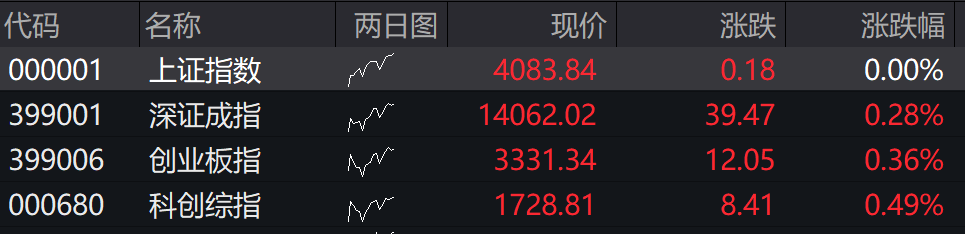
Group 1: Market Overview - The semiconductor sector is leading the market with significant gains, particularly in storage chips, with companies like Purun Co., Ltd. hitting a 20% limit up and reaching a historical high [1] - The A-share market opened with the Shanghai Composite Index slightly higher, while the Shenzhen Component Index and the ChiNext Index opened up by 0.28% and 0.36% respectively [2][3] - The semiconductor industry chain is experiencing a surge, with storage and advanced packaging sectors leading the gains, while rare earth, consumer electronics, AI applications, and smart driving concept stocks are also active [3] Group 2: Individual Company Performance - Shangfeng Cement opened over 3% higher after announcing plans to invest 900 million yuan to jointly establish a semiconductor industry fund [3] - Times New Material opened 3.38% higher following the signing of a sales contract for wind turbine blades worth approximately 3.32 billion yuan [3] Group 3: Hong Kong Market Performance - The Hong Kong stock market opened lower, with the Hang Seng Index down 0.41% and the Hang Seng Tech Index down 0.28%, while companies like Alibaba and NIO saw declines of over 2% [5][6]