玻璃制造

Search documents
O-I Glass(OI) - 2025 Q4 - Earnings Call Transcript
2026-02-11 14:02
Financial Data and Key Metrics Changes - The company reported full-year adjusted earnings of $1.60 per share, nearly doubling compared to 2024, with free cash flow rebounding to $168 million [3][4] - Adjusted EBITDA increased by 11%, with margins expanding by 220 basis points, driven by Fit to Win benefits [7] - Economic spread expanded by 200 basis points, supported by stronger earnings and disciplined capital allocation [5] Business Line Data and Key Metrics Changes - In the Americas, segment operating profit rose by 40%, despite a 10% decline in volumes, primarily in beer and spirits [12] - In Europe, segment operating profit increased by 8%, with volumes declining by 3.5% [14] - The company shifted its mix towards higher value categories, resulting in a 1% increase in the quality of its business portfolio [6] Market Data and Key Metrics Changes - Shipments in tons were down 2.5%, reflecting a 3% decline in consumer consumption [5] - The company maintained a stable top line, with average selling prices remaining flat while favorable foreign exchange largely offset volume declines [11] - The company noted that the U.S. market is experiencing high inventory levels, particularly in spirits, affecting consumption [23] Company Strategy and Development Direction - The company is focused on executing its Fit to Win initiative, which delivered $300 million in savings in 2025 and aims for at least $275 million in 2026 [8][9] - The company is committed to exiting unprofitable business segments to improve economic profit while maintaining or growing market share [15] - The company is reorienting its portfolio towards higher growth segments such as non-alcoholic beverages and premium spirits [58] Management's Comments on Operating Environment and Future Outlook - Management acknowledged ongoing macroeconomic pressures but expressed confidence in achieving 2027 financial targets [4][18] - The company expects continued progress in 2026, with adjusted EBITDA projected between $1.25 billion and $1.3 billion, representing up to 7% growth versus 2025 [15] - Management highlighted the importance of disciplined execution and cost management in navigating the challenging environment [8][18] Other Important Information - The company is working to improve supply chain efficiency, with forecasting success rates increasing from 50% to approximately 68%-69% [50] - The company anticipates a challenging first quarter in 2026 due to tough year-over-year comparisons but expects improvement as the year progresses [16][70] Q&A Session Summary Question: Volume decline in the Americas and inventory adjustments - Management indicated that up to half of the 10% volume decline in the Americas was due to inventory adjustments, particularly in beer and spirits [22][23] Question: Expanded savings target and energy headwind - The increase in the savings target to $750 million was not solely due to lower volumes but rather faster-than-expected savings execution [25][27] - The $150 million energy cost increase is expected to be a one-time adjustment due to expiring favorable contracts [26] Question: Volume outlook and exiting unprofitable business - The 2026 volume outlook includes efforts to exit unprofitable business, with an expected additional 1% movement in that direction [32][34] Question: Changes in go-to-market strategy - The company is revamping its go-to-market model to better leverage insights and improve sales performance [60][61] Question: European market dynamics and pricing - Management noted that while there is still some overcapacity in Europe, pricing has firmed up compared to the previous year [88][90] Question: Impact of the World Cup on volumes - The World Cup is seen as a potential upside, but current guidance does not fully account for event-specific impacts [102]

O-I Glass(OI) - 2025 Q4 - Earnings Call Transcript
2026-02-11 14:02
Financial Data and Key Metrics Changes - The company reported full-year adjusted earnings of $1.60 per share, nearly doubling compared to 2024, with free cash flow rebounding to $168 million [3][4] - Adjusted EBITDA increased by 11%, with margins expanding by 220 basis points, driven by Fit to Win benefits [7] - Economic spread expanded by 200 basis points, supported by stronger earnings and disciplined capital allocation [5] Business Line Data and Key Metrics Changes - In the Americas, segment operating profit rose by 40%, despite a 10% decline in volumes, primarily in beer and spirits [12] - In Europe, segment operating profit increased by 8%, with volumes declining by 3.5% [14] - Overall, shipments in tons were down 2.5%, reflecting a 3% decline in consumer consumption, but unit shipments were down only 1.5% due to a shift towards lighter weight and smaller format bottles [5][11] Market Data and Key Metrics Changes - The company maintained a modestly improved market share while shifting its mix towards higher value categories such as premium spirits and food [6][7] - The Americas faced challenges with inventory adjustments, particularly in spirits and beer, while Europe experienced price pressure in categories like wine and mainstream beer [12][14][88] Company Strategy and Development Direction - The company is focused on executing the Fit to Win initiative, which delivered $300 million in savings in 2025 and aims for at least $275 million in 2026 [8][10] - The strategic focus includes exiting unprofitable business segments to improve economic profit while maintaining or growing market share [15][33] - The company is reorienting its portfolio towards higher growth and higher margin segments, such as non-alcoholic beverages and premium products [58][59] Management's Comments on Operating Environment and Future Outlook - Management acknowledged ongoing macroeconomic pressures but expressed confidence in achieving 2027 financial targets [4][18] - The first quarter of 2026 is expected to be challenging due to tough year-over-year comparisons, but improvements are anticipated as the year progresses [16][70] - Management highlighted the importance of disciplined execution and cost management in navigating the current environment [8][39] Other Important Information - The company is working to improve supply chain efficiency, with forecasting success rates increasing from 50% to approximately 68%-69% [50] - The company expects to complete actions to eliminate excess capacity in Europe by mid-2026, which should improve operating performance [14][88] Q&A Session Summary Question: Volume decline in the Americas and inventory adjustments - Management indicated that up to half of the 10% volume decline in the Americas was due to inventory adjustments, particularly in beer and spirits [22][23] Question: Expanded savings target and energy headwind - The increase in the savings target to $750 million was not solely due to lower volumes but rather faster-than-expected savings execution [25][27] - The $150 million energy cost increase for 2026 is expected to be a one-time adjustment due to expiring favorable contracts [26] Question: Volume outlook and exiting unprofitable business - The 2026 volume outlook includes impacts from exiting unprofitable business, with expectations for continued improvement in volume management [32][33] Question: Changes in go-to-market strategy - The company is revamping its go-to-market model to better leverage insights and improve sales performance, focusing on higher growth segments [58][60] Question: European market dynamics and pricing - Management noted that while there is still some overcapacity in Europe, pricing has firmed up compared to the previous year [88][90]
O-I Glass(OI) - 2025 Q4 - Earnings Call Transcript
2026-02-11 14:00
Financial Data and Key Metrics Changes - Full-year adjusted earnings reached $1.60 per share, nearly doubling compared to 2024, with free cash flow rebounding to $168 million [3][4] - Adjusted EBITDA increased by 11%, with margins expanding by 220 basis points, while adjusted EPS nearly doubled due to stronger operating performance and a lower effective tax rate [6][11] - Economic spread expanded by 200 basis points, driven by stronger earnings and disciplined capital allocation [5][6] Business Line Data and Key Metrics Changes - In the Americas, segment operating profit rose by 40%, despite a 10% decline in volumes, primarily in beer and spirits [12] - European segment operating profit increased by 8%, with a 3.5% decline in volumes, reflecting contributions from strategic initiatives [13] - Overall, shipments in tons were down 2.5%, with a shift towards lighter weight and smaller format bottles contributing to a 1.5% decline on a unit basis [5][6] Market Data and Key Metrics Changes - Shipments in the Americas were impacted by inventory adjustments, with about half of the 10% volume decline attributed to this factor [21][24] - In Europe, consumption was down low single digits, with stable or slightly higher shipments in wine and food, while beer and spirits remained soft [13][85] - The company maintained a modestly improved market share while upgrading its business portfolio [5][6] Company Strategy and Development Direction - The company is focused on executing the Fit to Win initiative, which delivered $300 million in savings in 2025, with an increased target of at least $750 million for the next three years [8][9] - The strategy includes exiting unprofitable business segments to improve economic profit while maintaining or growing market share [15][33] - The company aims to optimize its portfolio and enhance its competitive position as markets recover [7][18] Management's Comments on Operating Environment and Future Outlook - Management acknowledged ongoing macroeconomic pressures but expressed confidence in achieving 2027 financial targets [4][18] - The company expects continued progress in 2026, with adjusted EBITDA projected between $1.25 billion and $1.3 billion, representing up to 7% growth versus 2025 [15][16] - Management highlighted the importance of disciplined execution and cost reduction in navigating the challenging environment [6][18] Other Important Information - Free cash flow is expected to approximate $200 million in 2026, reflecting higher earnings partially offset by slightly higher capital expenditures [16][70] - The company is working on improving supply chain efficiency, with demand forecasting success rates increasing from 50% to about 68%-69% [48][49] Q&A Session Summary Question: Volume decline in the Americas and inventory adjustments - Management indicated that up to half of the 10% volume decline was due to inventory adjustments, particularly in beer and spirits [21][22] Question: Expanded savings target and energy headwind - The increase in savings target to $750 million was not solely due to lower volumes but rather faster-than-expected savings execution [25][27] Question: Volume outlook and exiting unprofitable business - The 2026 volume outlook includes efforts to exit unprofitable business, with an expected additional 1% movement in that area [31][34] Question: Volume trajectory through 2026 - Management expects a tough first quarter but anticipates a transition to flat volumes in the second quarter and low to mid-single-digit growth in the back half of the year [66][67] Question: European market supply and demand dynamics - In Europe, there is still significant overcapacity in certain categories, but pricing has firmed up compared to the previous year [84][86]
三星新材股价连续3天下跌累计跌幅8.57%,中信保诚基金旗下1只基金持69.02万股,浮亏损失95.94万元
Xin Lang Cai Jing· 2026-02-11 07:13
Group 1 - Samsung New Materials' stock price fell by 2.11% on February 11, closing at 14.83 yuan per share, with a trading volume of 139 million yuan and a turnover rate of 5.11%, resulting in a total market capitalization of 2.675 billion yuan [1] - The stock has experienced a continuous decline over three days, with a cumulative drop of 8.57% during this period [1] - The company, Zhejiang Samsung New Materials Co., Ltd., was established on June 24, 1999, and went public on March 6, 2017, focusing on the design, research and development, production, and sales of low-temperature storage equipment glass doors and deep-processed glass products [1] Group 2 - The main revenue composition of Samsung New Materials includes glass doors (58.63%), photovoltaic glass (35.43%), plastic products (2.47%), deep-processed glass (1.83%), and others (1.65%) [1] - Among the top ten circulating shareholders, CITIC Prudential Fund has a fund that entered the list, holding 690,200 shares, which accounts for 0.38% of the circulating shares [2] - The CITIC Prudential Multi-Strategy Mixed Fund (LOF) A has a current scale of 996 million yuan, with a year-to-date return of 11.94% and a one-year return of 50.56% [2]

浮法玻璃深度:再平衡,看弹性
Changjiang Securities· 2026-02-11 06:06
Investment Rating - The report maintains a "Positive" investment rating for the industry [14] Core Insights - The glass industry has been experiencing continuous losses since 2025, leading to accelerated cold repairs. By the end of 2025, the production capacity decreased from approximately 160,000 tons/day to 151,000 tons/day, a decline of about 6%. The report anticipates that supply cold repairs will continue, gradually achieving a supply-demand rebalancing. If demand shows marginal improvement, glass prices are expected to exhibit elasticity and sustainability. The report is optimistic about leading companies such as Qibin Group and Xinyi Glass, which have significant cost advantages and sustained growth [3][8][12]. Current Situation: Profit Bottom, Accelerated Cold Repairs - The glass industry has faced significant pressure, with some companies experiencing cash flow losses. The average profitability level has been in continuous loss since 2025, with some companies expected to reach cash flow losses. The report highlights that the cold repair process has accelerated due to these pressures [23][26]. Supply Reduction Potential - The report identifies two main factors affecting glass cold repairs: profitability and furnace age. Currently, production lines over 10 years old account for a total of 18,800 tons/day. Excluding profitable lines from Xinyi and Qibin, as well as automotive and electronic glass lines, the potential cold repair capacity is around 15,000 tons/day. If all these lines are cold repaired, supply could drop to approximately 136,000 tons/day, representing a further 10% reduction from the end of 2025 capacity [9][35]. Supply Recovery Outlook - The report discusses the cautious approach companies may take regarding cold repairs due to high investment costs. For instance, the cold repair cost for an 800 tons/day glass production line typically exceeds 50 million, and upgrades could reach 100 million. The recovery period for investments is estimated to be 1.77 years under optimistic profit scenarios [10][43]. Price Elasticity Post Supply-Demand Rebalancing - The report suggests that under a scenario where real estate demand declines by 10% in 2026, the annual supply needs to decrease to about 145,000 tons/day, a reduction of 0.6 million tons/day from the end of 2025. The ongoing losses in the industry indicate that supply cold repairs will continue, potentially leading to a seasonal price recovery in 2026 [11][57]. Leading Companies: Cost Advantages and Growth - Qibin Group and Xinyi Glass are highlighted as industry leaders with significant profitability advantages. For instance, Qibin's gross profit per unit has been consistently higher than the industry average by 5 yuan/unit since 2020. The report also notes that Qibin has diversified into photovoltaic glass, enhancing its profitability [12][68].


中辉能化观点-20260211
Zhong Hui Qi Huo· 2026-02-11 03:07
1. Report Industry Investment Ratings - The report does not explicitly provide an overall industry investment rating. However, it gives individual ratings for each commodity: - Bullish: Methanol, Urea [3][37] - Bearish: LPG, L, PP, PVC, MEG, Asphalt, Glass, Soda Ash [1][15][19] - Neutral: Crude Oil, Natural Gas, PTA [1][6][26] 2. Report's Core Views - **Crude Oil**: Geopolitical uncertainties in the Middle East lead to short - term volatile and slightly stronger prices. However, the supply - surplus pattern remains, and with the arrival of the demand off - season, there is still downward pressure on oil prices [1][8]. - **LPG**: The cost - end oil price rebounds due to geopolitical disturbances in the short term, but the geopolitical premium is decreasing. The supply of liquefied gas is decreasing, and the chemical demand support is weakening. The inventory shows some positive factors [1]. - **L**: The basis weakens, and the market is in a bearish consolidation. Linear production is at a high level, and the supply is expected to continue to increase, with a bearish fundamental outlook [15][18]. - **PP**: The cost of propane and propylene fluctuates strongly. The supply - demand drive is insufficient before the festival. The current supply - demand is weak, and the PDH profit is low, providing cost support [19][22]. - **PVC**: The decline space of liquid caustic soda is limited. The chlor - alkali comprehensive gross profit is at a low level, providing bottom - cost support. Short - term export rush continues, but high inventory restricts the upward space, and the market is expected to fluctuate before the festival [23][25]. - **PTA**: The valuation is reasonable, and the processing fee has improved. The supply - side device maintenance is in line with the plan, and the downstream demand is seasonally weak. The 1 - 2 month inventory is slightly accumulated, but the overall expectation is positive [26][27]. - **MEG**: The valuation is low. The domestic device load increases, and the overseas device maintenance plan increases. The downstream demand is seasonally weak, and the inventory is expected to accumulate in 1 - 2 months. The short - term demand is under pressure, but the fundamentals are expected to improve in 3 - 4 months [29][30]. - **Methanol**: The domestic device starts to increase, and the overseas device load is expected to increase. The demand shows signs of improvement, and the cost has support. The fundamentals are slightly loose, but geopolitical conflicts still have uncertainties [32][34]. - **Urea**: The overall start - up load is rising, and the demand is strong in the short term. However, as the downstream demand enters the holiday off - season, the support is expected to weaken. The price is restricted by "export quota system" and "price stabilization policy" [37][38]. - **LNG**: The impact of the cold wave in the United States decreases, and the demand - side support gradually weakens, resulting in a weakening gas price trend [41][44]. - **Asphalt**: The cost - end oil price fluctuates disorderly. The asphalt valuation is high, and the supply - side uncertainty increases. Attention should be paid to the import situation of asphalt raw materials [46][50]. - **Glass**: The warehouse receipts increase, and the market is in a low - level consolidation. The supply - demand is weak, and the inventory is slightly accumulated. Supply reduction is needed to digest the high inventory [51][54]. - **Soda Ash**: The warehouse receipts continue to increase. The real - estate demand is weak, and the heavy - alkali demand support is insufficient. The supply is under pressure, and short - selling on rallies is recommended [55][58]. 3. Summary of Each Commodity Crude Oil - **Price**: WTI主力 fell 0.62% to $63.96/barrel, Brent主力 fell 0.35% to $68.8/barrel, and SC主力 rose 1.39% to 472.5 yuan/barrel [7]. - **Fundamentals**: OPEC+ maintains the production policy, and the production in the Middle East and the United States shows different trends. Indian imports increase, and the US inventory shows different changes in different types of oil [9]. - **Strategy**: In the medium - to - long term, the supply - demand fundamentals will improve after the first quarter. In the short term, it fluctuates and adjusts, and the SC price range is [465 - 485] [10]. LPG - **Price**: On February 10, the PG main contract closed at 4203 yuan/ton, down 0.17%. Spot prices in different regions showed different changes [11][12]. - **Fundamentals**: It is mainly affected by the cost - end oil price. The supply is stable, the downstream chemical demand weakens, and the inventory accumulates [13]. - **Strategy**: In the medium - to - long term, the price center is expected to move down. In the short term, the cost - end oil price is uncertain, and the fundamental outlook is bearish. The PG price range is [4200 - 4300] [14]. L - **Price**: L05 closed at 6775 yuan/ton, up 0.8% [16]. - **Fundamentals**: The basis weakens, and the linear production is at a high level. The supply is expected to increase, and the fundamental outlook is bearish [18]. - **Strategy**: Be cautious in operation before the festival and pay attention to the verification after the festival. The L price range is [6650 - 6850] [18]. PP - **Price**: PP05 closed at 6678 yuan/ton, up 0.9% [20]. - **Fundamentals**: The cost of propane and propylene fluctuates strongly. The supply - demand is weak, and the PDH profit is low, providing cost support [22]. - **Strategy**: Light - position and cautious operation before the festival. Pay attention to the future demand verification. The PP price range is [6600 - 6800] [22]. PVC - **Price**: V05 closed at 4971 yuan/ton, down 0.4% [23]. - **Fundamentals**: The decline space of liquid caustic soda is limited. The chlor - alkali comprehensive gross profit is at a low level, and the high inventory restricts the upward space. The market is expected to fluctuate before the festival [25]. - **Strategy**: Light - position operation. The V price range is [4850 - 5050] [25]. PTA - **Price**: TA05 closed at 5166 yuan/ton, at the 85.7% quantile level in the past three months [27]. - **Fundamentals**: The valuation is reasonable, the supply - side device maintenance is in line with the plan, and the downstream demand is seasonally weak. The 1 - 2 month inventory is slightly accumulated [27]. - **Strategy**: The fundamental expectation is positive. Pay attention to buying on significant pullbacks. The TA05 price range is [5110 - 5220] [28]. MEG - **Price**: EG05 closed at 3959 yuan/ton [29]. - **Fundamentals**: The valuation is low. The domestic device load increases, and the overseas device maintenance plan increases. The downstream demand is seasonally weak, and the inventory is expected to accumulate in 1 - 2 months [30]. - **Strategy**: Layout long positions on dips in the near - term. The EG05 price range is [3680 - 3780] [31]. Methanol - **Price**: The main contract is at a high valuation level in the past three months [34]. - **Fundamentals**: The domestic device starts to increase, and the overseas device load is expected to increase. The demand shows signs of improvement, and the cost has support. The fundamentals are slightly loose, but geopolitical conflicts still have uncertainties [34]. - **Strategy**: Hold long positions. The MA05 price range is [2219 - 2369] [36]. Urea - **Price**: The main contract closed at 1776 yuan/ton, at the 77.8% quantile level in the past year [39]. - **Fundamentals**: The overall start - up load is rising, and the demand is strong in the short term. However, as the downstream demand enters the holiday off - season, the support is expected to weaken. The price is restricted by "export quota system" and "price stabilization policy" [38][39]. - **Strategy**: Be cautious in chasing up. The UR05 price range is [1760 - 1790] [40]. LNG - **Price**: On February 9, the NG main contract closed at $3.140/million British thermal units, down 7.78% [43]. - **Fundamentals**: The impact of the cold wave in the United States decreases, and the demand - side support gradually weakens, resulting in a weakening gas price trend [44]. - **Strategy**: The demand supports the gas price in the consumption peak season, but the supply is relatively sufficient, and the gas price is under pressure. The NG price range is [2.900 - 3.400] [45]. Asphalt - **Price**: On February 10, the BU main contract closed at 3343 yuan/ton, up 0.27% [48]. - **Fundamentals**: The cost - end oil price fluctuates disorderly. The asphalt valuation is high, and the supply - side uncertainty increases. Attention should be paid to the import situation of asphalt raw materials [49][50]. - **Strategy**: Pay attention to the geopolitical situation in the Middle East and prevent risks. The BU price range is [3300 - 3400] [50]. Glass - **Price**: FG05 closed at 1070 yuan/ton, down 0.7% [52]. - **Fundamentals**: The warehouse receipts increase, and the market is in a low - level consolidation. The supply - demand is weak, and the inventory is slightly accumulated. Supply reduction is needed to digest the high inventory [54]. - **Strategy**: Be cautious in chasing up before the cold - repair is further implemented. The FG price range is [1040 - 1090] [54]. Soda Ash - **Price**: SA05 closed at 1171 yuan/ton, down 0.8% [56]. - **Fundamentals**: The warehouse receipts continue to increase. The real - estate demand is weak, and the heavy - alkali demand support is insufficient. The supply is under pressure [58]. - **Strategy**: Short - sell on rallies before the maintenance is further intensified. The SA price range is [1150 - 1200] [58].
株洲旗滨集团股份有限公司关于控股孙公司完成注册登记的公告
Shang Hai Zheng Quan Bao· 2026-02-10 18:44
证券代码:601636 证券简称:旗滨集团 公告编号:2026-013 株洲旗滨集团股份有限公司 关于控股孙公司完成注册登记的公告 本公司董事会及全体董事保证本公告内容不存在任何虚假记载、误导性陈述或者重大遗漏,并对其内容 的真实性、准确性和完整性承担法律责任。 一、注册登记事由 为统筹优化光伏玻璃业务的供应链管理,株洲旗滨集团股份有限公司(以下简称"公司")于2025年12月 18日召开第六届董事会第九次会议,审议通过了《关于控股子公司投资设立深圳旗滨新能源科技有限公 司的议案》。同意公司控股子公司湖南旗滨光能科技有限公司(以下简称"旗滨光能")在深圳市宝安区 投资设立深圳旗滨新能源科技有限公司(暂定名,工商管理部门最终核准的名称为"深圳市旗滨新能源 管理有限公司",以下简称"深圳新能源")。具体内容详见公司于2025年12月19日在《上海证券报》 《证券时报》《中国证券报》《证券日报》以及上海证券交易所网站(www.sse.com.cn)披露的相关公 告(公告编号:2025-143)。 二、新设公司注册登记情况 近日,公司完成了深圳新能源的注册登记,并取得了《营业执照》。具体登记信息如下: 1、公司名称: ...
2月10日安彩高科(600207)涨停分析:治理优化、产能升级、资产处置驱动
Sou Hu Cai Jing· 2026-02-10 07:43
Core Viewpoint - An analysis of the recent stock performance of AnCai High-Tech (安彩高科) indicates a significant increase in share price, attributed to various strategic and operational improvements within the company [1] Group 1: Company Developments - The board of directors completed a restructuring on February 3, with the new chairman Xu Dongwei and the management team having over ten years of experience in the photovoltaic and glass industries, leading to optimized governance [1] - The upgrade of the photovoltaic glass production line has been completed, increasing annual production capacity to 10.057 million square meters [1] - The sale of rhodium powder generated a pre-tax profit of 114 million yuan, representing a 366.67% asset appreciation, which aids in capital recovery and focuses on the core business [1] - The company has canceled the supervisory board and strengthened the functions of the audit committee, enhancing governance efficiency [1] Group 2: Market Performance - On February 10, the stock reached a closing price of 5.61 yuan, with a trading halt at 10:51 AM and a closing order volume of 135 million yuan, accounting for 2.22% of its circulating market value [1] - The net inflow of main funds was 119 million yuan, representing 26.81% of the total transaction volume, while retail investors experienced a net outflow of 65.39 million yuan, accounting for 14.76% of the total transaction volume [1] - The stock is recognized as a hot stock in the context of Henan state-owned enterprise reform and natural gas concepts, with related concepts showing slight increases of 0.09% and 0.06% respectively on the same day [1]


美媒炒作:中国玻璃巨头福耀反客为主,重创美国本土对手
Guan Cha Zhe Wang· 2026-02-10 06:20
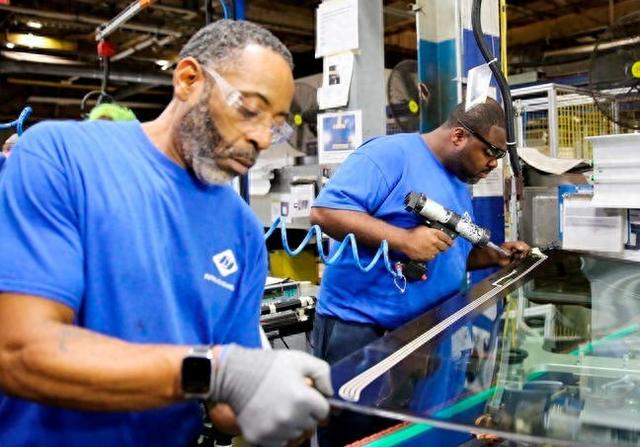
Core Viewpoint - The article discusses the tensions surrounding Chinese investment in the U.S., particularly focusing on Fuyao Glass's operations in Dayton, Ohio, and the backlash from local American companies and politicians who claim that such investments threaten domestic jobs and industries [1][4]. Group 1: Fuyao Glass Operations - Fuyao Glass successfully operates a factory in Dayton, Ohio, which was previously a closed General Motors plant, and has created over 3,000 jobs, primarily for local workers [3][8]. - The factory is now the largest automotive glass manufacturing facility globally, with a production capacity of 4.5 million automotive glass sets and 4 million automotive parts, capturing 30% of the U.S. market [8]. - Fuyao's investment has revitalized the local economy, providing new job opportunities and tax revenue in a region previously known as the "rust belt" due to economic decline [8]. Group 2: Local Competition and Complaints - Local American companies, such as Vitro, have expressed grievances about their inability to compete with Fuyao, attributing their struggles to unfair practices by the Chinese company [3][4]. - Vitro's factory has seen a 50% decline in sales over the past seven years, leading to considerations of closure by 2026, with management blaming competition from Chinese firms [3]. - Complaints from local businesses have garnered attention from U.S. politicians, who have labeled Chinese investments as a potential threat to national security and domestic manufacturing [4][6]. Group 3: Political and Regulatory Response - U.S. politicians, particularly those with hawkish views on China, have rallied around the complaints from local companies, suggesting that Chinese firms are undermining U.S. manufacturing through unfair labor practices and subsidies [4][6]. - Investigations into Fuyao's operations have been initiated by U.S. law enforcement agencies regarding allegations of financial crimes and labor exploitation, although Fuyao denies any wrongdoing [6]. - Discussions are ongoing among U.S. officials about potential restrictions on Chinese investments in key industries under the guise of national security concerns [6]. Group 4: Alternative Perspectives - The local chamber of commerce president, Chris Keshner, disagrees with the complaints from Vitro, suggesting that they are merely a reaction to losing market share and not indicative of unfair competition [7].
亚玛顿:公司向昆山协鑫光电送样钙钛矿用ITO导电玻璃产品
Mei Ri Jing Ji Xin Wen· 2026-02-10 04:34
Group 1 - The company has engaged in a collaboration with GCL-Poly Energy Holdings, specifically sending samples of ITO conductive glass for perovskite applications [2] - The company possesses the capability for mass production of core materials, including conductive glass and backplane glass for perovskite applications [2]