
私募

Search documents
上证3500了,现在入量化选股晚吗?
雪球· 2025-07-18 08:00
Core Viewpoint - The article discusses the evolution and current state of quantitative stock selection strategies in the private equity sector, emphasizing their performance and adaptability in various market conditions [3][4][5]. Group 1: Historical Development - Quantitative stock selection began to gain traction around 2021, as traditional index-enhanced strategies struggled due to a sluggish market, leading many top private equity managers to explore new avenues [4]. - In 2022, the flexibility and anti-drawdown characteristics of quantitative stock selection became apparent, with top-performing products achieving positive returns despite market turbulence [4]. - By 2023, the strategy gained mainstream acceptance, with nearly 90% of quantitative stock selection products yielding positive returns, significantly outperforming major indices [5]. Group 2: Performance and Market Conditions - The first half of 2024 saw a resurgence in quantitative stock selection performance, with some managers reporting returns exceeding 50%, driven by high trading volumes and increased market volatility [6]. - The article highlights that a conducive environment for quantitative strategies includes high trading volumes and volatility, which have been prevalent since the 2023 market rally [8]. Group 3: Investment Timing Concerns - Investors express concerns about entering the market at high points, particularly as the index approaches 3500 points, a level historically associated with bull markets [9][11]. - The article suggests that the timing of entry is less critical for quantitative stock selection, as the strategy is not tied to specific indices and can adapt to various market conditions [13]. Group 4: Specific Fund Analysis - Two private equity funds are highlighted: - Fund A has achieved a 36% return this year and 117% over the past year, utilizing a multi-factor strategy with high turnover and leverage [14][15]. - Fund B has reported a 30% return this year and 83% over the past year, employing a high-frequency trading strategy with low correlation to other market participants [16][17].


67家公司年内71次询价转让!百亿私募频繁现身,凌顶投资受让47家公司
Sou Hu Cai Jing· 2025-07-18 05:46
Core Insights - The A-share market has seen a significant increase in the number of listed companies engaging in inquiry transfers, becoming an important investment channel for private equity institutions [1] - The formal implementation of the inquiry transfer system on the ChiNext board has revitalized this trading model, with a notable increase in participation from ChiNext companies [3] - Quantitative private equity firms have demonstrated unique advantages in inquiry transfers, leveraging their strategies to enhance participation and investment opportunities [5] Group 1: Inquiry Transfer Growth - As of July 17, 67 listed companies have announced 71 inquiry transfers in 2023, compared to a total of 155 companies and 231 transactions since the pilot program began in 2020 [1] - The ChiNext board has seen a surge in inquiry transfer activity, with 25 out of 55 announcements coming from ChiNext companies, indicating a nearly 50% participation rate [3] Group 2: Private Equity Participation - Twelve private equity institutions have participated in inquiry transfers at least 10 times this year, with most managing over 2 billion yuan [4] - Lingding Investment stands out, appearing in the transfer lists of 47 companies, focusing on quantitative arbitrage trading with a management scale between 5-10 billion yuan [4] - Other notable private equity firms include Shengquan Hengyuan, Jinde Private Equity, and Kangmand Capital, each involved in multiple inquiry transfers [4] Group 3: Advantages of Quantitative Strategies - Quantitative private equity firms have actively engaged in inquiry transfers, utilizing models for comprehensive evaluations of listed companies to enhance pricing strategies [5] - The inquiry transfer process typically offers discounts compared to market prices, providing private equity firms with opportunities for rapid large-scale investments [5] - The requirement for a minimum transfer of 1% of total shares and a six-month lock-up period favors larger private equity firms, enabling them to participate in multiple inquiry transfers simultaneously [5]

红利指增策略走俏量化私募加大布局力度
Zhong Guo Zheng Quan Bao· 2025-07-17 21:03
Group 1 - The core viewpoint of the articles highlights a significant increase in market interest towards dividend index-enhanced strategies, particularly in the context of rising demand for "high dividend and low volatility" assets [1][2][3] - There has been a noticeable increase in inquiries and subscription willingness for dividend index-enhanced products among high-net-worth clients, with a reported over 30% month-on-month growth in consultations [2][3] - The trend indicates a shift in focus from traditional quantitative stock selection strategies to dividend index-enhanced strategies, driven by a desire for stable returns amid declining risk-free rates [3][4] Group 2 - The operational frameworks of dividend index-enhanced strategies and traditional broad-based index-enhanced strategies are largely similar, utilizing multi-factor scoring and algorithmic trading models [3][4] - Key differences lie in the focus on dividend-related factors within dividend index-enhanced strategies, which prioritize dividend yield and low volatility, while traditional strategies incorporate a broader range of factors [4][5] - Dividend index-enhanced strategies typically exhibit lower turnover rates compared to traditional strategies, as they emphasize fundamental factors such as dividend yield and cash flow stability [4][5] Group 3 - The dividend index-enhanced strategy is recognized for its low volatility, small drawdowns, and stable returns, making it suitable for defensive positioning in turbulent markets [5][6] - However, in strong market conditions, the strategy may underperform compared to other strategies, limiting its appeal for aggressive investors seeking higher returns [5][6] - Industry experts suggest that the allocation to dividend index-enhanced strategies should be dynamic, considering market cycles and investor risk preferences [6][7] Group 4 - A practical allocation framework proposed involves using broad-based index-enhanced strategies as the core of asset allocation, complemented by dividend index-enhanced or growth-style strategies as satellite investments [7]
中信建投十年“研究老将”丁鲁明正式官宣离职,转投私募创业
Nan Fang Du Shi Bao· 2025-07-17 09:04
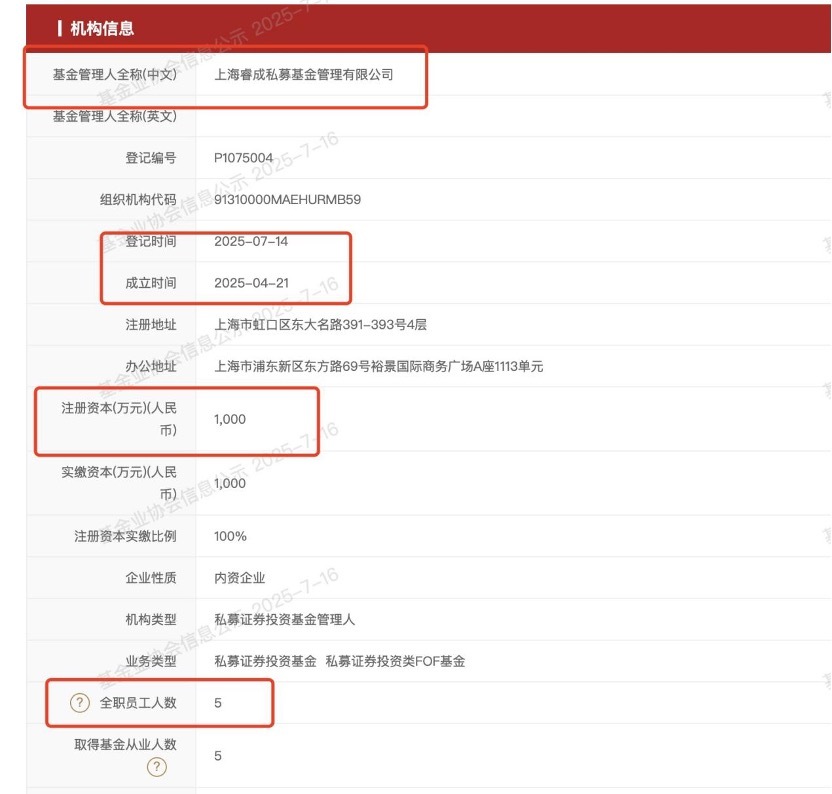
Core Viewpoint - Ding Luming, a prominent analyst at CITIC Securities, announced his departure from the sell-side research role after 16 years to enter the private equity industry, marking a significant career transition [2][4]. Group 1: Career Background - Ding Luming has been with CITIC Securities since 2014, holding various key positions including Executive General Manager of the Research Development Department and Chief Analyst for the Financial Engineering Team [4]. - He is well-known in the industry for creating the "quantitative fundamental" research system and has accurately predicted major market trends and turning points [4]. - Ding has received multiple accolades, including being ranked 1st in the New Fortune Best Analyst awards in 2013 and 1st in the Crystal Ball Best Analyst awards in 2009 and 2013 [4]. Group 2: New Venture - After leaving CITIC Securities, Ding Luming founded Shanghai Ruicheng Private Fund Management Co., Ltd., which was officially registered on July 14, 2025, with a registered capital of 10 million yuan [4][5]. - Ding holds a 51% stake in Shanghai Ruicheng, while the second-largest shareholder is Hainan Ruicheng Enterprise Management Center (Limited Partnership) with a 49% stake [5][6]. - The company is classified as a private securities investment fund manager and is located in Hongkou District, Shanghai [5]. Group 3: Industry Trends - The private equity sector has seen a trend of seasoned analysts transitioning from brokerage firms, with several notable departures from CITIC Securities in 2025 [6]. - Notably, former Chief Strategist Chen Guo also left CITIC Securities earlier in the year to join Dongfang Wealth, highlighting a shift in talent within the industry [6].

量化人才市场的“冰与火”
Jing Ji Guan Cha Wang· 2025-07-17 07:21
Group 1: Talent Acquisition and Market Dynamics - Leading quantitative private equity firms are offering million-level annual salaries and substantial equity incentives to attract top quantitative researchers, indicating a competitive talent market [2] - The current quantitative talent market is experiencing a bifurcation, with top-tier talent in high demand while junior talent faces increasing competition, requiring advanced qualifications to gain recognition [2][6] - Many quantitative private equity firms are struggling to retain talent due to insufficient resources, leading to a cycle of high salaries but low output [2][6] Group 2: Impact of AI on Quantitative Research - AI is transforming the quantitative strategy development process, reducing the need for deep involvement from quantitative researchers as AI models can now handle data processing and strategy adjustments [3][9] - The relationship between AI and quantitative researchers is seen as complementary rather than purely substitutive, with AI enhancing the ability to manage extreme market conditions [4][9] - Despite the potential for AI to improve efficiency, many quantitative researchers express concerns about job security as AI increasingly takes over tasks traditionally performed by humans [3][10] Group 3: Performance Metrics and Strategy Development - As of mid-2023, quantitative private equity firms have outperformed the market, with an average return of 10.87%, significantly higher than the Shanghai and Shenzhen 300 Index [5] - The average return for quantitative long-only strategy products reached 15.42%, surpassing the average return of other equity strategy products [5] - Firms are focusing on attracting more talented quantitative researchers to enhance strategy development and ensure sustained performance in a competitive market [5][6] Group 4: Challenges in the Quantitative Investment Sector - The shortage of qualified quantitative analysts is a pressing issue, with only a few hundred new analysts entering the market annually, leading to intense competition for top talent [6] - The demand for hybrid talent, skilled in data engineering, high-performance computing, and quantitative strategy development, is growing, but supply remains limited [6][10] - The rapid evolution of AI in quantitative strategy development is reshaping the skill set required for success, emphasizing the need for continuous learning and adaptation among quantitative researchers [10]

16年卖方老兵转身量化实战,中信建投前金工首席丁鲁明“奔私”,量化人才需要具备哪些能力?
Mei Ri Jing Ji Xin Wen· 2025-07-17 06:40
Core Insights - Ding Luming, former Chief Analyst of Financial Engineering at CITIC Securities, announced his departure from a 16-year sell-side career to establish Shanghai Ruicheng Private Fund Management Co., aiming to create a Chinese version of "Bridgewater Fund" [1][2][3] Company Overview - Shanghai Ruicheng Private Fund Management Co. was established in April 2025 and completed registration on July 14, 2025 [3] - Ding Luming has a strong academic background with a Master's in Financial Mathematics from Tongji University and has been recognized multiple times as a top analyst [3] Investment Strategy - Ding Luming has developed an innovative "quantitative fundamental" research system, focusing on the Kondratiev wave theory within economic cycles, which he applies to asset allocation and market trend predictions [3] - The strategy emphasizes absolute returns through large asset allocation and timing, fostering long-term investment habits among investors [3] Industry Trends - The private equity sector is experiencing a resurgence, with a significant number of top managers being quantitative private equity firms [4] - As of Q1 2025, the scale of public quantitative equity funds reached 302.588 billion, while by June 2025, there were 39 private quantitative fund managers managing over 10 billion, accounting for nearly half of the total [4] Talent Acquisition - The definition of talent in the quantitative finance sector is evolving, with a shift towards valuing mathematical and computational skills over traditional finance backgrounds [4][5] - A notable trend is the preference for candidates with strong quantitative analysis and programming skills, as opposed to those with purely financial education [5][6]
头部券商金工首席转型,进军量化私募,卖方转型私募不少见,但成功不易
Feng Huang Wang· 2025-07-17 00:17
Group 1 - The core viewpoint of the news is the transformation of a well-known sell-side analyst, Ding Luming, into a private equity fund manager, establishing Shanghai Ruicheng, which aims to implement quantitative investment strategies [1][2][5] - Shanghai Ruicheng was officially registered as a private fund management company on July 14, 2023, with a registered capital of 10 million RMB, and Ding Luming holds 90.2% of the shares [2][3] - Ding Luming has over 16 years of experience in securities research, having worked at Haitong Securities and CITIC Securities, where he rose to the position of Executive General Manager [3][4] Group 2 - Ding Luming announced his ambition to become the best fund manager in China, reflecting his long-standing commitment to the investment industry since his internship in 2006 [5][6] - The investment philosophy of Shanghai Ruicheng will incorporate economic cycle theories and various quantitative strategies to meet the comprehensive research needs of investors [6][7] - The trend of sell-side analysts transitioning to private equity is noted, with several examples of analysts who have made similar moves, although the transition is often challenging [7][13]
知名券商金工首席 官宣“奔私”!
Zhong Guo Ji Jin Bao· 2025-07-16 15:51
Core Viewpoint - Ding Luming, the former chief quantitative analyst at CITIC Securities, has transitioned from a sell-side career to establish a private equity fund management company named Shanghai Ruicheng Private Fund Management Co., Ltd. [1][2][8] Company Information - Shanghai Ruicheng Private Fund was established on April 21, 2025, and completed its registration as a private securities investment fund manager on July 14, 2025. The registered capital is 10 million yuan, and the company is located in Hongkou District, Shanghai, with its office in Pudong New District. It currently employs five full-time staff, all of whom hold fund industry qualifications [4][5]. - The major shareholder of Ruicheng Private Fund is Ding Luming, who holds 51% of the shares, while the second shareholder, Hainan Ruicheng Enterprise Management Center (Limited Partnership), holds 49% [6]. Leadership Background - Ding Luming has a master's degree in financial mathematics from Tongji University and is a qualified actuary with 17 years of experience in the securities industry. He previously worked at Haitong Securities and CITIC Securities, where he held various senior positions, including chief analyst and executive general manager [6][7]. - Ding Luming has developed a "quantitative fundamental" research system and has been recognized for his accurate predictions of major market trends and turning points [7]. Strategic Vision - Ding Luming aims to create a professional team to manage the private fund, focusing on absolute returns through large asset allocation and timing strategies. He plans to incorporate mature quantitative strategies into product management [8][9]. - The company aspires to become a Chinese equivalent of Bridgewater Associates, indicating a strong ambition for growth and influence in the private equity sector [9].
量化领跑!百亿私募产品榜揭晓!龙旗科技、鸣石基金等登榜!
Sou Hu Cai Jing· 2025-07-16 09:46
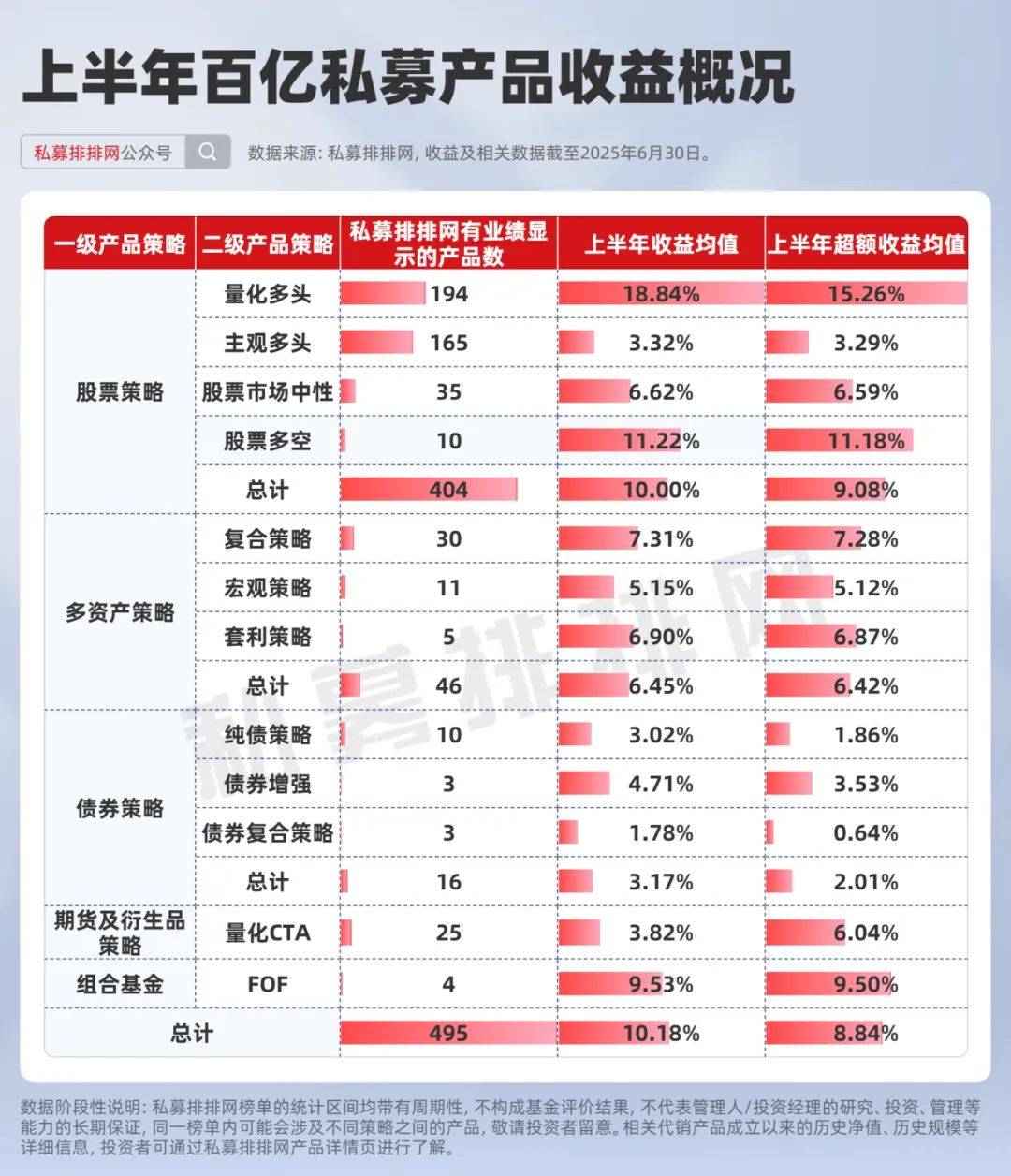
Market Performance - In the first half of 2025, the A-share market showed strong resilience amid a complex domestic and international environment, with the Shanghai Composite Index rising by 2.75% and the North Stock 50 Index leading with a remarkable increase of 39.45% [1] - The total trading volume in the A-share market reached 162.68 trillion yuan, significantly higher than the 101 trillion yuan recorded in the same period of 2024, indicating a rapid increase in market activity [1] Private Equity Fund Performance - Among the 495 billion private equity products with reported performance, the average return for the first half of the year was 10.18%, with an excess return of 8.84% [2] - There was a notable divergence in performance among different strategies, with quantitative long strategies achieving an average return of 18.84%, while subjective long strategies only averaged 3.32% [1][2] Strategy Breakdown Quantitative Long Strategies - A total of 194 quantitative long products were reported, with the top performers identified based on excess returns [3] - The leading product was from Longqi Technology, with significant returns attributed to favorable market conditions and a strong belief in the potential for excess returns in the Chinese market [7][8] Subjective Long Strategies - There were 165 subjective long products, with the average return being only 3.32%, highlighting a stark contrast with quantitative strategies [4][11] - The top-performing product in this category focused on medical innovation, benefiting from strong market trends in the healthcare sector [11] Market Neutral Strategies - The average return for 35 market-neutral products was reported at 6.62%, with notable performers including Mingcong Investment and Weiguan Asset [12][14] Multi-Asset Strategies - The average return for 46 multi-asset strategies was 6.45%, with several products achieving significant returns [15][17] Futures and Derivatives Strategies - The average return for 25 futures and derivatives products was 3.82%, with the top product from Xinhong Tianhe showing strong performance [19][22]
量化私募人才争夺战升级 灵均投资多维构建“选育用留”护城河
Xin Lang Ji Jin· 2025-07-16 01:29
Core Insights - The article discusses the competitive landscape of the domestic quantitative investment industry, highlighting the shift from salary competition to systematic capability assessment among leading firms [1] Selection - Lingjun Investment has established a dual-track selection standard focusing on comprehensive quality and development potential, emphasizing research capability and team collaboration for senior talent, while nurturing new talent through an internship retention program [2] - Professional background is a hard requirement, with candidates needing strong mathematical statistics, top programming skills, and insights into financial markets [2] Training - Lingjun has created a three-tiered training system to address the industry's focus on talent acquisition over development, providing tailored support throughout the talent lifecycle [3] - The foundational stage involves mentorship for interns and junior researchers, while the breakthrough stage encourages experienced researchers to share knowledge and explore new technologies [3] - The advanced stage offers top researchers management roles and funding for strategy implementation, promoting a balance of collaboration and competition within teams [3] Competitive Landscape - The competition in the quantitative industry revolves around three core dimensions: data algorithm technology barriers, organizational efficiency of talent, and the speed of new technology conversion [4] - Lingjun Investment is building differentiated advantages through a multi-dimensional approach, focusing on data, algorithms, and computing power [5] - The firm emphasizes a long-term commitment to technology barriers and has established a mechanism for rapid technology conversion, fostering a culture of continuous evolution [6] Future Outlook - The future winners in the quantitative industry will be those who can transform deep technology and talent density into sustainable evolution capabilities [6]