装备制造业

Search documents
1—8月份规模以上工业企业利润同比实现增长
Guo Jia Tong Ji Ju· 2025-09-27 02:19
国家统计局工业司首席统计师于卫宁解读2025年1—8月份工业企业利润数据 1—8月份,在宏观政策发力显效、全国统一大市场纵深推进,叠加去年同期低基数等多重因素作用下, 规模以上工业企业利润同比增长0.9%,装备制造业支撑有力,不同规模企业利润均有所改善。 工业企业利润明显改善。1—8月份,规模以上工业企业利润由1—7月份同比下降1.7%转为增长0.9%, 扭转了自今年5月份以来企业累计利润持续下降态势。从三大门类看,1—8月份,制造业增长7.4%,较 1—7月份加快2.6个百分点;电力、热力、燃气及水生产和供应业增长9.4%,加快5.5个百分点;采矿业 下降30.6%,降幅收窄1.0个百分点。从月度看,8月份规模以上工业企业利润两位数增长,由7月份下降 1.5%转为增长20.4%,工业企业当月利润改善明显。 下阶段,在外部环境严峻复杂、国内市场需求仍显不足的背景下,要全面贯彻落实党中央决策部署,进 一步扩大国内需求,纵深推进全国统一大市场建设,规范企业竞争秩序,为工业企业利润持续恢复创造 更多有利条件。 资讯编辑:费斐 021-26093397 资讯监督:乐卫扬 021-26093827 资讯投诉:陈跃进 0 ...
国家统计局:1—8月份规模以上装备制造业利润增长7.2%
Zheng Quan Shi Bao Wang· 2025-09-27 01:56
Core Insights - The core viewpoint of the article highlights the significant growth in profits within the equipment manufacturing sector, which has positively impacted the overall profits of large-scale industrial enterprises in China [1] Industry Performance - From January to August, profits in the equipment manufacturing industry increased by 7.2%, contributing 2.5 percentage points to the profit growth of all large-scale industrial enterprises, making it one of the strongest driving sectors [1] - Among the eight industries within the equipment manufacturing sector, seven reported profit growth during this period [1] Sector-Specific Growth - The railway, shipbuilding, and aerospace industries experienced rapid profit growth, with increases of 37.3% and 11.5% respectively [1] - The specialized equipment and electronics industries also saw profit increases of 6.9% and 7.2%, with acceleration in growth rates of 3.7 and 0.5 percentage points compared to the previous month [1]
国家统计局工业司首席统计师于卫宁解读2025年1—8月份工业企业利润数据
Xin Hua Wang· 2025-09-27 01:43
1—8月份规模以上工业企业利润同比实现增长 ——国家统计局工业司首席统计师于卫宁解读2025年1—8月份工业企业利润数据 1—8月份,在宏观政策发力显效、全国统一大市场纵深推进,叠加去年同期低基数等多重因素作用 下,规模以上工业企业利润同比增长0.9%,装备制造业支撑有力,不同规模企业利润均有所改善。 工业企业利润明显改善。1—8月份,规模以上工业企业利润由1—7月份同比下降1.7%转为增长 0.9%,扭转了自今年5月份以来企业累计利润持续下降态势。从三大门类看,1—8月份,制造业增长 7.4%,较1—7月份加快2.6个百分点;电力、热力、燃气及水生产和供应业增长9.4%,加快5.5个百分 点;采矿业下降30.6%,降幅收窄1.0个百分点。从月度看,8月份规模以上工业企业利润两位数增长, 由7月份下降1.5%转为增长20.4%,工业企业当月利润改善明显。 8月企业单位成本下降,营收利润率回升。8月份,规模以上工业企业成本状况有所改善,每百元营 业收入中的成本同比减少0.20元,为2024年7月份以来首次当月同比减少。8月份,规模以上工业企业营 业收入利润率为5.83%,同比提高0.90个百分点。 下阶段,在外 ...
1-8月,济南规上工业增加值同比增长8.1%
Qi Lu Wan Bao Wang· 2025-09-24 09:58
Core Insights - Jinan's industrial production has shown stability in the first eight months of the year, with a year-on-year increase of 8.1% in industrial added value, outperforming both national and provincial averages by 1.9 and 0.3 percentage points respectively, ranking second among the sixteen cities in the province [1] Group 1: Key Drivers - The manufacturing sector in Jinan has continued to lead, with a year-on-year increase of 8.4% in added value, contributing 7.1 percentage points to the overall industrial growth [3] - The equipment manufacturing industry saw a significant year-on-year increase of 21.3%, exceeding the growth rates of the overall industrial and manufacturing sectors by 13.2 and 12.9 percentage points respectively, contributing 9.6 percentage points to the industrial growth [3] - High-tech manufacturing also performed well, with a year-on-year increase of 21.1%, contributing 4.2 percentage points to the overall industrial growth [3] Group 2: Industry Performance - 51.2% of the major industrial categories in Jinan experienced year-on-year growth in added value [3] - Notable growth was observed in the computer, communication, and other electronic equipment manufacturing sectors, which increased by 63.3%, and the automotive manufacturing sector, which grew by 27.6%, together contributing 8.3 percentage points to the overall industrial growth [3] - The black metal smelting and rolling processing industry experienced a year-on-year decline of 9.6%, although the decline was narrower by 2.0 percentage points compared to the previous month [3] Group 3: Production and Sales Coordination - The industrial sales rate in Jinan reached 98.5%, ranking first among the sixteen cities in the province, exceeding the provincial average by 3.6 percentage points and improving by 1.0 percentage point compared to the same period last year [3] - Key products showed varied performance, with generator set production increasing by 21.3%, metal cutting machine tool production rising by 12.1%, and server production growing by 12.6%, while crude steel and steel product outputs declined by 9.5% and 12.7% respectively [3]

广东建工中标19.24亿项目股价涨停 净利两年半下滑拟加码清洁能源发电
Chang Jiang Shang Bao· 2025-09-24 07:28
Group 1 - Guangdong Construction won a major bid for the "Financial City East District Chebei Village Collective Property Reconstruction Project" with a bid price of 1.924 billion yuan [2] - Following the bid announcement, Guangdong Construction's stock hit the daily limit, closing at 4.16 yuan per share on September 23 [3] - The company's main business segments include engineering construction, clean energy generation, and equipment manufacturing, but it has faced declining profits in recent years [3] Group 2 - In 2023 and 2024, Guangdong Construction's projected revenues are 80.863 billion yuan and 68.315 billion yuan, reflecting year-on-year declines of 2.07% and 15.52% respectively [3] - The company's net profit attributable to shareholders is expected to decrease to 1.534 billion yuan and 1.168 billion yuan in 2023 and 2024, with declines of 10.27% and 23.84% respectively [3] - In the first half of 2025, the company reported a revenue of 29.312 billion yuan, a year-on-year increase of 10.64%, while net profit attributable to shareholders was 350 million yuan, down 23.44% [3] Group 3 - To enhance its clean energy business and alleviate operational pressure, Guangdong Construction plans to acquire five project companies with a total investment of 471 million yuan [4] - The acquisition involves 9 ground photovoltaic projects with a total direct current installed capacity of 249.78 MWp [4] - The company aims to effectively integrate resources and enhance its comprehensive strength in clean energy generation through this acquisition [5]


大连:1—8月份,全市规上工业增加值同比增长12.8%
Zheng Quan Shi Bao Wang· 2025-09-24 07:15
Economic Overview - Dalian's economy showed stable performance in the first eight months of the year, with industrial production improving and consumer momentum continuing to release [1] - The city's industrial added value for enterprises above designated size increased by 12.8% year-on-year, maintaining the same growth rate as the previous month [1] Industrial Performance - The added value of high-tech manufacturing increased by 15.9% year-on-year, continuing a double-digit growth trend [1] - State-owned enterprises saw a significant increase in added value by 21.9%, while joint-stock enterprises grew by 16.7%, foreign and Hong Kong, Macao, and Taiwan-invested enterprises by 4.2%, and private enterprises by 2.3% [2] - Mining industry added value surged by 61.5%, while manufacturing grew by 13.3% and the production and supply of electricity, heat, gas, and water increased by 6.8% [2] - Key industries such as petrochemical increased by 7.1%, equipment manufacturing by 17.8%, with notable growth in the railway and shipbuilding industry at 62.0% and the automotive industry at 27.7% [2] - Pharmaceutical manufacturing saw a remarkable increase of 42.9%, with raw material drug manufacturing skyrocketing by 536.3% [2] Service Sector - The service sector in Dalian remained stable, with most industries experiencing growth [3] - The total turnover of road, water, and air transport increased by 1.8%, 4.1%, and 2.5% respectively [3] - Retail sales for large-scale units reached 579.9 billion yuan, marking an 8.2% year-on-year increase, with significant growth in categories such as building materials (990.7%) and home appliances (285.9%) [3] Consumer Prices and Electricity Consumption - Consumer prices in Dalian continued to operate at low levels, with food and beverage prices decreasing by 1.6% [4] - Total electricity consumption in the city reached 33.79 billion kWh, a year-on-year increase of 2.7%, with industrial electricity consumption at 20.49 billion kWh, growing by 1.6% [4]
张瑜:“生产性”魔咒的破除——张瑜旬度纪要No122
一瑜中的· 2025-09-23 07:44
Group 1 - The article discusses the current macroeconomic situation, focusing on a simplified model of the economy divided into four sectors: households, enterprises, government, and overseas [4] - The household sector is characterized by high precautionary savings, with savings as a percentage of nominal GDP rising from around 80% (2008-2018) to approximately 120% in recent years, indicating a liquidity accumulation issue [5] - The government sector faces challenges due to declining fiscal revenues, driven by falling PPI and increased local protectionism, which has led to a drop in tax revenues and a structural imbalance in land sales [9][10] Group 2 - The enterprise sector has seen production investment growth outpacing demand, with manufacturing investment growth averaging 8.3% from 2022 to 2024, while nominal GDP growth is around 4.7% [14] - There is a persistent trend of production credit growth exceeding terminal demand credit, with production credit increasing by nearly 5 trillion compared to 2019, while terminal demand credit has decreased by a similar amount [15] - The overseas sector shows signs of a mild recovery in global industrial production, with six out of eight leading indicators trending upwards, suggesting resilient external demand in the coming months [19] Group 3 - The article outlines two potential policy paths: the optimal path of "suppressing supply + boosting demand" and a reliance path that returns to "production investment" as a support for economic data [20][23] - The optimal path involves maintaining anti-involution measures, addressing local protectionism, and implementing policies to stimulate domestic demand, which could lead to a narrowing of PPI declines [23] - The company maintains a positive outlook on gold and suggests a strategy of "buying stocks like bonds," indicating a favorable macro environment for equities and a potential reversal in stock-bond dynamics [24]

1-8月,济南市规模以上工业实现增加值同比增长8.1%
Qi Lu Wan Bao Wang· 2025-09-22 15:10
Economic Overview - Jinan's economy showed overall stability in the first eight months of 2023, with a focus on implementing national macro policies effectively [1] - The city's industrial production increased significantly, with a year-on-year growth of 8.1% in the value added of above-scale industries [1] Industrial Performance - The six key industries in Jinan experienced a combined value added growth of 13.0%, surpassing the overall industrial growth by 4.9 percentage points [1] - The computer, communication, and other electronic equipment manufacturing sectors saw remarkable growth, with increases of 63.3% and 27.6% in the automotive manufacturing sector [1] - The equipment manufacturing industry maintained a strong growth rate of 21.3%, contributing 9.6 percentage points to the overall industrial growth [1] - High-tech manufacturing also performed well, with a year-on-year growth of 21.1%, contributing 4.2 percentage points to the overall industrial growth [1] Service Sector - The service sector showed steady growth, with above-scale service industry revenues reaching 275.54 billion yuan, a year-on-year increase of 6.0% [2] - Among the ten major service sectors, eight reported revenue growth, with transportation, storage, and postal services generating 115.58 billion yuan, up 5.2% [2] - The leasing and business services sector achieved a revenue of 45.68 billion yuan, growing by 15.9% [2] - Private enterprises in the above-scale service sector generated 109.12 billion yuan, accounting for 39.6% of the total service revenue, with an 8.8% growth rate [2] Retail and Consumption - Retail sales in Jinan showed a stable growth, with a total retail sales of consumer goods reaching 131.92 billion yuan, a year-on-year increase of 2.1% [3] - Basic living goods performed well, with food and oil retail sales increasing by 5.8% and daily necessities by 8.4% [3] - Online consumption remained active, with retail sales through public networks reaching 35.26 billion yuan, growing by 21.2% [3] - The "trade-in" policy positively impacted sales, with significant growth in communication equipment (34.7%), cultural and office supplies (32.5%), and new energy vehicles (12.8%) [3] Financial and Trade Performance - Financial institutions in Jinan reported a total deposit balance of 3.19063 trillion yuan, a growth of 6.9% year-to-date [4] - The total loan balance reached 3.42752 trillion yuan, increasing by 10.2% since the beginning of the year [4] - Jinan's foreign trade saw rapid growth, with total imports and exports reaching 178.03 billion yuan, a year-on-year increase of 26.2% [4] - Exports amounted to 118.16 billion yuan (up 21.7%), while imports were 59.87 billion yuan (up 36.3%) [4] - Private enterprises accounted for 59.5% of the total trade, with a total of 105.92 billion yuan in imports and exports, growing by 17.5% [4] Price Trends - The Consumer Price Index (CPI) in Jinan increased by 0.2% cumulatively in the first eight months, with a year-on-year decrease of 0.8% in August [5] - Prices of eight major categories of goods and services showed a "five up, three down" trend, with healthcare and living services rising by 0.3%, clothing by 1.6%, and education and entertainment by 5.8% [5] - Conversely, housing prices decreased by 0.6%, food and tobacco prices fell by 1.7%, and transportation and communication prices dropped by 2.9% [5]
【感知中国活力】8月份我国装备制造业快速增长
Yang Shi Wang· 2025-09-18 16:11
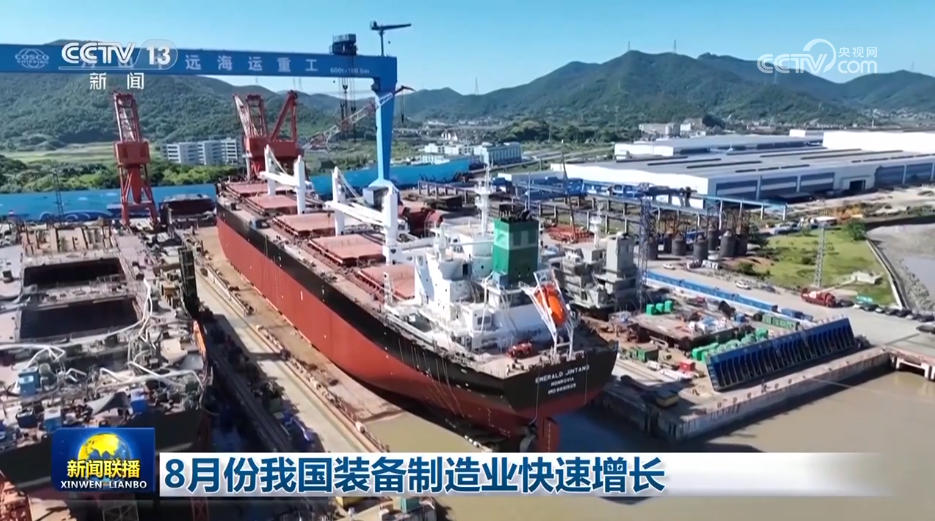
Core Viewpoint - China's economy continues to show a stable and positive trend, with significant growth in various sectors of the manufacturing industry [1] Group 1: Economic Performance - In August, China's above-scale equipment manufacturing industry experienced a year-on-year growth of 8.1% [1] - All eight sectors within the industry maintained growth, indicating a broad-based recovery [1] Group 2: Sector-Specific Growth - The railway, shipbuilding, and aerospace sectors achieved double-digit growth, with a rate of 12.0% [1] - The automotive and electrical machinery industries also reported substantial growth, with increases of 8.4% and 9.8% respectively [1]
8月份我国装备制造业快速增长
Yang Shi Wang· 2025-09-18 12:37
Core Insights - In August, China's equipment manufacturing industry saw a year-on-year increase of 8.1% in added value, driven by strong production and sales of major products, contributing to stable industrial economic performance [1][3]. Group 1: Industry Growth - All eight sectors within the equipment manufacturing industry maintained growth in August, with the railway, shipbuilding, and aerospace sectors achieving double-digit growth at a rate of 12.0%. The automotive and electrical machinery sectors grew by 8.4% and 9.8%, respectively [3][5]. Group 2: Product Performance - High-end equipment is rapidly developing, with production of civil steel ships, generator sets, and urban rail vehicles increasing by 39.8%, 30.7%, and 15.3%, respectively. In the first eight months of the year, the cumulative production of industrial robots reached 512,000 units, nearing last year's total, while sales of electric loaders exceeded 18,000 units, an increase of over 10,000 units compared to the same period last year [5]. Group 3: Market Dynamics - Recent efforts by relevant departments to promote industry self-discipline have led to an improved market competition order, with noticeable effects. In August, the year-on-year decline in factory prices for industries such as coal, steel, new energy vehicles, and photovoltaics narrowed, resulting in a stable month-on-month Producer Price Index (PPI) and a significant reduction in year-on-year decline [7].