
即时配送

Search documents
党员骑士送暖入户:顺丰同城助老餐配服务已覆盖上海多地,日均超千人次受益!
Huan Qiu Wang· 2025-12-08 03:04
Core Viewpoint - The aging population in China is prompting the development of innovative community and home-based elderly care services, with a focus on enhancing the quality of life for seniors through convenient meal delivery and support services [1]. Group 1: Elderly Meal Delivery Service - The elderly meal delivery service, initiated by SF Express in collaboration with local communities, aims to address the challenges faced by seniors, particularly those who are elderly, living alone, or have mobility issues [1][4]. - The service operates on a model combining government subsidies and corporate discounts, significantly reducing delivery costs compared to market rates [1]. - The program has successfully expanded across multiple streets in Shanghai, serving over 1,000 elderly individuals daily [4]. Group 2: Role of Delivery Personnel - Delivery personnel, particularly those trained as part of the program, have evolved from mere delivery agents to proactive community helpers, providing care and emergency assistance to seniors [3][8]. - Training for delivery personnel includes emergency response skills such as CPR and handling common health emergencies faced by the elderly, enhancing their ability to respond effectively in critical situations [6][8]. - Instances of delivery personnel assisting seniors in emergencies have been reported, showcasing their role as first responders in the community [6][8]. Group 3: Community Engagement and Social Value - The meal delivery initiative not only addresses the immediate needs of seniors but also fosters a network of community care, with delivery personnel reporting safety hazards and assisting in community governance [8]. - This collaborative model of "public welfare cooperation, professional operation, and social participation" serves as a valuable example for other enterprises and social forces looking to engage in grassroots governance and meet real-life needs [8].

5家消费公司拿到新钱;豆包手机陷入无法使用微信争议;蜜雪冰城开始卖早餐了|创投大视野
36氪未来消费· 2025-12-06 11:27
Group 1 - The high-end gold jewelry brand "寶蘭" has completed over 100 million RMB in Series A financing, led by Challenger Capital, with funds allocated for brand enhancement, omnichannel layout, supply chain resilience, and talent empowerment [3][4] - "江苏云闪送," a smart delivery company, has raised 30 million RMB in Series A financing, focusing on upgrading its intelligent scheduling system, expanding its national service network, and building a logistics ecosystem [5][6][7] - Pollo AI, a video content creation platform, has secured 14 million USD in funding, with over 20 million registered users and achieving breakeven in May this year [8][9] Group 2 - "优理奇机器人" (UniX AI) has announced a total of 300 million RMB in financing across two rounds, indicating market recognition of its integrated strategy in embodied intelligence [9][10] - "戴盟机器人" has completed a strategic round of financing worth over 100 million RMB, aimed at advancing technology breakthroughs, product development, and global market expansion [11] - Shanghai Lin Qingxuan Cosmetics Group has updated its IPO application, reporting a 98.3% year-on-year revenue growth in the first half of 2025, with a net profit increase of 109.86% [19][21][22] Group 3 - "蜜雪冰城" has initiated a breakfast program in select cities, expanding its product offerings beyond beverages [23][24] - "茶百道" launched a winter product, the "豆乳黑麒麟," which sold over 200,000 cups on its first day, highlighting the trend of seasonal beverage innovation [25][26] - "奈雪的茶" has appointed actress Gao Yuanyuan as its brand ambassador and introduced a low-GI fruit tea, marking a significant product innovation in the tea beverage sector [27][28] Group 4 - The 2025 New Year film season has surpassed 2.5 billion RMB in total box office revenue, with "疯狂动物城2" leading the charts [29] - China's esports industry revenue reached 29.33 billion RMB in 2025, showing a 6.4% year-on-year growth, with live streaming accounting for 80.81% of the revenue [30] - Global smartphone production reached 328 million units in Q3 2025, reflecting a 7% year-on-year increase, driven by seasonal demand and new product launches [31]


奈克萨斯资本7亿美元新基金半数投向印度初创企业
Xin Lang Cai Jing· 2025-12-04 12:16
如今许多风投公司似乎眼中只有人工智能(AI),但奈克萨斯风险投资公司(Nexus Venture Partners) 却在其 7 亿美元新基金的布局上刻意分散重心。 该公司将同时支持人工智能初创企业,并物色聚焦印度市场的初创公司,覆盖消费、金融科技及数字基 础设施领域。 人工智能已吸纳了全球大部分风险资本,这家拥有 20 年历史的风投公司也将人工智能视为具有决定性 意义的技术变革。但该公司认为,扎堆涌入单一过热领域本身存在风险。而印度数字经济恰好能提供平 衡:这一市场正不断扩张,人工智能的应用率持续上升,且机遇类型更为多元。 奈克萨斯风险投资公司美国区另一位管理合伙人阿比舍克・夏尔马(Abhishek Sharma)向 TechCrunch 透露,该公司的核心投资阶段仍集中在企业创立期至种子轮及 A 轮,初始投资金额通常低至几十万美 元,或在 100 万美元左右。 奈克萨斯的投资团队共有 8 名成员,公司最初以 1 亿美元基金起步,自 2023 年推出第七期基金以来, 始终将单只基金规模控制在 7 亿美元。该公司通常每 2.5 至 3 年募集一次资金。巴塔查尔吉表示,第八 期基金维持这一规模的原因在于,公司认 ...
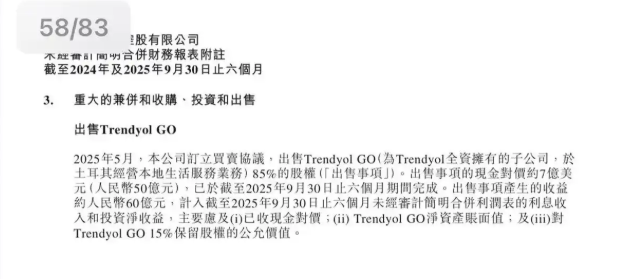
阿里卖掉子公司85%股权,收益60亿
2 1 Shi Ji Jing Ji Bao Dao· 2025-12-04 07:56
Group 1 - Alibaba disclosed in its mid-term report for the fiscal year 2026 that it sold 85% of Trendyol GO to Uber for approximately $700 million, generating a profit of about 6 billion RMB, which has been included in the investment net income for the first half of 2025 [1][3] - Trendyol GO, a rapid delivery service under Turkey's e-commerce giant Trendyol, completed over 200 million orders in 2024 with a transaction volume of $2 billion, making it a key player in Turkey's instant retail market [3] - The sale of Trendyol GO is part of a broader strategy, as Alibaba has also fully exited from offline retail formats by selling its stakes in Intime Retail and Sun Art Retail [3] Group 2 - Alibaba has established "AI-driven, cloud-first" as its core strategy, with CEO Wu Yongming indicating that the company is in a critical investment phase for building AI technology infrastructure and a consumer platform [3] - For the second quarter of fiscal year 2026, Alibaba reported revenue of 247.795 billion RMB, a year-on-year increase of 5%, while net profit decreased by 53% to 20.612 billion RMB [3] - The revenue from Alibaba's instant retail business reached 22.906 billion RMB, a 60% increase compared to 14.321 billion RMB in the same period last year [3] Group 3 - According to analysis from China Merchants Securities, Alibaba's e-commerce business is expected to maintain competitive strength, with growth potential in its food delivery services and long-term growth in cloud and AI businesses, projecting Non-GAAP net profits of 106.9 billion RMB, 166.6 billion RMB, and 201.8 billion RMB for FY2026-2028 [4]

学习贯彻党的二十届四中全会精神·五年路上你我他——四中全会精神大家谈丨一单“帮送”跑出经济加速度
He Nan Ri Bao· 2025-12-03 23:47
Core Insights - The article emphasizes the importance of invigorating various business entities as a key indicator of high-quality economic development, aligning with national and provincial policies aimed at enhancing the vitality of the private economy [2][5]. Group 1: Business Environment and Policy - Over the past five years, there has been a continuous improvement in the policy framework supporting the development of the private economy, with the "14th Five-Year Plan" highlighting legal protections for private enterprises [5]. - The financing environment remains a challenge for companies like UU Run, which faces regional disparities compared to first-tier cities, necessitating a focus on refined and specialized development paths [5]. - The government has implemented a series of policies and measures to promote high-quality development in the private sector, encapsulated in a framework referred to as "four beams and eight pillars" [9]. Group 2: Corporate Governance and Management - Establishing a modern enterprise system is crucial for private companies to effectively respond to challenges and seize opportunities, with five key areas identified for improvement: organizational structure, cost management, talent mechanisms, technology decision-making, and social responsibility [6][7]. - UU Run has adopted an innovative mechanism encouraging employee participation in idea generation and project development, which has led to the creation of new operational systems and integration of AI into daily tasks [7]. Group 3: Employee Development and Experience - The introduction of the "Universal Helper" service by UU Run has diversified career development paths for employees, enhancing their income sources and work experiences [8]. - Employees report feeling secure and valued due to the company's support systems, including insurance and transparent income reporting, which fosters a sense of trust and commitment to the platform [8]. Group 4: Digital Economy and Innovation - The digital economy is recognized as a critical force in restructuring resource allocation and economic frameworks, with local companies like UU Run playing a significant role in connecting users and laborers [10]. - The integration of technology and industry innovation is essential for driving economic growth, with a focus on creating an open and collaborative ecosystem to align technological advancements with market needs [10].

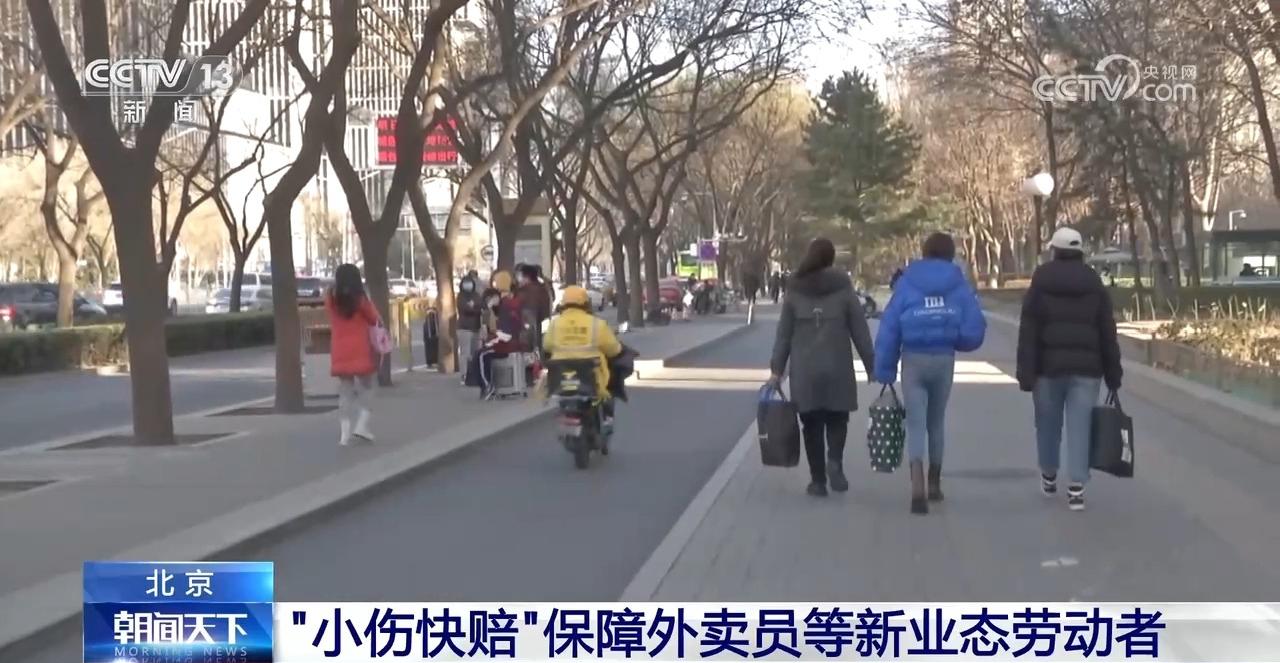
全程线上办!北京推出“小伤快赔”模式保障外卖员等新业态劳动者
Sou Hu Cai Jing· 2025-12-03 09:23
Core Viewpoint - Beijing is implementing a "small injury quick compensation" model for gig economy workers, significantly reducing claim processing time and allowing for online reimbursement of medical expenses for minor injuries [1][3]. Group 1: Policy Implementation - The "small injury quick compensation" model targets gig economy workers such as delivery personnel and ride-hailing drivers, allowing for online processing of medical expense reimbursements for minor injuries [1][5]. - The model is designed for injuries that do not require hospitalization and have no long-term impact on the worker's ability to work, such as soft tissue injuries and sprains [5]. Group 2: Coverage and Impact - The occupational injury insurance in Beijing currently covers 21 companies across three industries: transportation, instant delivery, and local freight, benefiting over 1.57 million gig economy workers [3]. - Cases that meet the criteria for "small injury quick compensation" will be prioritized and tracked by dedicated personnel, ensuring efficient processing [3].
美团-W(03690.HK):2025Q3业绩不及预期 待竞争格局企稳
Ge Long Hui· 2025-12-03 05:49
Core Insights - The company is increasing investments in user, rider, merchant subsidies, and ecosystem development to consolidate market share amid intensified competition in the instant delivery sector [1] - The company has revised its non-IFRS net profit forecasts for 2025-2027 to -19.9 billion, 32.2 billion, and 54.2 billion yuan, respectively, down from -2.6 billion, 35.8 billion, and 58.8 billion yuan [1] - The company anticipates a return to profitability in 2026 as the competitive landscape stabilizes, with a projected net profit growth rate of 68.4% in 2027 [1] Financial Performance - In Q3 2025, the company's revenue was 95.49 billion yuan, a year-on-year increase of 2.0%, but below Bloomberg's consensus estimate of 97.47 billion yuan [2] - The non-IFRS net loss for Q3 2025 was 16.01 billion yuan, worse than Bloomberg's consensus estimate of a loss of 13.96 billion yuan, primarily due to fierce competition in the food delivery sector [2] - Core business revenue declined by 2.8% year-on-year, with an operating loss of 14.1 billion yuan and an operating loss margin of 20.9% [2] Business Segments - The delivery service revenue fell by 17.1% year-on-year, attributed to increased subsidies and competitive pressures in the food delivery market [2] - New business revenue grew by 15.9% year-on-year, with an operating loss of 1.3 billion yuan, but the loss margin improved by 2.5 percentage points, mainly due to enhanced efficiency in the Hong Kong and Middle Eastern markets [2] - The company plans to pilot its new business, Keeta, in Brazil in late October 2025, expecting to continue significant investments during the initial phase [2]

流程做“减法”、效率做“加法” “小伤快赔”守护新业态劳动者健康防线
Yang Shi Wang· 2025-12-03 03:29
Core Points - Beijing has launched a "Quick Compensation for Minor Injuries" model aimed at gig economy workers such as delivery personnel and ride-hailing drivers, allowing for online reimbursement of minor medical expenses, significantly reducing claim processing time [1][3][5] Group 1: Implementation of the Model - The "Quick Compensation" model is designed for minor injuries that occur during work, specifically those that do not require hospitalization and have clear documentation, benefiting over 1.57 million gig workers across 21 companies in the delivery and transportation sectors [3][5] - The model simplifies the claims process by reducing the required documentation from 10 items to 5, allowing for full online submission, thus enhancing convenience for workers [5][7] Group 2: Operational Efficiency - The model focuses on three key review elements: amount, medication list, and treatment area, streamlining the materials required for claims [7][8] - The frequency of compensation payments for minor injuries has been optimized from three times a month to once daily, improving the efficiency of benefit disbursement [9]
面向外卖员、网约车司机等 北京全面推行“小伤快赔”
Yang Shi Wang· 2025-12-02 23:14
Core Points - Beijing has launched a "Quick Compensation for Minor Injuries" model aimed at gig economy workers such as delivery personnel and ride-hailing drivers, allowing for online reimbursement of minor medical expenses, significantly reducing claim processing time [1][3][10] Group 1: Implementation Details - The "Quick Compensation" model covers three industries: transportation, instant delivery, and local freight, benefiting over 1.57 million gig workers in Beijing [3] - "Minor injuries" are defined as those that do not require hospitalization, are clear-cut, and have no disputes regarding responsibility, allowing for expedited processing [3][5] - The model simplifies the claims process by reducing the required documentation from 10 items to 5, all of which can be submitted online, enhancing convenience for workers [6][8] Group 2: Operational Efficiency - The claims process includes six steps: reporting, medical treatment, and application, with the material submission phase being notably complex and time-consuming [6] - The new model focuses on three core review elements: amount, medication list, and treatment area, streamlining the material requirements and allowing for electronic submissions [8] - The frequency of compensation payments for minor injuries has been optimized from three times a month to once daily, improving the efficiency of benefit disbursement [10]
北京推动实施职业伤害保障制度 已覆盖21家平台企业,累计参保157万人
Ren Min Ri Bao· 2025-12-02 23:02
Core Insights - Beijing has implemented a work injury protection system since July 2022, covering high-risk industries such as transportation, food delivery, and local freight, with 21 platform companies participating and 1.57 million insured individuals [1] Group 1: Work Injury Protection System - The work injury protection system is designed to accommodate the characteristics of new employment forms, including flexibility and high mobility, using a pay-per-order insurance model funded by platform companies [1] - Workers injured during work can have their medical and rehabilitation expenses covered by the work injury insurance fund, and families of workers who die from work-related injuries receive compensation equivalent to work injury insurance benefits [1] Group 2: Impact and Statistics - Over the past three years, the city has confirmed 11,800 cases of work-related injuries and has provided relevant benefits to more than 7,700 workers [1] - The system employs a floating rate based on the accident rate of platform companies, encouraging them to prioritize work injury prevention through safety training and improved safety measures [1]