
航空机场

Search documents
【机构策略】把握好“春季躁动”行情下的主题投资机会
Zheng Quan Shi Bao Wang· 2026-01-06 01:30
Group 1 - The A-share market opened strong on Monday, with the Shanghai Composite Index returning above 4000 points, driven by sectors such as insurance, medical services, semiconductors, and electronic components [1][2] - The market is supported by the increasing attractiveness of RMB assets, expectations for early-year credit issuance, and positive changes in corporate earnings structures, particularly from advanced manufacturing and overseas enterprises [1] - There is a prevailing expectation that the Federal Reserve will continue its rate-cutting cycle into 2026, contributing to a more accommodative global liquidity environment [1] Group 2 - The A-share market is anticipated to maintain a slight upward trend, with investors encouraged to increase risk appetite and actively participate in the market to seize thematic investment opportunities during the "spring market" [1][2] - The domestic innovative drug market is expected to have significant growth potential in the medium to long term, despite a major adjustment anticipated at the end of 2025 [2]
人民币升值下的-春季躁动-机会有何不同
2026-01-05 15:42
Summary of Conference Call Notes Industry and Company Involved - The discussion primarily focuses on the impact of the appreciation of the Renminbi (RMB) on various industries, particularly the **aviation, airport, and paper printing industries** [1][2]. Core Points and Arguments - **RMB Appreciation Benefits**: The appreciation of the RMB is beneficial for the aviation and airport sectors as it increases the foreign exchange gains for airlines with significant USD debt. Additionally, the paper printing industry benefits from lower import costs for raw materials, which may lead to a recovery in gross margins [1][2]. - **Core Assets Driven by Capital Flow**: There is a notable interest in core assets driven by capital flow, particularly blue-chip stocks with high Return on Equity (ROE) and strong competitive advantages. The Long江证券 Northbound Heavyweight 50 Index and the A500 Index are highlighted as key references for investment [1][2]. - **Valuation Recovery in Low-Valuation Sectors**: Sectors related to economic recovery, such as finance and real estate, present opportunities for valuation recovery. This mirrors the performance of insurance and real estate during the RMB appreciation in early 2023 [1][2]. - **Comparison with Previous RMB Appreciation Cycles**: The current RMB appreciation shares similarities with the 2020-2021 period, supported by industrial trends. However, the influence of foreign capital is less pronounced this time, with a shift towards short-term market dynamics rather than valuation recovery, emphasizing opportunities from technological revolutions [3][4]. - **Investment Recommendations**: - **Short-term Focus**: Attention should be given to the paper and aviation sectors, which are expected to report better-than-expected results during the annual report phase due to the RMB appreciation [5]. - **Long-term Focus**: The market in 2025 is anticipated to be dominated by technology growth, with a focus on commercial aviation, robotics, and AI infrastructure and applications. The Hang Seng Technology Index may offer investment opportunities, while the A-share market should focus on infrastructure and manufacturing sectors, such as humanoid robots and commercial aviation [5]. Other Important but Possibly Overlooked Content - The recent RMB appreciation has led to a significant increase in market trading volume, reaching over 1.9 trillion to 2 trillion, indicating a strong domestic support effect despite the absence of foreign capital [2]. - The current market environment is characterized by a mix of short-term trading opportunities rather than a clear valuation recovery trend, highlighting the importance of technological advancements in shaping investment strategies [4].
2026开门红,时隔一月有余再度站上4000
Ge Long Hui· 2026-01-05 12:14
Market Performance - The three major indices collectively rose, with the Shanghai Composite Index increasing by 1.07%, the Shenzhen Component Index by 1.87%, and the ChiNext Index by 2.15% [1] - Over 3,800 stocks in the two markets experienced gains, with a total trading volume of 1.64 trillion [1] Sector Highlights - The brain-computer interface concept surged, with a notable increase of 12.56%, leading to over ten stocks hitting the 20% daily limit up, including Sanbo Brain Science, Botao Biology, Daoshi Technology, and Xiangyu Medical [3] - The commercial aerospace sector remained active, with China Satellite Communications achieving three consecutive trading limits in five days [3] - The insurance sector strengthened, with Xinhua Insurance and China Pacific Insurance both reaching historical highs [3] - The semiconductor industry chain showed robust performance, with stocks like Yaxiang Integration and Shenghui Integration hitting the daily limit up [3] Declining Sectors - The Hainan Free Trade Zone concept faced a decline, dropping by 3.06%, with Hainan Development hitting the daily limit down [3] - Other sectors such as duty-free shops, airports, and tourism hotels followed suit, each experiencing declines of over 1% [3] - The oil, banking, and lottery sectors also faced downward pressure [3] Company News - Salt Lake Co. recently announced its 2025 performance forecast, expecting a net profit attributable to shareholders of 8.29 billion to 8.89 billion, representing a year-on-year growth of 77.78% to 90.65% [3] - In 2025, China has approved 76 innovative drugs for listing, setting a historical record, with total external authorization transaction amounts exceeding 130 billion [3]

航空机场板块1月5日跌0.31%,中国国航领跌,主力资金净流入1.19亿元
Zheng Xing Xing Ye Ri Bao· 2026-01-05 09:09
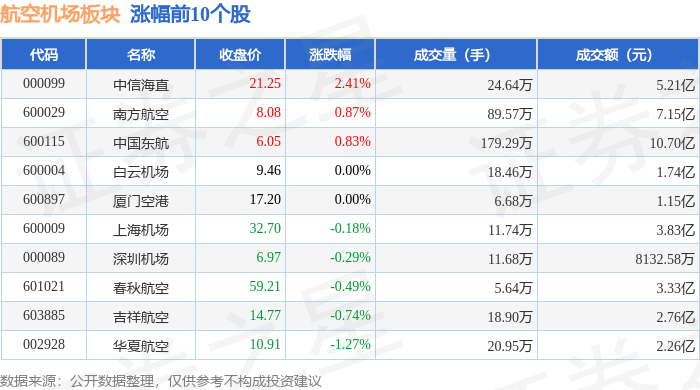
Market Overview - The aviation and airport sector experienced a decline of 0.31% on January 5, with China National Aviation leading the drop [1] - The Shanghai Composite Index closed at 4023.42, up 1.38%, while the Shenzhen Component Index closed at 13828.63, up 2.24% [1] Stock Performance - Key stocks in the aviation and airport sector showed mixed performance, with China National Aviation closing at 9.20, down 1.81%, and China Eastern Airlines at 6.05, up 0.83% [2] - The trading volume and turnover for major stocks included: - China National Aviation: 1.22 million shares, turnover of 1.11 billion [2] - China Eastern Airlines: 1.79 million shares, turnover of 1.07 billion [2] - Xiamen Airport: 66,800 shares, turnover of 115 million [2] Capital Flow - The aviation and airport sector saw a net inflow of 119 million from institutional investors, while retail investors experienced a net outflow of 173 million [2] - The capital flow for specific stocks indicated: - China Eastern Airlines had a net inflow of 94.70 million from institutional investors [3] - China National Aviation faced a net outflow of 18.89 million from institutional investors [3] - Shenzhen Airport had a net inflow of 12.24 million from institutional investors [3]




行业轮动ETF策略周报-20260105
金融街证券· 2026-01-05 08:42
Group 1: Report Industry Investment Rating - No relevant information provided Group 2: Report's Core View - Financial Street Securities Research Institute constructs a strategy portfolio based on industry and theme ETFs [2] - In the week of 20260105, the model recommends allocating sectors such as aviation equipment, aerospace equipment, and aviation airports. The strategy will newly hold products like Aerospace ETF, Satellite Industry ETF, Tourism ETF, Rare Metals ETF, and continue to hold products like Gold Stocks ETF [12] Group 3: Summary by Related Catalogs Strategy Update - Multiple ETFs are adjusted in the portfolio, including Aerospace ETF, Satellite Industry ETF, Tourism ETF, etc. [3] Performance Tracking - From 20251229 - 20251231, the strategy's cumulative net return is about -1.44%, and the excess return relative to the CSI 300 ETF is about -0.80%. From October 14, 2024 to now, the strategy's out - of - sample cumulative return is about 30.30%, and the cumulative excess return relative to the CSI 300 ETF is about 7.80% [3] ETFs' Information - Information on ETFs' market value, holding status, heavy - held Shenwan industries and weights, and timing signals are provided [3] ETFs' Adjustment in the Recent Week - Some ETFs are调出, and the future - week strategy recommends new holdings and continued holdings [3][12]
交通运输产业行业研究:元旦假期首日人员流动超2亿,美军突袭委内或利好油运
SINOLINK SECURITIES· 2026-01-04 08:09
Investment Rating - The report does not explicitly provide an overall investment rating for the transportation sector Core Views - The express delivery sector is experiencing a 5% year-on-year growth in business volume, with some companies benefiting from price increases due to reduced competition. The report recommends SF Express for its valuation and operational resilience, while also being optimistic about ZTO Express due to its increasing market share in the low-price segment [2] - In logistics, the chemical transportation prices remain stable, and the report recommends Haicheng Co. for its focus on smart logistics and improved demand [3] - The aviation sector is seeing a significant increase in passenger flow, with over 200 million people traveling during the New Year holiday, and the report recommends China Southern Airlines and Air China due to expected profit growth from optimized supply and demand [4] - The shipping sector shows a slight increase in container shipping indices, with potential benefits from geopolitical events affecting oil transportation. The report notes a 42.5% year-on-year increase in the crude oil transportation index [5] - The road and rail sector shows stable performance, with a slight decrease in truck traffic on highways but overall competitive dividend yields compared to government bonds [6] Summary by Sections Transportation Market Review - The transportation index fell by 0.7% during the week, underperforming the Shanghai and Shenzhen 300 index by 0.1%, with the aviation sector showing the highest increase at +4.8% and logistics experiencing the largest decline at -3.4% [1][13] Industry Fundamentals Tracking Shipping and Ports - Container shipping is stabilizing, with a slight increase in freight rates supported by seasonal demand. The report anticipates pressure on rates in mid-January due to expected capacity growth [21] - The export container shipping index (CCFI) was 1146.67 points, up 2.0% week-on-week but down 24.3% year-on-year [22] Aviation and Airports - The civil aviation sector saw a 6% year-on-year increase in passenger volume in November, with domestic routes growing by 5% and international routes by 19% [54] - The report highlights that major airlines are expected to see significant profit increases due to high load factors and rising ticket prices [54][75] Rail and Road - The rail sector reported a year-on-year increase in passenger volume of 8.94% and freight volume of 1.16% in November, indicating a positive trend in transportation demand [78] - The road sector experienced a slight decline in passenger traffic but an increase in freight volume, with competitive dividend yields noted for major road operators [83]
离岸人民币兑美元升破6.97,创2023年5月以来新高,行业如何配置?
Sou Hu Cai Jing· 2026-01-02 01:39
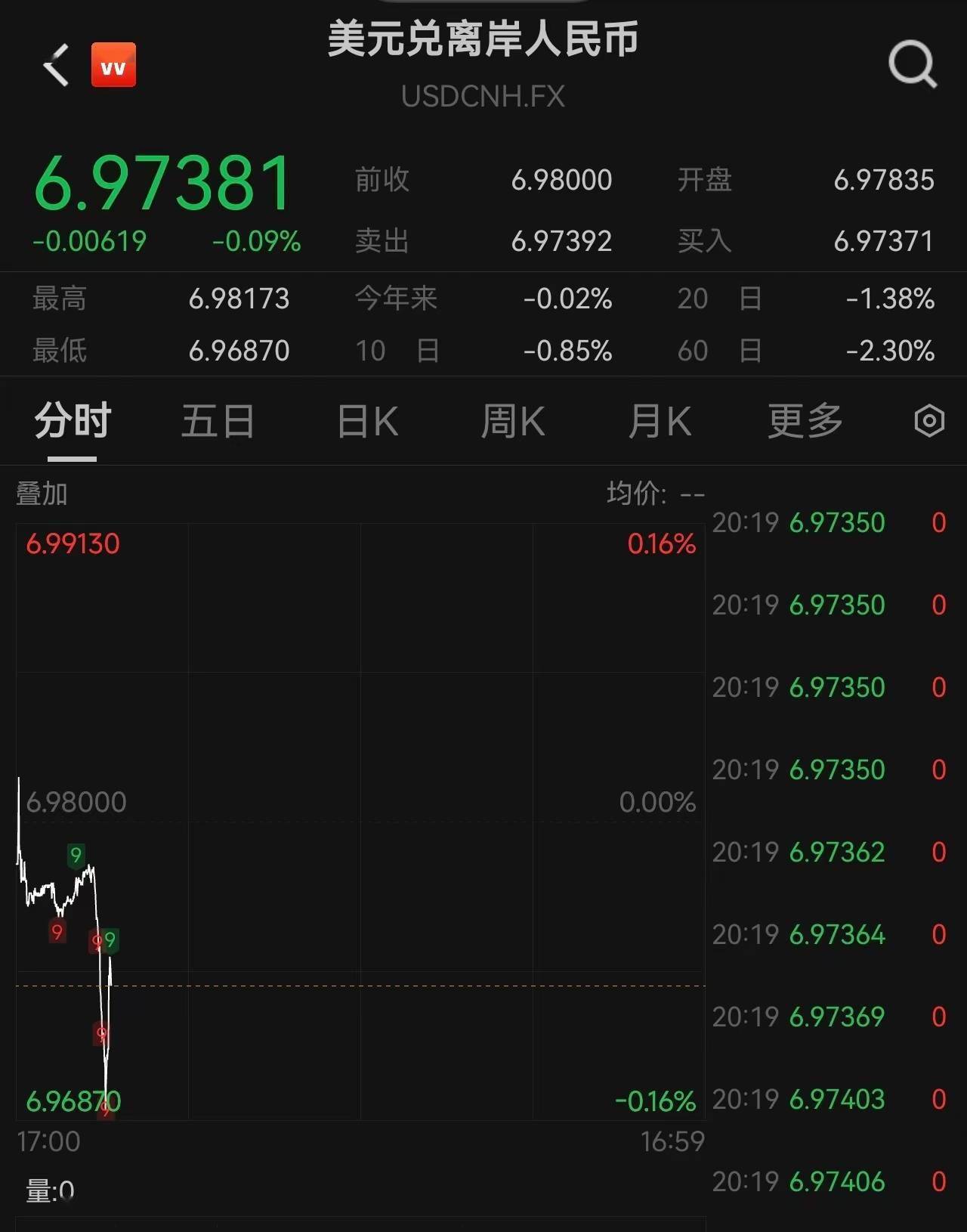
Core Viewpoint - The offshore RMB has appreciated against the US dollar, surpassing 6.97, reaching a high of 6.9678, the highest since May 2023 [1] Group 1: Impact of RMB Appreciation - The appreciation of the RMB is expected to reverse capital flows, including domestic funds waiting to be settled abroad and previously withdrawn foreign funds, potentially leading to a significant capital inflow into Chinese assets [3] - Historical data shows that during previous RMB appreciation cycles since 2016, both A-shares and Hong Kong stocks generally experienced gains [3] - The current macro environment is characterized by "domestic fundamentals improving + overseas easing," which may enhance the upward elasticity of Hong Kong stocks compared to A-shares [3] Group 2: Industry Configuration Logic - Four key logic points for industry configuration during RMB appreciation include: 1. Lower import costs benefiting upstream resource sectors such as coal, steel, and certain chemicals [4] 2. Decreased foreign currency debt costs benefiting industries with significant USD liabilities, including real estate and logistics [4] 3. Increased domestic purchasing power benefiting consumption-driven sectors like cross-border e-commerce and high-end services [4] 4. Attraction of foreign capital back to Chinese assets, with a shift in foreign investment preferences potentially reinforcing current market trends [4] Group 3: Key Sectors to Watch - Focus on sectors benefiting from changing foreign investment preferences and strong domestic consensus, including AI hardware, advanced manufacturing, and non-ferrous metals [5] - Upstream resource sectors benefiting from rising PPI and reduced import costs, such as steel and chemicals [5] - Service and high-end consumption sectors benefiting from improved domestic purchasing power, including duty-free and e-commerce [5] - Industries with reasonable valuations and potential for marginal improvement in 2024, such as aviation, paper, and logistics [5] Group 4: Industry Performance Metrics - The projected net profit growth rates for various sectors by 2026 and Q3 2025 indicate high growth potential in communication electronics, battery manufacturing, and certain chemical sectors [6] - Specific industries like steel and logistics show varying degrees of recovery potential, with some facing challenges while others are positioned for growth [6]
航空板块重点推荐-人民币升值下的-春季躁动-机会
2025-12-31 16:02
Summary of Key Points from Conference Call Industry Overview - The focus is on the aviation sector, particularly in the context of the appreciation of the Renminbi (RMB) and its impact on various industries including airports and light industry paper manufacturing [1][3]. Core Insights and Arguments - The appreciation of the RMB is expected to enhance the financial performance of sectors like aviation and light industry paper due to improved cost and debt structures [1][3]. - Historical data indicates that different sectors lead the market during phases of rapid RMB appreciation, with core assets leading in 2017, new energy and military industries in 2020-2021, and economic recovery valuation logic in late 2022 to early 2023 [1][6]. - The current phase of RMB appreciation differs from previous ones, with reduced foreign capital influence and increased domestic pricing power, shifting market focus towards technological transformation rather than mere economic recovery [1][7]. - The aviation sector is highlighted as a key beneficiary, with significant cost components (over 60%) being dollar-denominated, meaning even slight RMB appreciation can lead to substantial profit increases [3][9]. Investment Opportunities - Short-term investment opportunities are identified in the aviation and light industry paper sectors, particularly as companies prepare to release annual reports [1][8]. - The second tier of investment opportunities includes foreign-invested blue-chip stocks such as electric equipment, electronics, and food and beverage sectors, which have shown resilience during past RMB appreciation phases [5]. - The third tier includes large financial and real estate sectors, which have a high proportion of RMB-denominated assets, benefiting from balance sheet improvements during RMB appreciation [5]. Additional Important Insights - The global aircraft manufacturing industry is facing supply chain bottlenecks due to de-globalization, affecting the availability of materials and components [11]. - The performance of Chinese airlines has significantly outpaced the Shanghai and Shenzhen 300 index, driven by increased international route demand and favorable pricing dynamics [12]. - Airlines like China Southern, China Eastern, Air China, and budget carriers such as Spring Airlines are identified as high-elasticity investment opportunities due to their potential recovery from historical lows [3][12]. - The upcoming delivery of new aircraft orders (e.g., Spring Airlines and Juneyao Airlines) is expected to support fleet updates and future growth [10].

航空机场板块12月31日涨3.31%,吉祥航空领涨,主力资金净流入1.85亿元
Zheng Xing Xing Ye Ri Bao· 2025-12-31 09:07
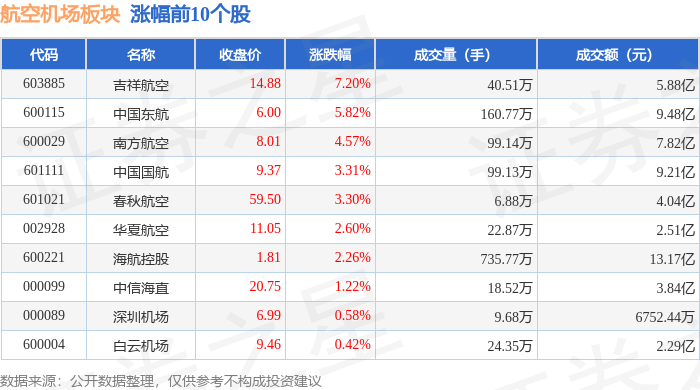
Core Insights - The aviation and airport sector experienced a significant increase of 3.31% on December 31, with Juneyao Airlines leading the gains [1] - The Shanghai Composite Index closed at 3968.84, up 0.09%, while the Shenzhen Component Index closed at 13525.02, down 0.58% [1] Stock Performance - Juneyao Airlines (603885) closed at 14.88, up 7.20%, with a trading volume of 405,100 shares and a transaction value of 588 million yuan [1] - China Eastern Airlines (600115) closed at 6.00, up 5.82%, with a trading volume of 1,607,700 shares and a transaction value of 948 million yuan [1] - Southern Airlines (600029) closed at 8.01, up 4.57%, with a trading volume of 991,400 shares and a transaction value of 782 million yuan [1] - Air China (601111) closed at 9.37, up 3.31%, with a trading volume of 1,991,300 shares and a transaction value of 921 million yuan [1] - Spring Airlines (601021) closed at 59.50, up 3.30%, with a trading volume of 68,800 shares and a transaction value of 404 million yuan [1] Capital Flow - The aviation and airport sector saw a net inflow of 185 million yuan from institutional investors, while retail investors experienced a net outflow of 209 million yuan [2] - The net inflow from speculative funds was 23.96 million yuan [2] Individual Stock Capital Flow - Hainan Airlines (600221) had a net inflow of 104 million yuan from institutional investors, but a net outflow of 22.42 million yuan from retail investors [3] - China Eastern Airlines (600115) saw a net inflow of 54.73 million yuan from institutional investors, with a net outflow of 73.04 million yuan from retail investors [3] - Air China (601111) had a net inflow of 46.63 million yuan from institutional investors, while retail investors experienced a net outflow of 77.78 million yuan [3] - Southern Airlines (600029) recorded a net inflow of 18.42 million yuan from institutional investors, with a net outflow of 40.39 million yuan from retail investors [3]



一月策略及十大金股:新的主线浮出水面
SINOLINK SECURITIES· 2025-12-31 00:55
Group 1: Strategy Overview - The report indicates that the market is gradually shifting focus from a single narrative around AI to a broader range of sectors, suggesting that a new investment theme for 2026 is emerging as the market stabilizes and industry rotation accelerates [5][12][15] - The report highlights that the recent rally in the market is driven by a recovery in global risk assets, with expectations of a cross-year market trend starting to take shape [5][12] Group 2: Metal Industry Insights - The report notes that the sharp rise in non-ferrous metals is likely driven by increased demand from high-margin and growth-oriented sectors, which are more tolerant of price increases [5][13] - It emphasizes that the relationship between metal prices and AI investments is similar to the past dynamics between coal/power and new energy sectors, indicating a potential for significant price movements in metals due to AI-related consumption [5][13] Group 3: Currency and Trade Dynamics - The report discusses a new cycle of RMB appreciation, driven by changes in export structure and settlement methods, suggesting that the impact of RMB appreciation on export competitiveness may be less severe than previously thought [6][14] - It highlights that the current high-value export sectors in China possess significant market share and production capacity, which enhances their resilience against trade protectionism [6][14] Group 4: Investment Recommendations - The report recommends focusing on industrial resource products that resonate with AI investments and global manufacturing recovery, including copper, aluminum, tin, lithium, crude oil, and oil transportation [7][15] - It also suggests investing in Chinese equipment export chains that have confirmed cyclical bottoms, such as power grid equipment, energy storage, lithium batteries, photovoltaics, and engineering machinery [7][15] Group 5: Company-Specific Insights - For Yun Aluminum Co. (000807.SZ), the report recommends a long-term investment due to favorable conditions for aluminum exports and potential price increases driven by supply-side reforms and low inventory levels [17] - For Hengli Hydraulic (601100.SH), the report highlights the company's growth potential due to rising global market share and collaboration with leading companies in robotics [18] - For China Southern Airlines (1055.HK), the report notes the expected improvement in industry supply-demand dynamics and the company's large fleet size as key growth drivers [21] - For Li Ning (2331.HK), the report points to management improvements and the upcoming Olympic cycle as catalysts for growth [24] - For Blue Special Optics (688127.SH) and Shengyi Technology (600183.SH), the report emphasizes strong demand in downstream sectors and the potential for price increases due to supply constraints [26][27] - For Te Bao Biological (688278.SH), the report highlights the expected commercial success of its growth hormone product and the potential for new indications to drive revenue growth [28]




