
脑机接口

Search documents
A股午评 | 沪指窄幅震荡半日涨0.31%! 资金热炒科技,科创50涨近1%
智通财经网· 2025-12-29 03:50
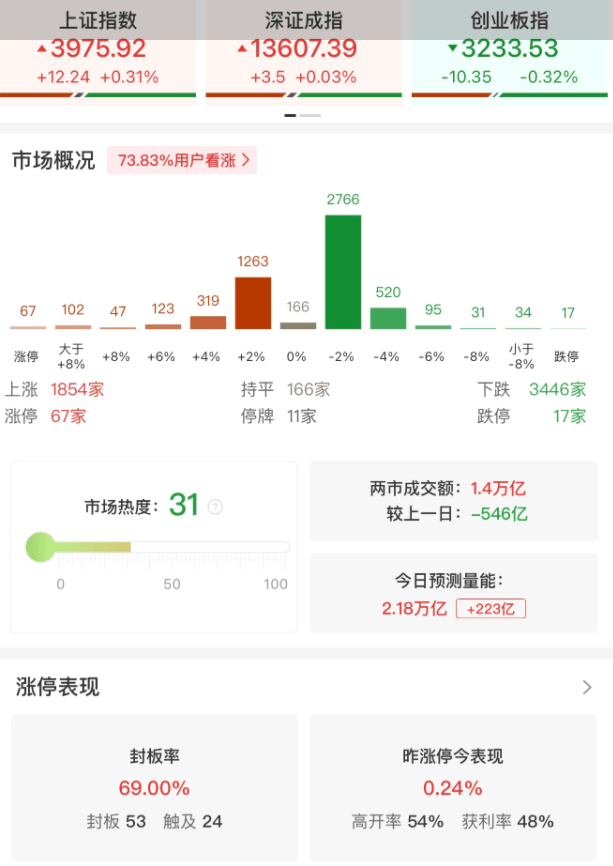
12月29日,三大指数早盘窄幅震荡,截至午间收盘,沪指涨0.31%,深证成指涨0.03%,创业板指跌 0.32%,科创50指数涨0.91%。两市下跌个股超3400只;半日成交1.40万亿元,较上一日缩量成交546亿 元。 国盛证券指出,当下市场震荡调整仍未结束,不过市场有望节前确认方向;中期对于投资者而言,仍然 可以逆势布局。 热门板块 1、脑机接口概念大涨 脑机接口概念表现活跃,海格通信、喜临门等涨停,翔宇医疗、麦澜德、三博脑科、创新医疗等跟涨。 点评:消息面上,12月28日,第五届脑科学前沿与产业大会暨2025深圳脑机接口博览会启幕,"粤港澳 大湾区脑科学与中枢神经疾病AI创新联盟"正式启动。 2、碳纤维概念拉升 碳纤维、化纤概念拉升,和顺科技、吉林化纤涨停。 点评:消息面上,日本东丽宣布,自2026年1月起将上调TORAYCA品牌的碳纤维及其预浸料、织物、 层压板等中间产品价格,涨幅区间为10%至20%。国泰海通证券认为,本轮东丽涨价有望改善外围和国 内碳纤维市场价格环境,进一步确认国内市场的价格底。 3、商业航天概念延续强势 盘面上,资金热炒科技,商业航天概念延续强势,10余只成分股涨停;机器人概念反 ...
A股午评:指数分化,沪指涨0.31%创业板指跌0.32%北证50涨0.11%,PEEK材料、脑机接口领涨!超3400股下跌,成交14078亿缩量578亿
Ge Long Hui· 2025-12-29 03:47
Market Performance - The A-share market showed mixed performance with the Shanghai Composite Index rising by 0.31% to 3975.92 points, while the Shenzhen Component Index increased by 0.03% and the ChiNext Index fell by 0.32% [1] - The North China 50 Index saw a slight increase of 0.11% [1] Trading Volume - The total trading volume in the Shanghai and Shenzhen markets reached 1.4078 trillion yuan, which is a decrease of 57.8 billion yuan compared to the previous day [1] - Over 3400 stocks experienced declines during the trading session [1] Sector Performance - The PEEK materials, brain-computer interface, and precious metals sectors showed significant gains [1] - Conversely, the pharmaceutical commercial, dairy, and battery sectors experienced declines [1]


A股午评:沪指涨0.31%,PEEK材料、脑机接口概念涨幅居前
Ge Long Hui· 2025-12-29 03:41
Market Performance - The three major A-share indices showed mixed results, with the Shanghai Composite Index rising by 0.31% to close at 3975.92 points [1] - The Shenzhen Component Index increased by 0.03%, while the ChiNext Index fell by 0.32% [1] - The North China 50 Index saw a slight increase of 0.11% [1] Trading Volume - The total trading volume in the Shanghai and Shenzhen markets reached 1.4078 trillion yuan, which is a decrease of 57.8 billion yuan compared to the previous day [1] - Over 3,400 stocks experienced declines during the trading session [1] Sector Performance - The PEEK materials, brain-computer interface, and precious metals sectors showed significant gains [1] - Conversely, the pharmaceutical commercial, dairy, and battery sectors experienced declines [1]
【人民日报】科学有答案 创新无止境——八位院士眼中的二〇二五
Ren Min Ri Bao· 2025-12-29 03:02
Core Insights - China's technological innovation is expanding into various fields, including quantum technology and lunar research, with significant breakthroughs expected by 2025 [4][6] - The "14th Five-Year Plan" emphasizes the importance of technology and innovation, highlighting a commitment to advancing scientific research and applications [4] - The development of deep space exploration and quantum computing is seen as crucial for China's strategic technological autonomy and future economic growth [8][17] Group 1: Deep Space Exploration - Major breakthroughs in lunar research are anticipated, including the discovery of new mineral types from samples returned by the Chang'e 6 mission, which will enhance understanding of lunar oxidation mechanisms [5] - The Tianwen-2 probe is set to conduct close-range exploration of a near-Earth asteroid, with sample return expected by the end of 2027 [5] - Future projects include the construction of a lunar research station, manned lunar missions, and exploration of Mars and Jupiter, aiming to enhance capabilities in deep space science and resource utilization [5][6] Group 2: Quantum Computing - Quantum computing is identified as a key technology for future strategic autonomy, requiring advancements in hardware and software integration [8] - China's third-generation superconducting quantum computer, "Benyuan Wukong," has been successfully deployed, participating in numerous collaborations across various sectors [9] - The development of quantum computing is likened to building a rocket, emphasizing the need for a comprehensive approach from hardware to software [8] Group 3: Brain-Computer Interfaces - Brain-computer interface technology is evolving to connect biological and machine intelligence, with advancements in decoding and encoding neural signals [10] - Clinical applications of brain-computer interfaces are emerging, with significant progress in invasive and non-invasive technologies [12] - The technology aims to redefine the boundaries of intelligence by integrating carbon-based and silicon-based systems [11] Group 4: Hydrogen Energy - Hydrogen energy is positioned as a vital component of the renewable energy revolution, complementing electricity and addressing sustainability challenges [17] - The development of hydrogen fuel cells is expanding into various sectors, including transportation and machinery, with China making significant strides in related technologies [18] - The strategic importance of hydrogen energy is underscored by its potential to facilitate a low-carbon energy transition [17] Group 5: Talent Development in Research - The cultivation of research talent is critical for supporting high-level technological independence, with a focus on aligning educational programs with national strategic needs [20] - Young researchers are increasingly prominent in key national projects, indicating a shift towards a younger demographic in scientific achievements [21] - A supportive environment for basic research is essential, requiring stable funding and a culture that encourages innovation and tolerates failure [22][23]
心玮医疗-B大涨超12%,机构指脑机接口近百亿美元蓝海市场加速开启
Jin Rong Jie· 2025-12-29 02:49
Core Viewpoint - The stock of Xinwei Medical-B (6609.HK) surged over 12%, reaching a peak of 54.05 HKD, driven by positive market sentiment regarding brain-computer interface (BCI) technology and its commercial potential in a nearly 10 billion USD market [1]. Industry Summary - The brain-computer interface sector is at a critical stage characterized by increased policy support, rapid technological advancements, and accelerated commercialization [1]. - The market for BCI technology is projected to be a nearly 10 billion USD blue ocean market, indicating significant growth opportunities [1]. Company Summary - Xinwei Medical is highlighted as a key player in the BCI space, benefiting from advancements in invasive, semi-invasive, and interventional technologies that offer unmatched advantages in signal quality and control precision [1]. - Domestic companies, including Xinwei Medical, have made technological breakthroughs in flexible electrodes and real-time Chinese language decoding, contributing to the acceleration of domestic substitution and showcasing significant long-term growth potential [1].
港股脑机接口板块集体大涨,心玮医疗-B涨超12%
Jin Rong Jie· 2025-12-29 02:36
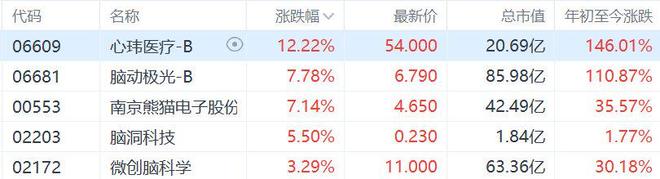
Group 1 - The Hong Kong stock market's brain-computer interface sector experienced a collective surge, with notable increases in various companies' stock prices [1] - Xinwei Medical-B saw a rise of over 12%, while Brain Dynamics and Nanjing Panda Electronics both increased by over 7% [1] - Brainhole Technology rose by over 5%, and Micron Brain Science experienced an increase of over 3% [1]
港股异动丨脑机接口板块集体大涨,心玮医疗-B涨超12%
Ge Long Hui· 2025-12-29 02:22
Group 1 - The Hong Kong stock market's brain-computer interface sector experienced a collective surge, with notable increases in stock prices for several companies [1] - Heartway Medical-B saw a rise of over 12%, while Brain Dynamics-B and Nanjing Panda Electronics both increased by over 7% [1] - The Fifth Frontier Brain Science and Industry Conference and the 2025 Shenzhen Brain-Computer Interface Expo commenced on December 28, marking the official launch of the "Guangdong-Hong Kong-Macau Greater Bay Area Brain Science and Central Nervous System Disease AI Innovation Alliance" [1] Group 2 - Heartway Medical-B's latest price is 54.000, with a total market capitalization of 2.069 billion and a year-to-date increase of 146.01% [2] - Brain Dynamics-B's latest price is 6.790, with a total market capitalization of 8.598 billion and a year-to-date increase of 110.87% [2] - Nanjing Panda Electronics' latest price is 4.650, with a total market capitalization of 4.249 billion and a year-to-date increase of 35.57% [2] - Brainhole Technology's latest price is 0.230, with a total market capitalization of 0.0184 billion and a year-to-date increase of 1.77% [2] - Microneuroscience's latest price is 11.000, with a total market capitalization of 6.336 billion and a year-to-date increase of 30.18% [2]
港股异动|心玮医疗-B大涨超12%,机构指脑机接口近百亿美元蓝海市场加速开启
Ge Long Hui· 2025-12-29 02:22
Core Insights - Heartway Medical-B (6609.HK) surged over 12%, reaching a peak of HKD 54.05 [1] Industry Overview - Brain-computer interface (BCI) is at the forefront of the convergence between life sciences and information technology, currently experiencing enhanced policy support, rapid technological iteration, and accelerated commercialization [1] - The global market for BCI is approaching a nearly USD 10 billion opportunity, indicating significant growth potential [1] Technological Advancements - Invasive, semi-invasive, and interventional technologies possess irreplaceable advantages in signal quality and control precision, serving as core solutions for complex application scenarios [1] - Domestic companies have achieved technological breakthroughs in flexible electrodes and real-time Chinese language decoding, accelerating the process of domestic substitution [1] Policy Developments - On December 18, the National Medical Products Administration held a meeting in Beijing to advance BCI medical device initiatives, emphasizing safety and effectiveness as primary considerations [1] - The meeting called for innovative regulatory methods, the establishment of standard systems, and enhanced technical guidance services [1] - There is a focus on cross-departmental collaboration among industry, academia, and medical sectors to address key technological challenges and improve the supply chain [1] - Companies are urged to take responsibility, adopt a problem-oriented approach, and enhance product reliability and overall competitiveness to better serve clinical needs and benefit patients [1]
A股脑机接口板块集体走强,三博脑科、创新医疗涨超6%
Ge Long Hui· 2025-12-29 02:17
Group 1 - The A-share market's brain-computer interface sector experienced a collective surge, with Xiangyu Medical rising over 9%, Sanbo Brain Science, Meihao Medical, Mylande, and Innovation Medical increasing over 6%, and Xilinmen, Pulite, and Botuo Bio rising over 5% [1] - The Fifth Frontier of Brain Science and Industry Conference and the 2025 Shenzhen Brain-Computer Interface Expo commenced on December 28, marking a significant event in the sector [1] - The "Guangdong-Hong Kong-Macao Greater Bay Area Brain Science and Central Nervous System Disease AI Innovation Alliance" was officially launched, indicating a collaborative effort to advance brain science and technology [1]





光大证券晨会速递-20251229
EBSCN· 2025-12-29 01:52
Group 1: Macro Insights - The US real estate market is currently in a "weak supply and demand" state, with expectations of a weak recovery by 2026 due to challenges in policy transmission and external risks [2] - Industrial profits in November continued to decline year-on-year, with only the midstream equipment sector showing stable growth, while upstream and downstream sectors weakened [3] - The A-share market has not shown clear signs of a bull market peak, indicating continued potential for market performance [4] Group 2: Market Strategies - The A-share market is expected to experience a spring rally supported by ongoing policy efforts and capital inflows, with a focus on growth and consumer sectors [5] - The REITs market has shown signs of price recovery after five weeks of decline, with notable returns compared to other asset classes [6] - Credit bond issuance increased by 15.42% week-on-week, indicating a positive trend in the credit market [7] Group 3: Industry Research - The green methanol sector is rapidly growing under the "carbon neutrality" initiative, with a focus on companies that have established a complete supply chain [10] - The engineering machinery industry is witnessing a recovery in domestic demand and accelerated overseas growth, with several key manufacturers recommended for investment [11] - Strategic metals are expected to see investment opportunities due to favorable supply-demand dynamics and resource nationalism [12] Group 4: Company Research - Sinopec Engineering's acquisition of the East China Pipeline Design Institute is expected to enhance its competitive edge in pipeline transportation [19] - China Oil Engineering has signed a $424 million EPC contract for a pipeline project in Kazakhstan, indicating its proactive expansion into overseas markets [20] - Jinhui Liquor is positioned to benefit from regional brand advantages and market expansion, with strong revenue and profit growth projections [21]