互联网技术

Search documents
稳岗就业惠民生 暖心举措助力务工人员从“家门口”直达“厂门口”
Yang Shi Wang· 2026-02-24 02:12
Group 1 - The article highlights the efforts made by various regions to facilitate the return of migrant workers to their jobs after the holiday season, including "point-to-point" transportation services [1][4][5] - In Chongqing's Zhongxian County, over 300 dedicated buses have been organized to ensure safe and convenient travel for migrant workers, with local specialties included in their travel bags [4][5] - In Guizhou's Danzhai County, a "point-to-point" service has successfully transported over 100 workers directly to their workplaces, addressing the challenges of ticket purchasing during the busy Spring Festival travel period [7][9] Group 2 - Various regions are also hosting job fairs to promote local employment opportunities, with over 4,000 job positions available in industries such as automotive, new energy, and electronic information in Anhui's Wuhu [12] - In Xinjiang's Wusu, a job fair attracted 122 companies offering 1,360 job positions across diverse sectors, catering to different employment needs [15]


时隔25年重返高位!思科(CSCO.US)股价冲破互联网泡沫峰值 AI支出热潮成关键推力
Zhi Tong Cai Jing· 2025-12-11 01:53
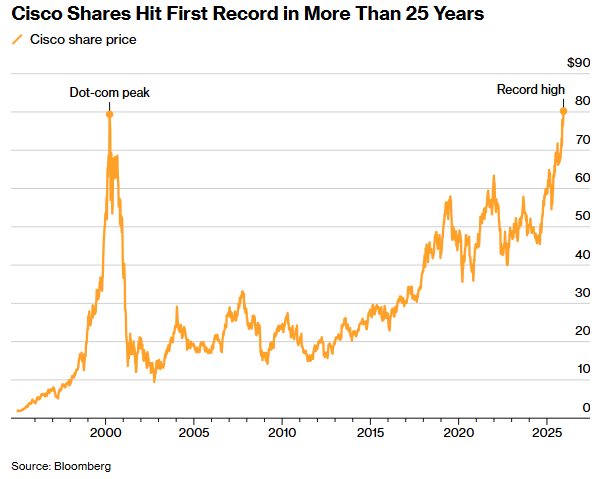
Core Viewpoint - Cisco (CSCO.US) has returned to its historical high after a quarter of a century, driven by the surge in artificial intelligence (AI) spending [1][5]. Group 1: Stock Performance - Cisco's stock rose 0.9% to $80.25, surpassing a peak that had been maintained for over 25 years [1]. - The stock's previous high was seen as the peak of the internet bubble in March 2000, which was a significant milestone for tech stocks [1][4]. - The recent increase in Cisco's stock is part of a broader rise in the U.S. stock market following the Federal Reserve's third consecutive interest rate cut, with the S&P 500 and Nasdaq 100 also experiencing gains [1]. Group 2: Historical Context - Before the record in 2000, Cisco's stock price surged nearly 600% over two years, leading to a market capitalization exceeding $500 billion [4]. - Following the burst of the internet bubble, Cisco's market value plummeted by approximately 90%, reaching a low of around $60 billion by the end of 2002 [4]. Group 3: Current Market Sentiment - Since the low point, Cisco's stock has increased by over 800%, although its market capitalization remains more than 40% lower than its peak during the internet bubble [5]. - The recent stock recovery is viewed as a sign of returning investor confidence, although Cisco is now perceived more as a utility company rather than an innovator [5]. - The latest boost in Cisco's stock is attributed to strong revenue forecasts, which have fueled optimism regarding potential growth from AI spending in the coming years [5][6]. Group 4: Financial Outlook - Cisco anticipates sales could reach up to $61 billion for the current fiscal year, exceeding Wall Street expectations by approximately $1 billion [6]. - UBS analyst David Vogt upgraded Cisco's stock rating to "buy" based on the expected demand for AI infrastructure products [6].

从数据透视到产业适配 资金流信息平台畅通金融服务链条
Jin Rong Shi Bao· 2025-08-07 02:42
Core Insights - The establishment of the fund flow information platform by the People's Bank of China in Guangdong aims to enhance financial services for small and micro enterprises, facilitating access to credit and supporting high-quality economic development [1][2][3][4][5][6][7][8] Group 1: Financial Support for Small and Micro Enterprises - The fund flow information platform has enabled financial institutions in Guangdong to query 58,000 instances of fund flow credit information and disburse loans totaling 46.81 billion yuan to small and micro enterprises [1] - Innovative financing models such as "fund flow + technology flow + information flow" have been developed to support tech-driven enterprises lacking traditional collateral [2] - The platform has helped banks streamline loan approval processes, reducing the time and documentation required for credit assessments [3] Group 2: Integration of Data and Digital Transformation - The platform serves as a digital infrastructure that integrates fund flow data with various types of information, enhancing the efficiency of credit management and risk monitoring [3] - Financial institutions are leveraging the platform to create a comprehensive credit assessment model based on real-time data, improving risk management capabilities [3] Group 3: Transforming Fund Flows into Credit Assets - The platform aims to convert fragmented operational flows and transaction records into quantifiable credit assets, extending financial services to the grassroots level [4] - Tailored financial products, such as "养殖e贷," have been developed to address the unique financing needs of local aquaculture businesses [4] Group 4: Promoting Green Development - The platform supports green industries by integrating environmental investment data and facilitating financing for projects with long investment cycles and slow returns [5][6] - Innovative financing models have been created for the offshore wind power industry, enabling precise financial services for related enterprises [6] Group 5: Addressing the Needs of the Aging Population - The platform is being utilized to develop tailored financial services for the elderly care sector, addressing the funding challenges faced by institutions [7] - By analyzing operational cash flows and government subsidies, banks can provide rapid credit assessments and loans to support the purchase of smart elderly care equipment [7] Future Directions - The People's Bank of China in Guangdong plans to further enhance the application of the fund flow information platform, extending its use to more scenarios and contributing to the financial service ecosystem [8]

又一上市公司爆雷!连续6年财务造假将被强制退市!
梧桐树下V· 2025-05-22 07:33
Core Viewpoint - Qingdao Zhongzi Zhongcheng Group Co., Ltd. (*ST Zhongcheng) has been under investigation for suspected violations of information disclosure laws, leading to significant financial discrepancies and potential delisting from the Shenzhen Stock Exchange [1][3][8]. Group 1: Investigation and Financial Misconduct - The company was officially investigated by the China Securities Regulatory Commission (CSRC) on January 16, 2025, for suspected information disclosure violations, with a notice of administrative penalty received on April 30, 2025 [1][3]. - From 2017 to 2021, the company inflated total profits by 776 million yuan and understated total profits by 567 million yuan [1][4]. - The company reported false financial data related to its projects in the Philippines and Indonesia, including premature revenue recognition and failure to write off expired mining rights [3][4]. Group 2: Specific Financial Irregularities - In 2017, the company inflated operating income by 1.403 billion yuan, accounting for 92.18% of reported operating income, and inflated total profits by 552.77 million yuan, which was 136.17% of reported total profits [4]. - In 2018, the inflated operating income was 467.89 million yuan (36.00% of reported income) and inflated total profits were 217.76 million yuan (94.92% of reported profits) [4]. - In 2019, the company understated operating income by 672.44 million yuan (88.83% of reported income) and total profits by 285.38 million yuan (78.36% of reported profits) [4]. Group 3: Legal and Regulatory Consequences - The company has received a notice of termination of listing from the Shenzhen Stock Exchange, with trading suspended since May 6, 2025 [1][8]. - The CSRC has proposed penalties including a fine of 7.5 million yuan for the company and various fines for key individuals involved in the misconduct [7][8]. - The company has been under audit scrutiny, receiving "qualified opinions" for three consecutive years, indicating ongoing concerns about its financial reporting [11][12].


二线城市,起势这么猛
投资界· 2025-05-03 07:38
Core Viewpoint - The article discusses the significant rise of second-tier cities in China, highlighting their potential to challenge first-tier cities in various aspects, including real estate, population growth, and economic development [3][34]. Group 1: Chengdu's Real Estate Boom - Chengdu has emerged as a leading city in China's real estate market, surpassing major cities like Shanghai and Beijing in both transaction volume and price, with new home prices reaching 16.98 million yuan per square meter [7][8]. - The city's land auction prices have rapidly increased, indicating strong demand and potential for future price growth [8]. - Chengdu's real estate market is driven by product quality, with successful projects like Luhui setting new standards and attracting significant external purchasing power [10][12]. Group 2: Population Growth in Hefei and Guiyang - Hefei and Guiyang are experiencing population growth amidst a national trend of population decline in many cities, with Hefei's population growth rate at 1.51% and Guiyang showing similar trends [13][15]. - Both cities have successfully attracted talent and investment, with Hefei benefiting from its educational institutions and Guiyang focusing on big data development [16][17]. Group 3: Chongqing's Economic Ascendancy - Chongqing has surpassed Shanghai in social retail sales, becoming the top consumer city in China, with a retail total of 28.31 billion yuan in early 2024 [20][22]. - The city's strong county-level economies have contributed significantly to its retail growth, showcasing a robust consumer market [22][23]. Group 4: Wuhan's Strategic Advantage - Wuhan is benefiting from the migration of businesses from coastal cities, with a net migration of 296 companies in early 2025, primarily to its optical valley industrial park [25][30]. - The city's strategic location and improved business environment have made it an attractive destination for enterprises seeking to relocate [30]. Group 5: Ningbo's Underestimated Potential - Ningbo, as Zhejiang's second city, has a GDP exceeding one trillion yuan and is home to the world's largest port, showcasing its economic strength [31][32]. - The city has a high concentration of manufacturing enterprises with significant global market shares, indicating its robust industrial base [32][33]. Group 6: The Rise of Second-Tier Cities - The article emphasizes that many second-tier cities are not merely competing with first-tier cities but are establishing their unique identities and strengths, leading to a shift in population preferences towards these cities [34].